
 New Years Eve Ritual 2026/2027 with Savannah
ANDREALPHUS

ANDREALPHUS
Andrealphus is the sixty-fifth spirit of the Ars Goetia, a mighty Marquis who rules thirty legions. He appears first as a peacock with great noises, then puts on human shape. He teaches geometry perfectly, makes men very subtle in it and in everything to do with measurement and astronomy, and he can transform a man into the likeness of a bird. For a magician that makes him a spirit of precision: exact thinking, exact measurement, and a sharpened mind, with a strange power of transformation at the edge of his office.
Andrealphus at a glance
- Number: 65th of the 72 spirits of Solomon
- Rank: Marquis
- Legions: 30
- Appearance: a peacock making great noises, then a man
- Other spellings: Androalphus, Andralfas
What the Goetia says
The entry gives Andrealphus four offices, and three of them belong together:
- Geometry, taught perfectly. Spatial reasoning, proportion, structure and design.
- Mensuration. The practical art of measurement: surveying, proportion, the exact judgement that drafting and engineering demand.
- Astronomy. The movements of the heavens, and with them calculation and timing.
- Transformation into a bird. He can turn a man into the likeness of a bird.
The wording matters. The Goetia does not say he makes men informed; it says he makes them subtle in these things. His gift is a sharpened faculty, not a heap of facts. Weyer adds that he makes a man a subtle disputer, so the same precision carries into argument.
His appearance follows a two-stage pattern. He comes first as a peacock, loud and unsettling, then settles into human form once he is properly addressed. The peacock, a bird of display, and the power to turn a man into a bird frame his whole entry: he changes his own form, and he can change yours. Some who work with him read the bird-transformation as a change in how the mind perceives space and the heavens, a bird’s-eye view. That is a modern reading, not the grimoire’s, but it fits his office.
Where Andrealphus comes from
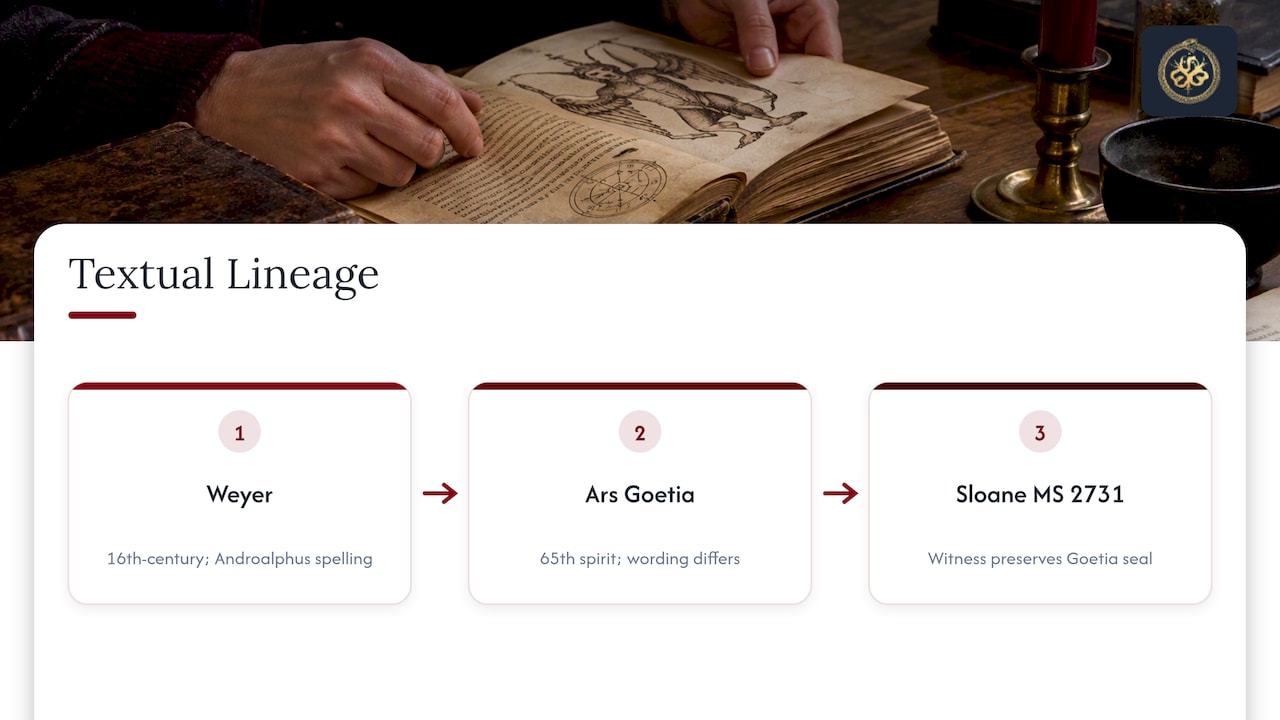
Andrealphus first appears in Johann Weyer’s Pseudomonarchia Daemonum (1577) as Androalphus, a great Marquis who appears as a peacock with great noises, teaches geometry and astronomy, makes men subtle disputers, turns men into birds and rules thirty legions. Reginald Scot carried the entry into English in 1584. The Ars Goetia, the first book of the seventeenth-century Lemegeton, inherits him with small changes of order and phrasing, gives him his number 65, and records his seal. He is absent from earlier medieval demon catalogues.
That gives you a simple rule. What Weyer and the Goetia share, the rank, the peacock, the sciences, the bird and the thirty legions, is his core profile. Anything else, including planetary rulers or incense lists, is later layering. Seals vary between manuscripts in line weight and orientation; trace yours from a good edition and keep the same version every time you work with him.
Benefits people seek from Andrealphus
- Mastery of technical subjects: mathematics, geometry, engineering, architecture, design and drafting.
- Exams and certifications that demand precise, analytical thinking.
- Astrology and astronomy: chart construction, calculation and the timing of other rites.
- Sacred geometry and ritual precision: drawing seals, circles and triangles accurately.
- Sharper argument and the subtlety of a good disputer.
- Transformation: shape-shifting work, astral flight and changing how you are perceived.
Working with Andrealphus
The Goetia gives his seal and offices but no incense or offering of his own. The structure below is how we approach him.
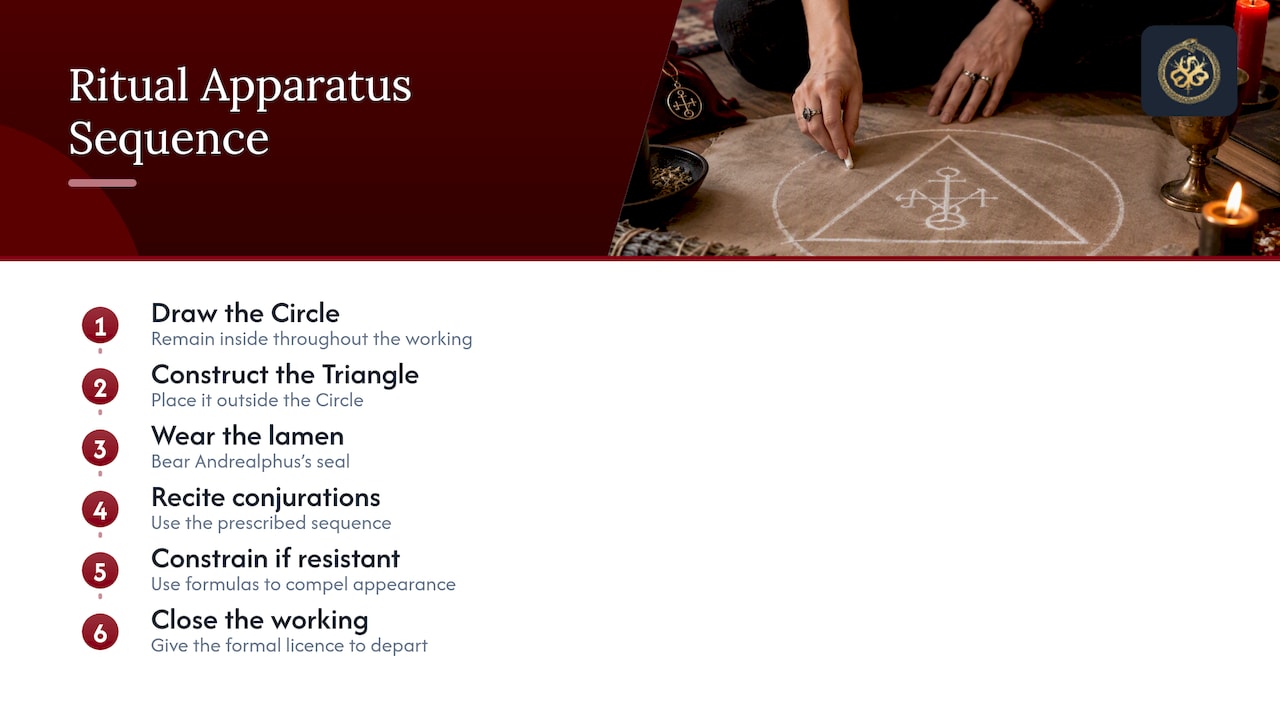
1. Name the outcome. He works on something specific. “Help me with maths” gives him little. “Make me subtle in structural calculation so that I pass my engineering exam in June” gives him a target. Write it in one sentence.
2. Draw the seal by hand. Use a compass and straightedge if you like; with a spirit of geometry, precision is a form of respect, and tracing it slowly catches errors that printing hides. Spend a few minutes each day with the seal before the working.
3. Prepare the space. Work undisturbed with good incense, candles and his seal clearly displayed, and a black mirror if you scry. Many choose a Mercury hour, or simply a clear night when the stars are visible. Those who follow the Solomonic form place the seal in a triangle outside their working space as the point of manifestation.
4. Call him. Many in our tradition first approach him through Satan or Lucifer, with a petition such as:
“Lord Satan, by your grace, grant me the power to conceive in my mind and to carry out that which I desire, the end I would reach by your help. I ask you to move Andrealphus to come before me, that he may give me a true and faithful answer and help me reach my desired end, provided it is proper to his office. This I ask in your name, Lord Satan.”
Then call him by name over his seal until the atmosphere changes. Do not be startled if the first sign is noise.
5. State the request and the terms. Say plainly what you want to master and what you will give in return. Offerings that suit his nature include a peacock feather, a drawing worked with care, or a pledge of study hours that you then keep. Treat the rite as the opening of a defined study period rather than a one-time request.
6. Close properly. Thank him, give the promised offering and dismiss him with respect.
7. Review. At the end of the study period, or after your exam or project, write down what changed: what came easily, what clicked, what you understood that you had not before.
How it looks in practice
These are illustrations, not client cases.
- The engineering student calls Andrealphus at the start of a twelve-week revision period for a structural exam, names the result she wants, and returns to his seal before each study session.
- The architect working on a difficult design asks to be made subtle in proportion and measurement, and keeps a record of every insight that arrives at the drafting table.
- The astrologer who struggles with calculation works with the office of astronomy before learning to cast charts by hand.
Black Witch Coven’s view
Andrealphus is a teacher who works on the mind itself. He does not hand you knowledge; he makes you subtle, so the effort you put in lands sharper and deeper. Bring him a defined subject and a defined period of work, and honour him with precision in everything you draw and measure. The peacock and the bird remind you that he is also a spirit of transformation, and that real mastery changes the one who gains it.
If you would rather have the working done for you, see our daemonic spell casting, or book a consultation to choose the right spirit and approach first. As with all magick, results are never guaranteed.
Similar spirits
- Asmodeus: teaches arithmetic, astronomy, geometry and all handicrafts
- Amy: gives perfect knowledge of astrology and the liberal sciences
- Stolas: teaches astronomy and appears as a raven or owl
- Caim: appears as a thrush and gives understanding of the voices of birds
- Malphas: appears as a crow and builds houses and towers
Sources
| Pseudomonarchia Daemonum, Johann Weyer (1577; Scot’s English, 1584) | Androalphus, a great marquis appearing as a peacock with great noises, teaching geometry and astronomy, ruling thirty legions. |
| The Lesser Key of Solomon (Goetia), ed. S. L. MacGregor Mathers (1904) | “The Sixty-fifth Spirit is Andrealphus. He is a Mighty Marquis, appearing at first in the form of a Peacock, with great Noises…” |
| The Complete Book of Demonolatry, S. Connolly | “Andrealphus: One of the 72 Spirits of Solomon.” |
- The Lesser Key of Solomon, Project Gutenberg
- Pseudomonarchia Daemonum, Wikipedia
- Ars Goetia from Sloane MS 2731, digital edition
- The Complete Book of Demonolatry, S. Connolly
- Goetia: The Lesser Key of Solomon, Mathers and Crowley