New Years Eve Ritual 2026/2027 with Savannah
Blog, Divination, Tools of the Trade
Black Mirror Scrying: Everything you need to know
Sep
Black mirror scrying is a divination practice that uses a dark reflective surface, obsidian, painted glass, or even a darkened phone screen, to receive visions, symbols, or impressions.
Beginners can practice it safely with simple materials as long as they follow three rules: ground before you start, cap sessions at 15 to 20 minutes, and close deliberately every single time.
Stop immediately if a session turns distressing. Or push through it if you’re feeling tough enough. 🙂
Scrying is extremely difficult, and so if you can do this form of divination without having any experience in energy workings or magic, then that is extremely lucky.
The easiest way to scry is through your peripheral vision, looking into a reflective blacked-out large surface and seeing what comes up without trying to force anything. Do that until you feel comfortable with the shadows behind you, and then start asking questions.
Remember, you may not be able to control what comes through, and you need to be comfortable with that in order to have effective sessions.
– Savannah
What Is Black Mirror Scrying and Where Does It Come From?
Scrying, broadly defined, means gazing into a reflective or translucent medium to receive visions, impressions, or symbolic imagery, according to the general overview of scrying practice.
Black mirror scrying is one branch of that practice. Instead of water, crystal balls, or flame, the practitioner uses a dark, non reflective (or minimally reflective) surface that swallows ambient light rather than bouncing it back.
That darkness matters more than it looks like it should. A glossy mirror shows you your own face. A black mirror, angled correctly, shows you almost nothing, and that visual near-blankness is exactly what lets the mind start projecting shapes, colors, and movement onto the surface.
This is the same territory as pareidolia (seeing faces in clouds) and the Ganzfeld effect (the brain generating imagery under low, uniform sensory input), and it’s a well documented mechanism behind why scrying produces visions in the first place, without requiring any external force to intervene.
The practice has deep roots on two separate continents:
- Mesoamerica. Tezcatlipoca, an Aztec deity, was closely tied to obsidian “smoking mirrors,” a direct historical antecedent to modern obsidian scrying tools.
- Renaissance Europe. John Dee, court advisor and mathematician to Elizabeth I, incorporated dark reflective media into his angelic and divinatory work, a documented example of mirror-based practice in European occultism.
- Folk and medieval traditions. Dark bowls of water, ink pools, and polished stone all served the same purpose for centuries before glass mirrors became affordable.
Two very different cultures, thousands of miles and hundreds of years apart, independently landed on the same tool. That’s not proof of anything supernatural, but it is a strong signal that the technique taps into something consistent in human perception, not a passing trend.
Choosing Your Scrying Surface: Obsidian, Glass, or Screen?
Three materials dominate modern practice, and each one suits a different kind of beginner.

Obsidian discs.
Polished black volcanic glass is the traditional choice, and it carries the cultural weight of Tezcatlipoca’s smoking mirror lineage.
Obsidian has a slight natural sheen even when polished flat, which some practitioners find gives visions extra depth. The tradeoff is cost and fragility. A polished obsidian disc suitable for scrying varies in price and requires careful handling due to fragility.
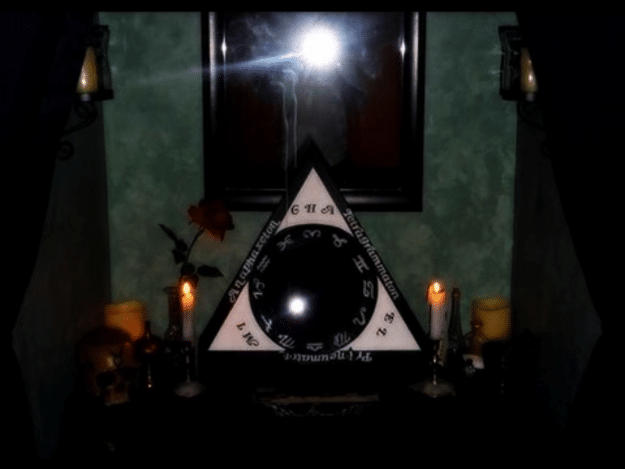
Painted glass mirrors.
A picture frame, a piece of glass cut to fit, and a few coats of matte black spray paint produce a scrying surface that works just as well for most beginners as obsidian does.
Field guidance from experienced practitioners consistently notes that a well painted glass mirror performs on par with polished stone for learning purposes. It costs under $15 in most cases and takes an afternoon to build.
Phone or monitor screens.
Turning off a phone screen and holding it at an angle creates an improvised black mirror in seconds. This is the fastest way to test whether scrying interests you before spending money, but it’s the least durable option long term.
Screens reflect too much ambient light unless the room is very dark, and the temptation to check notifications mid-session is real.
A few practical notes regardless of material:
- Round or oval shapes traditionally outperform square ones; corners create visual distractions.
- Mount or prop your mirror at a slight downward angle so you’re gazing into it, not catching your own reflection.
- Keep a lint-free cloth and a bottle of isopropyl alcohol or glass cleaner nearby. Smudges and dust break the visual field fast.
- A simple wooden stand or easel keeps the mirror stable without your hands in the frame.
- A dedicated journal, kept next to your mirror, turns scattered impressions into a pattern you can actually track over weeks.
How Do You Scry With a Black Mirror Step by Step?
This is a routine you can run tonight with materials you probably already have.
-
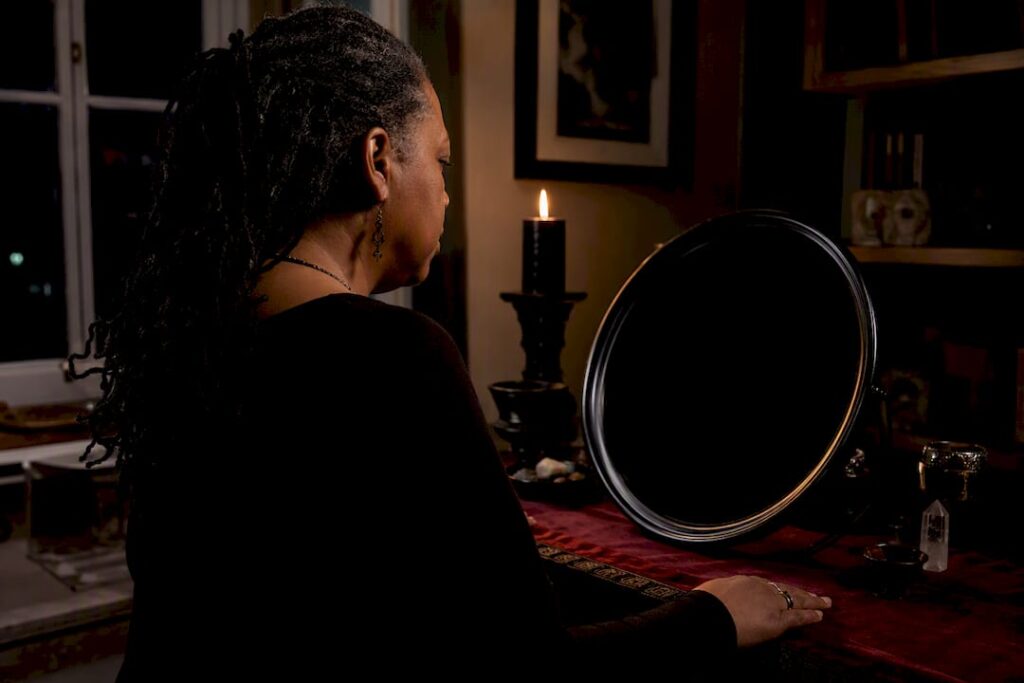
Set the room. Choose a quiet space where you won’t be interrupted for a suitable session length. Silence your phone completely, not just on vibrate. Dim the overhead lights and place a single candle behind or beside you, never directly behind the mirror where its flame reflects into your eye line.
-
Sit and settle. Sit upright but relaxed, mirror propped at a comfortable angle at a reasonable distance from your face. Rest your hands loosely in your lap. Take five slow breaths before doing anything else.
-
Ground and set intention. Picture roots extending from your spine into the floor, or simply press your bare feet flat on the ground and feel the contact. State a short, specific intention out loud or silently, something like “I open to what wishes to be seen” works better than a vague wish for “answers.”
-
Soften your gaze. This is the technique most beginners get wrong. Don’t stare hard at the surface. Let your eyes relax as if you’re looking through the mirror rather than at it, the same soft focus you’d use looking at a distant horizon. Forcing a sharp focus tenses the eye muscles and shuts the process down within minutes.
-
Hold the session. A session length of about a quarter of an hour is recommended for beginners. Most people who see anything at all report it appearing in the second half of that window, not the first sixty seconds. If your attention wanders, that’s normal. Gently return your soft gaze to the mirror rather than scolding yourself back into focus.
-
Notice without grabbing. Mist, moving shadows, flickers of color, or vague shapes are the most common early impressions. Let them pass through your awareness instead of trying to pin down meaning in the moment. Interpretation happens after the session, not during it.
-
Close deliberately. Pass your open palm across the mirror’s surface as if wiping it clean, and say a short closing line out loud, something like “This session is closed, I return fully to myself.” Cover the mirror with a cloth. This step is not optional theater. It’s the boundary that tells your mind the exercise has ended.
-
Journal immediately. Write down what you saw, felt, and any lingering images, even fragments, within five minutes of closing. Memory of scrying impressions fades faster than dream memory.
Pro Tip: If you notice your eyes watering or your jaw clenching, you’re forcing the gaze. Blink normally, look away for ten seconds, and start the soft focus over. Scrying works better relaxed than determined.
Is Black Mirror Scrying Safe, and What Mistakes Should You Avoid?
Scrying is generally safe for healthy adults practicing in moderation, but it’s not appropriate for every state of mind or every moment.
Skip a session entirely if you’re currently distressed, sleep deprived, intoxicated, recently bereaved, or working through active trauma without a therapist’s input. None of those states play well with a practice built on loosening your normal perceptual filters.
If a session turns frightening, here’s the exact sequence experienced practitioners use to shut it down fast:
- Break your gaze immediately. Look away from the mirror, don’t linger on the image.
- Cover the mirror with a cloth right away.
- Turn on the overhead lights. Bright, ordinary light resets the nervous system faster than dim ambiance.
- Run cold water over your hands and wrists for thirty seconds. This is a simple, physical grounding technique that pulls attention back into the body.
- If unease lingers past a few minutes, talk to someone, call a friend, step outside, or reach out to a trusted practitioner.
The most common mistakes are boring, technical ones, not mystical failures. Squinting or straining the eyes shuts down the soft focus that makes scrying work. A mirror angled too flat catches your own face instead of the dark field. And forcing results, sitting there demanding a vision appear, almost always backfires, since anxiety and scrying visions don’t coexist well.
One more point worth stating plainly: scrying is a contemplative and divinatory practice, not a substitute for medical or mental health care. If you’re managing a diagnosed condition, loop in a professional before adding intense practices to your routine.
How Do You Make Your Own Black Scrying Mirror?
Building a painted glass mirror is the most accessible entry point, and it takes about an hour of active work plus drying time.
Materials checklist:
- A flat glass insert (an old picture frame glass or a cut piece from a hardware store)
- A simple frame, wood or metal, sized to the glass
- Matte black spray paint rated for glass or multi-surface use
- A respirator mask or well ventilated outdoor space
- Disposable gloves
- Newspaper or cardboard to protect your work surface
Steps:
- Clean the glass thoroughly with isopropyl alcohol and let it dry completely. Any residue will show through the paint.
- Work outdoors or in a well ventilated garage. Lay newspaper down and put on gloves and a mask before opening the paint can.
- Spray the back side of the glass (the side that won’t face you) in thin, even coats, holding the can 10 to 12 inches away. Two to three light coats beat one heavy one, which tends to drip and pool.
- Let each coat dry fully, typically 15 to 20 minutes, before adding the next.
- Once dry, hold the glass up to a bright light. If you see any pinholes of light coming through, add another coat to the thin spots.
- Fit the painted glass into your frame, painted side facing away from you, so the untouched glass surface is what you gaze into.
- Store the finished mirror covered with a dark cloth when not in use, both to protect the paint and to maintain the ritual boundary between active use and rest.
If you’d rather buy polished obsidian, look for a flat, evenly polished surface with no visible pitting, a diameter of at least 4 inches for comfortable gazing distance, and a seller who states the stone’s origin. Wipe obsidian with a soft, dry cloth only; avoid harsh chemical cleaners that can dull the polish over time.
What Will You See, and How Should You Track It?
First sessions tend to be unimpressive, and that’s actually a good sign, not a failure. Expect mist, drifting color fields, faint geometric shapes, or vague half-formed figures rather than clear scenes. That’s consistent with the same perceptual mechanisms behind pareidolia, your visual system filling in ambiguous input with pattern and structure, and it typically sharpens with repeated, unhurried practice rather than with effort or intensity.
Practitioner guidance consistently favors a steady, patient rhythm, something like one focused 15-minute session per week, over sporadic marathon attempts. A short weekly sit builds the soft-gaze skill gradually; three two-hour sessions crammed into one weekend tend to produce eye strain and frustration instead of clarity.
A simple journal template keeps the pattern visible:
- Date and time of the session
- Intention stated going in
- Lighting and conditions (candle, room darkness, time of day)
- Impressions seen (shapes, colors, movement, anything specific)
- Emotional tone during and after
- Follow-up notes written a day or two later, once initial impressions have settled
Reviewing that log after a month often reveals a symbol or color repeating more than you’d expect from chance alone, which is where interpretation actually becomes useful.
What Does a Full Practitioner Ritual Look Like?
Here’s a complete session built for a practitioner ready to move past casual gazing into a structured working.
Tools needed: a painted glass or obsidian mirror, one black candle, a small dish of salt, a fireproof surface, and your journal.
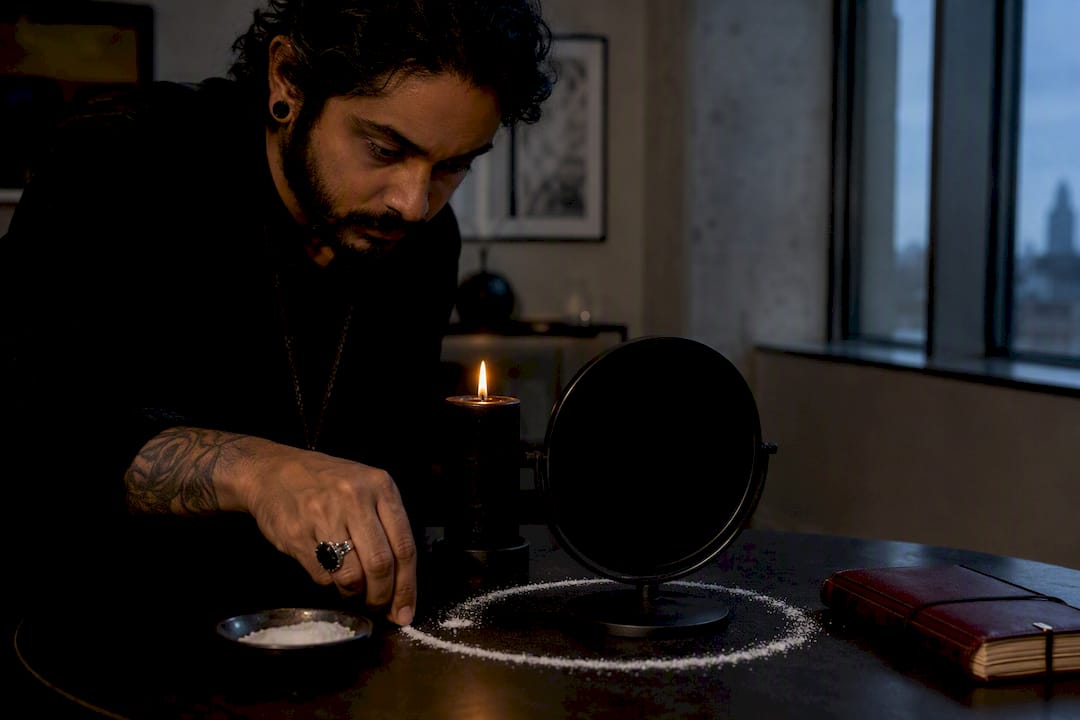
Setup: Place the mirror on its stand at the center of your workspace. Set the black candle behind and to the left of the mirror, angled so its light never reflects directly into the glass. Circle the mirror’s base with the salt as a boundary marker.
Opening: Light the candle. Sit facing the mirror and speak the opening line aloud:
The working:
Soften your gaze into the mirror.
Hold your intention silently for the first two minutes, then release it and simply observe for the remainder of a 20-minute sit.
If a shape or figure holds steady rather than drifting, note its position and form without breaking gaze to write it down yet.
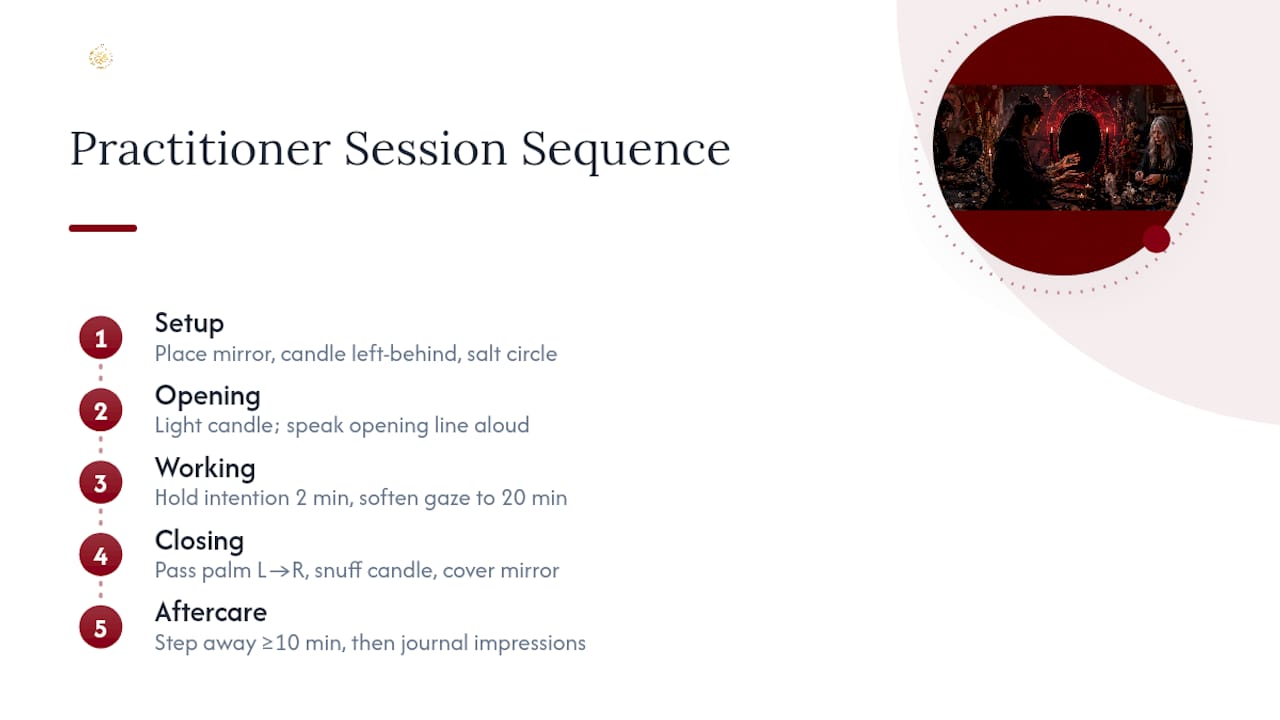
Closing: Pass your palm over the mirror’s surface once, left to right, and speak:
Snuff the candle (never blow it out in ritual work; use a snuffer or your fingers). Cover the mirror. Step away from the space for at least ten minutes before journaling, giving impressions time to settle rather than forcing interpretation immediately.
Pro Tip: If a figure or symbol repeats across three or more separate sessions, that’s a pattern worth bringing to an experienced practitioner rather than interpreting alone, particularly if the working carries an unfamiliar or unsettling energy.
Adapt the wording to your own tradition and always work within your local laws regarding ritual practice and any physical materials involved. If sessions consistently leave you anxious, or if you feel pulled toward contacting a specific entity or spirit you don’t fully understand, that’s the signal to seek mentorship rather than push forward solo.
A Practitioner’s View on Discipline and Patience
The biggest misconception beginners bring to scrying is that intensity equals progress, longer sessions, more candles, more insistence on seeing something. It’s the opposite.
The practitioners who develop real skill are the ones who treat scrying like a weekly appointment, not a breakthrough they’re chasing.
A short, consistent, well closed session teaches the mind to trust the process; a forced marathon session teaches it to brace against strain.
Keep a journal without exception, even on sessions where nothing seemed to happen. Patterns only reveal themselves in hindsight, across weeks, never in a single sit. And if your practice starts pulling toward work that feels bigger than casual gazing, contacting a specific entity, working a pact, or anything that carries real weight, that’s the point to consider guided mentorship rather than improvising alone.
Sources
The historical and technical claims in this guide draw on a small set of reliable references worth reading directly.
The general overview of scrying covers the practice’s broader forms and mechanisms. The Tezcatlipoca entry documents the Mesoamerican obsidian mirror tradition. The John Dee entry covers Renaissance European use of dark reflective media.
For readers pairing scrying with crystal work, this guide to meditation crystal placement covers complementary third-eye practices.
FAQ
Is mirror scrying safe?
Yes, for most healthy adults practicing in moderation. Avoid sessions when distressed, sleep deprived, intoxicated, or grieving, and always close each session deliberately by covering the mirror and grounding yourself afterward.
How do I activate a scrying mirror?
There’s no special activation ritual required. Clean the surface, set a clear intention aloud, soften your gaze, and begin; some practitioners add a short opening line or a candle to mark the session’s start, but the mirror itself needs no separate charging.
What is the purpose of a scrying mirror?
A scrying mirror gives the mind a dark, low-stimulus surface to project internally generated imagery onto, letting practitioners access impressions, symbols, or intuitive insight they might not reach through ordinary thinking.
What is the craziest Black Mirror episode?
That refers to the Netflix anthology series, a separate piece of pop culture unrelated to the divination practice covered here. For scrying purposes, the “black mirror” is simply a dark surface used for divination, not the television show.
Do I need obsidian, or can I use painted glass?
Painted glass works just as well as obsidian for beginners and costs a fraction of the price. Obsidian carries a longer cultural lineage tied to Mesoamerican practice, but it isn’t required to learn or practice effectively.