
 New Years Eve Ritual 2026/2027 with Savannah
Blog, Luciferianism, Occultism
Luciferianism for Critical Thinkers: Inquisition, Scholarship, and Ritual
Nov
A Luciferian is someone who venerates the qualities attributed to Lucifer, the light-bringer, as a teacher, liberator, or archetype of self-sovereignty, rather than a servant of a singular evil deity. Luciferianism spans theistic devotion and purely symbolic philosophy, has no central church or doctrine, and is frequently confused with Satanism despite real differences in emphasis and practice. This article separates the scholarship from the conspiracy noise and offers insights into the light-bringer archetypes and transformative practice associated with Luciferian symbolism.
Table of Contents
- Etymology and Origins of the Word Lucifer
- From Inquisitorial Slander to Modern Occult Revival
- Core Beliefs and the Major Internal Variants
- What Luciferian Practice Actually Looks Like
- Luciferian Versus Satanism and Related Paths
- Notable Figures, Groups, and Their Limits
- A Witch’s View on Luciferian Symbolism in Ritual
- Why Rigor Matters More Than Aesthetic in This Tradition
- FAQ
- Sources
Etymology and Origins of the Word Lucifer
The word “Lucifer” did not start as a name for a devil. It began as a Latin descriptor meaning “light-bearer,” used in the Vulgate translation of Isaiah 14 to render the Hebrew term hêlêl ben shachar, “shining one, son of the dawn.” That passage was originally a taunt against a Babylonian king compared to the morning star falling from the sky, and only later did Christian commentators read it as a secret reference to a rebellious angel, a reinterpretation that fused the Latin word with the figure of Satan. The Vulgate’s choice of “lucifer” to translate that Hebrew phrase is the hinge on which centuries of theology turned.
Classical mythology offers parallel imagery that predates and runs alongside the Christian reading:
- Phosphoros, the Greek personification of the morning star, carried the same light-bearing association without any connotation of evil.
- Prometheus, who stole fire from the gods to give to humanity, established the template of a defiant bringer of illumination who suffers for enlightening others.
- These parallels gave later occult writers a vocabulary for reclaiming Lucifer as a symbol of knowledge and defiance rather than accepting the fallen-angel reading as final.
Modern Luciferians draw on both threads: the literal etymology of light-bringing and the mythic pattern of a figure punished for giving illumination to those below.
From Inquisitorial Slander to Modern Occult Revival
The term “Luciferian” has a long history as an accusation before it became a self-chosen identity. Medieval inquisitors used it to label heretical groups, often without evidence that those groups actually venerated Lucifer in any coherent way.
- Sources such as the Gesta Treverorum and various inquisitorial bulls describe supposed Luciferian sects, but historians treat most of these accounts as polemical fabrications designed to justify persecution rather than accurate descriptions of belief or ritual.
- Academic work on the origins of religious Satanism confirms that the idea of organized Lucifer worship in the medieval period is largely a modern construction projected backward onto scattered and often invented heresy trials.
- The nineteenth century reshaped the figure again. Theosophical writers, including Helena Blavatsky, recast Lucifer as a symbol of intellectual illumination rather than evil, while the Taxil hoax, a fabricated exposé of supposed Masonic devil worship, planted conspiracy narratives that still circulate today.
- Anton LaVey’s Satanic framing in the twentieth century borrowed Luciferian imagery for atheistic symbolism, while separate from LaVey’s tradition, authors such as Michael W. Ford built out explicitly Luciferian philosophy and organization, culminating in groups like the Assembly of Light Bearers.
The throughline is a shift from outside accusation to inside authorship: the people now called Luciferian are the ones who chose the word for themselves.
Core Beliefs and the Major Internal Variants
Luciferianism is not one doctrine but a family of positions united by a few recurring themes. Across nearly every variant, occultists emphasize illumination over obedience, self-sovereignty over submission to external authority, the pursuit of knowledge as a moral good rather than a danger, and a reframing of rebellion as the origin of consciousness rather than a crime against it.
- Theistic Luciferianism treats Lucifer as an actual being worthy of devotional practice, ritual address, and ongoing relationship, closer in structure to traditional religious devotion than to pure philosophy.
- Atheistic or symbolic Luciferianism uses Lucifer as an archetype representing reason, individuation, and psychological integration, with no claim that the figure exists outside human consciousness or myth.
- Gnostic-inflected approaches reread the Eden narrative so that the serpent becomes a liberator offering forbidden knowledge rather than a corrupting force, turning the fall into an awakening.
- Many magicians sit on the left-hand path, prioritizing self-mastery and personal apotheosis over union with or submission to a higher power.
Academic treatment of this material, including work describing Lucifer as a vehicle for revisionary mythmaking, frames the modern movement as an active re-appropriation project. Writers rebuild old myths to serve new ends, often feminist or explicitly intellectual, which helps explain why the tradition draws people who want a philosophy of defiance rather than a creed of fear.
In practical terms, these beliefs translate into an ethical outlook built around refinement: the idea that a person becomes more capable, more awake, and more responsible for their own outcomes through deliberate effort, rather than through grace granted from outside.
What Luciferian Practice Actually Looks Like
Practice ranges from purely intellectual engagement to structured ceremonial magick, and the two ends of that spectrum rarely look alike. Some witches never perform a ritual at all, treating Luciferianism as a philosophical framework studied through texts and applied through daily conduct. Others build out full ceremonial systems with invocation, consecration, and offerings addressed to Lucifer as a specific intelligence.
Common ritual elements include:
- Study of primary and secondary texts, including grimoires, philosophical essays, and historical material on the figure of Lucifer, before any ritual work begins.
- Solitary invocation or meditation, where the magician establishes a working relationship with Lucifer as archetype or being through repeated, structured address.
- Advanced or initiatory work, often involving more elaborate ceremonial structure, sustained devotional practice, or group ritual within an organized body.
The left-hand path orientation shapes method as much as belief: practice tends to be results-driven, measured by concrete change in the witch’s life rather than by metaphysical certainty, and self-deification, the idea of becoming one’s own highest authority, replaces surrender as the stated goal.
Pro Tip: Keep a written ritual log, dated and specific, so that claimed results can be checked against intention rather than reconstructed from memory months later.
Luciferian Versus Satanism and Related Paths
Luciferianism and modern Satanism overlap enough in publishing, personnel, and aesthetic that outsiders often treat them as synonyms, but the distinctions are consistent enough to matter.
- Theistic composition differs sharply: LaVeyan Satanism is explicitly atheistic by design, while a meaningful share of Luciferians hold theistic or quasi-theistic positions toward Lucifer as an actual intelligence.
- Core emphasis diverges too. Satanism as codified by LaVey centers on indulgence, skepticism, and a kind of applied psychology, while Luciferianism centers more consistently on illumination, gnosis, and the myth of the fall as an awakening.
- Ritual vocabulary differs: Luciferian ritual draws more heavily on grimoire traditions, classical light-bearer imagery, and gnostic reinterpretation, where Satanic ritual leans on self-aware theater and psychological catharsis.
- Public organization also separates the two: Satanism has higher-profile, more institutionally visible bodies, while Luciferian groups remain smaller and more scattered.
Scholars treat the boundary as genuinely contested rather than clean, since authors and magicians often move between both spaces or claim both labels at once. What is not contested is that conspiratorial uses of “Luciferian,” the kind found in anti-Masonic and politically motivated material descended from the Taxil hoax, have nothing to do with the actual beliefs or practices described here.
Notable Figures, Groups, and Their Limits
Modern Luciferianism has produced a small number of visible reference points rather than a unified institution. Michael W. Ford stands as one of the most cited contemporary authors and organizers in the space, and his work helped establish the Assembly of Light Bearers as a publicly identifiable American Luciferian body with published materials and a defined philosophical system.
- Beyond Ford’s organization, the landscape consists mostly of small, independent groups, self-published authors, and loosely connected online communities rather than large formal institutions.
- This decentralization is the norm, not the exception, and it mirrors the broader left-hand path world where authority is earned through published work rather than conferred by hierarchy.
- Membership estimates for any given group should be treated skeptically, since there is no central registry, no oversight body, and strong incentive for self-reported numbers to run in either direction depending on the group’s goals.
A Magician’s View on Luciferian Symbolism in Ritual
Luciferian symbolism maps cleanly onto specific ritual goals when it is treated as a functional language rather than abstract theology. Light-bearing imagery suits work aimed at liberation from a stuck situation, whether that is a legal bind, a toxic relationship, or a career plateau, because the symbolism itself encodes movement from darkness into clarity. Sovereignty-focused imagery suits protective and self-mastery work, where the aim is to reinforce boundaries rather than appeal for external rescue.
A witch working toward a defined outcome, say breaking a pattern of financial stagnation, typically pairs a Luciferian framework of self-authorship with a concrete ritual structure: defined intent, consistent timing, and a record of conditions before and after the working. The symbolism supplies the psychological and philosophical frame; the ritual mechanics supply the discipline.
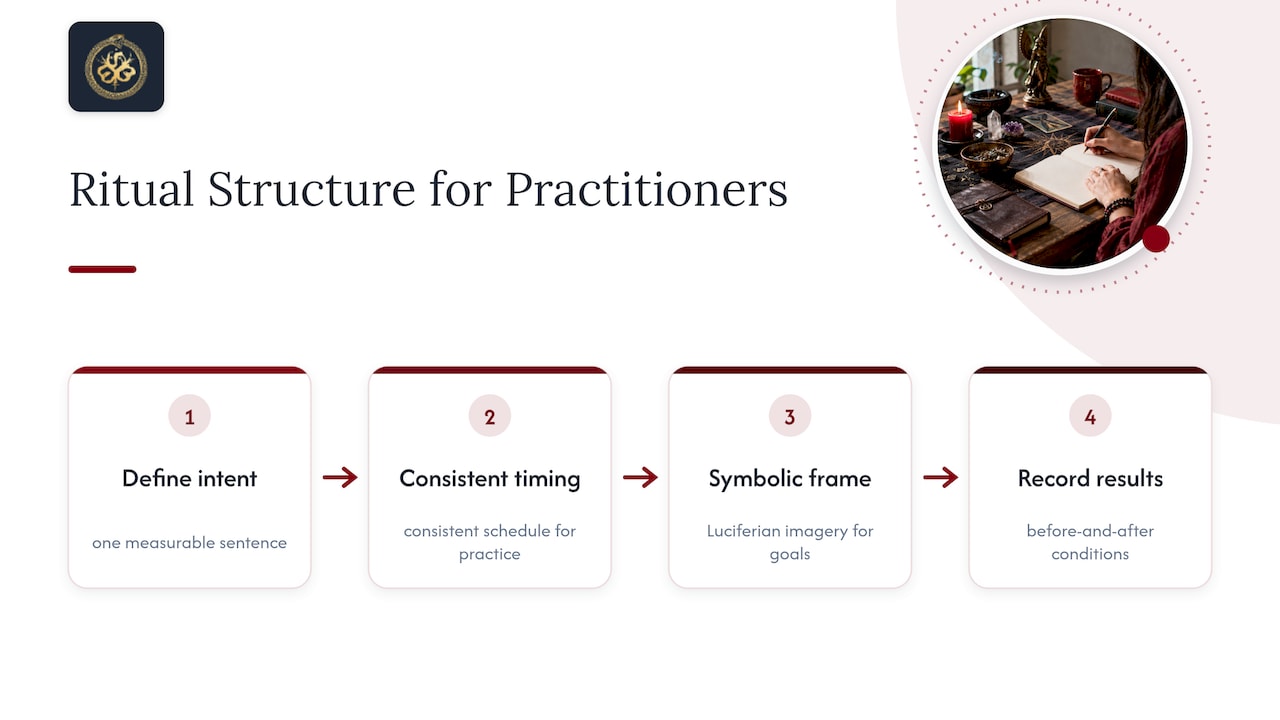
Pro Tip: State the ritual’s intended outcome in one measurable sentence before beginning, so the working can be evaluated against a specific result rather than a vague feeling of change.
Why Rigor Matters More Than Aesthetic in This Tradition
Luciferianism rewards people willing to read the primary sources rather than absorb the aesthetic secondhand. The history is layered: a mistranslated Hebrew phrase, centuries of polemic, a nineteenth-century hoax, and a genuine modern philosophical movement all sit stacked on top of each other, and sorting them out takes real reading, not a glance at a symbol.
We treat this tradition as worth that effort. Scholarship from historians of religion and the primary texts of contemporary Luciferian authors deserve the same careful attention a magician would give to any serious magical or philosophical system, and the occultists who get the most out of this path are the ones who study before they ritualize. For readers who want to go further into how left-hand path discipline is actually structured day to day, our piece on left-hand path approaches to self-mastery builds directly on the themes covered here.
— Black Witch Coven
FAQ
What do Luciferians believe?
Luciferians generally hold that Lucifer represents illumination, self-sovereignty, and the pursuit of knowledge, whether as an actual being worthy of devotion or as a symbolic archetype of reason and individuation. The specific content of belief varies widely between theistic, atheistic, and gnostic-leaning magicians, since the movement has no central doctrine.
Is Luciferianism evil?
Luciferianism is not organized around malevolence; it centers on illumination, self-mastery, and reframing the biblical fall as an awakening rather than a crime. The “evil” framing largely traces back to nineteenth-century hoaxes and anti-Masonic conspiracy material rather than to the actual beliefs of witches or scholarly descriptions of the movement.
What’s the difference between Luciferian and Satanist beliefs?
Satanism as codified by Anton LaVey is explicitly atheistic and centers on indulgence and applied psychology, while Luciferianism includes theistic positions and centers more on illumination and gnosis. The two traditions overlap in publishing and personnel, which is why scholars describe the boundary between them as contested rather than clean.
What is Luciferian intelligence?
The phrase generally refers to Lucifer understood as an intelligence or consciousness that occultists engage with through ritual, study, or meditation, rather than a doctrine with one fixed definition. Theistic magicians treat this intelligence as an actual being to build relationship with, while symbolic witches treat it as an archetype representing human reason and self-liberation.
Where can I find reliable spell casting or ritual guidance rooted in this tradition?
Reliable guidance is available through our ritual and consultation services, which cover Luciferian-oriented and demonic workings for those who want structured, results-focused practice rather than aesthetic-only engagement. Pricing and scope vary by service and are listed on each offering’s page.
Sources
