
 New Years Eve Ritual 2026/2027 with Savannah
Blog, Luciferianism, Rituals
Black Flame Rituals: Working With the Luciferian Fire
Sep
The Black Flame is the Luciferian inner will: the animating force witches invoke to assert sovereignty, direct personal power, and push for tangible change in love, money, legal standing, and protection. It is not a metaphor for ambition in the self-help sense. It is a working concept with textual roots, concrete correspondences, and a ritual structure you can adapt tonight.
Table of Contents
- What the Black Flame is: lineage and occult sources
- Principles and correspondences: tools, symbols, timing, and preparations
- A stepwise invocation framework (adaptable ritual template)
- Working with entities: Lucifer, Andras, Clauneck, and Astaroth, practical notes
- Integration: applying Black Flame ritual work to goal-directed outcomes
- Aftercare and maintenance: immediate and ongoing practices
- Common misconceptions and debates surrounding the Black Flame
- First-person perspective from experienced occultists
- Professional support for Black Flame ritual work
- FAQ
What the Black Flame is: lineage and occult sources
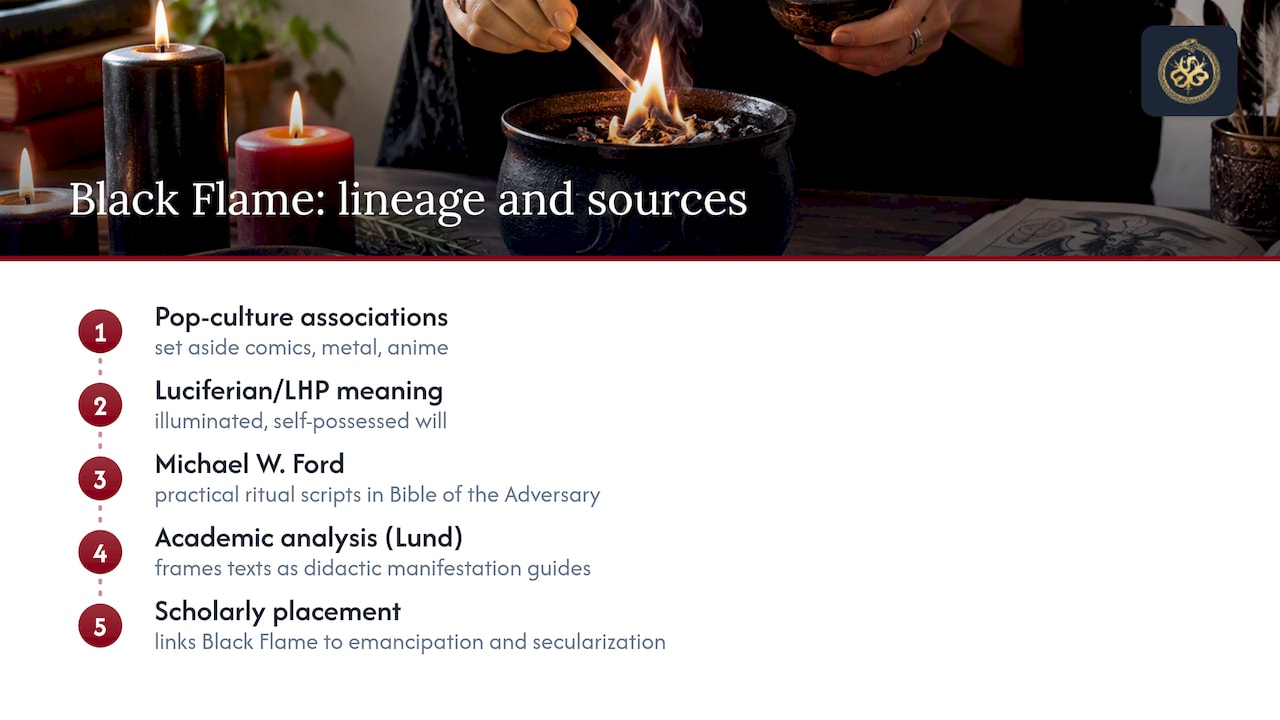
Set aside any association with comic imprints, metal albums, or anime terminology. Within Luciferian and Left-Hand Path practice, the Black Flame refers to the illuminated, self-possessed will: the spark attributed to the Adversary that grants the witch autonomy, hidden knowledge, and the authority to act on desire rather than wait for permission.
The clearest textual throughline comes from Michael W. Ford, an American Luciferian author whose body of work, including The Bible of the Adversary, frames ritual as a method for manifesting individual will and supplies practical scripts rather than abstract theology. Academic analysis of that same text, housed in Lund University’s research portal, describes Ford’s ritual writing, including the Book of Taromat, as didactic material built to guide manifestation-focused practice rather than purely symbolic reading.
Scholarly treatment of the broader movement situates this work inside a longer arc. The study Children of Lucifer on modern religious Satanism places Luciferian and Satanic currents within Western secularization and emancipation movements, which is why Black Flame practice reads less like superstition and more like a deliberate technology of self-authorship.
Principles and correspondences: tools, symbols, timing, and preparations
Black Flame work favors correspondences that reinforce autonomy, illumination through darkness, and direct will rather than passive petition, resonating with the rich tarot symbolism and card imagery that support symbolic examples of Black Flame sigils and imagery.
- Candles: black for the flame itself, paired with red for will or gold for sovereignty and material gain.
- Oils and incense: dragon’s blood, black copal, or frankincense blended with myrrh to anchor intensity without diffusing focus.
- Sigils: a personal sigil of intent drawn fresh for each working, plus the sigil of the entity being petitioned when one is involved.
- Elemental lean: fire for drive and transformation, with earth brought in when the goal is material (money, property, legal outcomes).
Before any working, settle the body: eat lightly, hydrate, and clear the space of clutter and noise. Mentally, write the intent as a single declarative sentence before you ever light a candle, since vague desire produces vague results.
Timing supports but does not replace preparation. New moon phases suit initiatory or foundational workings, full moon favors workings meant to culminate quickly, and the planetary hour of Mars or the Sun strengthens will-driven and sovereignty-focused intent.
Pro Tip: Keep a single dedicated black candle you only use for Black Flame work; repeated use on one object builds a charge that sharpens every subsequent ritual.
A stepwise invocation framework (adaptable ritual template)
This template is a scaffold, not a script. Swap language, entity names, and offerings to match your lineage and the specific outcome you want.
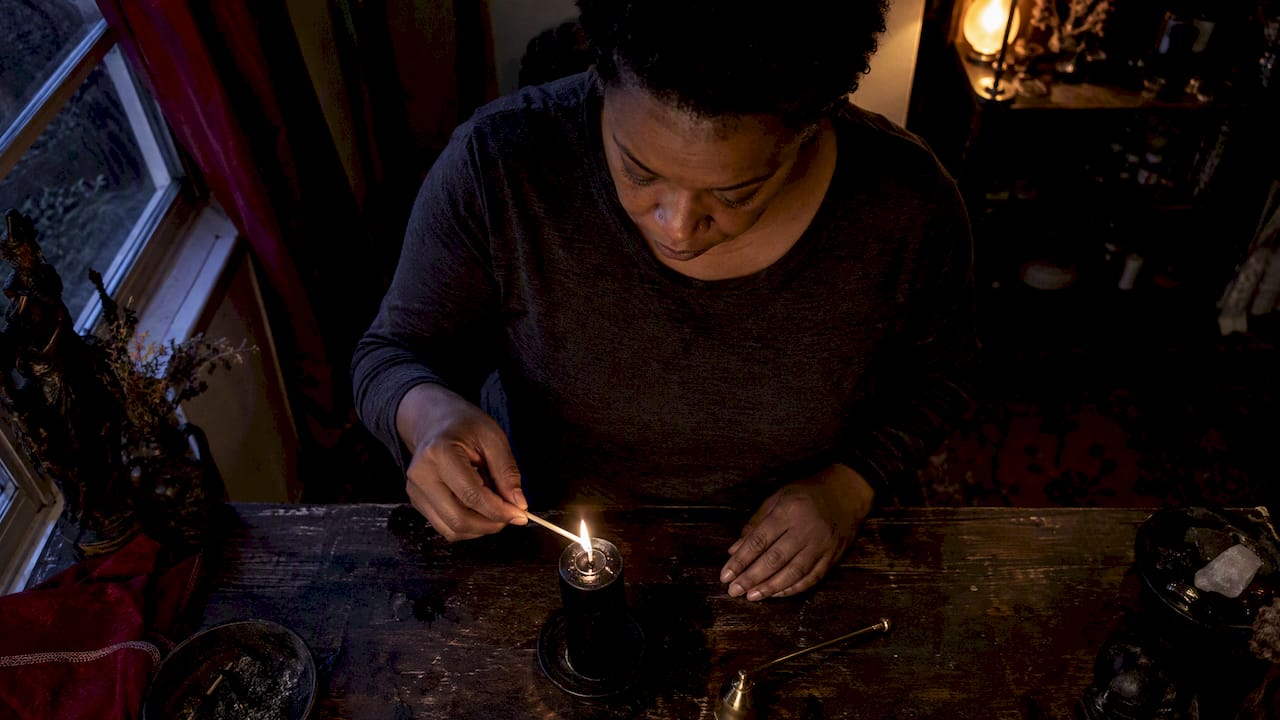
- Prepare the space. Cleanse the area with smoke or saltwater, set the altar with your candle, sigil, and any entity-specific tools, and silence devices.
- Open. Light the black candle and state aloud that you stand in the current of the Black Flame, invoking will rather than asking for favor.
- Align and state intent. Read your single-sentence intent statement from preparation, then expand it into two or three concrete outcome markers.
- Invoke or petition. If working with a named entity, speak the invocation directly to that current; if working the Black Flame alone, address it as your own sovereign will made manifest.
- Offer. Provide an offering proportional to the request: a libation, incense burned to completion, or a written pact sealed and kept.
- Close. Thank the current or entity, extinguish the candle deliberately rather than letting it burn out unattended, and ground with food or physical movement.
- Record. Log the date, phase, intent, and any immediate sensations or signs in a dedicated journal.
- Solitary work benefits from longer silence between steps four and five to notice subtle responses.
- Coven or small-group work can assign one voice to invocation while others hold the sigil or maintain the circle, which concentrates focus without diluting intent.
A generic opening line: “I call the flame that does not ask, the will that does not wait.” A generic closing line: “What is spoken is set in motion; what is offered is received.”
When a working takes, the first outcomes tend to show up as shifts in opportunity (unexpected contact, a sudden opening) within one to four weeks for most practical workings, or as a felt change in resolve that precedes external results. Track both.
Working with entities: Lucifer, Andras, Clauneck, and Astaroth, practical notes
Each entity carries a distinct working domain, and petitions land better when phrased toward that domain rather than treated as interchangeable requests to a generic “dark power.”
- Lucifer: sovereignty, illumination, liberation from imposed limits; frame petitions around autonomy and clarity rather than narrow material asks.
- Andras: discord aimed at a specific obstacle or rival; use sparingly and only where conflict is already present, with a modest, focused offering.
- Clauneck: wealth and material increase; petitions work best when tied to a concrete financial target with a timeline attached.
- Astaroth: hidden knowledge, truth-finding, and emotional or relational clarity; suited to legal discovery, confession-seeking, or untangling deception.
Scale offerings to the size of the request: a quick clarity working with Astaroth might warrant incense and a short libation, while a wealth working with Clauneck tied to a business decision calls for sustained attention across several moon cycles. Aftercare should match intensity too. Larger workings with Andras or Clauneck call for a longer grounding period and a follow-up acknowledgment once results appear, which keeps the working relationship functional for future requests.
Integration: applying Black Flame ritual work to goal-directed outcomes
A wealth-focused magician might pair a Clauneck petition with a 30-day tracking sheet noting every new financial opportunity, then repeat the offering at the next new moon if nothing material surfaces. A legal matter calls for an Astaroth-aligned clarity working before any court date, followed by a short daily candle burn until the date passes. Relationship work often pairs a sovereignty-focused Lucifer invocation with a separate, smaller working aimed at the specific outcome desired, since conflating self-power with a relationship goal muddies both.
Daily maintenance can be as small as relighting a sigil candle for five minutes. Weekly maintenance might mean revisiting the journal to compare stated markers against what actually happened. Scale ritual intensity up only when a 4 to 12 week review shows partial movement that needs reinforcement, not when nothing has happened at all, since repeating an ineffective approach wastes the current rather than strengthening it.
Aftercare and maintenance: immediate and ongoing practices
- Immediately after: ground with food or water, extinguish candles deliberately, and write the working down while details are fresh.
- Within the week: note any dreams, coincidences, or opportunities that could be early signs of movement.
- Monthly: revisit active workings on the new or full moon and decide whether to repeat, intensify, or close them out.
Repeat a working when markers show partial movement; alter the approach entirely when several cycles pass with no change at all.
Common misconceptions and debates surrounding the Black Flame
The most persistent misconception treats the Black Flame as a fixed object, something a witch receives once and keeps forever like a badge. In practice, most Luciferian writers frame it as a current you reconnect to each time, which means a single successful invocation does not guarantee future results without continued discipline.
A second debate concerns theism. Some magicians treat the Black Flame as literally granted by Lucifer or another named entity, while others work it as a purely psychological or psychotechnic model, will externalized through ritual symbol rather than granted by an outside force. Ford’s own corpus supports both readings, offering theistic and non-theistic ritual models side by side, which is part of why the concept travels well across different Left-Hand Path lineages rather than belonging to one fixed dogma.
A third point of friction is the idea that intensity equals effectiveness, that a more dramatic ritual with more entities invoked produces stronger results. Experienced witches generally find the opposite: a precisely worded, proportionate working aimed at a single entity or current outperforms a crowded ritual stacking multiple petitions without clear hierarchy. Academic surveys of contemporary Satanist and Luciferian occultists note real diversity in belief and practice across the movement, which is worth keeping in mind before treating any single interpretation, including this one, as the only correct version.
First-person perspective from experienced magicians
We have guided Black Flame workings and observed that precision beats spectacle. A single, well-aimed invocation tied to a clear marker consistently outperforms elaborate ritual stacked with unfocused asks. Adapt this framework to your own current rather than copying it line for line.
— Black Witch Coven
Professional support for Black Flame ritual work
When a working calls for depth beyond a solo framework, we offer daemonic ritual services built around these same currents: Lucifer, Andras, Clauneck, and Astaroth among them. Our consultations and ritual services cover prosperity, love, legal, and protection outcomes, with monthly maintenance subscriptions available for readers who want sustained upkeep rather than a single working.
FAQ
What does the Black Flame mean in Luciferian practice?
The Black Flame refers to the inner will and sovereign fire attributed to the Adversary, invoked to assert autonomy and direct personal power rather than wait on outside permission. It is a working concept found in Luciferian ritual texts, not a symbol from comics, music, or anime.
Is the Black Flame the same as a literal entity?
Interpretations vary across witches: some treat it as a force granted by Lucifer or another entity, while others work it as a self-directed psychological current. Michael W. Ford’s writing supports both theistic and non-theistic readings, so neither interpretation is considered incorrect within the broader tradition.
Do I need an entity to work with the Black Flame?
No, solitary occultists can address the Black Flame directly as their own will made manifest, without invoking a named entity at all. Entity work with figures like Clauneck or Astaroth simply directs the current toward a specific domain, such as wealth or hidden truth.
How do I know if a Black Flame ritual worked?
Look for shifts in opportunity, unexpected contact, or a felt change in resolve within one to four weeks of a practical working, and track these against the markers you set beforehand. A longer review window of four to twelve weeks is realistic for wealth, legal, or relationship outcomes that require external movement to catch up.
What is the cost of professional Black Flame ritual work?
Pricing depends on the specific service: our daemonic ritual offerings range from $190 to $450 per working, while ongoing monthly maintenance starts at $32 per month.
