
 New Years Eve Ritual 2026/2027 with Savannah
Black Magic, Blog, Rituals
A Five-Step Ritual to Claim Your Sovereignty on the Left Hand Path
Sep
Personal sovereignty, in Left-Hand Path practice, is the disciplined attainment of authority through ritual command, binding work, and material inscription. It is not a mood or a mindset but a working relationship with power, built through repeated conjuration, pact negotiation, and consecrated tools. Witches at Black Witch Coven treat entities like Lucifer and Clauneck as partners in this authority, not metaphors for it, and the techniques below come from that same operative tradition.
Table of Contents
- Core Principles Behind Ritual Authority
- Ritual Elements That Build Sovereign Authority
- A Repeatable Ritual Sequence for Enacting Sovereignty
- Tools and Inscription Techniques That Anchor the Work
- Sustaining Sovereignty After the Ritual Closes
- Grounding the Practice in Grimoire Evidence and Hands-On Experience
- Ethical Considerations and Risks Occultists Should Weigh
- Psychological Integration of Sovereignty Work in Daily Life
- How Sovereignty Concepts Shift Across Occult Traditions
- Applying Sovereignty Principles Outside Ritual Contexts
- A Witch’s Note on What Actually Works
- Working with Black Witch Coven on Sovereignty Rituals
- FAQ
- Sources
Core Principles Behind Ritual Authority
Sovereignty in this tradition is earned, not granted. It emerges from an enacted relationship with entities rather than a passive transfer of power from spirit to magician, and that relationship has to be managed the way any alliance is managed: with clear terms, consistent follow-through, and enforcement when terms are broken. Manuscript grimoires back this up directly. The Folger manuscript grimoire commentary describes repeated devotional acts and preparatory consecrations performed before summoning, specifically so the spirit obeys rather than dominates the witch. That sequencing, devotion before command, is the structural backbone of every ritual in this guide.
Three principles hold the praxis together:
- Authority is relational: entities respond to consistent, confident address, not one-time requests.
- Agency stays with the magician: every working names what you will do and what the entity will deliver.
- Material inscription anchors intention: written bonds, sigils, and consecrated tools make the working concrete and repeatable.
Right-Hand Path frameworks tend to treat power as something bestowed by a higher authority in exchange for submission. Left-Hand Path work inverts that: you negotiate, you command, and you verify the result.
Pro Tip: Treat your first working with any entity as a negotiation, not a request. State what you offer and what you expect in the same sentence.
Ritual Elements That Build Sovereign Authority
Every sovereignty working draws from a small set of recurring components, documented across centuries of operative grimoires. The Munich Manual of Demonic Magic preserves fifteenth-century goetic ritual structure: concentric magick circles, invocation diagrams, and a Bond of Solomon used specifically to bind demons into the role of guardian or servant rather than adversary. The circle itself is a boundary instrument, not decoration. It marks where your authority is absolute and where the entity’s movement ends.
Inscription carries equal weight. The Chetham’s Library commentary on the Tractatus de Nigromatia details consecrated oils, copper plates, and handwritten sigils used to summon and bind spirits, noting that the physical act of inscribing symbols functions as both focus and contract. A sigil you draw yourself, in your own hand, carries more weight than a printed one.
The entities themselves have working specialties:
- Lucifer: authority, illumination, and personal liberation workings.
- Clauneck: wealth, prosperity, and material advancement.
- Andras: assertive movement, conflict resolution, and forcing stalled situations to break open.
- Astaroth: counsel, strategy, and long-range planning.
A pact, in practical terms, is a sealed exchange: you name the benefit you want, the entity names its terms, and the sealing act (spoken, written, or both) makes the bond binding on both sides.
A Repeatable Ritual Sequence for Enacting Sovereignty
A sovereignty working follows a fixed sequence, and the sequence is what makes the result repeatable rather than accidental.
- Preparation. Set a specific intent in writing before you light a single candle. Choose timing deliberately, a waning moon for binding work, a waxing moon for growth workings, and note it in a ritual ledger aligned with lunar phases.
- Consecration and inscription. Hand-write the sigil or formula you will use. Consecrate your tools (blade, chalice, copper plate, or mirror) with oil or smoke, and do this the same way every time so the gesture itself becomes a trigger for focus.
- Invocation and command. Stand in the circle, address the entity by name, and state your request as a command, not a plea. Posture matters: shoulders back, voice level, no hedging language.
- Sealing and binding. Speak the terms of the bond aloud, then seal it with a written signature, a drop of blood, or a sealed sigil placed in a fixed location. This is the moment the pact becomes active.
- Verification. Set one small, measurable test: a specific sign, event, or outcome within a defined window. If the test fails, the working needs revision before you escalate its scope.
A witch working with Andras for a stalled legal dispute might set the test as “a response from opposing counsel within seven days.” A magician invoking Clauneck for prosperity might test for “an unsolicited financial opportunity within one lunar cycle.” Small, falsifiable tests separate functioning authority from wishful thinking, a method the Folger manuscript tradition also relies on for confirming that a spirit is responding to command rather than resisting it.
Pro Tip: Never escalate a pact’s scope until the first small test has confirmed the bond is active.
Tools and Inscription Techniques That Anchor the Work
The physical kit matters because repetition with the same objects builds the conditioned focus that makes ritual reliable. A working set typically includes parchment or heavy cotton paper, iron or dragon’s blood ink, a copper plate for sigils tied to prosperity or authority, consecrated candles, anointing oils, and a black mirror for entity contact work.
- Parchment and ink: used for written pacts, sigils, and the ledger that records every working.
- Copper plate: holds inscribed sigils for wealth and authority workings, following the material precedent in the Tractatus de Nigromatia.
- Consecrated oils: anoint candles, tools, and the witch’s own hands before invocation.
- Black mirror: a contact and verification tool for entity communication outside active ritual.
A solo magician’s kit can be minimal: parchment, a single consecrated candle, oil, and a dedicated journal. Covenant-level work scales up with multiple inscribed tools, a shared ledger, and tools reserved exclusively for pact renewal.
Sustaining Sovereignty After the Ritual Closes
A pact is not a vending machine transaction. The Oxford Academic chapter on satanic pacts traces the long historical pattern of negotiated, reciprocal exchanges between humans and entities, meaning the relationship carries ongoing obligations on both sides, not a single payout.
- Hold a brief maintenance rite monthly or at each lunar phase shift to keep the bond active.
- Run small boundary tests periodically: a minor request, observed against a clear timeframe.
- Keep a ledger of every inscription, offering, and spoken phrase, since that record is your evidence of the pact’s terms.
- Scale up (renegotiate or deepen a binding) only after routine maintenance confirms the entity is responsive and terms are being honored.
Pro Tip: Renegotiate a pact the moment its original terms no longer match what you need, rather than letting an outdated bond run on inertia.
Grounding the Practice in Grimoire Evidence and Hands-On Experience
Experienced magicians have worked directly with Lucifer, Andras, Clauneck, and Astaroth for workings across love, wealth, protection, and legal outcomes, and the sequencing above reflects that operative history rather than theory. The grimoire record supports every step: the Munich Manual documents circles and binding diagrams, the Tractatus de Nigromatia establishes inscription and consecration as central to efficacy, and the Folger manuscript commentary confirms that preparatory devotion and small verification tests were standard practice centuries before modern witches adopted the same sequence.
Ethical Considerations and Risks Occultists Should Weigh
Pact work carries real consequences because it establishes a binding, reciprocal relationship, and failing to honor your side of that relationship has consequences that outlast the ritual itself. The primary risk is not moral but practical: an unclear or incomplete pact leaves room for the entity to interpret terms in ways you did not intend.
Magicians reduce that risk by writing exact terms before sealing anything, specifying both what they are offering and what constitutes fulfillment on the entity’s side. Vague language (“bring me success”) invites vague, unsatisfying results. Specific language (“a signed contract within thirty days”) gives both parties a measurable standard.
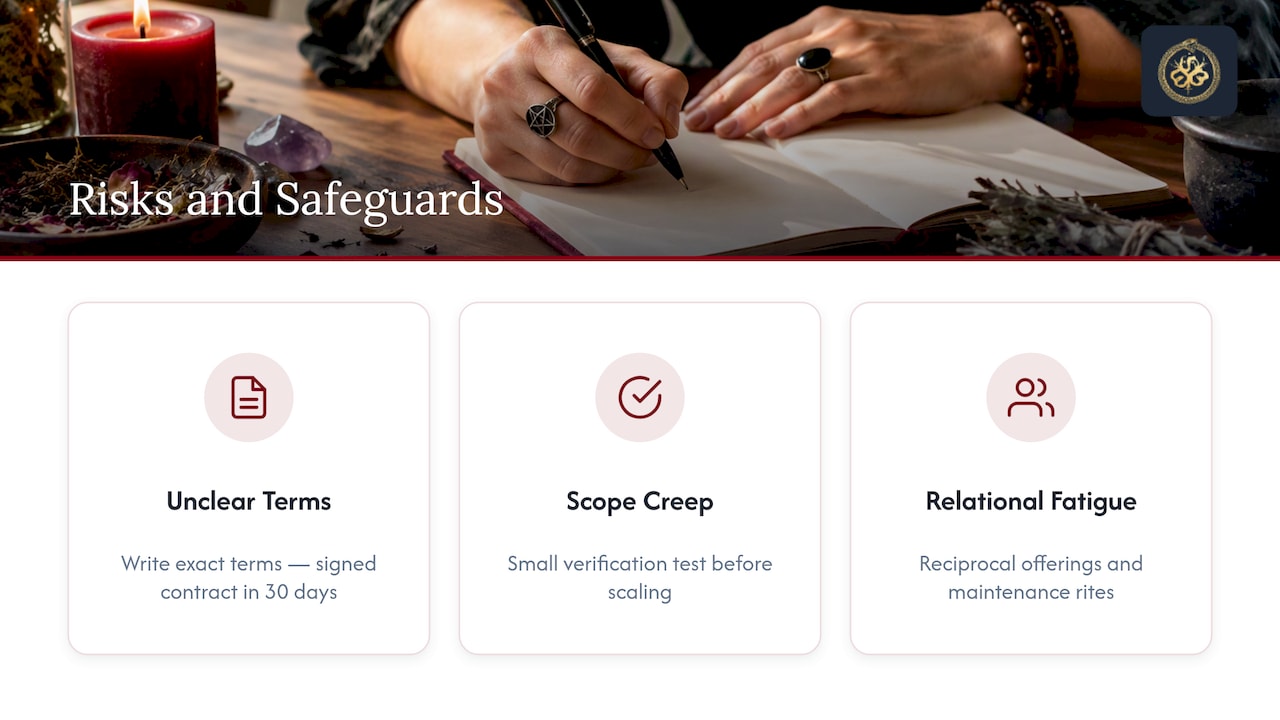
A second risk is scope creep: escalating a pact’s demands before confirming the entity is responsive at a smaller scale. The verification step described earlier exists precisely to prevent this, and skipping it is the most common reason a working underperforms.
A third consideration is relational fatigue. Entities engaged repeatedly without reciprocal offerings, maintenance rites, or honored terms tend to become less responsive over time, mirroring the reciprocal pattern that the academic literature on satanic pacts identifies as central to how these exchanges have functioned historically. Treating the bond as transactional in both directions, rather than purely extractive, keeps the relationship productive across repeated workings.
Psychological Integration of Sovereignty Work in Daily Life
Ritual authority does not stay confined to the circle. Witches who work sovereignty rites consistently report a shift in how they carry themselves in ordinary negotiations, whether that is a salary discussion, a custody dispute, or a business deal, because the posture of command practiced in ritual becomes a habit of mind outside it.
The discipline of writing exact terms before sealing a pact also transfers directly into daily decision-making. Occultists who get used to specifying precise outcomes in ritual tend to apply the same precision to mundane goals, replacing vague wishes with concrete, testable plans.
There is also a feedback loop between the verification step and ordinary confidence. Confirming that a small working produced a measurable result builds a kind of evidence-based self-trust that differs from generic affirmation practices: it is not “I believe in myself,” it is “I tested this and it worked.” That distinction matters for those who come to the Left-Hand Path from more passive spiritual backgrounds, where power was something received rather than exercised.
Integration also means recognizing when a ritual gain needs reinforcement through ordinary action. A binding that resolves a legal obstacle still requires the witch to show up, sign documents, and follow through. The magick clears the path; the magician still walks it.
How Sovereignty Concepts Shift Across Occult Traditions
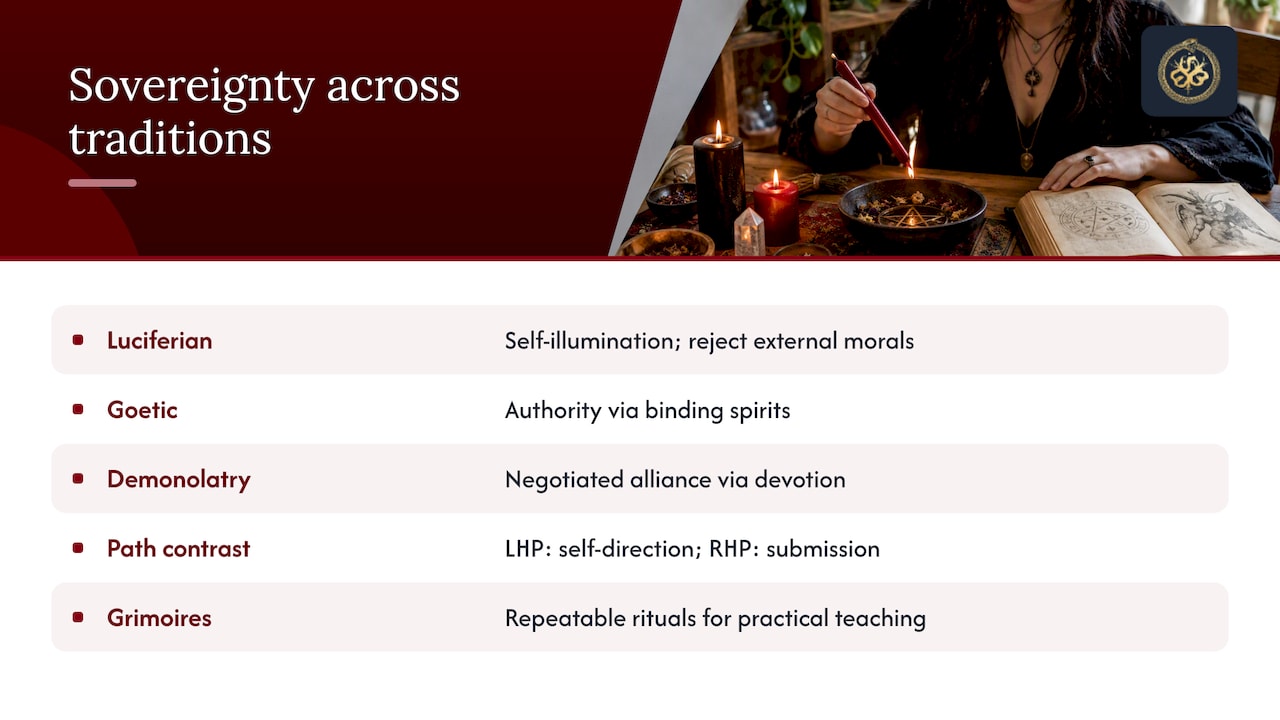
The core idea, that authority is built through active relationship and enforced boundaries rather than received passively, appears across multiple traditions, though the mechanics differ. In Luciferian frameworks, sovereignty centers on self-illumination and the rejection of external moral authority, with Lucifer functioning as a liberator figure rather than a master to be served.
Goetic practice, by contrast, frames sovereignty almost entirely through binding: the witch’s authority is demonstrated by the ability to command spirits into fixed roles, as the Munich Manual’s Bond of Solomon illustrates. The emphasis there is control of the relationship’s terms, not personal illumination.
Demonolatry traditions, which treat entities as worthy of reverence and exchange rather than simple tools, frame sovereignty differently again: as a negotiated status earned through sustained devotion and reciprocal offering, closer to an ongoing alliance than a one-time command.
The distinction between Left-Hand Path and Right-Hand Path frameworks, as general occult scholarship notes, also shapes how sovereignty gets defined: Right-Hand Path systems tend to locate authority in submission to a higher order, while Left-Hand Path systems locate it in self-direction, negotiated power, and the magician’s own enforced will. Chapbook and printed grimoire traditions, documented in research on the popularization of printed magical manuals, show that simplified, repeatable ritual formulas spread specifically because magicians wanted workable techniques rather than purely theoretical systems, a pattern that still shapes how sovereignty work gets taught today.
Applying Sovereignty Principles Outside Ritual Contexts
The structural habits built through pact work translate cleanly into secular situations that have nothing to do with ritual. Negotiating a business contract benefits from the same discipline used in sealing a pact: specific terms, a measurable standard for compliance, and a clear consequence if those terms are not honored.
Boundary enforcement, practiced through the small tests described earlier, carries over into relationships and workplaces where witches previously tolerated vague or shifting expectations from others. The habit of testing authority at small scale before escalating applies equally to a difficult negotiation, a custody arrangement, or a business partnership.
Record-keeping is another transferable habit. A witch who maintains a detailed ritual ledger, tracking inscriptions, offerings, and outcomes, often applies that same discipline to tracking commitments, deadlines, and results in professional contexts, turning a ritual practice into a broader habit of accountability.
None of this requires framing daily life as ritual. It simply means the underlying skill, stating clear terms and verifying results before trusting a relationship further, works the same whether the other party is a demon or a landlord.
A Magician’s Note on What Actually Works
The techniques that hold up under repetition are the boring ones: written terms, small verifiable tests, and maintenance rites that most occultists skip because they are not dramatic. A client who wanted Andras’s help forcing a stalled custody case into motion got results not from the invocation itself but from the follow-up test two weeks later that confirmed the bond was active before anything larger was asked of it. Sovereignty is built in that unglamorous middle step, not in the candlelit moment everyone pictures.
— Black Witch Coven
Working with Black Witch Coven on Sovereignty Rituals
Readers who want guided ritual authority work rather than solo experimentation can draw on our daemonic spell-casting services, including pacts and workings tied to Lucifer, Clauneck, Andras, and Astaroth.
- Black magick spells for money, love, and mind-focused work without demonic pacts.
- VIP programs for sustained, multi-month sovereignty and protection work.
- Monthly maintenance subscriptions for keeping active bonds and protections current.
Start with a tarot or spirit guidance reading to scope which entity and working fits your situation before committing to a pact.
FAQ
What makes a pact different from a simple spell request?
A pact is a negotiated, reciprocal exchange with named terms on both sides, sealed through a written or spoken bond, while a spell request is typically a one-directional ask. The historical record on satanic pacts frames pacts specifically as ongoing obligations rather than single transactions.
How do I know if a working actually gave me authority over an outcome?
Set a small, specific, time-bound test before you seal any working, then check it against the result. Manuscript tradition documents in Folger’s grimoire commentary describe this same verification approach as standard practice before escalating a pact’s scope.
Why do magick circles matter for sovereignty work?
A magick circle marks a fixed boundary of magical authority during invocation, a structure the Munich Manual documents through concentric circle diagrams used in fifteenth-century goetic ritual. It establishes where the entity’s movement ends and the witch’s command holds.
Does Black Witch Coven perform pact and sovereignty workings for clients?
Yes, our daemonic workings with entities including Lucifer, Clauneck, Andras, and Astaroth are offered as custom spell-casting services, priced individually by working. VIP and monthly maintenance options are also available for clients who want sustained support.
Why is inscription considered essential rather than optional?
Writing a sigil or bond by hand functions as both a focusing act and a contractual record, a point the Tractatus de Nigromatia commentary makes explicit across multiple manuscript traditions. Skipping inscription removes the physical anchor that keeps a working specific and enforceable.
Sources
- Munich Manual of Demonic Magic — Wikipedia
- Conjuring spirits in the ‘Tractatus de Nigromatia’ — Chetham’s Library
- Satanic pacts/Diabolism — Oxford Academic / Cornell Scholarship Online
- Lost and Found: A Manuscript Grimoire — Folgerpedia
