
Blog, Demons, Working With Demons
Balam Demon: Goetia Entry, Seal and How to Work With Him
Oct
Balam is the fifty-first spirit of the Ars Goetia: a three-headed king who gives true answers, makes men invisible, and governs 40 legions. His catalogue entry pairs a bull, a man, and a ram with a serpent’s tail, flaming eyes, a furious bear for a mount, a goshawk on his fist, and a hoarse voice. Here is what the entry says and how to use it. His short profile is on our Balam Demon Directory page.
What does the Ars Goetia say Balam looks like and does?
The Goetia entry is compact, and every phrase is a datum worth keeping apart from later commentary. Read line by line, it gives us:
- Rank: a “Terrible, Great, and Powerful King,” the fifty-first spirit in the catalogue.
- Heads: three, one of a bull, one of a man, and one of a ram.
- Body: a serpent’s tail, and eyes that burn like flame.
- Mount and companion: he rides a furious bear and carries a goshawk on his fist.
- Voice: hoarse, which the text states plainly and does not explain.
- Offices: he gives true answers about things past, present, and to come, makes men go invisible, and makes them witty.
- Command: 40 legions.
- Seal: the entry records his seal and says it may be worn as a lamen.
Notice what is missing. The entry gives no biography, no planetary attribution, no day or hour, and no petition formula. Everything you read elsewhere on those points is added material, and the useful habit is to label it as such.
The imagery rewards close reading. Three heads that are animal, human, and animal suggest a being whose perception does not run through one channel. A serpent tail and a bear mount suggest both cunning and brute force traveling together. The goshawk on the fist is a hunter’s bird, a trained instrument of sight and pursuit, which sits comfortably beside an office that retrieves information. You do not need to adopt any of these readings as doctrine, but they give you a vocabulary for choosing ritual materials later.
Where does the Balam entry come from, and why do editions differ?
Balam’s entry lives in the first part of the Lemegeton, the Ars Goetia. The Lemegeton is a compiled catalogue. It draws on earlier works such as Weyer’s Pseudomonarchia daemonum of 1577, and its manuscripts carry variant readings, including differences in the order of the spirits, whether seals appear, and how much ritual elaboration is attached.
The Pseudomonarchia daemonum matters because it is the earlier catalogue behind much of the later compilation. The wider Goetic and Lemegeton material is a tangled network of copies spanning several languages and manuscripts, with variant forms throughout. In practice, no single printed page is “the” Balam.
A workable order for tracing him:
- Start with a readable edition of the Ars Goetia. The Mathers edition of 1904 gives you the entry in modern typography, which suits first-pass reading.
- Compare it with a second edition of the Goetia. Differences in spelling, ordering, and seals show you where your edition made choices.
- Consult the Pseudomonarchia daemonum. Reading the earlier catalogue shows what the Goetia inherited and what it reshaped.
- Check the manuscripts. The Sloane manuscripts, chiefly Sloane 3825 and 2731, show how the text moved between copies, which explains why discrepancies exist and keeps you from treating any one variant as final.
- Write your own working summary. Record the description, offices, legion count, and seal in your own notes, with the edition cited beside each fact.
The catalogue lists description and offices. It does not hand you a continuous life story or a fixed ritual formula, and that absence is the central methodological fact about Balam. Where a practitioner needs a method, it comes from the Goetia’s general operation, the circle, triangle and conjurations that serve all seventy-two spirits (set out in our conjuring method from the Goetia), or from the practitioner’s own framework.
How do you work with the textual Balam without blending in later layers?
The discipline is simple to state and hard to maintain: keep three things separate. The first is the catalogue description. The second is the seal. The third is your chosen ritual framework. The Balam entry gives rank, appearance, offices, and legion count, but it does not itself prescribe an altar layout, an incense formula, a petition template, or a pact structure. Anything in those categories is your design, informed by tradition, and should be recorded as design.
That separation pays off in practice because you can later tell which parts of a working came from the source and which came from you. When a result disappoints, you can adjust your framework without doubting the entry. When a result impresses, you know what to repeat.
Translating the catalogue offices into aims looks like this:
- Information requests: Balam’s office of true answers about past, present, and future maps to focused questions with a defined scope, such as a specific decision, a specific document, or a specific unknown.
- Wit and quickness: the office of making men witty suits preparation for negotiation, debate, writing, or any exchange where verbal speed decides the outcome.
- Concealment: the office of invisibility maps to discretion, going unnoticed during a sensitive period, or keeping a project out of view while it matures.
- Symbolic alignment: the bull, ram, bear, and goshawk give you imagery for candles, cords, carvings, or visualization anchors, chosen because the entry names them.
Two high-level framings show the principle. A practitioner preparing for a contract negotiation might frame the petition around the witty office: sharpness of speech and clarity under pressure on a stated date. Another facing an investigation they cannot yet explain might frame a petition around the answers office: a single clearly worded question about what is true in a defined matter, with the working repeated until a pattern emerges.
The seal and lamen deserve the same care. The entry says the seal may be worn as a lamen, which is a historical datum. Treat it as a starting point for your own adaptation, and note which edition’s seal you used.
Pro Tip: Before any working, photograph or trace the seal from two different editions and compare them side by side. Choose one, write down which, and keep that version fixed across every repetition so your results stay comparable.
What is known about Balam beyond the Ars Goetia?
Much less than modern summaries suggest. The reliable thread runs from the Pseudomonarchia daemonum into the Lemegeton, through a tangled transmission across languages and manuscripts. That tangle means Balam is documented as a catalogue entry that traveled between compilations, not as a figure with an independent mythology preserved in narrative.
What later writers added is a separate matter. Modern occult authors have attached planetary rulerships, correspondences, and devotional personalities to Goetic spirits, and some of that material is useful as practitioner synthesis. It is not part of the source entry, and presenting it as ancient fact misleads readers about what the text supports.
The practical consequence is that your background reading on Balam should be a reading of editions and transmission, not a hunt for myths. When you come across a story that places him in a specific legend, ask where it first appears. If the trail ends in a modern book, you have found synthesis, which you can still use as long as you label it.
Which spheres of influence and intentions suit Balam?
The catalogue ties Balam to three offices: true answers, invisibility, and wit. Everything else is extrapolation, and honest extrapolation starts from those offices.
Answers point toward divination, research, and clarity. Practitioners seeking the truth about a hidden situation, an unexplained pattern, or a decision with missing information are working in the territory the entry actually names. Invisibility points toward privacy, protection through not being seen, and the quiet advancement of a project away from rivals. Wit points toward persuasion, eloquence, and mental agility.
Love, protection, and prosperity appear in many modern lists, but the entry does not assign them. If you want to work in those areas, the clean approach is to translate through the offices: protection through concealment, prosperity through sharper negotiation, and relationships through clearer communication. Doing so keeps your stated intention connected to something the text says Balam does, and it gives you a way to explain, afterward, why the working was designed as it was.
What ritual methods fit working with Balam in the Left-Hand Path?
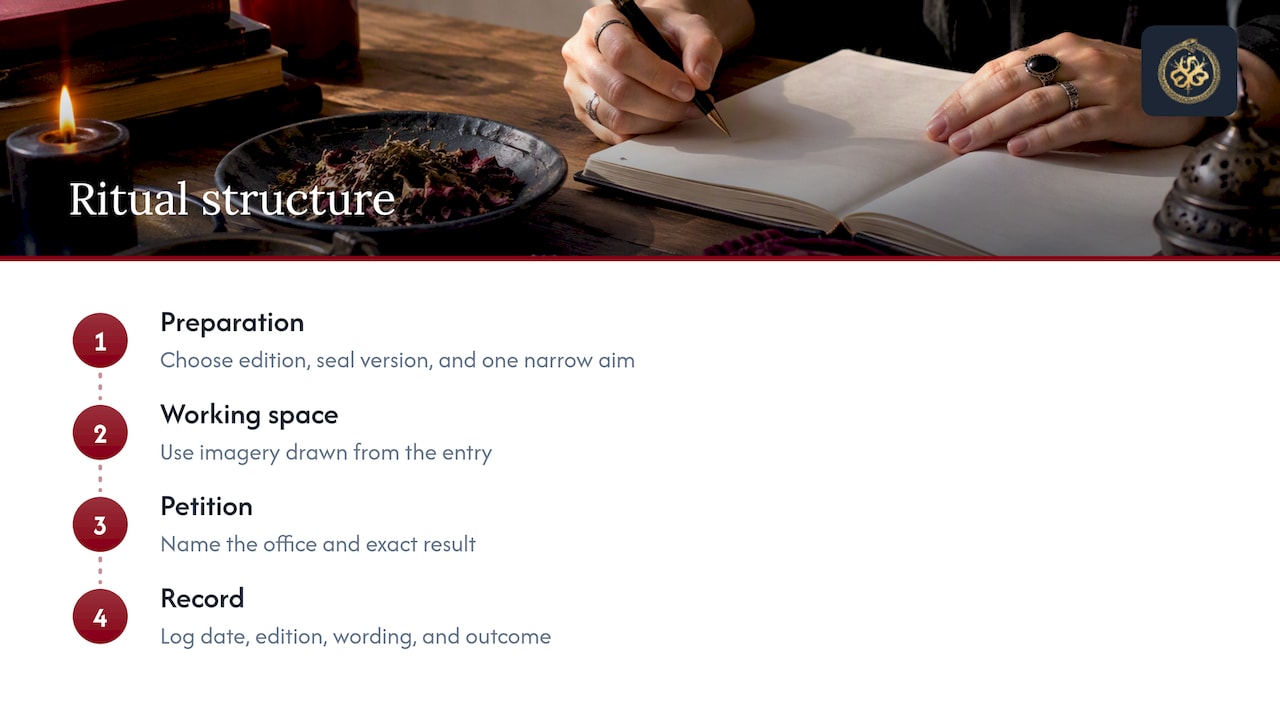
Because the entry prescribes no rite of its own, Left-Hand Path practitioners often build one, and the strongest builds make their reasoning visible. A sound structure has four parts. First comes preparation: choose the edition, the seal version, and a single narrow aim drawn from one office. Second comes the working space: set an altar with imagery taken from the entry, such as a bull, ram, or bear figure, or a hawk feather, so the symbolism traces back to the text. As one of the Goetic kings, Balam also suits our Goetia Kings Oleums for dressing candles and the seal.
Third comes the petition itself, spoken or written in plain language that names the office you are invoking and the exact result you want. Vague petitions produce results you cannot evaluate. Fourth comes the record: log the date, the edition used, the wording, and what happened. After several workings, the log tells you whether Balam’s answers office behaves differently for you than his concealment office, and which of your framework choices carry weight.
Many practitioners also fold in a Left-Hand Path emphasis on direct relationship: repeated contact over time, offerings tailored to the entity, and an honest account of what each side contributes. Our own demonolatry resources cover that relational approach for readers who want a broader foundation.
What sigils, seals, and symbols are used for Balam?
The seal in the Goetia is a central symbol, and the entry itself says it may be worn as a lamen. Different editions render it with variations, so “the” seal of Balam is really a family of related drawings. That is why comparing two editions before you commit to one is worth the few minutes it takes.
Beyond the seal, the usable symbols come straight from the description: the bull, man, and ram heads, the serpent, the bear, the goshawk, and the flame of his eyes. A practitioner can draw these as a composite image, carve them into a candle, or hold one of them as a visualization anchor while speaking a petition. Personal sigils constructed from the letters of his name are another common practice, though that technique is a modern working method and not something the entry describes.
If you make your own sigil, record the method and keep it distinct from the historical seal. A Demonic Tarot Reading can also help you think through how symbolic imagery shapes a working, particularly if you are designing an altar from scratch.
What pacts and offerings suit Balam?
The entry specifies neither, so any pact or offering is a practitioner’s proposal to the spirit, and it works best when it is concrete and proportionate. Offerings that echo the entry’s imagery are a natural choice: a hawk feather, a small bull or ram figure, incense burned during the working, or a written statement of the question you want answered. Offerings tied to the offices work too: time spent on research when asking for answers, or a period of deliberate discretion when asking for concealment.
A pact, in practical terms, is a clear exchange with defined terms, and our guide on how to write a demonic pact covers the form. State what you seek, state what you will provide, state the time frame, and write it down. A narrow, time-limited agreement is easier to evaluate than an open-ended one. If the aim is a single answer, the pact can end when the answer arrives. If the aim is ongoing wit in a recurring professional situation, a recurring offering on a regular schedule matches the ongoing need.
Keep the written terms. When you review the log later, the record of what you promised and what you received is the most useful evidence you will have.
How does Balam’s depiction vary across grimoires and traditions?
Variation comes mostly from transmission. The Lemegeton shows variant readings across editions in spirit order, the presence of seals, and the degree of ritual elaboration, and the Pseudomonarchia daemonum predates the Goetia and supplies earlier forms of the catalogue. A reader comparing sources should expect small differences in spelling, ordering, and how much detail each version provides.
The Solomonic corpus adds a further complication: the material moved through multiple languages and manuscripts, so a given detail might be a faithful inheritance, a scribal slip, or a deliberate revision. The practical method is to treat the core attributes stable across your sources as the firm layer: the king’s rank, the three heads, the serpent tail, the offices, and the 40 legions. Treat anything that appears in only one edition as provisional, and note the edition when you use it.
Modern devotional material is a separate layer on top. It comes from practitioners working with Balam now and describes that relationship rather than what the catalogue records.
Our perspective: why we work source-faithfully with Goetic kings
Our position is that a practitioner who cannot say which parts of a working came from the text and which from their own design has no way to learn from the results. We start every Goetic project by reading the entry as written, listing what it states, and then building the ritual framework on top in clearly labeled layers. Balam is a good case because his entry is short and his offices are clear, so the temptation to overload him with borrowed attributes is strong.
For example, a practitioner facing a contract dispute might seek clarity about what the other party is withholding. They could frame a working around the answers office, with one clearly worded question, the seal from a chosen edition, and a written record of the date and wording. A single question and a single source make it easy to see what the working brought to the surface. If you want to go deeper into this method, we are glad to talk it through.
How we can help with daemonic ritual and consultation
We offer daemonic spell casting, ritual consultation, and demonolatry study materials for practitioners who want guided work with Goetic and other entities. Our daemonic spell casting services cover ritual work for prosperity, love and marriage, legal matters, and protection, and our Left-Hand Path readings give direction before committing to a full working. For tailored ritual planning, practitioner mentorship, or a sounding board for a source-faithful design of your own, reach out through the service pages and tell us what you are trying to accomplish.
FAQ
Who is Balam in the Ars Goetia?
Balam is the fifty-first spirit of the Ars Goetia, described as a terrible, great, and powerful king. He has three heads (bull, man, and ram), a serpent’s tail, and flaming eyes, and he governs 40 legions.
What powers does Balam have?
The catalogue entry credits him with giving true answers about things past, present, and to come, making men go invisible, and making them witty. These three offices are the only ones the text assigns to him.
Does the Goetia give a ritual for calling Balam?
The entry gives rank, appearance, offices, legion count, and a seal, but no altar layout, incense formula, or pact structure. The Goetia’s general conjurations, circle and triangle serve for every spirit, Balam included; anything beyond them is the practitioner’s own framework.
Why do different editions describe Balam differently?
The Lemegeton compiles earlier catalogues such as the Pseudomonarchia daemonum, and its editions vary in spirit order, seals, and ritual detail. Comparing editions and noting which details they share is a useful approach.
