
 New Years Eve Ritual 2026/2027 with Savannah

Nov
A loyalty binding spell fixes a partner’s attention, desire and commitment on one person, you, and closes the gaps through which both drift. Done well, it is a short, precise working with a named spirit or a clear spoken intent, a personal link to the person, a binding act that can be seen and held, and a closing that seals it. This article gives you the history behind the form, the structure of the working, the materials, the timing, the wording of the petition, the steps, the signs that it has taken hold and the way to close it.
The form is ancient. Women in the ancient Mediterranean, in Late Antique Syria and in medieval Egypt were already binding wandering husbands, and the surviving texts show what the work was meant to do and how it was built.
Where the loyalty binding comes from
The oldest records are lead tablets. The Greco-Roman amatory tablets, written between the 4th century BCE and the 4th century CE, fall into three recurring aims: agoge (drawing someone to you), separation and philia (affection). They were made by people of every social level, gender and sexuality, and again and again they speak of the wish to “bind” oneself to the desired person. Binding as attachment is the original idiom of the form.
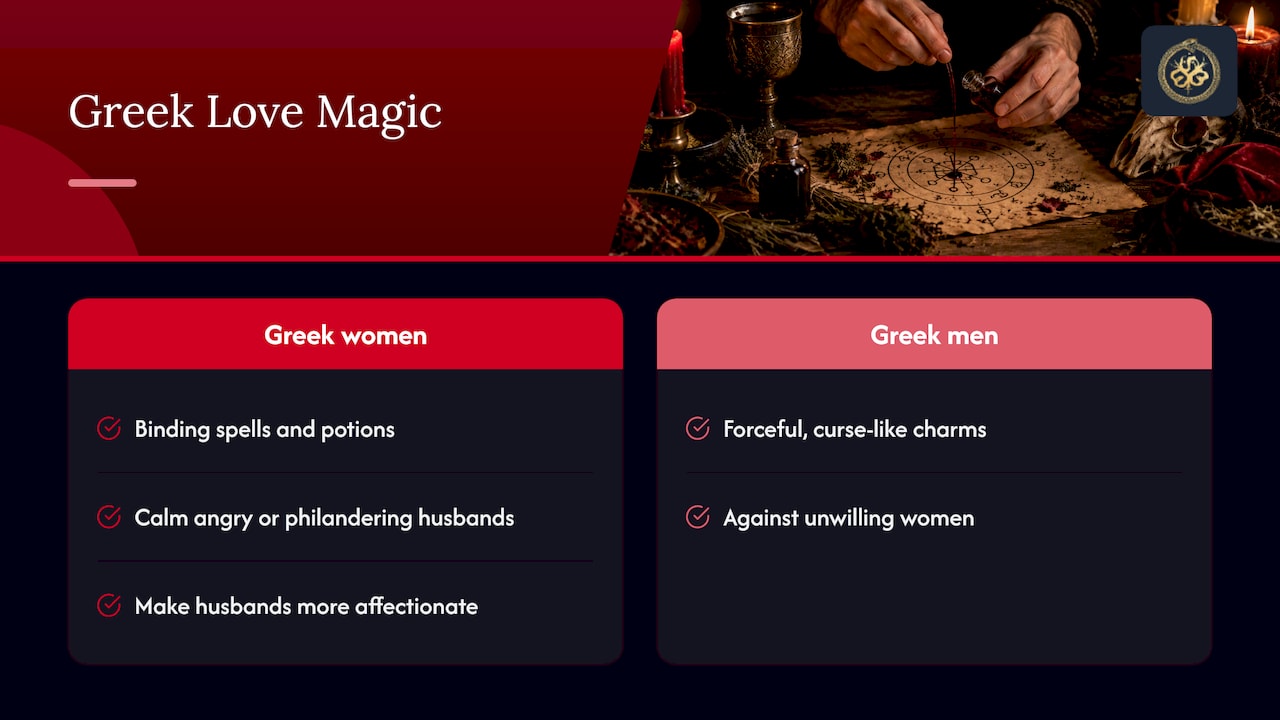
Christopher Faraone’s Ancient Greek Love Magic (Harvard University Press, 2001) draws a clear distinction. Greek women generally used binding spells and potions to calm angry or philandering husbands and make them more affectionate, while men more often used forceful, curse-like charms against unwilling women. The wife’s form is the ancestor of the loyalty binding: a restraint on straying and a warming of the home bond.
The most direct ancestor is a Syriac charm, “Binding of an Adulterous Husband from Another Woman,” a spell a wife used to restrain her husband and end an affair. It survives in three manuscripts, one in the British Library and one in Harvard’s Houghton Library. Alongside it stand a counter-spell, “Protection for Grooms,” and a Cairo Geniza spell aimed at a woman suspected of adultery. Two things follow for anyone building a working today. First, the binding was addressed to the specific problem, not to love in general. Second, the old magicians expected rival magick and built counter-work into the practice. We return to that in the closing section.
The modern folk version is simpler. A well-known fidelity charm binds two nutmeg seeds together, one carrying each partner’s name, wraps them in both partners’ clothing, ties the bundle with red ribbon in a red bag and keeps it in the wardrobe or between mattress layers. The logic is the same as the tablets: two identities joined into one object, kept where the couple sleeps.
What separates a loyalty binding from other love work
The terms get blurred, so it helps to separate four kinds of working.
| Working | What it acts on | Typical object |
|---|---|---|
| Attraction (agoge) | Draws a person toward you | Photo, hair, personal item |
| Reconciliation | Reopens a broken line of contact | Letter, candle, shared object |
| Loyalty binding | Fixes an existing bond in place and closes the exits | Paired objects bound together |
| Return to sender | Turns a hostile working back on its origin | Mirror, jar, black cord |
A loyalty binding assumes the bond already exists. That is why it is the right working for a couple who are together, and the wrong one for someone who is still waiting for the person to call. For the second case, the working you want is reconciliation or attraction, and the order matters: you cannot bind what is not yet in the room.
It also assumes you have decided what loyalty means in your case. Monogamy, availability, honesty about where the person is, and emotional attention are four separate things. A binding that tries to hold all four at once is vague, and vague petitions produce vague effects. Choose the one that matters most this season and say so in the wording. One problem at a time.
Working with Sallos for fidelity
The spirit in the primary texts
Sallos is the 19th spirit of the Ars Goetia in the Lesser Key of Solomon, and Johann Weyer records him in the Pseudomonarchia Daemonum under the name Saleos. The Goetia describes him as a great duke commanding thirty legions who appears as a gallant soldier in a ducal crown, riding a crocodile, mild in manner. His single office is to turn the love of men toward women and of women toward men, and to make that love mutual. Mutual is the key word. Sallos is a spirit of reciprocity, and a loyalty binding asks for exactly that: a bond both people feel pulling in the same direction.
The crocodile is an animal that holds on, and in a loyalty working that is the hold: patient, steady and hard to shake loose. More spirits of love and attachment are listed in our Demon Directory.
Materials
- One red or pink taper candle for the bond, one black candle for the exits you are closing
- A pair of small objects that belong to each of you: a strand of hair from each, or a worn thread from each person’s clothing. Where you have neither, a handwritten name on paper works
- Red cord or ribbon, about three feet
- A small dish, a saucer or a shallow bowl
- Sallos’s seal, drawn by hand on a piece of unlined paper in red ink
- An offering: a small glass of red wine or a sweet liqueur, a pinch of cinnamon and a few drops of rose oil (or Sallos Oil for dressing the red candle)
- A small red cloth bag to hold the finished bundle
Timing
Work on a Friday, the planetary day of Venus, and ideally in the first Venus hour after sunrise or sunset. Start during the waxing moon, from the new moon to the full, so the working grows with the light. If you want the binding to carry through to a peak, finish it on the night of the full moon. Our page on moon phases for magick lays out the cycle in detail.
The petition and the enn
Set the dish between the two candles with the seal under it. Light the black candle first, then the red. Speak the call of Sallos slowly and in full:
Sallos, Great Duke, rider of the crocodile, crowned in peace and bound to love, I call you to this table. Sit with me and hear my petition.
Then speak the petition in your own name and the name of the person. Replace the bracketed words:
Sallos, I, [your name], ask you to turn the love of [partner’s name] to me alone, as mine is turned to them. Let our desire be mutual, steady and closed to any third. Let their eyes, their attention and their evenings come home to me. Let what is tied tonight stay tied. So I will it. So it is spoken.
The enn, the short invocation that carries the name, is the line you repeat while you work with the cord: “Sallos, hold what is mine.” Say it as a steady rhythm, not as a shout.
Step-by-step actions
- Cleanse the working surface with a cloth and set the candles at either side of the dish.
- Place the seal in the middle and set the two personal objects, one on each side of it.
- Pour the offering into a small glass beside the seal and sprinkle the cinnamon around the dish. Anoint the red candle with a drop of rose oil, from the base to the wick.
- Light both candles in the order given, speak the call and wait one full minute in silence. Feel for the room to change: heavier air, a pressure at the shoulders, warmth near the red candle.
- Speak the petition three times, then begin the binding. Lay the two objects together, wrap the red cord around them once, and say the enn as you pull the knot tight.
- Tie nine knots, saying the enn once for each. On the ninth, say: “This bond is closed. No third may enter.”
- Place the bundle in the red bag and hold it against your chest for one minute. Think of the specific loyalty you chose: the nights, the honesty, the attention.
- Let the red candle burn down in the dish. Snuff the black candle with your fingers or a snuffer, never by blowing it out.
Signs of presence and signs it is working
Sallos’s presence is usually felt as warmth, a flush in the face, a quiet confidence and sometimes a sudden scent of roses or river water. Candle flames lean toward the seal or burn tall and steady.
Signs that the binding is taking hold show up in the partner’s behavior, usually gradually over the following weeks and months, and they differ from person to person. Look for small shifts:
- They start telling you where they are before you ask.
- They reach for you first when they have good or bad news.
- A third person who used to occupy their messages goes quiet.
- Dreams of the partner become more frequent for both of you.
The signs come in their own time. A journal kept every day for a month shows the pattern more clearly than memory does.
How to close the working
When the red candle is spent, thank the spirit aloud:
Sallos, I thank you for your attendance. What was asked is placed in your keeping. Go in peace, and return when I call.
Pour the wine offering onto soil outside, or into running water if you can reach it. Wrap the cooled wax remains in the paper seal and bury them near your door. Keep the red bag in the bedroom, in a dresser drawer or under the mattress, as the old nutmeg charm does. The bag is the anchor. Refresh it on each Friday of a waxing moon with a drop of rose oil and one repeat of the enn.
When the petition is about an affair
When infidelity is the problem, three needs come up: holding a spouse who is straying, returning a rival’s working to its source, and bringing a confession to the surface. They are three different workings and each has its own structure.
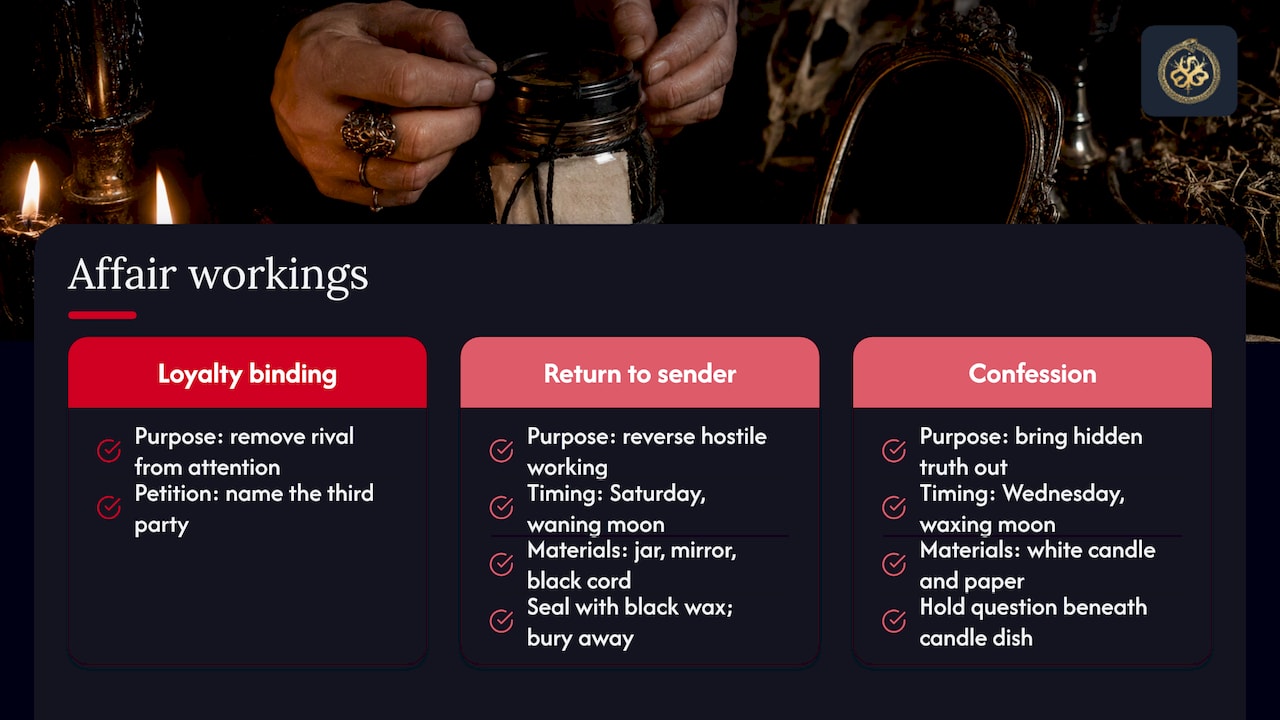
A monogamy or loyalty binding for a spouse who is straying uses the working above, with one change in the petition. Replace “closed to any third” with the specific line: “Let the one who stands between us be pulled from [partner’s name] and cast out of their attention.” This is the same shape as the Syriac text, which targeted the other woman as much as the husband.
A return to sender applies when you believe a rival or the partner is working against you. Use a black jar, a small mirror turned face-inward inside it, black cord, and the name of the sender if you know it. Work on a Saturday, the day of Saturn, during the waning moon, and say: “What was sent returns to its source, doubled and closed. It finds no home in me.” Seal the jar with black wax and bury it away from your home.
A confession working is the lightest of the three. Use a white candle on a Wednesday, Mercury’s day, during the waxing moon. Write on a slip of paper the question you want answered, fold it toward you, and hold it under the candle dish while you say: “What is hidden speaks. What is withheld is brought into the open.” Expect the answer to arrive through conversation, a slip of the tongue or an object left where you will find it. The answer is usually specific.
How the working is typically used
A wife of many years whose husband’s phone is always face-down and whose evenings have grown long works the Sallos binding on a Friday in the waxing moon and keeps the red bag under the mattress. She keeps a daily note of when he texts, mentions his schedule or reaches for her, and adds the confession working on a Wednesday so the matter comes into the open between the two of them.
A woman newly reconciled with a partner after a separation does not need attraction, because he is already back. She needs the bond held. Her binding names one aim, honesty about where he is, and she repeats the enn on each waxing Friday for three cycles.
A husband who suspects a coworker is working against his marriage through gossip and mutual friends performs the return-to-sender jar on a Saturday in the waning moon, then binds his marriage the following Friday. Close what is hostile first, then fix what is yours.
Pair the working with action in the room
Magick moves through channels, and the strongest bindings are the ones backed by the person’s real choices. The Syriac wife and the Greek wife worked in a household where the spell and the daily conduct of the home pulled together. You can do the same. While the red bag is in the bedroom, change one concrete thing in the relationship: a standing evening that belongs only to the two of you, a plain conversation about what each of you needs, a repaired habit. Couples who can speak plainly to one another give the binding something to hold.
Bring your own state into the work too. The weak point of loyalty magick is the worrier’s habit of checking, testing and re-casting every night. A binding is cast once, fed on a schedule and left alone between feedings. Constant re-casting disperses it and keeps you in the posture of someone who is already losing. Sovereignty means that you stand in the relationship as someone whose petition has been made and who now lives like it.
Timing and keeping the bond fed
A binding keeps its own time. What you control is the feeding rhythm:
- Weekly: a minute of the enn over the red bag on Friday evenings.
- Monthly: at the full moon, a fresh drop of rose oil on the bag and a small offering of wine to Sallos.
- Quarterly: a full repetition of the working, with the petition reworded to match how the relationship has changed.
When the relationship has moved on and the original binding no longer fits, close it deliberately: thank Sallos, open the knots one at a time, and bury the cord. A bond that has been closed with care leaves room for the next one.
Perspective
Across the old texts, the pattern is consistent. The oldest loyalty bindings were never generic love spells. They named a specific problem, a specific spirit or power, a specific object and a specific outcome. That is the structure we follow in our own work with Sallos and the other spirits of love, and it is why we prefer one clearly stated petition over a long list of wishes.
We work as believers. Sallos is a real, intelligent spirit with an office, a temperament and preferences about how he is approached, and the Ars Goetia and Weyer’s Pseudomonarchia Daemonum (1577) are our starting point for knowing him. A loyalty working is a conversation with him, and a conversation goes better when you know whom you are speaking to.
The second pillar is sovereignty. The spirit is a guide and an ally, and you stay the author of the petition. Choose the loyalty that matters, word it in your own voice, and then live as someone whose request has been heard.
Black Witch Coven
For those who want the working cast for them
Black Witch Coven casts loyalty and relationship work for clients who would rather have it done by experienced hands: the Daemonic Magick for Love & Marriage ritual, the Black Magick Love Spell (No Demons), and work with the spirit of this article through Bring Back an Ex-Partner with Demon Sallos. Other spirit workings are listed under Daemonic Spell Casting.
FAQ
How long does a loyalty binding spell take to work?
There is no fixed timetable. The signs tend to arrive as gradual shifts in attention, openness and routine over weeks. Keep a short daily journal so you can see the pattern, and feed the working on its Friday and full-moon rhythm.
How do you tell whether a binding is working?
Look for small, repeated changes: your partner volunteers where they are, reaches for you first, and the third party fades from their messages. Dreams of each other and a sense of warmth when you hold the red bag are further signs.
Can I use a loyalty binding without demons?
Yes. The same structure works with your own voice, the paired objects, the red cord and the candles, and the petition spoken to the powers you already work with. The spirit adds a named intelligence to the work, which is why many choose to call Sallos.
How do I end a binding I cast?
Open the knots one at a time, thank the spirit aloud, pour the offering onto soil or running water and bury the cord and wax. Do it on a waning moon, on a Saturday if you can, and say plainly that the bond is released.
