
 New Years Eve Ritual 2026/2027 with Savannah
Blog, Learn Witchcraft, Occultism
Occult Mentorship Programs: How to Find and Vet a Teacher

Nov
An occult mentorship program is a structured, ongoing relationship in which an experienced mentor trains you in a defined body of practice: ritual technique, divination, working with spirits, and the discipline to sustain all of it. A good one has a scope, a rhythm, a way of assessing your progress and a clear exit. This guide covers what these programs contain, how to choose a mentor on the left-hand path, what to ask before you commit, and how to make the training produce skill rather than dependence.
Table of Contents
- What an occult mentorship program actually involves
- What a left-hand path mentor teaches that a right-hand path teacher does not
- How to choose an occult mentor
- Questions to ask before you begin
- Warning signs in a mentor or a program
- Keeping your judgment while someone else guides you
- How to get the most from the first ninety days
- Our perspective: mentorship as a path to sovereignty
- Where hands-on guidance fits
- FAQ
- Sources
What an occult mentorship program actually involves
Strip away the branding and nearly every program is built from the same four parts.
A curriculum, explicit or implied. Some mentors hand you a syllabus: a year of foundations, then a year of specialization. Others teach by assignment, giving you one practice, reviewing your results, and choosing the next step from what they see. Both can work. What fails is the third model, where sessions are open-ended conversations with no sequence, because nothing builds on anything.
Practice you do between sessions. The meetings are the smaller part of the work. The larger part is daily or weekly practice: meditation, banishing, divination, journaling, and eventually ritual. A mentor’s job is to review what you did, correct it, and adjust the next assignment.
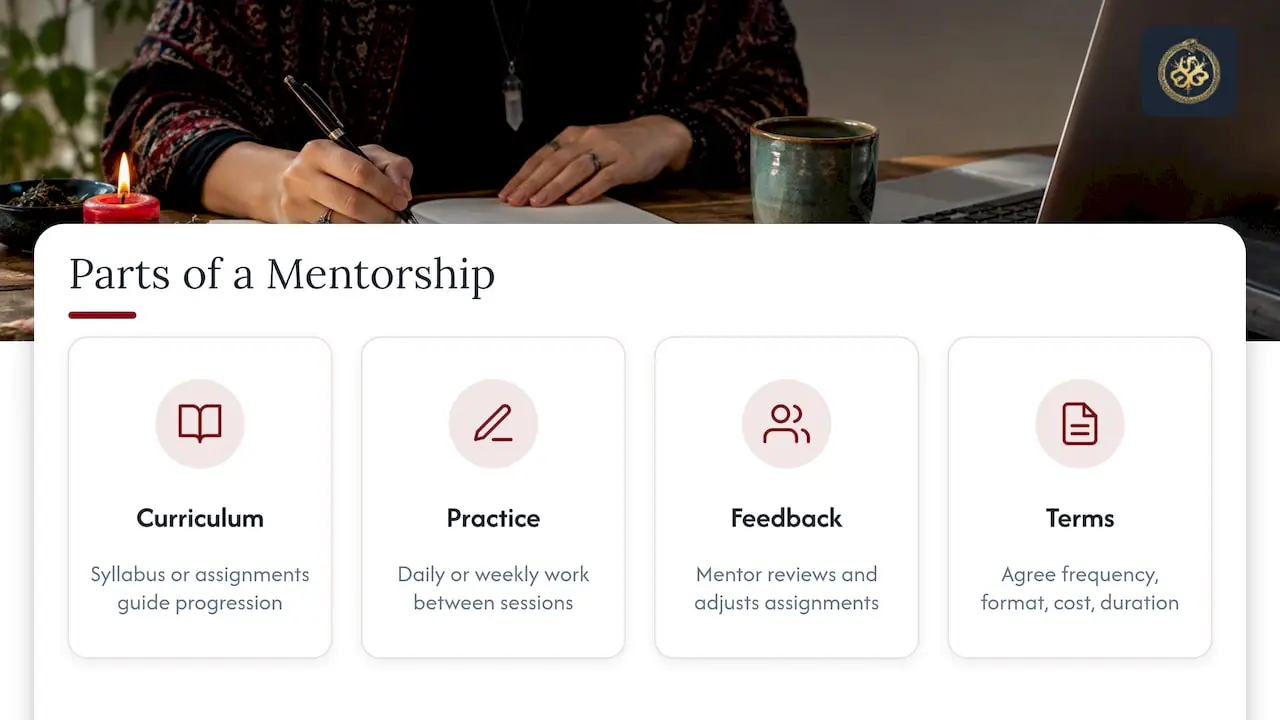
Feedback on experience. This is what a book cannot give you. When you report a strong dream series after a working, or a stretch of flat, dead results, someone with years behind them can tell you whether it is ordinary or worth adjusting.
A defined relationship. Frequency, format (video, voice, written correspondence, in person), cost and duration are agreed at the start. Programs vary widely here. Some are one-to-one for a few months, some are group lodges that run for years, and some are loose apprenticeships with no fixed end.
If you want to see how others in the field describe the one-to-one model for women seeking grounded guidance, this overview of spiritual mentorship benefits is a useful comparison point for what regular guidance can add to a practice.
What a left-hand path mentor teaches that a right-hand path teacher does not
The left-hand path centers on the self as the working center of the tradition: self-deification, individuation, sovereignty, and the cultivation of will. That changes what mentorship looks like in practice.
In many right-hand path or devotional settings, the teacher’s authority is partly structural. You advance through degrees, and the lineage vouches for you. On the left-hand path the goal is that you eventually stop needing the teacher. A mentor in this tradition is therefore closer to a coach for an independent spell caster than a guru for a follower. The most useful ones teach you how to build your own tests, keep your own records and judge your own results.
The subject matter also differs. Expect the curriculum to include:
- Shadow work: identifying the parts of yourself you have disowned and deciding deliberately what to do with them.
- Work with spirits and daemonic entities: how to research an entity’s history, build an approach from its sources, structure an invocation or pact, and evaluate what comes back.
- Sovereignty practice: boundaries, energy management, and the habits that stop self-sabotage from eating your results.
- Integration with real-world action: a working aimed at a promotion or a contract is paired with an application, a portfolio and a negotiation plan.
A reasonable program is also clear on what it will not give you. A credible spell caster states their limits, avoids instant promises, and assesses whether magical work is appropriate before agreeing to it. A mentor who tells you what is possible within your timeline is more useful than one who tells you what you want to hear.
How to choose an occult mentor
Selection is the highest-leverage decision in the whole process. A strong mentor compresses years of trial and error. A weak one costs money and, worse, teaches habits you later have to unlearn. Work through these criteria in order.
Start with the person, not the title
The Covenant of the Goddess, a long-standing US Wiccan and Pagan organization, gives plain advice on seeking a teacher: choose someone you respect as a person, who has reasonably good control over their own life, and consider whether you want to share their karma. Translate that for the left-hand path: look at how the mentor handles money, deadlines, conflict, their own health and their own relationships. Magick that does not show up in a person’s life is worth questioning. You are not looking for perfection. You are looking for evidence that the practice produces someone stable and effective.
Match the tradition to your goal
Write down what you want to be able to do in twelve months. Then match it to a lineage of method:
| Your goal | What to look for in a mentor |
|---|---|
| Work with a specific entity (Lucifer, Goetic spirits) | Documented personal practice with that current, willingness to discuss primary sources, and a method that you can reproduce |
| Luciferian philosophy and self-initiation | Reading depth, a history of structured self-work, and comfort with intellectual challenge |
| Practical results in money, law or relationships | Case-based teaching, record-keeping habits, and a strategy that pairs ritual with action |
| Hoodoo or traditional witchcraft roots | Lineage or documented apprenticeship in that tradition, and a clear account of where their methods come from |
| Divination (tarot, spirit guidance) | Regular readings with testable predictions and a method of review |
A mentor who claims mastery of everything is a mild warning in itself. Depth in a defined area beats breadth.
Ask for a small first step
Community advice on forums tends to say the same thing about approaching a teacher: do not open with a request to be taught everything. Pick one person you have a specific reason to approach and ask for one specific piece of guidance. How they respond to a small, well-formed question tells you how they will respond to a larger relationship. Do they answer precisely? Do they ask what you have already tried? Do they stay within what they know?
Check them across more than one source
Reputation is evidence, but it has to be gathered carefully. One Pagan community writer on the subject advises that you check multiple sources independently, across different parts of the community and, where possible, different platforms and in person. The same piece notes that informal community knowledge works as a safety tool: pay attention when experienced, well-connected peers go quiet or give a careful non-answer about a teacher.
Apply that as a method:
- Find three or four people who have studied with the mentor, or who have been in their community, and ask each separately what they learned.
- Look for people who left, and ask why.
- Notice what the mentor’s reputation rests on. Reputation built on self-promotion alone deserves scrutiny, especially when they are selling you something.
- Compare what the mentor says in public with what students say in private.
Worked example: choosing between two candidates
Imagine a 38-year-old physician, call her Dana, who wants to build a disciplined Luciferian practice and has about five hours a week. She short-lists two mentors.
Mentor A has a large social following, offers an “initiation” in the first session and quotes a single price for a year. Mentor B has a small online presence, asks Dana to send a one-page summary of her practice history, and proposes a six-week trial with a review before any longer commitment.
Dana asks both for three former students she can speak to. Mentor A offers testimonials on a sales page. Mentor B gives two names and says the third student left on bad terms, and that Dana is welcome to ask that person too. She contacts all three. The former students describe Mentor B as exacting, a bit dry, and consistently useful. The student who left says the pace was too slow for them. Dana can work with that. She takes the trial.
Nothing in that process required faith. It required a few emails and some patience.
Questions to ask before you begin
Write these down and ask them in the first conversation. The answers matter as much as the program’s content.
About scope and method
- What will I be able to do at the end of three months, six months, twelve months?
- How do you assess whether a student is ready for the next stage?
- What is the first assignment, and how long will it take?
- Which parts of your method come from lineage or tradition, and which are your own development?
About structure and cost
- What is the total cost, what does it cover, and is there any scenario in which it escalates?
- Is there a trial period, and what is the process to end the arrangement?
- How often do we meet, and how do you handle communication between sessions?
About boundaries
- How do you handle consent and boundaries with students, and who decides what I am asked to do?
- What happens to the things I tell you? Who else may hear them?
On consent, one teacher writing about leaving abusive groups sets out a standard worth holding any mentor to: consent is ongoing and can be withdrawn at any time, and students are told explicitly that they can leave. That same piece distinguishes between discomfort that comes with real growth and the feeling of being trapped. Ask the mentor how they would tell the difference with you.
On confidentiality, the norm among clergy in the United States is instructive. A New York State guidebook for faith leaders states that clergy are bound to maintain confidentiality, with the only justification for breaking it being the prevention of further harm, including suspected child abuse or evidence of harm about to be committed. You are not asking a mentor to be clergy, but you are entitled to know where their line sits before you disclose anything. A mentor with a clear answer is a mentor who has thought about it.
Warning signs in a mentor or a program
A short list of patterns that show up repeatedly in occult discussions of unreliable teachers. A guide to credible practice names several of them: urgency pressure, escalating charges, guaranteed success, and isolation tactics.
In practice they look like this:
- Urgency: “This offer closes tonight,” or “the window for your initiation is this week.” Real training is sequenced, not timed to a sales calendar.
- Escalating charges: a modest first fee followed by a series of additional “necessary” payments for protection, cleansing or advanced access.
- Guaranteed outcomes: any promise about a specific result by a specific date.
- Isolation: discouraging you from speaking to other witches, former students or anyone outside the program.
- Power over your private life: instructions about your relationships, your finances or your health that go beyond the scope you agreed.
The power imbalance matters most here. The same New York guidebook cites Rev. Dr. Marie Fortune’s position that no consensual sexual relationship can exist between clergy and congregants because of the power differential. The reasoning carries over to any relationship in which one person controls access to teaching, initiation and the student’s sense of progress. A mentor who pursues students romantically has abandoned the role.
Keeping your judgment while someone else guides you
Sovereignty is the whole premise of the path, so a program should leave you better at evaluating claims, not worse. Build these habits from the first week.
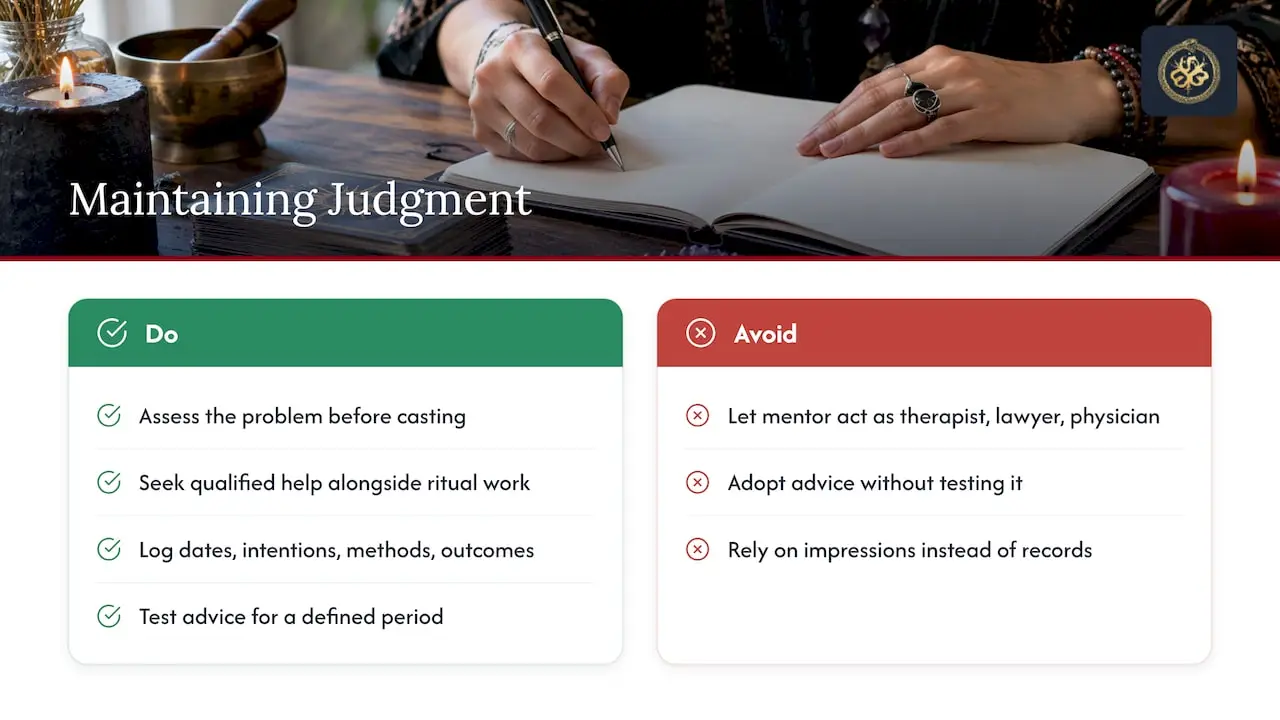
Sort the problem before you cast. When something goes wrong, assess whether the situation is spiritual, psychological, social or medical, and distinguish emotion, intuition, projection and panic. If the answer is legal, medical, financial or psychological, get that kind of help alongside any ritual work. A mentor worth keeping will say this to you before you ask.
Know when a mentor is outside their competence. The New York guidebook is specific about a related point: faith leaders who cannot serve a person’s best interest should refer them on, and only professionally trained counselors should provide counseling. If your mentor starts acting as your therapist, lawyer or physician, the relationship has drifted out of its lane.
Keep your own records. A practice log with date, intention, method, and what happened in the following two weeks is the single best tool for assessing both your mentor’s advice and your own results. After three months you will have data. Without it you will have impressions.
Test advice before adopting it. When a mentor recommends a change, run it for a defined period, record the effect and then decide. This is how you learn which of their methods are principle and which are habit.
How to get the most from the first ninety days
A structured start prevents most of the common failures. A workable shape:
- Weeks 1 to 2: Baseline. Share your practice history, your goals and your constraints (time, privacy, living situation). Agree on a daily minimum you will actually keep, even if it is ten minutes.
- Weeks 3 to 6: Foundations. Establish a banishing or cleansing routine, a meditation practice and a divination habit. Review the logs weekly.
- Weeks 7 to 10: First working. Choose one problem, not three. Design a single ritual with your mentor, define what success looks like in observable terms, and set the review date.
- Weeks 11 to 13: Review. Compare outcome against definition. Decide whether to continue, change direction or end the arrangement.
A case example: a small-business owner wants steadier revenue. In the first working she and her mentor agree on one measurable aim, three new retainer clients in sixty days. The ritual is paired with a rewritten outreach plan and five calls a week. At day sixty she has one retainer client, two proposals out, and a log showing her outreach dropped in the two weeks she skipped practice. That is a usable result: it shows what moved, what did not, and where her own consistency was the variable. The next working targets the gap.
Working on one problem at a time is not a limitation. It is how you tell what caused what.
Our perspective: mentorship as a path to sovereignty
We hold that spiritual sovereignty is the point of left-hand path training, and a mentor is useful exactly to the degree that they move you toward it. The best teaching we have seen, and the teaching we try to give, treats the student as a capable adult: it supplies method, sources and honest feedback, and then it steps back.
We also think the field has a credibility problem that mentorship can solve. A great deal of occult material is vague by design. Much of it avoids saying what a practice is supposed to do or how you would know. A mentor with real experience can be specific. They can tell you which part of an invocation carries the weight, what a week of flat results usually means, and when a result is coincidence.
Our own work blends ritual with real-world strategy because the two reinforce each other. A prosperity working paired with a pricing review outperforms either alone, and a protection ritual paired with documented boundaries holds better than a ritual by itself. We encourage students to bring a plan, a calendar and a log to every conversation.
Finally, we believe serious occultists, including physicians, executives, academics and founders, deserve discretion and professionalism from the people who teach them. Clear terms, clear scope and clear confidentiality are part of what makes the path livable for people with demanding lives.
Black Witch Coven
Where hands-on guidance fits
If you want a first reading of where your practice stands before committing to a longer program, we offer left-hand path tarot readings and spirit guidance at $65-$85 per session. For ongoing structure, our monthly ritual subscriptions start at $32 per month.
FAQ
How much does an occult mentorship program cost?
Prices vary widely with format. One-to-one work is typically priced per session or per month, while group programs charge a flat term fee. Instead of comparing headline numbers, ask for the total for the full term and what it covers, and treat any structure that adds charges after you start as a reason to reconsider.
Do I need a mentor to practice the left-hand path?
No. Many magicians work from primary sources and their own logs. A mentor shortens the learning curve and gives you feedback you cannot generate yourself, which is most valuable in the first one to two years or when you take on a new current of practice.
How do I know a mentor’s experience is real?
Speak to several former students separately, look at the mentor’s own life for evidence that the practice works, and ask for a method you can reproduce. Cross-check what you hear on different platforms and in person, since reputation built only on self-promotion tells you little.
Can I leave a program once I start?
Yes, and the terms should say so before you begin. Ask in the first conversation how ending the arrangement works, what happens to any prepaid fee, and whether you keep access to materials. A mentor who is comfortable with your leaving is usually one who expects the work to stand on its own.
Sources
- Seeking a Teacher, Covenant of the Goddess
- People are the System, The Pagan Fringe
- You Are Allowed to Leave, Lisa McSherry
- Domestic Violence and Faith Communities guidebook, State of New York
