
 New Years Eve Ritual 2026/2027 with Savannah
Blog, Pacts, Working With Demons
Demon Pact Cost: What You Pay, What It Covers
Nov
There is no standard price for a demon pact. The cost has two parts: what you owe the spirit under the terms of the agreement, and what you pay a witch if you hire someone to build, perform or maintain the working for you. The first is set by the pact itself: the offering, the timeline and the closure. The second is set by the market, and in the United States it runs from a few hundred dollars for a single ritual to several thousand for a months-long program. This article separates the two, shows what the historical record says the pact was supposed to cost, and gives you a method for pricing a pact you intend to make.
Table of Contents
- What a pact is, and why the cost question is two questions
- The historical price list
- What the spirit asks for in modern practice
- Why the written terms are where the money is saved or lost
- Three worked examples
- What a quoted fee covers when someone else does the work
- How to read a quote
- Perspective
- If you want the work done for you
- FAQ
- Sources
What a pact is, and why the cost question is two questions
A pact is a binding agreement between a magician and a spirit. In folklore and in the grimoire tradition it is made for treasure, love, power, youth, knowledge or worldly success, and the human side of the bargain is obedience, service, blood, sacrifice or, in the most dramatic versions, the soul. The trope is old enough that the Faustian bargain is now a standard cultural reference, with Faust trading his soul to Mephistopheles for knowledge and pleasure.
Modern practice is quieter and more precise. The independent occultist Lee W. Johnson describes a pact as an oath or contract involving an exchange, and notes that many modern daemonolators prefer an ongoing relationship with a spirit to a one-time deal. That distinction matters for cost. A one-time pact has a fixed price: you agree, you pay, you close. A relationship has a running cost: regular offerings, regular contact, periodic renewal.
So when someone asks what a demon pact costs, there are really two questions underneath:
- What does the spirit require of me, and for how long?
- What does it cost to have the pact written, the spirit contacted and the working carried out, if I am not doing it myself?
The rest of this article takes them in that order.
The historical price list
The demonologists of early modern Europe were obsessed with the terms of the pact, and their accounts are the closest thing to a published price list the tradition has. They are also hostile sources, written by people building a case against witches, so they describe what the pact was believed to cost rather than what any witch reported paying.
By the end of the sixteenth century, many educated Europeans believed that witches made an explicit, face-to-face pact with the Devil. The pact was imagined as a formal ceremony in which the Devil appeared, tempted the witch with material reward or sexual pleasure, and the witch agreed to reject the Christian faith, often symbolized by trampling the cross, and to be rebaptized in the Devil’s service.
The itemized versions are harsher. According to a University of South Florida honors thesis on demonology, Guazzo’s Compendium Maleficarum of 1608 has the Devil taking the witch’s faith and baptism, blood, children and a piece of clothing, with the witch expected to strangle or suffocate a child at regular intervals. In the Malleus Maleficarum, the same thesis notes, the devil offered worldly prosperity and long life in exchange for an oath. The thesis also makes the central point about these texts: in the minds of many demonologists and judges, the pact was what defined a witch, and the power to do harm was thought to come from renouncing God and paying homage to the Devil.
The idea has an older, more technical root. Dr. Victoria Burns Price traces the pact to medieval necromancy: if a magician could summon a demon, the reasoning went, the demon must want to be bound, and the only thing a demon could want from a human was a soul. The magick then became the product of an agreement. The pact, in other words, started life as a theory to explain why summoning worked, not as a ritual anyone performed for a fee.
The chronology is useful when you read older texts. Accounts of devil pacts emerged after Satan became important in Christian theology, and the same reference points to Johannes Nider’s Formicarius of 1435 as an early extended description and the 1486 Malleus Maleficarum as a major text tying Satan worship to witchcraft. The costs in those books are theological claims. Treat them as a record of what an inquisitor feared, not as a menu.
The grimoires are different, because they were written as working manuals. The Grand Grimoire contains instructions for summoning Lucifer or Lucifuge Rofocale in order to form a pact, and its Sanctum Regnum section gives a route to a standing pact that lets the operator command the spirit without the heavy apparatus of the first book, at greater risk. Here the cost is expressed in preparation, tools, discipline and exposure. That is the real historical price: effort and risk, not coin.
What the spirit asks for in modern practice
In contemporary practice, the pact is a document. Johnson’s account says it may be written as a letter that states the result you want and what you offer in return. Some witches seal it with blood, others use red ink or another sealing method. The tradition on this point is old and not unanimous: the older demonological literature distinguishes oral pacts from written ones, and notes that some demonologists accepted red ink or animal blood in place of the conjurer’s own.
Whatever the sealing method, a well-built modern pact states four things:
- The request. One outcome, stated in terms that can be recognized when it happens.
- The offering. What you give, and whether it is a single act or a recurring one.
- The timeline. When you expect the result, and when the spirit’s side is considered complete.
- The closure. How the agreement ends: burning the document, a final offering, or a renewal.
The cost of the pact is the sum of the offering and the discipline of keeping it. Offerings in the modern tradition tend to fall into a few categories, and it helps to price them honestly:
| Offering type | Typical form | Real-world cost |
|---|---|---|
| Material | Incense, candles, wine, food, a specific resin or herb | A few dollars to a few tens of dollars per working |
| Time and attention | A daily or weekly rite, a vigil on a fixed day | Hours per month, which is the largest cost for most people |
| Action in the world | A donation, a commitment, a habit changed, a task done for someone | Varies with the commitment you write down |
| Blood or body | A drop of blood, a hair, a fingernail | Negligible in money, high in seriousness |
| Service | Ongoing work or devotion over a defined period | The long tail: months or years |
The figures in the right-hand column are not a published standard. They are what the items cost at a store or what the hours are worth to you. No source sets a market rate for the offering itself, and that is the honest answer to the keyword: the spirit’s side of the cost is whatever you write into the pact, which is why the drafting matters more than almost anything else.
Why the written terms are where the money is saved or lost
A pact with vague terms is expensive, because open-ended commitments never close. Three drafting habits keep the price down.
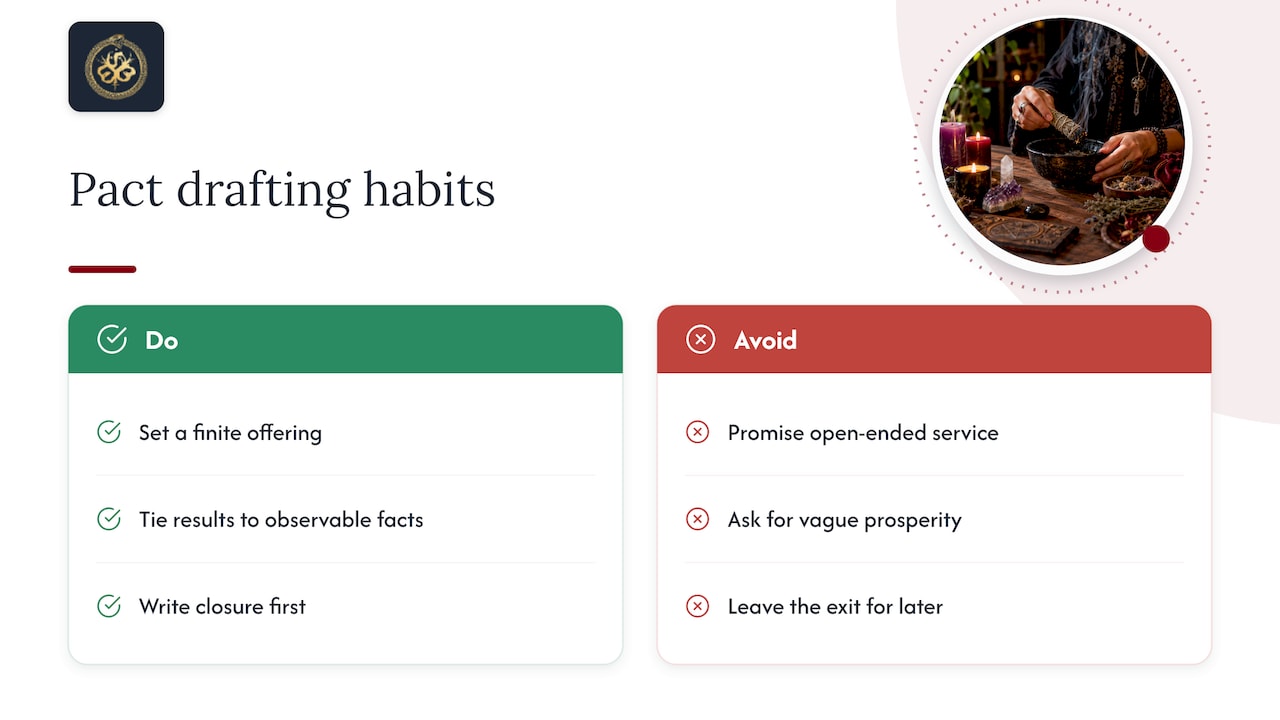
State a finite offering. “I will give a candle and a glass of wine each new moon for six months” is a cost you can calculate. “I will serve faithfully” is not. Experienced occultists tend to write in a number of cycles, because it gives the pact an endpoint and gives you a clean moment to evaluate.
Tie the result to something observable. If you ask for “prosperity,” you cannot tell whether the spirit has delivered, so you cannot tell whether you have paid your debt. If you ask for a specific contract, a specific payment or a specific verdict, you can close the pact on a fact.
Write the closure first. Decide how it ends before you decide how it begins. Most people draft the request and the offering and leave the exit for later. The exit is where recurring obligations hide.
Three worked examples
The following are illustrative scenarios, built to show how cost reasoning works. They are not case reports.
A consultant seeking a single contract
A freelance consultant wants one specific client to sign a retainer. She writes a pact that asks for that signature within ninety days. The offering is a weekly rite for twelve weeks, a small material cost each time, and a donation to a local food bank on the day the contract is signed. Her total money cost is under a hundred dollars and her time cost is roughly twelve hours. The pact closes on the signature or on day ninety, whichever comes first. Because the outcome is binary and the term is fixed, she can see exactly what she spent.
She also does the practical work: she sends the proposal, follows up twice, and reduces her rate for a first quarter. The pact and the strategy share the same deadline, which is the point. A result that arrives through ordinary channels is still a result, and a pact that ignores ordinary channels asks the spirit to do work the magician could have done.
A litigant working toward a hearing
A small-business owner facing a contract dispute drafts a pact tied to the hearing date. The request is a favorable ruling or a settlement he can accept. The offering is a series of rites in the weeks before the hearing, plus a commitment to prepare his documents on a set schedule. Here the cost is mostly discipline: the offering forces him to organize his evidence by a fixed date. That is a benefit that does not depend on any metaphysical claim, and many magicians with a professional background value pact structures for exactly this reason.
A witch building a standing relationship
A long-time magician wants an ongoing arrangement with one spirit rather than a single result. His pact has no specific outcome. It sets a monthly rite, a yearly renewal, and a review each solstice. Money cost: low and steady. Time cost: high and indefinite. This is the model Johnson describes when he says modern daemonolators often prefer a relationship to a single deal, and it is the one whose true price is easiest to underestimate, since the bill arrives in small amounts for years.
What a quoted fee covers when someone else does the work
Most people who ask about cost are not asking about candles. They are asking what a witch charges to write the pact, make the contact and carry the rite. There is no regulated rate and no trade body that publishes one, so a quote is only as meaningful as its breakdown.
A fee for ritual work can legitimately cover:
- A consultation to define the request and its limits
- Drafting and sealing of the pact document
- The working itself: the preparation, the invocation, the offering made on your behalf
- Follow-up, such as a report on how the rite went and a closure rite
- Materials consumed in the working
What a fee cannot cover is a guarantee that a particular real-world event will occur. The customer’s and the spirit’s sides of a pact are distinct, and a magician can only commit to their own side: the work performed, the terms drafted, the rites kept. Reading a quote with that division in mind prevents most disappointment.
To put the market in perspective, the closest published comparisons come from adjacent fields. A 2021 peer-reviewed study of Catholic exorcism in the United States notes that money questions, including what exorcists charge, are part of the contemporary discourse. A 2014 Daily Beast piece reported that one American provider advertised a one-hour Skype exorcism for a $295 suggested donation. That is an exorcism price, not a pact price, but it shows the scale at which single-session spiritual services have been marketed in the United States. And the demand is real: polling is fairly consistent that roughly half of Americans believe in demons and in their ability to possess people, which is part of why a market for this kind of work exists at all.
How to read a quote
Because there is no standard rate, the useful skill is reading a quote for structure. Consumer protection bodies have documented the patterns that separate a defined service from an open-ended charge, and the same patterns apply to ritual work.
The Federal Trade Commission’s general guidance on fraud lists pressure to act immediately, claims of a problem or prize, and demands for cryptocurrency, wire transfers, payment apps or gift cards as common indicators. Its advice is to resist pressure, contact a business independently, and talk the situation over with someone you trust before paying. AARP’s consumer guidance on psychic services adds recurring new fees, guaranteed outcomes outside the provider’s control, threats of consequences unless you pay, and secrecy to the list, and describes an escalating pattern in which a reading is followed by claims of negativity and a series of paid remedies.
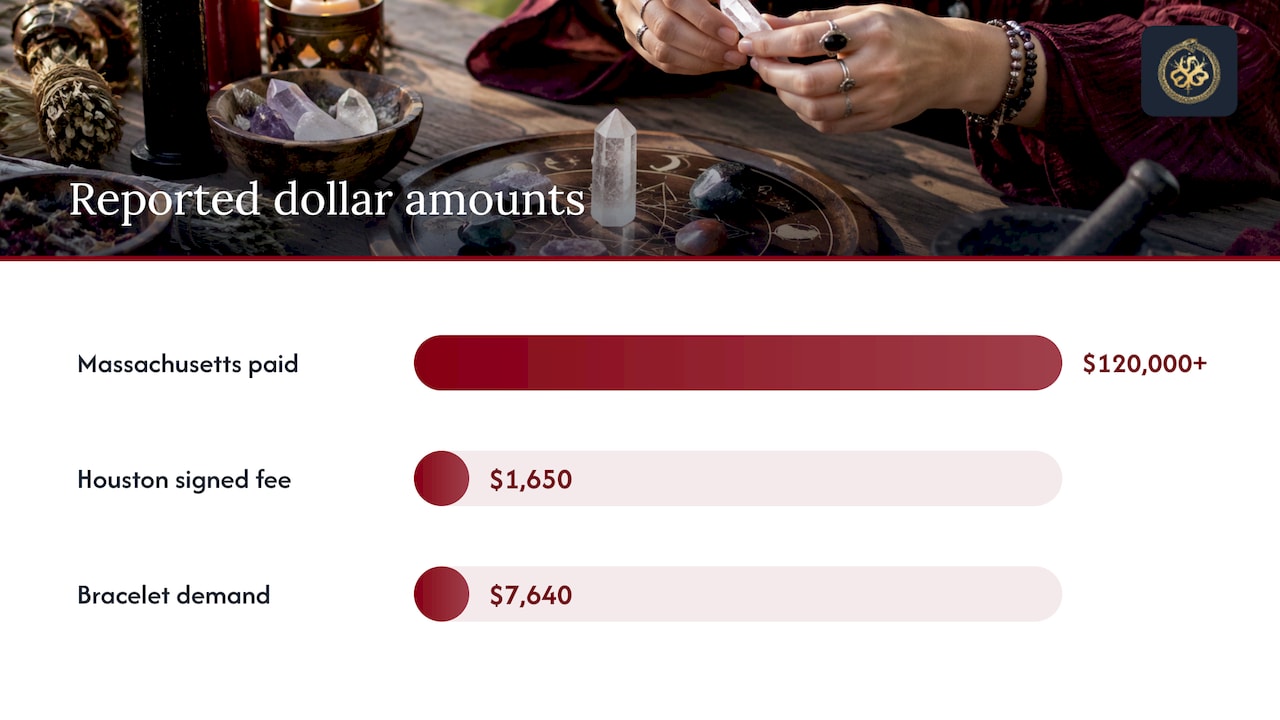
The documented cases show what that pattern looks like in dollars. A man in Massachusetts paid more than $120,000 after being told an evil spell blocked reconciliation with his wife, and the provider was arrested on grand-larceny charges. In Houston, a 2008 report described a customer who signed for $1,650 and was expected to finance a further $7,640 bracelet, with a romantic result promised within nine days. A regulator’s older action is also instructive: the FTC’s 2002 injunction against a psychic-line promoter required disclosure of pay-per-call costs and an end to describing the service as free.
Turn those into questions you can put to any provider before you pay:
- What exactly is delivered for this price? A rite, a document, a report: named items.
- Is the price final? A fixed fee for a defined working is a different thing from a fee that grows each time a new obstacle appears.
- What happens at the end? A closure rite or a stated end date.
- What is promised? Work performed, or a result in the world with a date attached.
- How do I pay? A conventional, traceable method, with no pressure on timing.
A provider who answers these plainly, in writing, is quoting a service. One who answers with urgency or mystery is quoting a hook.
Perspective
We treat the cost of a pact as a question of structure before it is a question of money. In our work, the price that matters is the one written into the agreement: what is offered, for how long, and how the pact ends. A pact with a finite offering and a clear closure costs what it says it costs. A pact with loose terms keeps billing you in time and attention long after the ritual is over.
We also think the practical side deserves equal weight. Left-Hand Path practice is built on sovereignty, which means you remain the author of your own life and the agent of your own results. The strongest pacts we see are paired with strategy: the proposal is sent, the evidence is organized, the budget is rewritten. The working and the effort share a deadline, and each makes the other more effective.
That is why we draft with a result you can observe, an offering you can calculate and an exit you decide in advance. It is a more disciplined way to work with Lucifer, Andras, Clauneck, Astaroth and the other spirits we work with, and it respects both parties to the agreement.
Black Witch Coven
If you want the work done for you
We offer pact-based and ritual work with a published price for each service. Our daemonic workings, such as Daemonic Prosperity Magick at $450 or the Ritual to Lucifer: Light of Liberation, Wisdom, and Sovereignty at $190, are one-time services. For ongoing work, our monthly subscriptions start at $32 per month, and our VIP programs run for three months for those who want a sustained operation. Each is a defined service with its price listed.
FAQ
Is there a standard price for a demon pact?
No. No trade body or published schedule sets one. The cost splits into the offering written into the pact, which you control, and any fee paid to a witch for drafting and performing the working, which varies by provider and scope.
What does a pact with a demon do, according to the tradition?
It binds a spirit to provide a stated service, such as wealth, love, knowledge, power or protection, in exchange for the magician’s offering. Folklore describes the offering as obedience, service, blood, sacrifice or the soul, while modern witches generally write a limited, specific exchange.
Do you have to sign a pact in blood?
Not necessarily. Older demonological writing treats blood as the strongest seal, but it also records that some demonologists accepted red ink or animal blood as substitutes. Modern occultists differ, and many seal the document by burning it after writing the terms.
Does a pact have to be permanent?
No. A pact can be a single exchange with a closing date or an ongoing relationship with scheduled renewals. Specifying the closure in the original document is what keeps the commitment from becoming open-ended.
Sources
- Deal with the Devil (Wikipedia)
- Making Daemonic Pacts, Lee W. Johnson
- The Witch Hunt in Early Modern Europe (PDF)
- Making a Witch: The Triumph of Demonology Over Popular Belief, University of South Florida
- “Hell hath no limits”: The Devil’s Pact in Medieval Magic
- Pacts with the Devil, Encyclopedia.com
- The Grand Grimoire (Wikipedia)
- Modern Practice, Archaic Ritual: Catholic Exorcism in the United States
- My $295 Skype Exorcism, The Daily Beast
- The Demon Slayers, Harper’s Magazine
- How To Avoid a Scam, FTC Consumer Advice
- What You Should Know About Psychic Reading Scams, AARP
- Jilted husband loses $120,000 trying to lift curse, Cape Cod Times
- Amazing: “Love Spell” Psychic Apparently A Fraud, Houston Press
- FTC Obtains Stipulated Preliminary Injunction Against Promoters of Miss Cleo
