
Blog, Demons, Working With Demons
Gaap Demon: History, Seal and How to Work With Him

Nov
Gaap is the thirty-third spirit of the Ars Goetia, a President and Prince who teaches, carries, and turns the heart toward love or away from it. This article gives you the textual record first, then a complete working: materials, timing, seal, offerings, the petition in full, the steps, the signs of presence and the closing. His short entry, with seal and correspondences, sits on the Gaap page of our Demon Directory.
Gaap in the primary texts
The name travels under several spellings. Gaap is the form in the Lesser Key of Solomon, while the same spirit appears as Tap, Goap, Coap and Taob in other sources, including Johann Weyer’s Pseudomonarchia Daemonum and the Munich Manual of Demonic Magic. That spread of spellings matters to you for a practical reason: when you read an old passage and the name looks unfamiliar, you are often still reading about him.
The Ars Goetia
In the Ars Goetia he is numbered 33rd of the seventy-two. The text calls him a Great President and a Prince, and says he rules sixty-six legions of spirits. It says he appears when the Sun is in the southern signs, in a human shape, and that he is preceded by four mighty kings who act as guides, which makes his arrival a procession rather than a single presence. The text lists his offices plainly:
- He teaches philosophy and the liberal sciences.
- He causes love or hatred.
- He makes people insensible or ignorant, which later writers read as the clouding of a person’s perception.
- He delivers familiar spirits from other magicians and answers truly about things past, present and to come.
- He carries a person swiftly from one nation to another, which commentators have read as both literal transport and the movement of a person’s circumstances.
Notice that the offices fall into three families: knowledge, the heart, and movement. Most of what you can do with him sits in one of those three.
Weyer and the Pseudomonarchia
Weyer, writing in the sixteenth century, gives the spirit as Tap or Goap and treats him as a Prince and President with the same cluster of knowledge and love offices. He presents the spirit in the setting of the Pseudomonarchia’s catalog, which is the older roster from which the Goetia’s order descends. If you work from Weyer’s version you will meet the same character, only with the spelling Goap, and you will see how little the core offices shifted between catalogs.
The Grimorium Verum, the Testament of Solomon and the Dictionnaire Infernal
He is not a major figure in the Grimorium Verum or the Testament of Solomon. The nineteenth-century Dictionnaire Infernal of Collin de Plancy carries him as a prince of the infernal order, and it is the version that fed much of the modern popular image of him as a teacher and a traveler. The Goetia and Weyer remain the texts that give you working detail.
What Gaap is like to work with
Gaap is a spirit of instruction and relocation. Those who work with him often describe a patient, precise presence that wants you to frame a question exactly and then act on the answer. We treat him as a real, intelligent being with his own preferences. You are asking a teacher and a guide for help, and you keep your own sovereignty in the exchange.
In practice his three families of office translate into these uses:
- Study and divination. You are learning a difficult subject, a discipline, a language, or a craft, or you want a clear answer about a situation you cannot read.
- Relationships and the heart. You want warmth to rise or to fall between you and another person, or you want clarity about whether a bond is worth carrying.
- Movement. You need a change of place, work, or position, a relocation, or a path out of stagnation.
The working below is written for the first family, study and clear sight, because it is the one in which the spirit’s own character is most direct. We note adaptations for the other two afterward.
Typical uses of a Gaap working
These are typical situations, not client cases.
The stalled student. A graduate student in comparative religion keeps stalling on a dense reading list. She works with Gaap for one lunar cycle, with a short daily session of study straight after the invocation. The working sets the intention and opens the channel. The reading is where the teaching lands.
The outgrown post. A surgeon feels trapped in a hospital she has outgrown. She asks him for movement, and alongside the ritual she updates her résumé and writes to three people in her field. His office of carrying people between places works through the openings you make.
The undecided heart. Someone deciding whether to stay in a long relationship asks Gaap for clarity about the bond and records every dream and synchronicity in a notebook. The notebook turns what comes through into something she can weigh.
In each, the magick and the ordinary effort run together.
The working: invoking Gaap for knowledge and clear sight
Materials
- A black or deep violet candle, one for the main invocation.
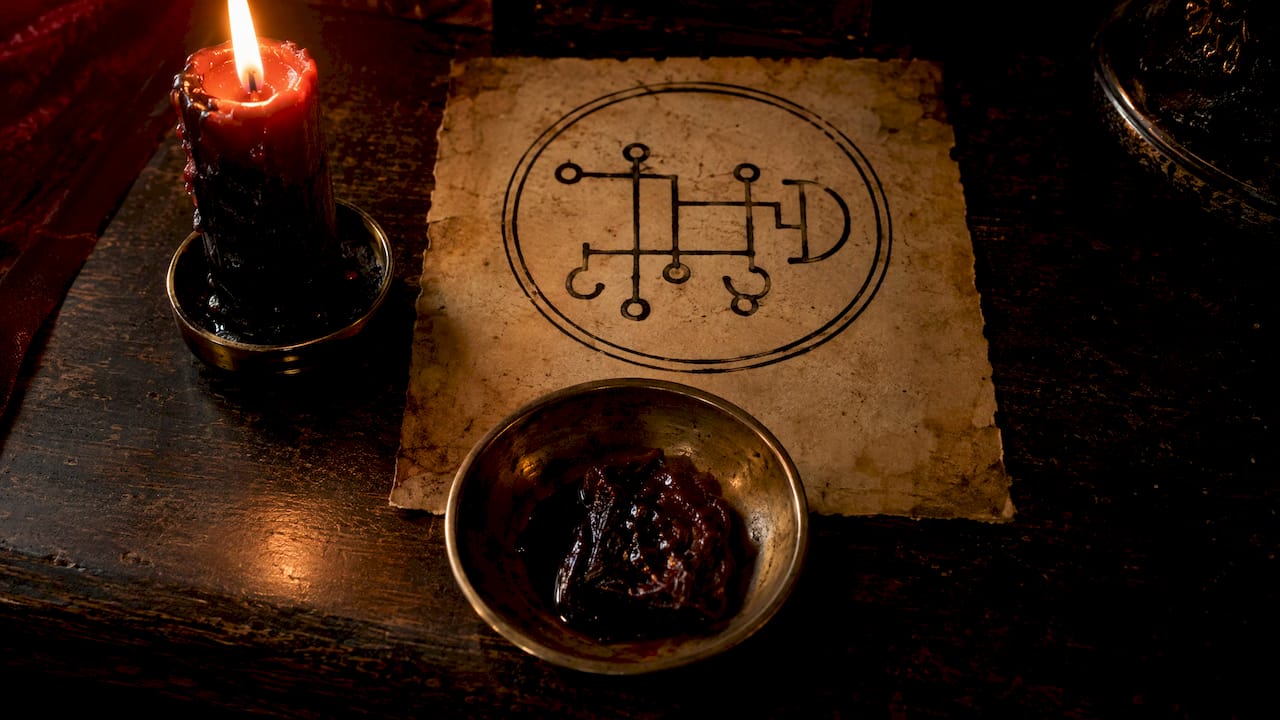
- A sheet of clean paper or parchment and black ink, to draw his seal from the Ars Goetia. Copy it by hand; the act of drawing is part of the working.
- A small dish for offerings.
- Offerings: dark red wine or whiskey, a few pieces of frankincense or myrrh resin on a charcoal disc in a heatproof burner, and a small written gift of your own, such as a page of the work you intend to finish.
- A notebook and pen for recording the session.
- Water to drink afterward and a small bell, if you use one to mark the opening and the close.
Timing
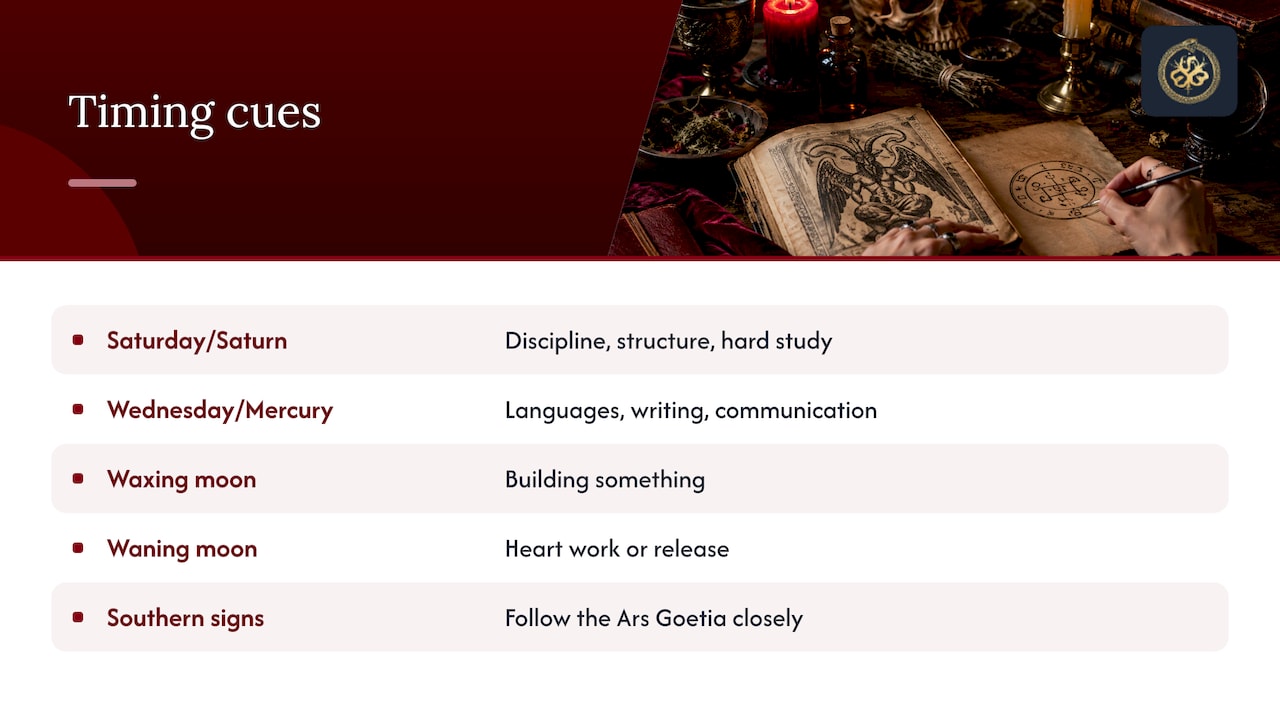
We set work with Gaap on a Saturday, in the hour of Saturn, because the day favors discipline, structure and hard study. Mercury’s hour on a Wednesday suits work focused on languages, writing and communication. Begin during the waxing moon, from the first sliver toward the full, when you are building something. For work on the heart or on a release, a waning moon fits better. The Ars Goetia ties his appearance to the Sun in the southern signs, so if you want to follow the text closely, schedule your working for the part of the year when the Sun is in the southern signs of the zodiac, in the autumn and winter months.
Preparing the space
Clean the room and put your phone in another room. Lay the seal in the center of your table with the candle to its north side and the offering dish before it. Wash your hands and face. Sit for five minutes in silence and let your breathing slow. Tell yourself what you are asking for, in one sentence, before you begin to speak to him.
The enn and the invocation
In demonolatry the enn is the spirit’s own call, a phrase in the spirit’s language that you speak to open contact. Use the enn that is recorded in his directory entry and speak it three times, slowly, with your eyes on the seal. Then speak the petition below in your own breath and rhythm. Learn it well enough to say it without reading. If you prefer the full Solomonic form with circle and triangle, our conjuring method from the Goetia sets out the classical procedure.
Gaap, Prince and President, Master of the sixty-six legions, I call you by your name and by your seal. I am [your name], and I stand in my own authority. I ask for your instruction. Open my mind to the work in front of me, give me clear sight in [name the subject], and show me the road I am meant to walk. I offer you this wine, this smoke and this work of my hands. Come in your own manner, speak in your own way, and let me hear you. I will answer your teaching with discipline and with action.
Replace the bracketed pieces with your actual subject. Keep the request to a single matter; one problem at a time is cleaner than a list.
Step by step
- Light the candle and strike the bell once, if you use one.
- Light the resin on the charcoal and let the smoke rise over the seal.
- Speak the enn three times.
- Speak the petition aloud.
- Pour a small amount of the wine into the dish and place your written gift beside it.
- Sit quietly for fifteen to thirty minutes with the seal in view, your gaze soft. Do not hurry the silence.
- Write down every image, word, sensation, and thought that comes, without ranking them.
- Ask your question once more, plainly, and wait again.
- Thank him by name.
Signs of presence
People who work with him describe a change in the room’s pressure, a sudden steadiness in the mind, a sense of being observed by someone attentive and unhurried, or a clear, structured thought arriving fully formed. Some feel warmth in the hands or a cooling at the back of the neck, and some receive vivid dreams in the following nights. Dreams of travel, teachers, libraries, or unfamiliar roads are common reports tied to his offices. Record what comes and compare notes over several sessions, because the pattern across a week tells you more than any single impression.
Signs the working is taking hold
- Difficult material starts to make sense and your focus lengthens.
- Books, people, or opportunities relevant to your question appear without much searching.
- Your dreams become organized around the question.
- Doors in your work or location begin to open when you act on a lead.
Spirits keep their own counsel, and the pace belongs to the relationship.
Closing the working
To close, speak to Gaap directly: thank him for his attention, tell him the working is complete for this session, and release him to return to his own place with respect. Say it in your own words or use this:
Gaap, I thank you for your presence and your teaching. This working is complete. Go in peace to your own realm, and be welcome when I call again.
Strike the bell once more, snuff the candle with a snuffer or wet fingertips rather than blowing it out, and pour the remaining wine outdoors on the ground. Drink a glass of water and eat something. Keep the seal somewhere private, since you will use it again.
Adapting the working to his other offices
For the heart. Change the petition to ask for clarity about, or a shift in the feeling between, you and one named person. Work during a waning moon for release and a waxing moon for drawing close. Add a personal item to the offering dish, yours or theirs, and keep your language fixed on the one person and the feeling you want to move.
For movement. Ask for a path out of a specific position, place, or situation. Pair the working with concrete steps within the week: applications, conversations, a visit to the place you want to go. Place a small map or a printed address beneath the seal to make the direction plain.
For divination. Use the same opening, then lay out a tarot spread or cast whatever method you favor while the candle burns, and ask him to speak through it. Write the reading down before you interpret it.
Building a lasting relationship with the spirit
A single working opens a door; a rhythm keeps it open. Many who work with Gaap return on the same weekday once a month, make a small offering each time, and keep one notebook devoted to him. After three or four sessions you will have enough of a record to see his manner, which may differ from the textual description. Read the Ars Goetia entry and the Weyer entry side by side again after your third session; the texts read differently once you have met the spirit.
Our perspective
We treat the Goetic spirits as real, intelligent beings with their own temperaments, and Gaap is a good example of why. His old description gives him three distinct domains, and in our experience people tend to come to him with one of them in mind and discover the others.
We pair ritual with ordinary effort. A working with Gaap for study is strongest when the study gets done. A working for movement is strongest when the applications go out.
The texts are the foundation. We read the Ars Goetia, Weyer and the Dictionnaire Infernal as the record of a long relationship between humans and these spirits, and we build our work from that record and from direct contact.
Black Witch Coven
If you want guidance on your own working
If you want a second view on which spirit suits your situation, book a Left-Hand Path tarot reading and spirit guidance session, or browse our other Left-Hand Path readings.
Frequently asked questions
Who is Gaap in the Ars Goetia?
Gaap is the thirty-third spirit, a Great President and Prince who commands sixty-six legions. He teaches philosophy and the liberal sciences, stirs love or hatred, answers about past, present and future, and carries people between places. His other spellings include Tap and Goap.
When is the best time to work with Gaap?
We use Saturday in the hour of Saturn, beginning in the waxing moon, for study and clarity. The Ars Goetia ties his appearance to the Sun in the southern signs, so some prefer the autumn and winter months. Your own notes over several sessions will refine the timing.
What offerings does Gaap accept?
In our work we give dark red wine or whiskey, frankincense or myrrh resin, and a written piece of the work we are asking help with.
Can I work with Gaap for love?
The Ars Goetia lists the causing of love and hatred among his offices. A working for the heart is best framed around clarity or a shift in feeling between you and one named person, paired with your own actions in the relationship.
