
Blog, Demons, Working With Demons
Haagenti Demon: History, Seal and How to Work With Him
Nov
Haagenti is the forty-eighth spirit of the Ars Goetia, a President who governs 33 legions, and the text gives him three offices: he makes a person wise, he transmutes metals into gold, and he turns wine into water and water into wine. He first appears as a great bull with gryphon’s wings and takes human shape when commanded. Below you will find his textual history from Weyer forward, a close reading of his offices, and a complete working with materials, timing, petition, signs of presence and closing. Haagenti has no page of his own yet, but the rest of the 72 are in our Demon Directory.
Where Haagenti Comes From: Weyer, Scot and the Goetia
The oldest printed form of Haagenti’s entry is not in the Lesser Key of Solomon. It is in Johann Weyer’s Pseudomonarchia Daemonum, which Weyer added as an appendix to the 1577 edition of De praestigiis daemonum. Weyer kept expanding the work through later editions until 1583, and the manuscript he drew on had already passed through other hands before it reached him. The list we inherit was edited before it ever reached print.
In Weyer, Haagenti is entry 67, Haagenti magnus Praeses. The Latin describes a bull with gryphon’s wings who, on taking human form, makes a man wise, changes all metals into gold, and exchanges wine and water. He commands as many legions as Zagan, a pairing that matters later in this article.
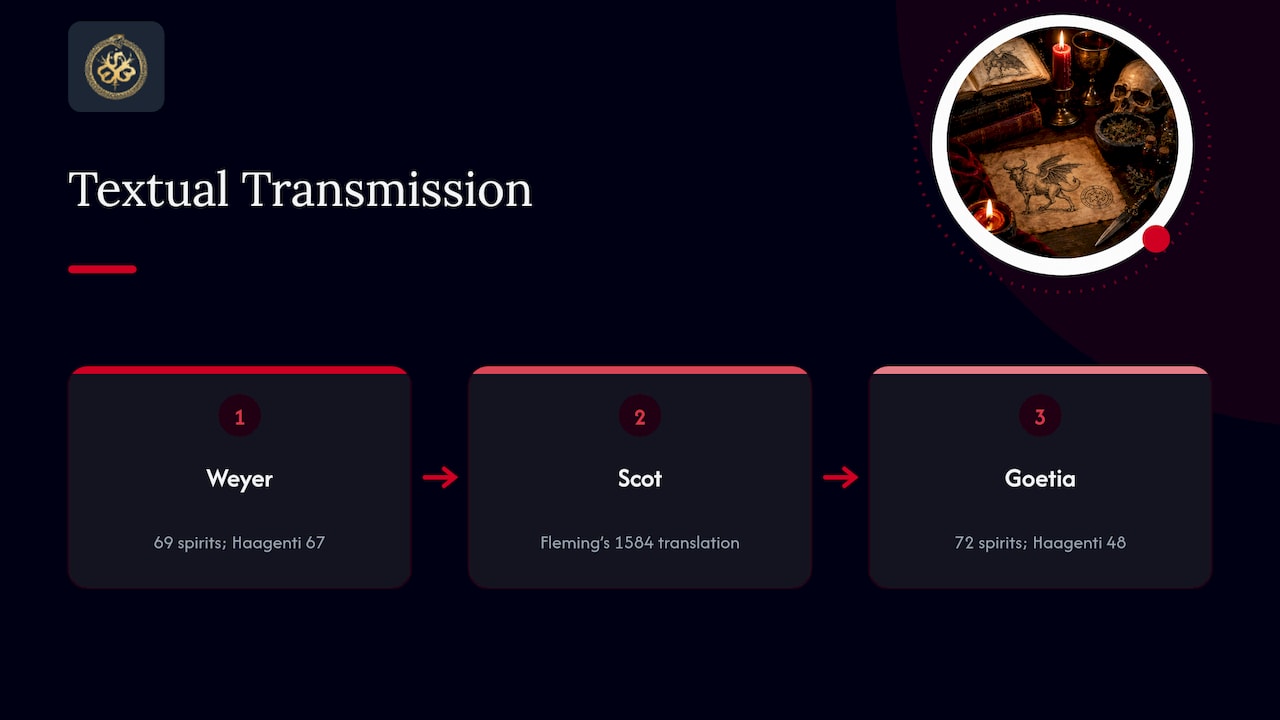
The English line of transmission runs through Reginald Scot. The Goetia catalogue is built on a variant of the Offices of Spirits, reached through the 1584 English translation printed in Scot’s Discoverie of Witchcraft, which itself rests on Weyer. The Goetia then grew the roster to 72 spirits, where Weyer lists 69. That growth is why the same spirit carries two numbers: 67 in Weyer’s catalogue and 48 in the Goetia order.
Variant spellings follow from this chain of translation. Haagenti appears as Haage, Hage and Hagenti in different editions, and the manuscripts of the Lesser Key of Solomon themselves shift spellings, order and even which spirits are included. If you meet a different spelling in an older book, you are almost certainly reading the same President.
Rank, Legions and the Mercury Seal
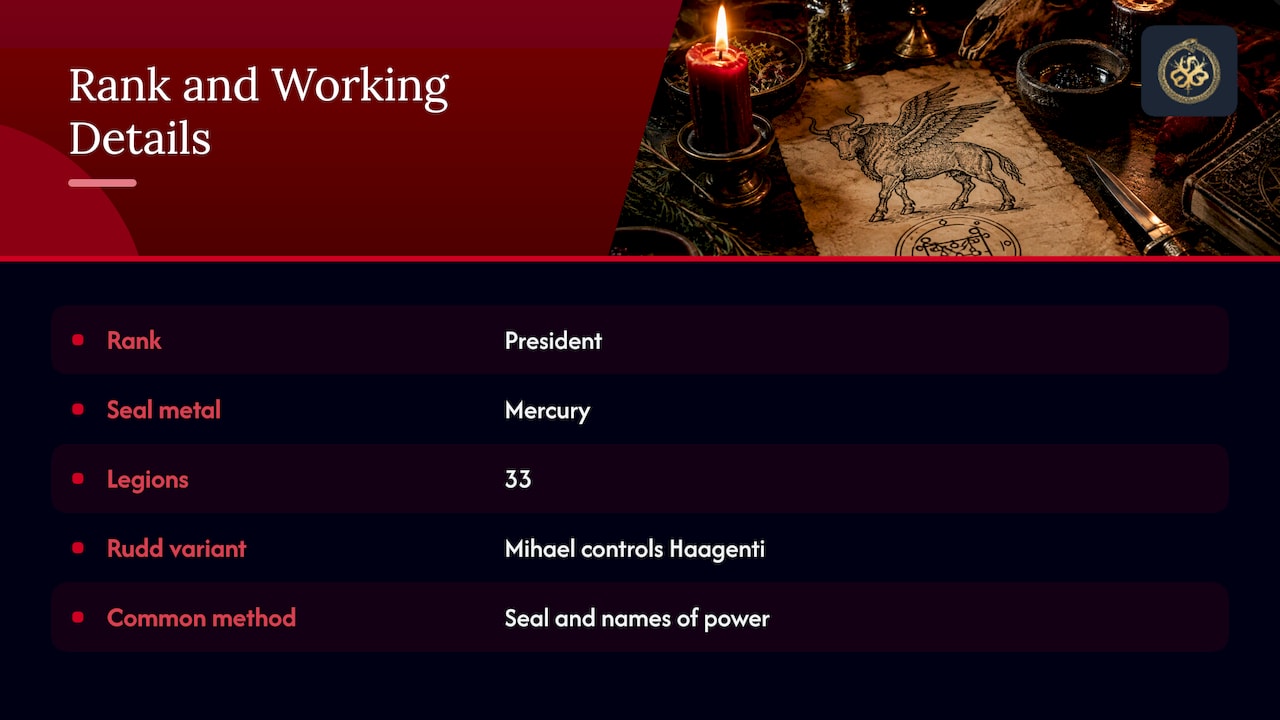
The Goetia places Haagenti among the Presidents. The Goetia’s classified list of the 72 chief spirits states that the seals of the Presidents are made in Mercury. This is the single most useful fact for a working magician, because it sets the metal, the planetary day and the hour for everything that follows.
The entry itself gives him 33 legions. The number recurs through the Goetia, but for Haagenti it sits against an office of transformation, and magicians who work with him often read it as a count of the channels of conversion he governs, material and intellectual among them. That reading comes from practice, not from the text.
One variant detail is useful if you work with the older English tradition. In the Goetia of Dr. Rudd, Haagenti is controlled in the name of the angel Mihael. In the Goetia as most magicians know it, the spirit is simply called and commanded by the seal and the names of power.
The Three Offices Read Closely
The offices are brief, and each rewards a slow reading.
He makes men wise. Weyer’s English says he makes a man wise in every thing. Later Goetia wording says he instructs a person in divers things. This is the office most often overlooked, because the gold draws the eye. Wisdom here means the conversion of scattered knowledge into usable judgment, which is why his presence so often shows up as a sudden ordering of what you already half know.
He transmutes all metals into gold. This is the alchemical office. The Goetia says all metals, so the office covers refinement in general as well as coin. A magician working for finances will reasonably ask him for the conversion of an existing resource into a more valuable one: a skill into a contract, a stalled venture into an income line.
He changes wine into water and water into wine. The office runs both ways. Haagenti can enrich, and he can also dilute, strip back and return a thing to a plainer state. Reading the office this way explains why some magicians consult him when something has become too intense, as well as when something needs enriching.
Haagenti and Zagan as a Pair
Weyer’s statement that Haagenti commands as many legions as Zagan binds the two together. Practitioners who work with both describe a difference of method: Haagenti clarifies, while Zagan, a Goetic King, overturns. The texts do not say this, but it gives you a practical rule: when the task is to refine what exists, you go to Haagenti. When the structure itself must be broken and remade, you look toward Zagan.
The same logic of transformation shows up in tarot, where the Devil card, the card of bondage and appetite, is often paired in modern work with alchemical ideas of dissolving and recombining. A reading that lands on that card before a Haagenti working is a common prompt for deciding what, exactly, you want converted.
Modern Approaches: Who Haagenti Is to Those Who Work With Him
Here we write as believers: Haagenti is a real, intelligent spirit, and the Goetia is a record of how earlier magicians met him. Modern accounts of contact vary in tone. Magicians describe him as courteous and quick, with an affinity for information, records and the movement of money through systems. Some find him charming, even funny. Your own contact will teach you more than any of these reports.
A strong current in modern goetic work treats it as relational, learned directly from the spirits as well as from grimoire procedure. That suits Haagenti. His offices are conversions, and a conversion has to be lived through as well as recited.
Preparing a Working With Haagenti
The following is a single-purpose working: one request, one spirit. Keeping to one problem at a time makes the signs readable afterward.
Decide What Is Being Converted
Haagenti’s offices are verbs: make wise, transmute, exchange. Write your intent as a conversion of something you already have. “I want money” gives him nothing to work on. “I want the consulting skills I already hold converted into a steady client” does. “I want clarity on the decision in front of me” calls his first office.
Materials Needed
- A copy of his seal, drawn by hand on clean paper or, better, engraved or scratched onto a plate of mercury-associated metal. The Goetia assigns Presidents’ seals to Mercury, and brass or quicksilver-toned metals are the usual choices of those who make physical seals.
- One yellow or gold candle for the spirit and one black candle for your own intent, in holders.
- A small glass of red or white wine and a small glass of water, set side by side. These mirror the third office.
- A gold-colored coin, or a small piece of gold-toned metal.
- A small piece of bread or a spoonful of honey as an offering.
- Your petition, written out in full on paper.
- A notebook for recording impressions.
- Frankincense or storax resin on charcoal, or a clean incense of your choice.
Timing
Planetary day: Wednesday, the day of Mercury, which fits the Mercury seal. Planetary hour: the first hour of Mercury after sunrise, or the hour of Mercury at night, depending on whether you want a clear, daytime working or a quiet, inward one. Moon phase: waxing, from the first crescent to the full, for gaining, refining and increasing. A waning moon suits the second direction of his third office, where the aim is to dilute or reduce an excess.
Calculate the Mercury hour from your own local sunrise and sunset, since planetary hours stretch and shrink through the year.
The Working: Step by Step
-
Prepare the space. Clear the table. Set the seal in the center with the yellow candle to its right and the black candle to its left. Place the wine and water in front of the seal, the coin above it, and the bread or honey in a small dish at the base.
-
Light the incense, then the candles. Light the black candle first for your own will, then the yellow candle for him.
-
Settle and state who you are. Say your name aloud and what you are bringing. Spend a few minutes in silence, with your attention on the seal.
-
Speak his name. Say “Haagenti” slowly, three times. Some magicians vocalize an enn, a spoken call tied to a spirit’s name. If you have received one in your own work with him, use it here. If not, the plain-speech invocation below stands on its own.
-
Make the invocation. Read the following aloud:
“Haagenti, Great President, bull of the gryphon’s wings, keeper of thirty-three legions, I call you to this table. I come with respect and with a clear purpose. You who make a man wise, who turn base metal to gold, who change water into wine and wine into water, hear me. Be present. Be welcome. Take the offering I have set for you.”
-
Give the offering. Pour a little of the wine into the water glass, then a little water into the wine glass, saying: “As you exchange, so exchange for me.” Place the coin on the seal.
-
Speak the petition. Read the petition you wrote, using this frame and filling the blank with your specific conversion:
“Haagenti, I ask that you transmute [name the skill, resource or situation] into [name the outcome], by your office and in your way. Give me the wisdom to see the path and to act on it. I will do my part in the world. I thank you.”
-
Listen. Sit for ten to fifteen minutes in quiet. Write down anything you perceive: images, phrases, a sense of weight or lightness, a sudden idea.
-
Seal the petition. Fold the paper three times toward you and place it under the yellow candle’s holder, on top of the seal.
Signs of Presence and Signs the Working Is Moving
During the working, magicians who call Haagenti report a change in the air of the room, a feeling of attention arriving, a drift of ideas that connect, or the image of a bull or of a wing. Flames may lean without a draft. None of these is required, and the absence of a strong sensation says nothing about whether he heard you.
After the working, the signs follow his offices:
- Wisdom: a problem you circled for weeks suddenly reorganizes. You see the order of steps. A mentor, a book or a stranger supplies the missing piece.
- Transmutation: a resource you were undervaluing becomes visible as an asset. An offer, referral or opening shows up in the field you named.
- Exchange: something that felt overwhelming becomes manageable, or something flat becomes worth keeping.
Keep the notebook going for a full lunar cycle. Magick works through ordinary events, so judge by the pattern across weeks and not by a single day.
Closing the Working
- Thank him by name: “Haagenti, thank you for your attention and your counsel. Go in peace to your own place. The working is complete.”
- Let the yellow candle burn down if it is small, or snuff it with a wet finger or snuffer rather than blowing it out.
- Pour the wine and water together onto soil, outside, as a return of the offering. Leave the bread or honey outdoors.
- Keep the coin on your desk or carry it with you as a link to the working.
- Keep the folded petition and seal somewhere private until the lunar cycle ends, then burn the petition.
- Record the date, hour, moon phase and your first impressions in the notebook.
Typical Uses of Haagenti in a Working Life
These are typical situations, not client cases.
The undercharging freelancer. A freelance designer has strong technical skills but undercharges and has a thin client list. She writes her petition as a conversion of her portfolio into a retainer client and works on a waxing Wednesday. In the weeks that follow, she keeps a log of every new contact and pitch, which makes any movement easy to see, and she reads each as a response to her request.
The divided student. A graduate student is stuck between two thesis directions and needs clarity more than money. She uses his first office, asking him to make her wise in the matter. Her notebook entries focus on the ideas that arrive after the rite, and she tests each in a short outline.
The overheated shop. A small-business owner has a busy shop, but her cash flow runs hot and chaotic. She calls on the third office on a waning moon, asking for the excess to be diluted into steadiness, and pairs the working with a cleaned-up budget.
Each pairs the rite with plain effort, because Haagenti converts what you bring.
Working With Haagenti Over Time
A single rite opens a line of contact. A sustained relationship needs regular acknowledgment and honest dealing.
- Weekly acknowledgment. On Wednesdays, light a small yellow candle at his seal and speak his name. Two minutes is enough.
- One request at a time. Finish or release one petition before you submit another.
- Record the exchange. Note what you asked, what you gave and what followed. After three or four workings you will see how he tends to respond: through people, through ideas, or through circumstances.
- Return what you promise. If you said you would do something in the world, do it. A spirit whose office is exchange keeps an account.
Some magicians later move from single requests to a written pact. How a pact is built is covered in our guide to writing a demonic pact, which treats the pact as an agreement between you and a spirit.
Why the Textual History Matters to the Working
Knowing the chain from Weyer to Scot to the Goetia keeps your work grounded. The text is a thin sketch: a rank, a number of legions, a form and three offices. Weyer preserves only that sketch. Everything beyond it, including the offerings, the hours and the invocation above, is the craft of magicians who met him and wrote down what worked. Weyer’s catalogue, Scot’s translation and the Goetia each reshaped the entry, and working magicians have added to it ever since.
This means your own record counts. When you note what he responds to, you continue a line of work that began with whoever first described a bull with gryphon’s wings.
Our Perspective on Haagenti
Haagenti is one of the most practical spirits in the Goetia, and we say that as magicians who treat him as a real and intelligent being. His three offices describe a method: take what exists, refine it, and know when to dilute it. He needs something concrete on the table.
At Black Witch Coven we are a left-hand path, black magick and demonolatry coven, and we teach that spiritual sovereignty comes first. A spirit like Haagenti is a guide and a counselor, and you remain the author of your own decisions. His request, in effect, is that you bring clarity about what you want converted and the will to act on what he shows you.
For wealth, for sharper judgment, or for the steadying of an overheated situation, Haagenti rewards the magician who prepares well, writes a clear petition, keeps a record and does the work in the world that the rite points to. Our own approach combines ritual with real-world strategy, one problem at a time.
Black Witch Coven
If You Want the Work Done for You
If you would rather have a rite cast on your behalf, our Daemonic Prosperity Magick is a one-off service in our daemonic spell casting range. Our guide to demons for money, business and wealth sets Haagenti beside the other spirits of gain. A Left-Hand Path Tarot Reading or Spirit Guidance session helps if you want a reading before choosing which spirit to approach.
FAQ
What is Haagenti the demon of?
In the Ars Goetia, Haagenti is a President whose offices are making people wise, transmuting metals into gold, and changing wine into water and water into wine. Magicians associate him with wisdom, alchemy and the refinement of resources. His Weyer entry gives the same three offices.
How many legions does Haagenti command?
The Goetia gives him 33 legions. Weyer’s earlier text says he commands as many legions as Zagan.
What day and hour suit a working with Haagenti?
The Goetia assigns the seals of Presidents to Mercury, so Wednesday and the hour of Mercury are the natural choice. Use a waxing moon when you want to refine or increase something, and a waning moon when you want to reduce an excess.
Why does Haagenti have two numbers, 48 and 67?
He is the forty-eighth spirit in the Goetia but entry 67 in Weyer’s catalogue. The Goetia expanded Weyer’s 69 spirits to 72 and rearranged the order.
