
 New Years Eve Ritual 2026/2027 with Savannah
Blog, Demons, Working With Demons
Raum Demon: History, Seal and How to Work With Him
Nov
Raum is the fortieth spirit of the Ars Goetia, a Great Earl who appears first as a crow, takes human shape at the command of the magician, governs thirty legions, and was once of the Order of Thrones. His office is double: he steals treasure from the houses of kings and destroys the dignity of men, yet he also tells things past, present and to come and makes love between friends and foes. That contradiction is the reason to work with him: he is a spirit of leverage, exposure and reconciliation, and this article gives you the textual record first and then a complete working, with materials, timing, enn, petition, steps, signs and closing. Raum has no page of his own yet; the rest of the 72 are in our Demon Directory.
What the Goetia Says About Raum
The Goetia, the first book of the Lemegeton or Lesser Key of Solomon, lists seventy-two spirits said to have been bound by Solomon in a vessel of brass. Raum stands fortieth. The text gives him four facts of identity: the rank of Earl, thirty legions, a first form as a crow, and a former place among the Thrones. Everything else in his tradition grows from those four lines.
The crow matters. He does not arrive in a human body. He arrives as a bird of carrion and battlefields, and he is made to change form only when the magician commands it. That detail tells you how the old compilers saw him: a spirit whose natural shape is scavenger and watcher, whose human face is a concession to the operator.
The office, as the Goetia states it, has four parts:
- He steals treasure from the houses of kings and carries it where he is told.
- He destroys cities and the dignities of men.
- He tells things past, present and future.
- He causes love between friends and foes.
Note how those four fit together. Treasure and dignity are both things a person holds by reputation and guarded position. Knowledge of the past and future is the knowledge that lets a thief choose the moment. Love between enemies is the settlement that follows once the guarded position has fallen. Read in sequence, the office is a campaign: locate, remove, reveal, reconcile.
How the Record Changed From Weyer to the Printed Editions
You are not working with a single fixed text. Raum’s description passed through at least four hands, and each one left marks you should know about.
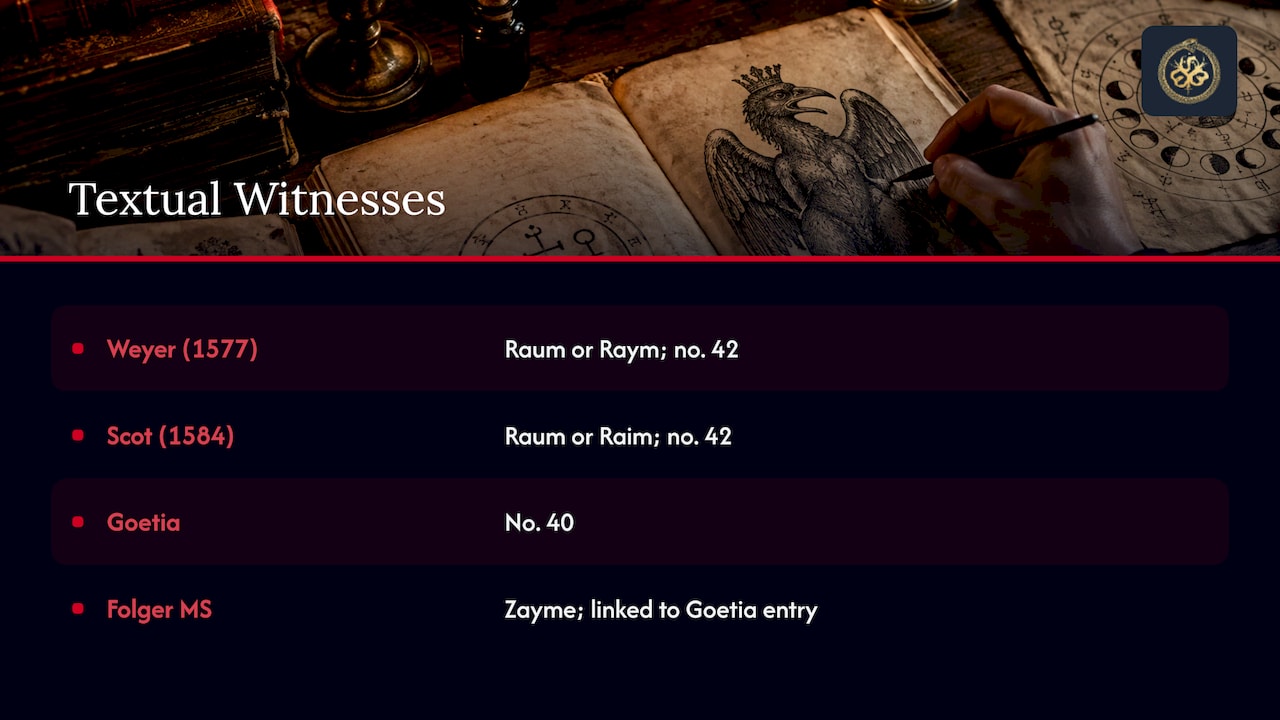
The earliest known appearance by name is in Johann Weyer’s Pseudomonarchia Daemonum, added as an appendix to the fifth edition of De praestigiis daemonum in 1577. Weyer, a student of Agrippa, drew on an older manuscript called the Liber officiorum spirituum. In Weyer the spirit is entered as Raum or Raym, and Reginald Scot’s 1584 English version, The Discoverie of Witchcraft, gives Raum or Raim. Scot’s English was made from a carelessly written copy, so some drift entered at the first step into English.
He is number 42 in Weyer and Scot and number 40 in the Goetia, and the Goetia entry corresponds to a spirit called Zayme in the Folger manuscript. So the number, the spelling and even the name depend on which witness you read.
The character shifted too. Weyer’s Latin says Raum brings contempt upon dignities, not that he bestows them. Collin de Plancy’s Dictionnaire infernal of 1863 reverses this and says he gives dignities. A modern magician who reads only the later French source will work with a different spirit than the one Weyer described. When you build a petition, decide which of these you are addressing and word it accordingly. We recommend the older reading: Raum lowers false dignity and does not hand out titles.
The seal has its own history. The seventeenth-century manuscripts give each spirit a drawn sign, and nineteenth and early twentieth century printed editions standardized the version most people now copy. Earlier manuscripts lacked that fixed modern framing. In practice, your seal should be copied by hand from a reliable edition of the Goetia, because the act of drawing it is part of the working.
The Name
The name has a German face. Raum means space, room or chamber, and the verb räumen means to vacate, empty or clear out. Whether the compilers intended the pun is unknown, but it is useful to you either way. A spirit whose name means emptying a room is a spirit of clearing: emptying the vault, the position, the office, the grudge. Alternate spellings in circulation are Raim, Raym and Räum, and you may use any of them in invocation. We use Raum throughout and recommend you pick one spelling and keep it in every working so the name carries a consistent weight.
The Double Character: Raider and Peacemaker
The Thrones lineage is the key many magicians use to resolve his contradictory office. In the old orders of angels the Thrones sit third from the summit and carry the seat of the divine. A spirit who once bore a throne and now lowers thrones has a coherent character: he knows exactly where a seat of power is weak because he used to hold it up. Some modern practitioners call him the un-throner, a spirit turned against false sovereignty. The name is not in the Goetia, but it fits his four lines of office.
For those of us in the Left-Hand Path this has a direct application to spiritual sovereignty. The thrones Raum removes in a working are the borrowed seats of authority in your own life: the supervisor who holds a position through intimidation, the family elder whose word you obeyed for decades, the inner voice that still speaks with a pastor’s tone. He is as much a spirit of your own liberation as of external leverage.
Correspondences
The Goetia itself names no metals, stones or plants for Raum. Correspondences come from later systems, and they agree on the essentials. Modern demonolatry tables give Mars as his planet, Air as his element, copper and silver as metals, red as his color, thistle as his plant, dragon’s blood as his incense, the Five of Pentacles as his tarot card, the east as his direction, and the first ten degrees of Taurus as his zodiac position, with dates of 21 to 30 April. The same tables give the enn used below.
The Five of Pentacles is a good clue to his temperament: it is the card of hardship outside the lit window, material loss and exclusion. Raum answers the person standing in the cold who knows where the warmth is kept.
Materials for the Working
Gather these before you begin:
- A sheet of clean parchment or unlined paper, and a pen you use only for ritual.
- Red ink, or black ink if red is unavailable, for the seal and the petition.
- One red candle, with a black candle if your aim is exposure or removal.
- Dragon’s blood resin and a charcoal disc with a heat-safe censer.
- A thistle, fresh or dried, or a black feather as a crow token.
- A copper coin, for the offering and as a physical anchor for the working.
- A small glass of dark red wine or black coffee as a libation.
- A written statement of one aim, one sentence long. Raum’s office is broad, so working one problem at a time keeps your intent sharp.
Timing
Mars governs Raum, so Tuesday is the planetary day and the hour of Mars is the planetary hour. Calculate the Mars hour for your location from sunrise, with the first hour of Tuesday belonging to Mars. Taurus degrees and the dates in late April add a seasonal option if your working can wait for them.
For the moon, the Goetia tradition prefers a waxing moon for operations, and we suggest this division for Raum:
- Waxing moon: acquisition work, recovering what is owed, reconciliation, and the winning of a hearing.
- Waning or dark moon: removal work, the undermining of a false position, and exposure.
Pick one. A working that tries to do both in a single night splits the intent.
The Seal and the Enn
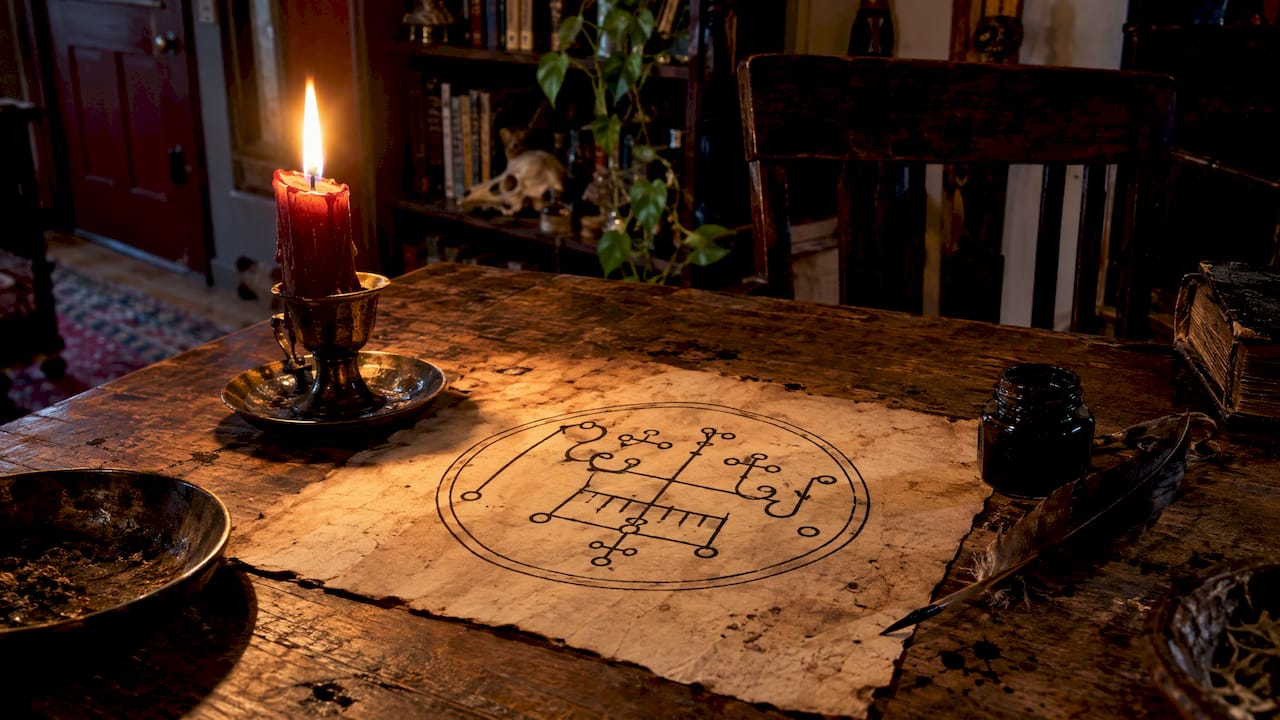
Copy his seal by hand from a trusted edition of the Goetia onto the center of your parchment. If you want the full Solomonic apparatus of circle and triangle around it, our conjuring method from the Goetia gives it in order. Draw slowly and do not correct mistakes by overwriting. If a line goes wrong, start a new sheet. The seal is the address you give the spirit and it should be clean.
The enn, the short phrase in the spirit’s own language used to call him, is Furca na alle laris Raum, as recorded in modern demonolatry. Speak it slowly, in a low voice, one syllable at a time at first. You will repeat it three times at the opening and once more when you ask your petition.
Step-by-Step Working
- Prepare the room. Work at night in a quiet space where you will not be interrupted. Face east. Put the parchment with the seal on your altar with the candle above it and the censer to its right.
- Set your state. Sit for several minutes with slow breathing. Read your one-sentence aim aloud once so that the room knows why you are there.
- Light the candle and the incense. Light the red candle first. Place a pinch of dragon’s blood on the charcoal. Put the thistle or feather and the copper coin beside the seal.
- Call with the enn. Speak Furca na alle laris Raum three times. Then say his name and rank: Raum, Great Earl, Count of Hell, thirty legions at your command.
- Speak the petition (below). Say it aloud, steadily, from memory if you can.
- Hold attention on the seal. Look at the seal and the candle flame for ten to fifteen minutes. Let impressions arise without forcing them. Write down anything you sense.
- Make the offering. Pour a small portion of the libation onto a dish and place the copper coin on the seal. Say that these are given freely in exchange for his work.
- Seal the intent. Fold the parchment with the petition toward the inside, with the seal facing the coin. Keep it on the altar until the candle has burned down in a sturdy holder, or snuff it and relight it for the next two nights, always at the same hour.
- Close (below) and record the date, moon phase, planetary hour and your impressions in your journal.
The Petition
Use these words as written, replacing the bracketed phrase with your single aim:
“Raum, Great Earl, crow of the high places, once of the Thrones, I call you by your name and your seal. Furca na alle laris Raum. You who carry treasure from the houses of kings, who lower the dignities of men, who know what was, what is and what will be, and who turn enemies into friends: hear me. I ask you for this work: [state your aim in one sentence]. Take what has been withheld from me and bring it to my hand. Show me the hidden thing I must see. Remove the false seat that stands in my way. I give you this offering freely and I keep my side of the work with my own hands. Raum, attend.”
Two notes on wording. First, the phrase about keeping your side is intentional: Raum’s office is a campaign, and he needs an operator who acts on what is revealed. Second, avoid listing several aims. A petition that asks for wealth, a reconciliation and the downfall of a rival in one breath asks him to be three spirits.
Signs of Presence and Signs the Working Is Taking Hold
Signs of presence during the rite are usually sensory and brief. Common reports among magicians who work with him include a sudden drop or rise in room temperature, the flame leaning or flaring without a draft, a sense of being watched from a high corner, the sound of wings or a dry rustle, and the smell of dragon’s blood sharpening. Crows or ravens appearing near your home in the days after are a frequent sign, and dreams of black birds, empty rooms, locked chests or vaults are typical.
Signs the work is progressing are practical rather than dramatic. Watch for:
- Information surfacing that you were not looking for: a document, an overheard remark, a name connected to your problem.
- A sudden loosening of a stuck situation, such as a silent party replying or a hidden cost appearing.
- Someone you thought of as an obstacle shifting position or losing standing.
- Opportunities in money or leverage that require you to act within a short window.
Magick works through the structure of your life and the spirit’s will, and the signs above show the relationship at work.
Closing the Working
Close with gratitude and a clear release. Say:
“Raum, Great Earl, I thank you for your attendance and your work. What I have asked is given into your keeping and into my own hands. Go in peace to your own place, and return when I call by name and seal. The working is ended.”
Snuff the candle, extinguish the charcoal, and clear the offering. Take the libation outdoors and pour it on soil, with the coin left at a crossroads or at the base of a tree, or kept on your altar if the working is ongoing. Wash your hands and eat something. Keep the folded parchment somewhere private until the matter resolves, and then burn it.
Three Typical Uses
These are typical situations, not client cases.
The project manager passed over twice. She suspects a colleague has been taking credit for her work. She works the waning moon on a Tuesday in a Mars hour, with the petition asking Raum to reveal the hidden thing she needs to see. In the following weeks she keeps a dated log of her contributions and finds that a shared document history shows who wrote what. Raum’s office as revealer meets her own preparation.
The unpaid invoice. A freelancer is owed a large invoice by a client who has gone quiet. She works on a waxing moon, petitioning for what has been withheld to be brought to her hand. Alongside the rite she sends a formal written demand. The ritual sets the direction, and the paperwork is the hand that closes it.
The estranged sisters. A woman has not spoken to her sister since an argument over their mother’s house. She takes the lesser-known office, the maker of love between friends and foes, and asks Raum to remove the false seat of pride that stands between them. She follows the working by writing a short, honest letter. The magick prepares the ground, and the letter is the act.
In each, the spirit’s information is treated as an instruction to act.
Working Raum Into a Disciplined Practice
Raum suits a once-a-month working better than a daily one. Keep a short daily habit alongside it: a Tuesday evening candle with the enn spoken once, a journal entry on what you noticed, and a weekly review of whether you are doing your part. Over a lunar month you will see patterns in the signs, which tells you whether he is responding to a waxing-moon or waning-moon approach, and whether the problem you named is really the problem.
If you work with other spirits, give Raum his own working and keep each aim separate. Lucifer is a guide who teaches self-accountability and illumination, a grandfather figure who can discipline, love and offer wisdom, and you may find that a Luciferian foundation steadies your work with a spirit as sharp as Raum.
Our Perspective
We see Raum as one of the most practical spirits in the Goetia, because his office is a sequence you can follow: locate, remove, reveal, reconcile. Most of the confusion around him comes from reading only one of his faces. The raider and the peacemaker are the same spirit working at different stages of the same problem.
In our experience of the Left-Hand Path, sovereignty is built through clear aims and action. Raum responds to a petition that names one target and an operator who is ready to move when the information arrives. We work from the primary texts, Weyer, Scot and the Lemegeton, and we treat the spirits as real, intelligent beings who deserve exact address and fair exchange.
We join magick to strategy. The ritual opens the door and the person walks through it.
Black Witch Coven
Daemonic Work With Black Witch Coven
If you want a spirit worked on your behalf in a related office, our daemonic spell casting category lists the demonic rituals we offer, including the Demonic Ritual for Court & Legal Success (Eligor) and Daemonic Prosperity Magick. If you are unsure which spirit fits your problem, a Demonic Tarot Reading can settle it first.
FAQ
What kind of demon is Raum?
Raum is the fortieth of the seventy-two spirits of the Ars Goetia, a Great Earl commanding thirty legions. He appears as a crow, takes human form on command, and was formerly of the Order of Thrones.
What does Raum do?
His office is to steal treasure from the houses of kings, destroy cities and the dignities of men, tell things past, present and to come, and cause love between friends and enemies. In practice he is called for leverage, recovery of what is owed, exposure and reconciliation.
When is the best time to work with Raum?
Tuesday in the hour of Mars is the traditional choice, because Mars is his planet. Use a waxing moon for acquisition and reconciliation, and a waning or dark moon for removal and exposure.
Is Raum the same spirit in Weyer and in the Goetia?
The names and offices overlap, but the sources differ in number, spelling and detail. Weyer lists him as Raum or Raym at number 42, the Goetia places him at number 40, and the Folger manuscript has a corresponding spirit named Zayme.
