
 New Years Eve Ritual 2026/2027 with Savannah
Blog, Learn Witchcraft, Spells
How to Choose a Spell Caster You Can Trust
Nov
Choose a spell caster the way you would choose any specialist whose work you cannot inspect directly. Define the one problem you want worked, find a witch whose tradition matches that problem, ask questions that make them explain their method in plain language, and get the terms (price, scope, timeline, refunds, privacy) in writing before any money moves. Results are never guaranteed, so the quality of the process is the thing you can actually evaluate. This guide walks through each step with the questions to ask, the answers worth listening for, and worked examples.
Table of Contents
- Start With the Work, Not the Worker
- Match the Tradition to the Problem
- What a Credible Spell Caster’s Public Presence Looks Like
- The Consultation: Questions Worth Asking
- Fees, Timelines and Terms in Writing
- Signs the Arrangement Is Not Serving You
- State and Local Rules for Witches
- Three Case Examples
- Our Perspective
- Where to Begin With Us
- Keeping the Working on Track After You Hire
- FAQ
- Sources
Start With the Work, Not the Worker
Most bad matches begin with a vague request. Someone writes to a magician and says they want things to get better. A witch cannot design a working around that, and you cannot judge afterward whether it did anything.
Before you contact anyone, write down three lines:
- The single problem. One situation, one person or institution, one outcome. A court date, a stalled business, a relationship that ended eight months ago, a pattern of hostility at work.
- What you can do in the physical world. Magick that runs alongside action tends to be easier to read. If the problem is a lawsuit, you have an attorney and a filing calendar. If it is money, you have a pricing sheet, a pipeline, a list of people to call.
- What counts as a result. Name an observable change and a window in which you will look for it. This protects you from reading every coincidence as success or every quiet week as failure.
The discipline of fixing one problem at a time is not only tidy. It is how you learn which working produced which effect. If you commission a love working, a money working and a protection working in the same month, you will never know what moved.
A quick example
A surgeon who is in a licensing dispute wants help. Her first draft of the request reads: I need everything to go my way this year. Her rewritten version reads: I want a favorable outcome at my hearing in the spring, my lawyer is already preparing, and I will judge the work by the board’s decision and by whether the process stays on schedule. The second version gives any magician something to build a ritual around and gives her a way to evaluate it.
Match the Tradition to the Problem
Spell casting is not one discipline. A witch who is excellent at one current may have little to say about another, and the vocabulary alone will tell you a lot.
| Tradition | Typical strengths | What to listen for |
|---|---|---|
| Goetic and demonic work | Directed, spirit-specific workings: legal matters, reconciliation, wealth, command and influence | A named spirit tied to a stated function, with a reason that spirit suits your problem |
| Luciferian practice | Self-sovereignty, initiation, wisdom, personal power | Emphasis on your development, not only on external events |
| Hoodoo and rootwork | Practical workings with candles, jars, roots, oils and everyday materials; protection, luck, crossing and uncrossing | Specific materials and timings, and a lineage of method you can name |
| Traditional witchcraft and folk magick | Charms, jar and candle spells, seasonal and lunar timing | Consistent correspondences and a clear account of why they were chosen |
| Energy and cleansing work | Clearing, shielding, maintenance | A coherent description of what is being cleared and how |
The point is not that one row is better. The point is fit. If you want a legal outcome and the magician’s whole presentation is about aura readings, ask directly how they would approach a court matter. If you work within a Left-Hand Path framework and want pact work, you want someone who speaks fluently about that framework, including how a spirit is approached, how an offering is determined and what the working sustains over time.
Tradition fit is also about temperament
Some occultists work gently and slowly. Others are blunt and fast. If you are the sort of person who wants to understand every step, choose someone who will teach as they go. If you want to hand off a working and receive a report, choose someone who documents. Neither is wrong. Mismatch is what produces frustration.
What a Credible Spell Caster’s Public Presence Looks Like
You do not need to see a license to evaluate whether someone knows their craft, because for most spiritual work no license exists. You can still read what they publish.
- They explain, in their own words, how a working is built. Not just what it will do, but what is performed, over how many days, with what materials and which spirit or current.
- Their descriptions are consistent. If a witch describes the same type of working three different ways on three pages, that is worth noticing.
- They are specific about scope. A credible description says what the working addresses and what it does not.
- They do not promise control over a specific person’s free choices. Reconciliation and influence work is a real category, but the honest framing is that it shifts circumstances, attention and openings, and the outcome depends on the whole situation.
The Ohio Attorney General’s consumer office recommends asking friends and family about the reputation of a spiritual advisor’s practice, asking about cancellations and refund policies, and asking to see certifications or credentials. The same guidance advises asking detailed questions about the spiritual practice itself. That last point is the most useful one for a knowledgeable client: a magician who can answer in depth, and who does not bristle at the question, has shown you something real.
If you want a general framework for checking reputation and clarifying terms with any professional you pay for guidance, these questions to ask a coach translate well to a spiritual worker: who they have worked with, how they define success, and what happens if the arrangement is not working.
The Consultation: Questions Worth Asking
A good consultation is a two-way interview. You are not being tested. You are hiring. These are the questions that separate a considered witch from a polished one.
About method
- Which tradition or current will you use for my situation, and why that one?
- If a spirit is involved, which one, and what is its function in this working?
- What will you actually do, and over what period? How many sessions or days?
- What materials, offerings or preparations are involved, and who supplies them?
- Will I have a part in the work, such as daily actions, abstentions or a short ritual of my own?
About expectations
- What is a realistic outcome for this type of situation?
- What would you expect to see first, and over what window?
- What happens if conditions change halfway through, for instance my goal shifts or a legal date moves?
- Do you recommend a single working or a follow-up? What would the follow-up be for?
About conduct
- How will you report back to me, and how often?
- Who will perform the work, you personally or someone on a team?
- How do you handle the information I share with you?
Listen for answers that are specific and unhurried. A strong magician is comfortable saying that a working addresses one part of a problem, or that something is outside what they do.
Fees, Timelines and Terms in Writing
This is where informed clients protect themselves. The checklist is short.
- Total cost. The U.S. Postal Inspection Service advises researching the total cost and exactly what you will receive, and asking about hidden costs. Ask for one figure that covers the working, any materials and any reporting.
- What the price includes. One casting, a series, a follow-up, a written summary? Write it down.
- Timeline. Ask for the start date, the duration of the working and the point at which you should expect to review. A timeline is a planning tool, not a promise of outcome.
- Cancellations and refunds. The Ohio Attorney General’s guidance specifically includes asking about these policies. Ask what happens if you cancel before the work begins, and what happens once it has started.
- Written record. The same Ohio guidance says to get verbal promises in writing and save all documentation. Email works. Keep the thread.
- Privacy. Ask what is recorded, who sees your name and your request, and whether your details are used anywhere else. If you use a representative’s name or a first name only, ask whether that is acceptable.
- Payment method. Pay through a method with a paper trail. The Ohio office advises never wiring money to a stranger. The USPIS adds that you should never give financial information to someone you do not know or trust.
How pricing usually scales
Prices follow scope. A reading is a conversation and costs the least. A single casting is a defined piece of work. A program over several months is a sustained effort with check-ins. For reference, we publish ours: readings and spirit guidance run $65 to $85, single castings run from $150 for a jar spell to $450 for demonic workings on prosperity or legal matters, and our three-month programs run from $2,300 to $2,900. Whatever spell caster you consider, the structure should look like this: the more extended and individualized the work, the more detail you should receive about what you are getting.

Signs the Arrangement Is Not Serving You
These are the patterns consumer agencies describe, and they apply to any witch you consider.
- Cash demanded before any work begins. The Ohio Attorney General lists requests for up-front cash payment before services as a mark of a scam artist.
- A rising price tag for the same problem. The Postal Inspection Service describes victims being taken on an emotional roller coaster that demands more and more money without ever reaching the outcome.
- Manufactured urgency. A curse that suddenly appears the moment you hesitate, or a spirit that suddenly demands more, is pressure, not diagnosis.
- Guaranteed outcomes and fixed deadlines. No one controls another person’s mind with certainty, and a specific date promised for a specific result is a sales line.
- Vagueness about method. If you ask what they will do and the answer is mystery and energy and trust, you have learned that they cannot or will not tell you.
The same Ohio guidance notes that people caught in these schemes can lose hundreds to thousands of dollars a session. The better the terms are documented at the start, the less room there is for that kind of drift.
There is a constitutional dimension too. Wendy Kaminer, writing in Free Inquiry, argues that charlatans are defined by insincerity and intent to deceive, not by whether their beliefs are false. That is a useful standard for a critical thinker. You are not judging whether a magician’s cosmology is correct. You are judging whether they are honest about what they are doing and what they are charging.
State and Local Rules for Magicians
In the United States, the law on fortune-telling and related practices varies from state to state and city to city. Kaminer reports that Oklahoma, Wisconsin, Minnesota and North Carolina prohibit fortune-telling by state law, and that Massachusetts allows it only with a municipal license. She also notes that categorical bans on fortune-telling are unconstitutional, while regulation aimed at people who fraudulently claim powers they know they lack is permissible under the First Amendment.
Some recent specifics:
- In Massachusetts, a fortune teller must have lived in the city or town for at least 12 months before licensing, and the municipal license fee must be at least $2 and no more than $50, according to CommonWealth Beacon in August 2026.
- In Arizona, Glendale is the only city that requires a specific fortune-telling permit, classed under special regulatory business types that need documentation beyond a standard business license.
What this means in practice: a license or permit, where one exists, is a document you can reasonably ask about. Where none exists, the credential that matters is a record of consistent, documented work. Remote services also sit across jurisdictions, so the witch’s location and yours may be governed by different rules. If you are in a state where the practice is restricted, ask the magician how they handle that and read the terms carefully.
Three Case Examples
The reconciliation client
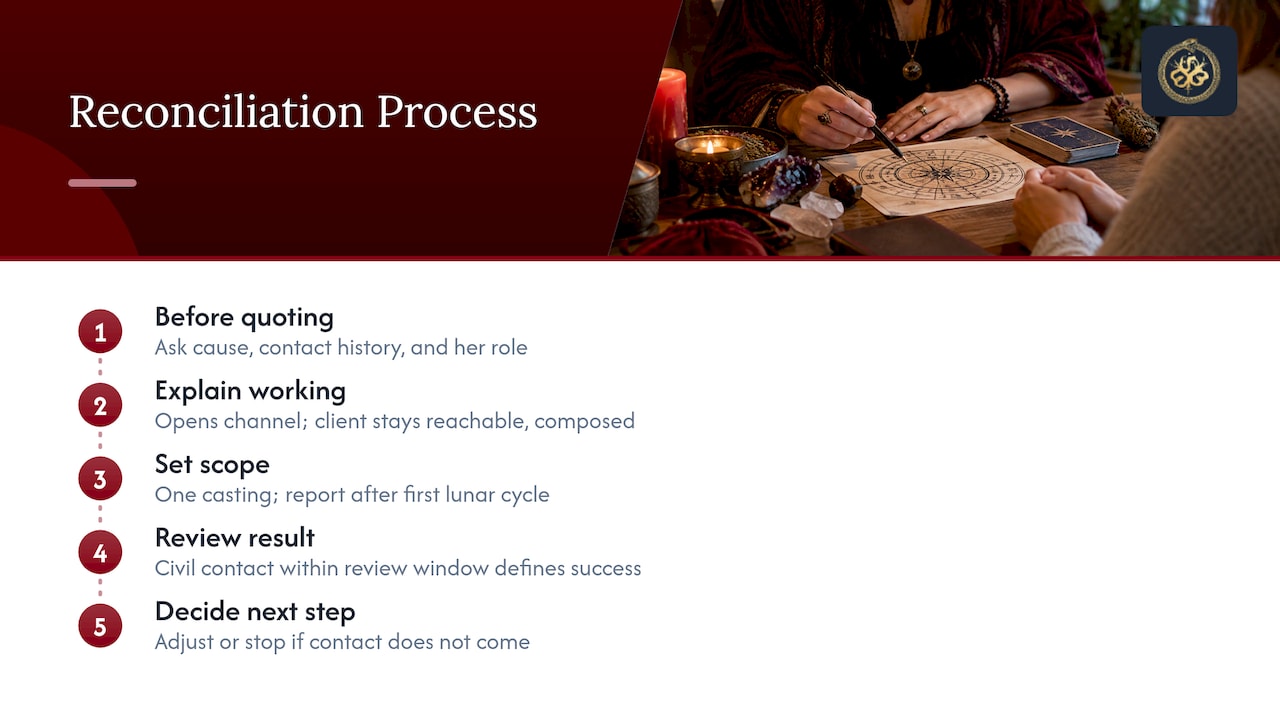
Maya’s relationship ended nine months ago. She wants him back. Her witch asks three things before quoting: what ended it, whether there has been contact, and what she is prepared to do herself. The magician explains that a reconciliation working can open the channel and soften resistance, but that she will need to be reachable, composed and consistent in how she shows up. The agreed scope is one casting, a report after the first lunar cycle, and a review at that point. Maya has her answer to the question of what a result looks like: renewed contact on civil terms within the review window. If it does not come, she and the witch discuss whether to adjust or stop.
The business owner
Daniel runs a four-person design studio with a revenue slump. He asks a prospective spell caster what the working will do. The answer includes a named current, a stated duration, and a request that he simultaneously raise outreach to ten former clients per week. He has a clear sense of what the magick is for (opening opportunity and favorable attention) and what he is responsible for (the pipeline). When he reviews at eight weeks, he can see which part moved.
The protection client
Renee feels she has been under hostile attention since a falling out with a former colleague. She asks a magician for a protective working. Rather than inventing a dramatic diagnosis, the witch explains that protection is built, maintained and renewed, and offers a structure: an initial shielding followed by a monthly maintenance schedule. Renee asks for the price of each stage in writing, and for the cancellation terms of the monthly arrangement. Protection that she understands and can end at will is protection she can trust.
Our Perspective
We hold that choosing a magician is the first act of sovereignty in the work. You decide what you want, you decide who is qualified to help you, and you decide what you will accept as evidence.
In our experience, the clients who do best are the ones who arrive with one defined problem, ask direct questions about method, and are willing to pair the ritual with action in the physical world. Magick and strategy are not opposites. A working that opens a door is worth very little to someone who does not walk through it.
We design our services around that. A reading or spirit guidance session is a way to clarify a question before committing to a casting. Single workings are scoped to one outcome, whether that is a legal matter, prosperity, protection or reconciliation. Longer programs exist for people who want sustained work and regular review. We work with Lucifer, Andras, Clauneck, Astaroth and other spirits, and we explain which current we are using and why, because a working you understand is a working you can participate in.
We also believe the Left-Hand Path asks more of the client, not less. It asks for honest self-assessment, discipline and the willingness to take responsibility for outcomes. That is the standard we try to meet on our side of the table.
Black Witch Coven
Where to Begin With Us
If you want a conversation before committing to a working, a Left-Hand Path tarot reading or spirit guidance session is $65 to $85 and is a practical way to define your question. When you are ready to scope a single outcome, our daemonic spell casting category lists the workings by purpose and price.
Keeping the Working on Track After You Hire
Choosing well is half of it. The other half is how you run the engagement.
- Keep a log. Note the start date, what was performed, any actions you committed to, and what you observe. Dates matter more than impressions.
- Hold to the review point. Decide at the start when you will evaluate, and evaluate then, not daily. Daily checking turns ordinary noise into data.
- Avoid stacking. Resist adding a second working on the same issue before the first has run its course, unless the witch recommends a specific follow-up for a specific reason.
- Communicate changes. If your circumstances change, tell your spell caster. A working built for last month’s situation may need adjusting.
- Maintain your own practice. A daily routine of grounding, cleansing and focused intention keeps you steady and makes you a better participant. If you are managing self-sabotage, boundaries or a stretch of isolation as you move away from a traditional religion, that groundwork is part of the result, not a side issue.
A magician who welcomes this kind of structure is usually one worth keeping.
FAQ
How do I know if a spell caster is legitimate?
Look for a clear, consistent explanation of their method, a stated tradition, and written terms covering price, scope and refunds. Consumer agencies recommend checking reputation through people you trust and asking about credentials. A legitimate spell caster will answer detailed questions about their practice without pressure.
What should I ask in a spell consultation?
Ask which tradition and which spirit or current they will use, what they will actually do and over what period, what the total cost includes, and how they will report back. Ask what outcome is realistic for your situation and what your own part is. Request the answers in writing.
How much does a spell caster cost?
Prices vary with scope: a reading costs less than a single casting, and a multi-month program costs more. The figure that matters is the total for a defined deliverable. Ask what is included and whether any materials or follow-ups are billed separately, and get the number in writing before paying.
Is it legal to hire a spell caster in the United States?
It depends on where you and the witch are. Laws on fortune-telling differ by state and by city, and some places restrict or license it. Courts have held that categorical bans are unconstitutional, but fraud is regulated. Check your own state and city rules if you are unsure.
Sources
- Spiritual Advisor or Scam Artist? Ohio Attorney General
- Psychic Scam, United States Postal Inspection Service
- The First Amendment Is for Fortune-tellers, Too, Free Inquiry
- The Download August 13, 2026, CommonWealth Beacon
- Is Tarot Reading Legal in Arizona?, KWCD Country
