
Blog, Demons, Working With Demons
Halphas Demon: History, Seal and How to Work With Him
Oct
Halphas is the thirty-eighth spirit of the Ars Goetia, a Great Earl who appears as a stork or stock dove, speaks in a hoarse voice, commands twenty-six legions, and builds towers, stocks them with weapons and ammunition, and sends men of war to the places appointed for them. Behind that short entry sits a surprisingly rich problem: a name nobody can fully explain, a manuscript tradition that disagrees with itself about birds and buildings, a near-twin in Malphas who is easy to confuse with him, and a modern practice that reads a military spirit as a patron of structure, defense and discipline.
This article works through all of it in order: the texts, the textual variants, the comparison with Malphas, the way contemporary practitioners interpret him, and a concrete method for working with him that keeps what the books say separate from what practitioners have added. For the short version, see our Halphas Demon Directory page.
Halphas at a glance
The table below collects the core data from the primary editions. Everything in the “Grimoire record” column comes from the Goetia manuscripts and from Weyer’s 1577 text. Everything in the modern column is interpretation.
| Attribute | Grimoire record | Modern practitioner reading |
|---|---|---|
| Number | 38th in the Ars Goetia; 43rd in Weyer’s list | Often grouped with the “builders” of the Goetia |
| Rank | Great Earl (Count) | A mid-ranking officer who delivers practical results |
| Legions | 26 | Organized, disciplined forces; resources under command |
| Form | Stork or stock dove | Bird imagery as a messenger or watcher |
| Voice | Hoarse, rough | A blunt, unornamented communicator |
| Function | Builds towers, supplies arms and ammunition, sends men of war | Personal fortresses, boundaries, structure, defense |
| Opposing angel | Haamiah, in modern editions of the Shemhamphorasch scheme | Used in balancing or banishing work |
In the books, Halphas is an officer of the infernal hierarchy. No surviving Mesopotamian or Greek myth names him, so the grimoire entry is the oldest written account of him you will find. What it records is his office, building, arming and sending, and that office is what you work with.
The name and the texts that carry it
Halphas appears in two foundational sources. In the Lesser Key of Solomon he is the thirty-eighth demon of the Ars Goetia, and in Johann Weyer’s Pseudomonarchia Daemonum he is the forty-third. Weyer printed his catalog of demons in 1577 as an appendix to his De praestigiis daemonum, and he states that he drew it from an older manuscript, the Liber officiorum spirituum, which was evidently much older than 1577. The Goetia as we know it survives in seventeenth-century manuscripts, so the spirit’s attestation runs from a lost medieval source, through Weyer, into the English grimoire tradition.
The order of spirits differs between Weyer and the Goetia, which suggests pages were scrambled and dislocated somewhere in transmission. That detail matters if you read numbers as meaningful. Halphas is 38th in one list and 43rd in another, which tells you the numbering is a feature of a particular manuscript lineage, not a fixed cosmic address.
The name itself is less settled. The spirit is also written Malthus, Malthas or Malthous, and the precise history of the name is uncertain. Anyone who offers you a confident Hebrew or Arabic etymology is supplying a guess. The forms Malthus and Malthas are the reason Halphas gets tangled with Malphas, whose name differs by a single letter in the shorter variants.
Why spelling variants matter to a practitioner
If you intend to write or speak a name in a working, you are choosing a variant. Most modern work uses Halphas because it is the form in the standard Goetia numbering, but the alternates are legitimate manuscript readings. A practical approach: use Halphas as the primary name in all written work, and record in your journal which variant you used if you ever experiment with another. That way, if results seem to differ, you have data instead of memory.
Stork, stock dove and the problem of the bird
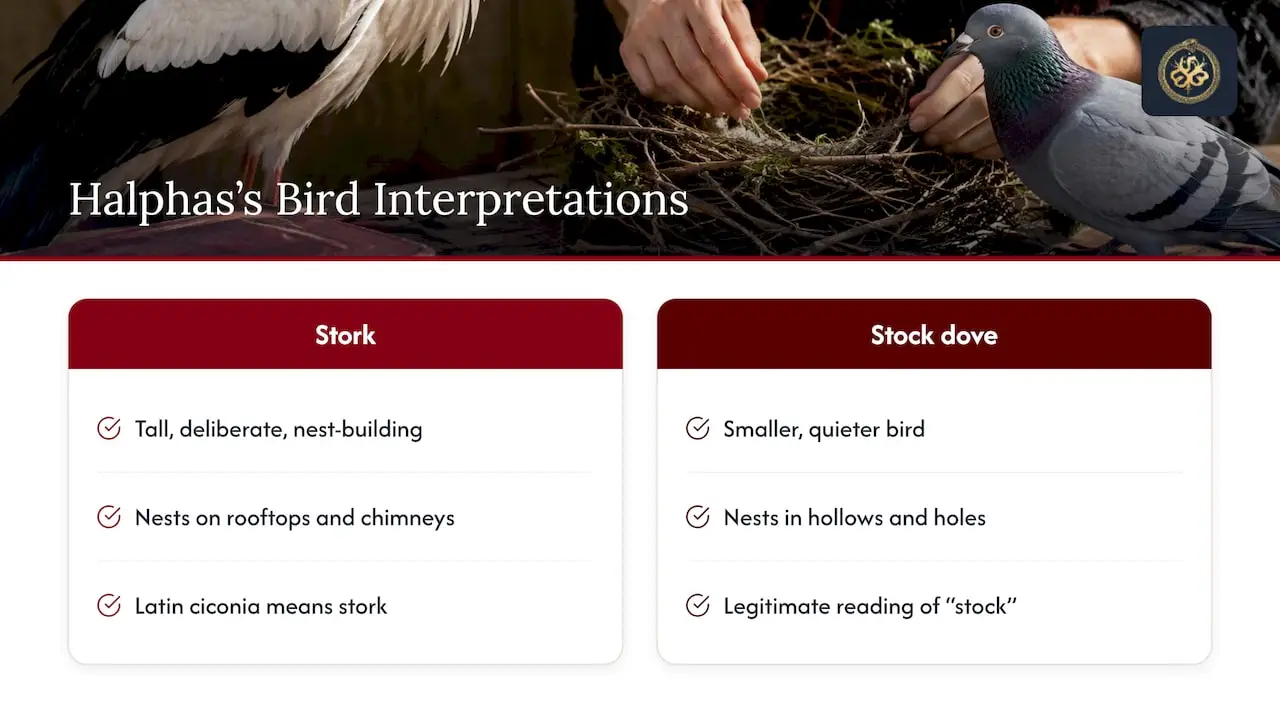
The Goetia gives Halphas’s form as a “stock,” which editors of the Goetia take to be a stork. Weyer’s Latin settles the matter in one direction: he writes ciconia, which means stork. Later English writers then split, with some describing a stork and others a stock dove, a kind of pigeon. Both are old, legitimate readings of an ambiguous English word.
For practice, the two birds suggest different things, and it is reasonable to ask which image you receive. The stork is a tall, deliberate, nest-building bird associated in European folklore with households and thresholds. It nests on rooftops and chimneys, which fits a spirit concerned with towers and strongholds almost too well. The stock dove is a smaller, quieter bird that nests in hollows and holes. If you do visionary work and meet a tall bird at the edge of a built structure, the stork reading is supported by the oldest Latin witness. If you meet something small and hole-dwelling, note it and do not force it into the textual image.
The voice is the other consistent detail. Every account describes it as hoarse. That is an unusual choice for a spirit, since most Goetic entries stress eloquence, beauty or authority. A rough voice implies a spirit who does not decorate. It is consistent with the way the work tends to go: short, direct exchanges, with little flattery either way.
Towers or towns: the variant that changes his meaning
This is the most important textual point in the whole entry. The Goetia manuscripts vary between “towers” and “towns,” and Weyer’s Latin has oppida, which means towns. So one tradition has Halphas building towers, while another has him building or burning towns. Some later writers even say he burns towns, which is a different thing entirely.
The two readings produce two spirits:
- The builder. He raises fortified towers, equips them with ammunition and weapons, and dispatches soldiers. This is the dominant reading in the Goetia and in most modern work.
- The destroyer of towns. The Latin points toward settlements, and the associated war function leans toward conquest. This is the reading behind the “demon of war” label often attached to him.
It would be tempting to pick whichever suits the working you want. A more careful method is to treat the ambiguity as part of the spirit’s profile: Halphas governs the entire lifecycle of a military position, from building it to arming it to deploying the people inside it. Whether a given manuscript says towers or towns, the common thread is organized force applied to a place. That framing is easy to carry into a modern working and does not require ignoring either reading.
Rank and legions: what an Earl commands
In the Goetia’s hierarchy, an Earl is a mid-to-upper officer, below Dukes and Marquises in the order of presentation but above Presidents in some lists. The classified list in the Goetia places Halphas among the Earls or Counts and Malphas among the Presidents, so the two ranks are confirmed by a second independent listing. Halphas commands twenty-six legions.
The legion count is not a headcount you can use. In grimoire usage it communicates scale and standing. What it does tell you is that the spirit has a large administrative apparatus and works through subordinates, which fits the idea that his workings tend to be structural and logistical instead of dramatic. A Duke may be asked for sudden shifts. An Earl who builds, arms and deploys is a spirit of planning.
Halphas and Malphas: two neighbors, two jobs
The most common mistake is merging them. They are consecutive entries and distinct spirits. Halphas is number 38, an Earl with 26 legions. Malphas is number 39, a President who rules 40 legions, first appears as a crow (the Latin gives raven), builds houses and high towers, gathers artificers, destroys enemies’ desires or thoughts and what they have done, and gives familiars.
| Feature | Halphas | Malphas |
|---|---|---|
| Goetia number | 38 | 39 |
| Rank | Great Earl | President |
| Legions | 26 | 40 |
| Opening form | Stork or stock dove | Crow (Latin: raven) |
| Core function | Builds towers, arms them, sends soldiers | Builds houses and towers, gathers craftsmen, undermines enemy intent, gives familiars |
| Modern emphasis | Fortification and defense | Territory, architectural change, subversion of opponents |
Malphas both builds and pulls down, while Halphas constructs and arms fortifications. That is a useful working distinction. Practitioners who separate them for ritual use often treat Halphas as the spirit of fortification and defense, and Malphas as the spirit of broader territory and structural change.
There is also a folk tradition in which the two appear together. Some practitioners report they often arrive as a pair and connect them to Harut and Marut, the fallen angels of Islamic tradition. That comes from personal gnosis, not from the grimoire, and it is a lead worth following in your own work. The near-identical names, the consecutive numbering and the shared interest in towers are enough to explain why the association formed.
The practical consequence of the distinction is simple. If your problem is that something you have built is exposed and under pressure, you are in Halphas’s territory. If your problem is that an opponent’s ground needs to be taken apart, or you need an informant or familiar, you are in Malphas’s. Picking the wrong one is a category error, and it produces muddy results.
How modern practitioners read him
The military language of the grimoire is rarely taken literally now. Contemporary demonolatry, as described in S. Connolly’s 2010 book, approaches Halphas for discipline, defense, structure, and personal fortresses or boundaries in preference to literal warfare. Connolly is clear that these uses come from modern practice and personal gnosis, not from the Goetia. It is a good habit to carry into your own notes: mark every claim in your journal as either “text,” “tradition” or “my experience.”
Practitioners translate his office into building your own defenses and marshalling your resources. A tower is a defended vantage point. Ammunition and weapons are the resources you hold in reserve. Sending men to appointed places is delegation and deployment. Map those three onto an ordinary life and you have a profile for any serious project:
- A defensible position: a business structure, a legal setup, a home, a schedule, a boundary that others cannot cross without your consent.
- Reserves: money, documentation, skills, allies, time.
- Deployment: the discipline to send those resources where they matter, at the right time, instead of scattering them.
Halphas is also listed in modern occult works such as the Skinner and Rankine edition as opposed by the Shemhamphorasch angel Haamiah. If you work with the angelic and demonic correspondences as paired forces, Haamiah is the counterweight, and some practitioners use that pairing to check or end a working with Halphas. This too is a modern layer, so log it as such.
Working with Halphas: a practical method
Nothing in the grimoires gives a procedure aimed specifically at modern fortification work, so what follows is a method built from the textual profile. It aims to be testable. You will define the work in advance, run it for a fixed period and record what changes.
Step 1: Define the tower
Write one sentence naming the structure you want built or reinforced. Vague goals (“protection”) give vague results. Concrete ones work better: “My consulting practice has a signed retainer structure that no single client can collapse,” or “My household has one fixed quiet evening a week that nobody else schedules over.” Limit yourself to a single problem at a time. Halphas’s brief is construction and arming, and a project with six foundations is six projects.
Step 2: Take inventory of the arsenal
Before any ritual, list the resources the structure needs: cash reserves, contracts, evidence, contacts, skills, hours. This is the “ammunition and weapons” of the text. Spend a week closing the gaps you can close by ordinary means. A ritual added to a stripped position does little; a ritual added to a prepared position focuses it.
Step 3: Prepare the sigil and the space
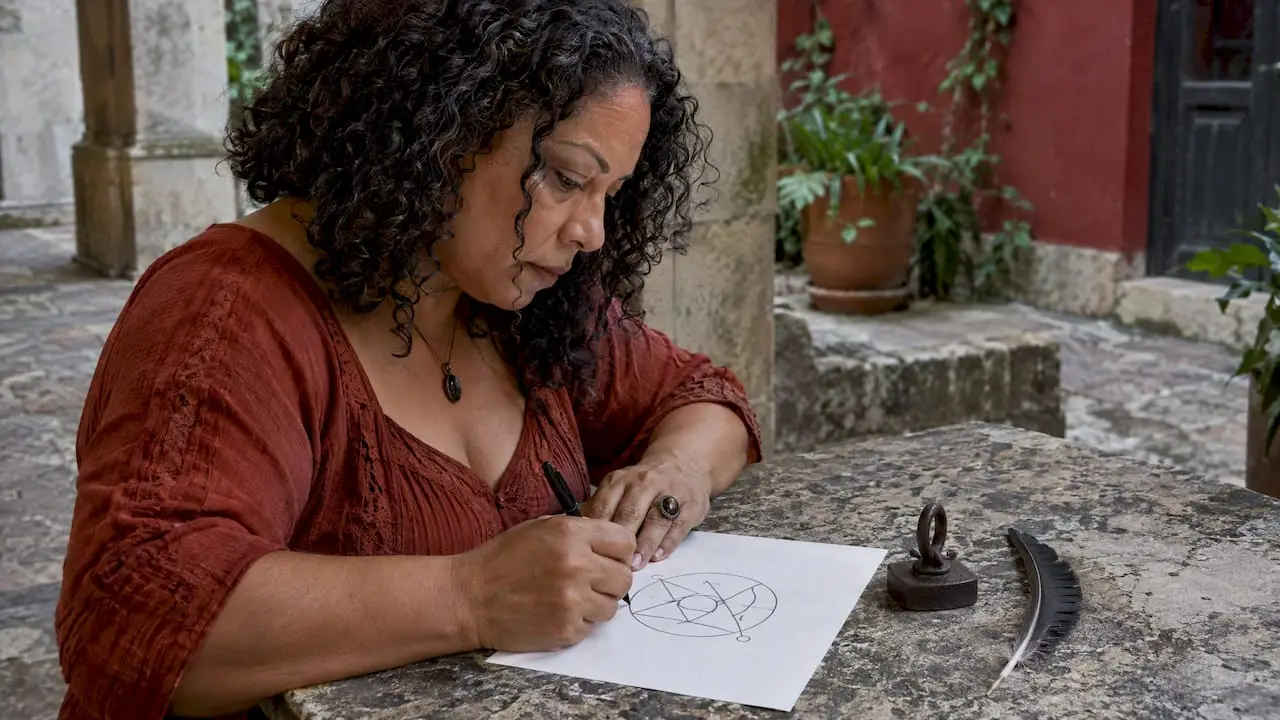
Draw his seal from the edition you trust, on paper you will keep. Many practitioners work in a Mars hour, since his themes are military. The grimoire sets no rule, so choose a timing and keep it consistent. The conjuring method from the Goetia gives the traditional frame for the call itself. A small stone, iron or brick item can serve as a physical anchor, a literal piece of the tower. A feather is a fitting offering to the bird form, though the choice is yours.
Step 4: Make a plain statement of intent
Given his hoarse, unadorned voice in the sources, use short, declarative language. State the structure you want, the resources you have prepared and the actions you will take in the physical world. Offer a defined exchange: you will complete specific tasks by specific dates. A spirit of logistics responds, in the experience of many practitioners, to commitments that can be audited.
Step 5: Run the work for a fixed period
Thirty days is a manageable window. Repeat a brief invocation at a set time each day, then spend ten minutes on the physical task that supports the tower: filing the contract, building the backup, writing the schedule. Keep the ritual short and the physical work substantial.
Step 6: Review and close
At the end of the period, compare your starting sentence with the facts. Did the structure exist? Did the reserves grow? Did anything deploy? Record the result without commentary, then thank the spirit and close the working. If you use the angelic pairing, this is where Haamiah enters as a closing or balancing step.
Case examples
These are illustrative scenarios of how the method translates, not reports of specific clients.
The freelance surgeon consultant. A physician who consults on the side finds that two clients make up nearly all her income. Her tower is a diversified client base with written retainers. During the thirty days she inventories her arsenal (referral contacts, a template contract, three months of reserves), works the ritual in the evening, and spends each morning on one outreach task. The measurable result is the number of signed retainers, not a feeling.
The tenant under pressure. A renter facing an unreliable landlord defines the tower as a documented, defensible tenancy. The arsenal is dated photographs, written correspondence, a copy of the lease and the contact for a tenants’ association. The ritual gives the daily structure; the documents give the strength.
The practitioner with leaky boundaries. Someone who keeps being drawn into other people’s emergencies defines the tower as three hours of protected practice every evening. The deployment problem is the interesting one here: the work is not building a wall but sending her own resources, time and attention, to the places she has chosen. The journal tracks every breach.
In all three, the spirit’s profile (build, arm, deploy) maps onto an observable plan, which is why this reading has staying power.
Our perspective
We read Halphas as a spirit of preparation. The grimoire gives him a very specific, unglamorous job: before force is used, there has to be a place to stand, something to stand with and someone to send. Most failed workings, in our view, fail at exactly those three points, not at the level of the spirit’s power. People ask for an outcome and have built nothing for the outcome to land in.
That is why we push back on the “demon of war” shorthand. It is accurate to the text and misleading about the work. A practitioner who treats Halphas as a source of aggression usually gets noise. A practitioner who treats him as a quartermaster and builder gets structure, and structure is the form that sovereignty takes in daily life. A person who controls their position, their reserves and their deployments is not at anyone’s mercy, which is the practical meaning of the word we use most.
We also hold that the honest practitioner keeps the layers separate. The text says what it says, the tradition added what it added, and personal gnosis is yours. Mixing them is how a made-up detail hardens into “ancient teaching” within a decade.
Black Witch Coven
Where a ritual practice can take this further
If you want the structural work of a fortification carried out for you instead of building it yourself, we offer the Dragon’s Veil Protection Spell: Draconian Shield as a one-off working. For continuing upkeep of a defensive position, the Monthly Protection Maintenance Subscription keeps the work renewed each month. Our guide to demons associated with specific powers lists the other spirits of defense and structure.
Frequently asked questions
What does Halphas mean?
No one can say with confidence. The precise history of the name is uncertain, and the spirit also appears as Malthus, Malthas and Malthous. What the name does carry is a clear function: in the grimoires, Halphas builds towers, arms them and sends soldiers to appointed places.
What kind of demon is Malphas, and is he the same as Halphas?
Malphas is a separate spirit, the thirty-ninth in the Ars Goetia and a President with forty legions. He appears first as a crow, builds houses and towers, gathers craftsmen and gives familiars. Halphas is the thirty-eighth, an Earl with twenty-six legions, and the two are distinct entries distinguished by rank and command.
Is Halphas a stork or a dove?
The English text reads “stock,” which editors take as a probable stork, and Weyer’s Latin has ciconia, meaning stork. Some modern writers prefer stock dove because of the English wording. The Latin evidence favors the stork.
What is Halphas used for today?
Many practitioners work with him for discipline, defense, structure and personal boundaries, not for literal warfare. These uses are contemporary interpretations and personal gnosis and are not part of the original grimoire instructions, so it helps to document your own results carefully.
