
Blog, Demons, Working With Demons
Zagan Demon: History, Seal and How to Work With Him
Nov
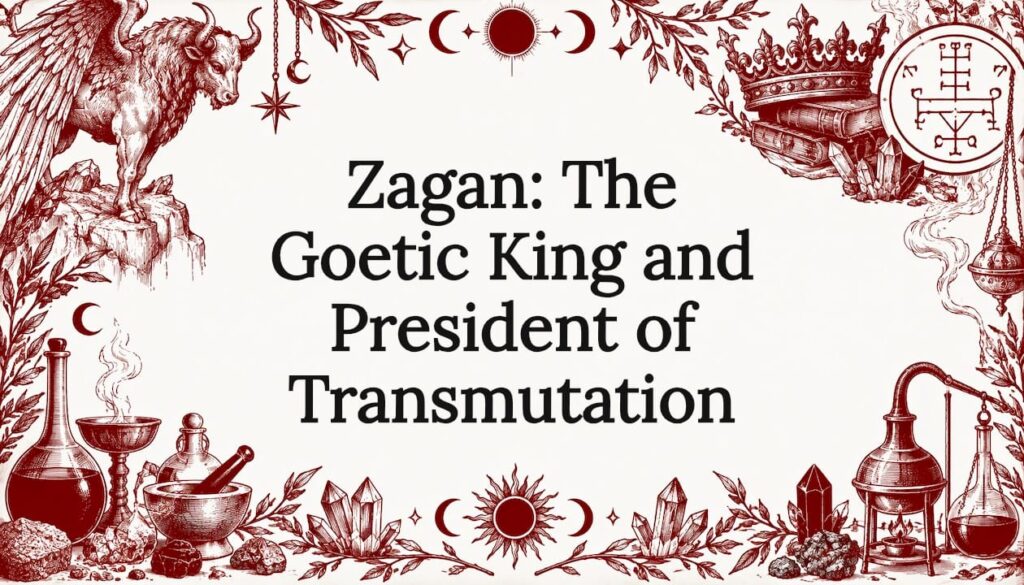
Zagan is the sixty-first spirit of the Ars Goetia, a Great King and President who commands thirty-three legions. He is a spirit of transformation: he turns one substance into another, sharpens the mind, and, in the grimoire’s own words, makes fools wise. For a practitioner, that makes him a working partner for conversion. Skill becomes income, raw ability becomes recognized talent, and a muddled mind becomes a clear one. Below is what the primary text says, how the profile traveled from 1577 onward, what the claims about his origins rest on, and how to build a working relationship with him that produces something you can measure. His seal and correspondences are on our Zagan Demon Directory page.
Who Zagan is in the Ars Goetia
The Ars Goetia, the first book of the Lemegeton or Lesser Key of Solomon, lists Zagan as a Great King and President. The double rank is unusual. Most Goetic spirits hold one title, whether King, Duke, Prince, Marquis, Earl, or President. Zagan holds two, and the text gives him command over 33 legions of spirits.
The same entry describes his appearance in two stages. He first shows himself as a bull with gryphon’s wings, and only afterward takes human shape. Practitioners tend to underweight that sequence. The text does not describe a creature that is permanently a hybrid. It describes a spirit that arrives in a form and then resolves into another, which is the same pattern as his powers. Change is built into how he presents.
The spirit is also spelled Zagam in older material, and some manuscripts give Zagayne. When you read old printed editions, look for all three spellings, or you will miss the earliest appearances.
In the Goetic numbering he is number 61, which matters if you work through the spirits in order or cross-reference them with planetary, zodiacal, or hour-based schemes from other grimoire traditions. The number belongs to the Goetia’s later organization. It was not part of the earlier catalogue, as the next sections show.
The powers the text attributes to him
The grimoire’s list is short and specific. According to the Lesser Key text, Zagan makes men witty, turns wine into water and water into wine, turns blood into wine and wine into blood, and turns metals into the coin of the dominion that the metal belongs to. He also makes fools wise.
That gives four distinct offices:
- Wit. Sharpness of speech, quickness, the ability to make a point land.
- Reversible conversion of liquids. Wine to water and water to wine, blood to wine and wine to blood. Note that the conversions run both directions.
- Metal into coin. Not just gold. The phrasing ties each metal to its own coinage, so copper becomes copper coin, silver becomes silver coin, and so on.
- Wisdom for the foolish. Education, correction, the repair of judgment.
Two details deserve a close read. First, the reversibility. Most spirits are credited with a single direction of effect. Zagan’s offices run in both directions, which marks him as a spirit of exchange and equivalence more than of acquisition. Second, the coin clause. The older phrasing is often rendered as coin of the realm, while the Goetic version says coin of the metal’s own dominion. The difference is small. It moves the sense from state currency to the native value of the material. A metal becomes what it is worth by its own nature.
Seen together, the powers describe one process: a thing of low function becomes a thing of high function without losing its essential identity. Wine and water are both liquids, and blood and wine are both red. The metal remains a metal, and the fool remains a person, but becomes wise.
How the profile traveled: Weyer, Scot, and the Goetia
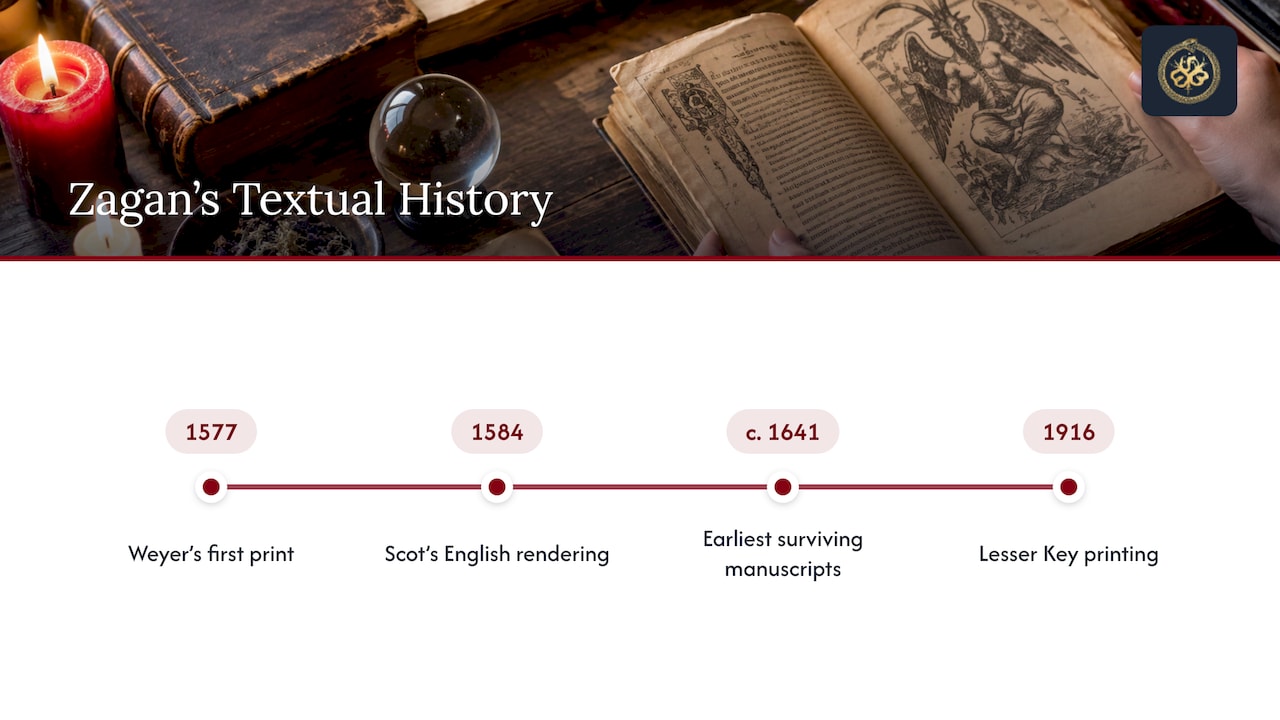
The story of Zagan on the page is a story of copying. His first printed appearance is in Johann Weyer’s Pseudomonarchia Daemonum of 1577, followed by Reginald Scot’s English rendering in 1584. Weyer’s description already matches the bull with gryphon’s wings who then takes human shape, and the 33 legions survive intact through the later versions.
The Ars Goetia is the best-known part of the Lemegeton, a compilation of five magickal treatises assembled in the mid-seventeenth century, with the earliest surviving manuscripts dated to around 1641. Weyer’s catalogue is its immediate ancestor, and it listed sixty-nine spirits. The Goetia’s seventy-two was reached by later additions. The number and order you work with today are a seventeenth-century arrangement of older material.
The edition most English readers use is the early twentieth-century text: the 1904 Mathers and Crowley Goetia and L. W. de Laurence’s 1916 printing of the Lesser Key of Solomon. When you work with a modern retelling, compare it against that text first. Retellings often simplify him, and from the nineteenth century onward the spirit moved into wider occult and popular culture, where his body, powers, and seal were sometimes exaggerated or embroidered.
The practical consequence is a simple discipline. Before you build a rite on a claim about Zagan, trace it. If it appears in the Goetia and in Weyer, it belongs to the core profile. If it appears only in a modern book or website, treat it as modern layering. Then you know which parts of your working rest on the old text and which on your own experience.
Fallen angel, ancient god, or something else
The question asked most often about Zagan is whether he is a fallen angel. Many modern writers state it flatly. The Goetic text itself is more reserved. It gives rank, form, legions, and offices, and it does not set out a genealogy for him. The fallen angel framing belongs to a Christian theological category developed through roughly eighteen hundred years of commentary on Genesis, Isaiah, Ezekiel, Jude, Revelation, and the wider Second Temple literature. Applying it to Goetic spirits lays a Christian reading over the catalogue. Black Witch Coven regards these spirits as older pagan gods and powers that Christian writers recorded and renamed.
The same applies to extraterrestrial origin theories. The modern ancient-aliens framework was first articulated by Erich von Däniken in 1968, and it reads some of the same ancient texts as the fallen angel tradition while disagreeing about what kind of being is described. Nothing in the Zagan entry mentions another planet. A practitioner who wants to work with the idea can hold it as personal gnosis, labeled as such in the working notes and kept apart from what the grimoire says.
What the grimoire does make plain is this:
- Zagan is an intelligent being with his own existence, encountered, named, and catalogued by earlier magicians.
- His rank, form, legions, and offices are recorded; his ancestry is not.
- What you learn of him beyond the entry comes from working with him, and it belongs in your own notes, in a column separate from the text.
Reading the offices on three levels
The offices are written as concrete wonders, and practitioners usually read them on three layers at once.
The literal layer
The literal reading takes the text at its word: wine and water exchange, metal becomes coin. Few modern practitioners work this way for the liquids, but the coin clause has a literal analogue in financial outcomes. You ask for money to arrive, and you watch whether it does.
The alchemical layer
The Goetia sits near alchemy in its vocabulary of transmutation, and Zagan’s profile has been read as one thing becoming another, a transformative pattern. Read this way, wine, blood, and metal are stages and grades of a substance. The question you bring is what, in your own life, is lead that could be silver.
The personal layer
The third layer is what he changes in the operator. Wit is verbal fluency, wisdom for fools is the repair of poor judgment, and the conversions turn experience into something usable.
A common modern reading takes blood as vitality, wine as luxury, and metal turned to coin as skill turned into value. That reading belongs to practitioners, not to the grimoire, and it shows how the literal text becomes a working map. Health, enjoyment, and earning power are three currencies, and Zagan is the spirit of exchange between them.
Working with Zagan: a practical framework
The Goetic tradition offers sigils, offerings, and calls, and the work rests on preparation and clear terms. The framework below is built from the grimoire’s offices and from the structure most practitioners share; the grimoire itself gives no modern ritual script. For the formal evocation, follow our conjuring method from the Goetia.
Step 1: Define the conversion
Zagan’s offices are about conversion, so state your request in that form: what you have, and what it should become. “I want money” gives him nothing to work on. “I want my existing design skill converted into a steady client base paying a defined monthly sum” does. Write it in one sentence with a measurable end point and a time window.
Step 2: Build the contact
Practitioners commonly start with the seal. Draw the sigil on paper and look at it with relaxed but focused eyes, letting the lines shift and fade. Repeat this daily for a week or two before any formal call. Anointing the seal with an oil made for the Goetic Kings, such as our Goetia Kings Oleums, marks it as his. By the time of the evocation, he already knows you.
Step 3: State the terms
Practitioners who work with him report that spirits work with you toward the result and do not hand it over for free. Plan on that basis. Decide in advance what you will do in the physical world: the outreach, the pricing, the filing, the learning. The working supplies leverage, and your action supplies the motion.
Step 4: Perform the working and set a review date
Keep the ritual itself simple: your preparation, the call, the statement of the conversion, the offering you have decided on, and a clean closing. Then set a review date, typically at thirty days, and record what has shifted in the physical world: inquiries, conversations, opportunities, changes in your own conduct.
Step 5: Match your capacity to the request
Practitioners who have worked with him for wealth describe it arriving through business, and growing only as far as their skills and character could carry at the time. The conversion is bounded by what you can carry. If the working delivers a larger client than you can serve, the result will leak. Build capacity alongside the request.
Three typical uses
These are typical uses, not reports about real people. They show how the offices translate into a situation.
The underpaid specialist. A practitioner who works as a hospital pharmacist has deep expertise and a modest salary. Her request to Zagan is a conversion of knowledge into a consulting income. She drafts a one-page service description, contacts ten clinics in the first month, and logs every reply. The ritual sets the intent, and the outreach produces the data. At the review, she adjusts the offer rather than the rite.
The inarticulate founder. A magician who founded a software company loses investor meetings because he cannot explain what he built. He takes the wit and wisdom offices and sets a concrete practice: rehearsing a three-minute pitch daily, recording it, and reviewing it. The working addresses fluency, and the daily practice tests it.
The stalled artist. A painter has a stack of finished canvases and no sales. She frames the request as turning finished work into coin, and commits to listing a fixed number of pieces a week and contacting a set number of galleries. Zagan’s role is conversion, and her role is to put the material into circulation.
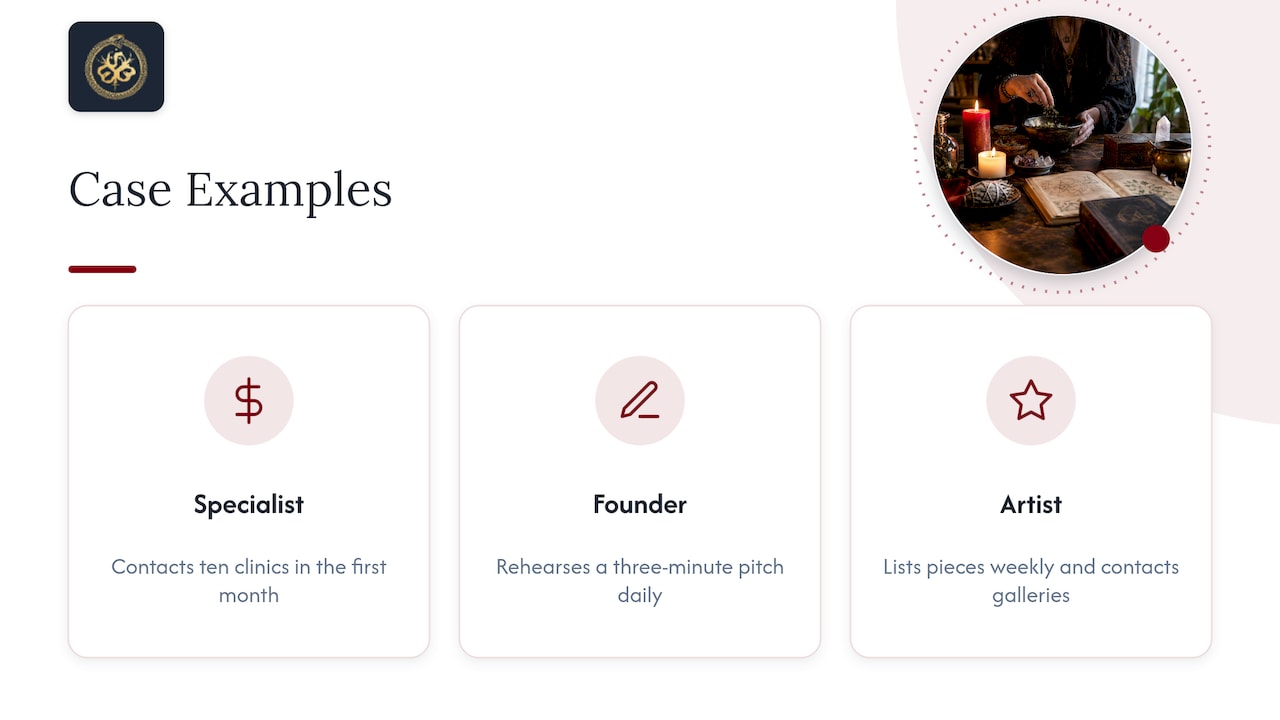
In each case the request is specific, the conversion is stated, the physical action is scheduled, and the review is dated. More spirits suited to this kind of work are ranked in our guide to demons for money, business and wealth.
Perspective
We read Zagan as the spirit of exchange. The Goetia gives him offices that run in both directions, wine into water and water into wine, blood into wine and wine into blood, and that detail tells a practitioner where to put attention. A spirit like this is not a vending machine for money. He is a partner for turning what you already hold into something more useful.
That is why we pair magickal work with real-world strategy. A conversion needs raw material. If a client brings a skill, a business, a body of knowledge, or a relationship network, there is something for the working to act on. If the material is not yet there, the first task is building it, and a spirit of transformation will respond to that effort more readily than to a bare wish.
We also hold that the sources should be read plainly. The grimoire catalogues his offices, later retellings embellish them, and personal gnosis fills the gaps. Keep those three apart and you always know which voice you are listening to.
Our Goetic and Luciferian work rests on precise intent, clear terms, follow-through and a plain review of what happened.
Black Witch Coven
Prosperity work with a Goetic spirit
For readers who want the working carried out for them, our Daemonic Prosperity Magick is a one-off ritual, and our other demon work is listed on the daemonic spell casting page.
FAQ
Is Zagan a fallen angel?
The Ars Goetia does not call him one. It gives his rank, form, legions, and offices without a genealogy. The fallen angel label comes from later Christian commentary and modern occult writing. It is not in the core text.
Who is the demon Zagan, and what does he do?
He is the sixty-first spirit of the Ars Goetia, a Great King and President with thirty-three legions. He appears as a bull with gryphon’s wings and then takes human shape. His listed offices are making men witty, exchanging wine, water, and blood, turning metals into coin, and making fools wise.
Is Zagan the same as Zagam?
Yes. Zagam is a historical variant of the name in older texts, and some manuscripts give Zagayne. Look for all the spellings in early printed references.
Where does the Zagan material first appear in print?
His first printed appearance is in Weyer’s 1577 Pseudomonarchia Daemonum, followed by Scot’s English version in 1584 and the seventeenth-century Lemegeton arrangement. The profile stayed largely intact across all three, including the 33 legions.
