
 New Years Eve Ritual 2026/2027 with Savannah
Black Magic, Blog, Protection
Left Hand Path Protection: The Five Layers of a Warded Practice

Apr
Layered protection means nesting several complementary magical defenses, wards, talismans, guardian spirits, pacts, and environmental anchors, around a person, home, or object so each layer reinforces the others. The single rule that determines whether it works: coherence beats quantity. Every layer must share one planetary and elemental tone, and none of it holds unless you handle custodianship first, cleaning the space, feeding your spirit allies, marking your boundaries, before you add ritual layers on top.
TL;DR:
- Custodianship must be maintained through regular space cleaning, offerings, and boundary mapping to ensure protection layers stay effective and grounded.
- Ward boundaries require inspection and physical marking, such as salt spread or nail placement, and should be checked periodically for physical or energetic damage.
- Reconsecrating talismans at least monthly and testing protections daily helps prevent decay and detect issues early before they cause failures.
- Pacts and guardian spirits need clear terms, ongoing negotiation, and consent to avoid resentment or broken relationships that weaken protective layers.
- Seek professional help for persistent intrusions, complex bindings, or when needing tailored rituals for targeted or high-stakes situations.
What Is Custodianship, and Why Does It Come First?
Custodianship is the ongoing relationship you keep with a place: its ancestors, its resident spirits, and its physical condition. Skip this step and every talisman you consecrate afterward is standing on loose ground. Orchis8’s household protection framework treats custodianship as the living field that makes everything else effective, not a preliminary chore you check off once.
Poor stewardship shows up as protections that seem to work for a week, then quietly stop. A ward loses its bite when the threshold it guards is cluttered with resentment, unpaid debts to spirits, or a home nobody has swept in months.
Build custodianship with a few concrete actions:
- Cleanse the physical space with smoke, salt water, or Florida Water, room by room, moving from the back of the property toward the front door.
- Set out steady offerings, water, rum, cornmeal, tobacco, on a small dish for local spirits and any ancestor you work with, refreshed on a fixed schedule rather than sporadically.
- Map your spirit team before you invite anyone new in: who already watches this space, and do they get along?
- Walk the property line (perambulation) once, chalking or salting entry points as you go, to physically mark where your custodianship begins and ends.
Pro Tip: Test the space before layering anything on top of it. Sit quietly at the threshold for ten minutes with no ritual intent at all. If the air feels sour, resentful, or simply flat, fix the custodianship problem first; a ward laid over stagnant ground will not hold.
Wards, Talismans, Guardian Spirits, Pacts, and Anchors: The Five Core Layers
Each layer does a different job, and mismatching their tone is the fastest way to sabotage the whole stack. Circle Thrice’s catalog of apotropaic techniques groups these operations into expulsion, repulsion, deflection, delay, and confusion, useful categories for deciding which layer solves which problem.
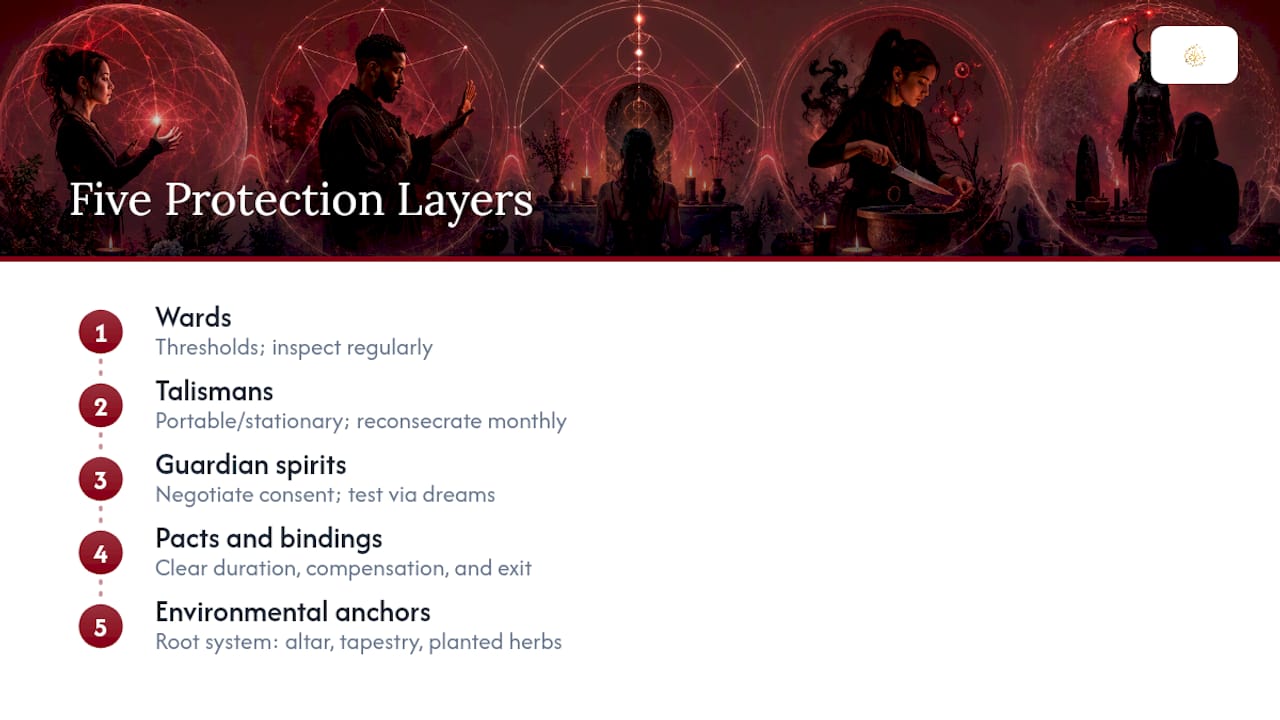
Wards live at thresholds: doors, windows, property corners. Iron nails, salt, and charcoal are traditional materials because they carry apotropaic weight across multiple traditions, not because any single one is mandatory. Draw or carve a sigil, place it where the boundary actually is, and never bury a ward you can’t check on; you need to be able to inspect it.
Talismans are portable or stationary charged objects. Between The Pillars’ consecration process walks through material selection, timing, and the ritual steps that turn an object into something that actually carries charge. Wear a talisman when the threat follows you; place a stationary amulet when the threat is tied to a location. Reconsecrate on a fixed cadence, monthly at minimum for anything doing heavy work.
Guardian spirits are a well documented category across cultures. Britannica’s overview of guardian spirits notes they often guide individuals through dreams or portents, which lines up with how LHP witches describe testing a new relationship before relying on it. Never assume consent; negotiate terms the way you would with any spirit you intend to work alongside repeatedly.
Pacts and bindings carry real weight and real risk. A minimal contract needs clear duration, clear compensation, and an exit clause both parties understand before you begin.
Environmental anchors, planted herbs at entry points, a tapestry over a vulnerable wall, a fixed altar, root the whole system in physical space, treating the “anchor” layer as the third leg of a three-part structure alongside threshold and circulatory layers.
A Complete Layered Protection Ritual You Can Perform Tonight
This ritual builds custodianship, an inner shield, a talisman, a threshold ward, and a guardian invocation into one sequence. Perform it on a Saturday (Saturn, boundaries and banishing) during the waning moon if you’re clearing something out first, or a Tuesday (Mars) if the priority is active defense.
Tools needed:
- Protection oil (or a mix of rosemary and black pepper in a carrier oil)
- One piece of black obsidian or hematite
- One iron nail
- Sea salt
- A sigil drawn on paper or carved into wax
- A small offering (rum, water, or tobacco) for your guardian spirit
- A black or white candle
Steps:
- Cleanse the room. Smoke or salt water, moving clockwise from the far corner to the door.
- Set the household boundary. Sprinkle salt across every threshold, speaking your intention aloud once per doorway.
- Weave the inner shield. Sit, breathe slowly, and visualize a dark, close layer of protection forming around your body, three breaths in, three held, three released.
- Consecrate the talisman. Anoint the obsidian with protection oil, name its purpose aloud, and pass it briefly through the candle flame.
- Set the threshold ward. Press the iron nail into the doorframe or bury it just outside the entrance, sigil facing outward.
- Call the guardian spirit. State your request plainly, leave the offering, and wait for a sign of acceptance, a shift in temperature, a sound, a feeling of settling.
- Seal the working. Close the circle of salt, extinguish the candle, and speak a closing line acknowledging the work is done.
- Test it. Return the next day and check whether the space feels different: calmer, heavier, more defined.
Safety and revocation: Always ask consent before binding a spirit to ongoing service; forced servitude invites resentment that erodes the ward from inside. If a working needs to be undone, use a short banishing: salt water at the affected point, a clear verbal revocation (“I release this working, this bond is closed”), and a fresh cleanse afterward.
Pro Tip: Never skip the test step. A protection that hasn’t been checked is a protection you’re only assuming works.
Keeping Layered Protection Working: Maintenance and Repair
Protection decays without upkeep. Orchis8’s stewardship framework is explicit that this is long-term maintenance, not a spell you cast once and forget.
Check daily by sensing the threshold when you walk through it. Check weekly by inspecting wards for physical damage or displacement. Check quarterly with a full reconsecration pass across every talisman in the stack.
- A talisman that feels cold or inert has stopped carrying charge and needs discharging, reconsecrating, or replacing outright.
- Sudden emotional drain in one room, but not others, usually points to a localized intrusion at that specific boundary point.
- Recurring nightmares or a guardian spirit that stops responding to offerings often signals the relationship needs renegotiating, not abandoning.
Between The Pillars is direct on this point: never repurpose a “dead” talisman for a new intention without a full cleansing first, cross-contaminated charge causes more problems than it solves.
| Sign | Likely cause | Fix |
|---|---|---|
| Talisman feels cold | Charge depleted | Discharge and reconsecrate |
| Localized cold spot or drain | Ward breach at that point | Inspect and repair the specific boundary |
| Guardian spirit unresponsive | Neglected relationship or broken terms | Renegotiate offerings and terms |
| Recurring nightmares | Intrusion or unresolved binding | Targeted banishing, then journal the pattern |
Journaling after every check helps you notice slow drift before it becomes a full failure. If a repair attempt doesn’t hold after two tries, or the intrusion involves something you can’t identify, that’s the point to bring in outside help.
What Serious Occultists Get Wrong About Layered Protection
Many people seeking protection work have already tried a scattered mix of wards, salt, and half-remembered chants, and wonder why none of it held. The answer is almost always the same: they added layers that didn’t share a tone, or they skipped custodianship entirely and expected a talisman to compensate.
Pacts and guardian invocations carry weight that DIY guides tend to understate. Negotiating with an entity for ongoing service without clear terms, without an exit clause, is how magicians end up bound to something they can’t easily release. Experienced witches working directly with entities such as Lucifer, Andras, Clauneck, and Astaroth find that confidentiality and clear terms protect the witch as much as the spell protects the client.
— Black Witch Coven
When to Bring In Professional Protection Work
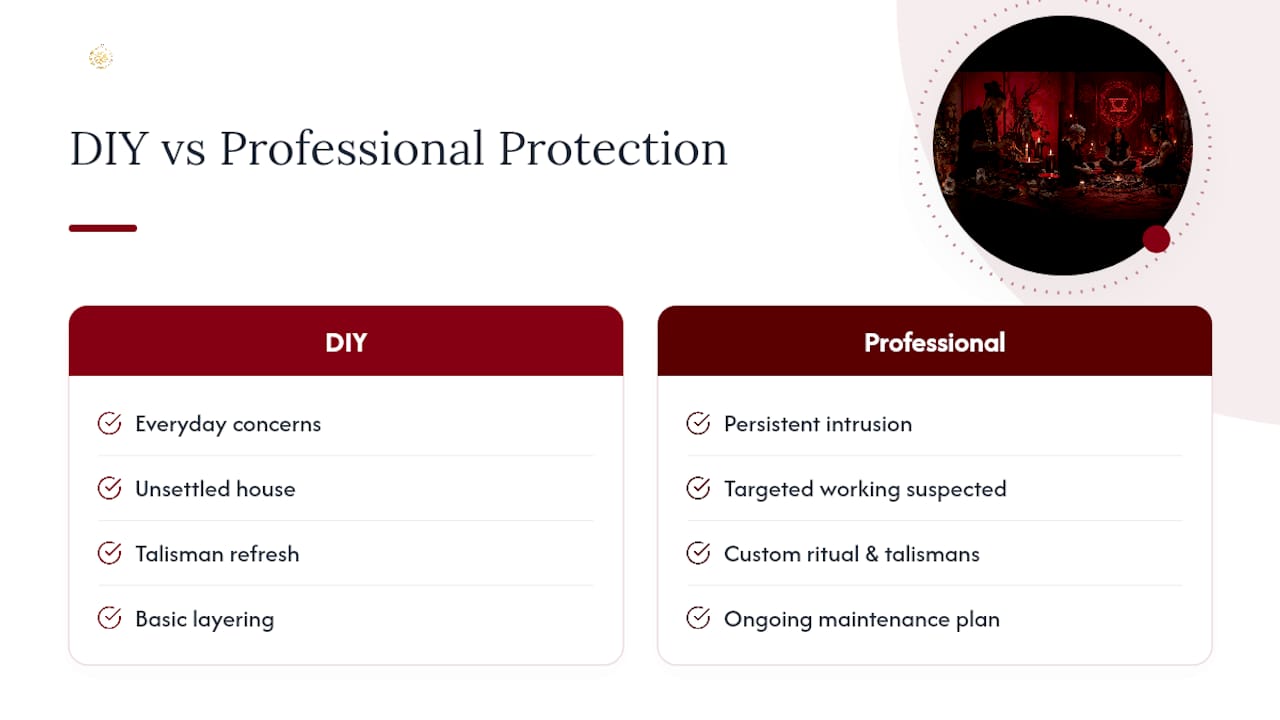
DIY layering handles most day-to-day concerns: a house that feels unsettled, low-grade psychic drain, a talisman that needs refreshing. Hire a professional when the intrusion is persistent, when you suspect a targeted working aimed at you, or when the fix requires a pact or binding you don’t have the standing to negotiate safely on your own.
A professional engagement with an experienced spiritual service typically includes a custom ritual built around your specific situation, talismans consecrated for your exact circumstances, and an ongoing maintenance plan so the protection doesn’t quietly decay the way unattended DIY layers often do. If something you cast has already gone sideways, the first move is often reversal, not another layer on top of a working that’s fighting itself; our guide on how to break a spell you’ve cast walks through what that process actually involves.
If you’re weighing whether your situation needs a full protection working, consider seeking advice from qualified sources. Serious cases deserve a serious response, not another candle spell pulled off a blog.
Sources
- guardian spirit — Britannica
- Layers of Protection – Orchis8’s Substack
- Protection and Energetic Hygiene | Circle Thrice
- Making Occult Talismans and Charms (properly) – Between The Pillars
FAQ
What Is the Most Important Principle in Layered Protection?
Coherence. Every layer, ward, talisman, guardian spirit, needs to share the same planetary and elemental tone, or the layers work against each other instead of reinforcing one another.
Do I Need a Guardian Spirit for Basic Home Protection?
No. Wards, talismans, and solid custodianship handle most everyday concerns; a guardian spirit adds ongoing, active defense best suited for persistent or targeted problems.
How Often Should I Reconsecrate a Talisman?
For a talisman doing heavy protective work, reconsecration is recommended regularly, and whenever it feels cold, inert, or unresponsive to charging.
Can I Undo a Protection Working If It Backfires?
Yes. A short banishing, salt water at the affected point plus a clear verbal revocation, can close most workings; complex pacts or bindings often need professional reversal work.
When Should I Hire Black Witch Coven Instead of Doing It Myself?
When you’re facing a targeted intrusion, negotiating a pact you don’t have experience structuring safely, or your DIY layers have already failed more than once without a clear cause.
