
 New Years Eve Ritual 2026/2027 with Savannah
How Do People Become Possessed?
Possession and serious spiritual attachment rarely arrive without conditions that make them possible. Some of those conditions are obvious. Many are quieter and more ordinary than people expect. This page looks at the main routes we see, the states that increase vulnerability, and the mistakes that repeatedly lead people into difficulty.
MOST COMMON
Curses and Magical Attack
One route that is often underestimated is directed magical work. A person may have done nothing to invite a spirit, yet still end up dealing with serious interference because someone else sent it.
Curses, domination work, binding, or deliberate sending of a spirit can create attachment or oppression that the target did not open themselves.
In these cases the influence feels imposed rather than invited. Catholic exorcists frequently list this as a major cause, and in practical experience it accounts for a noticeable number of difficult cases.
Generational and Family Patterns
Some openings appear to run in families. This can involve unresolved ancestral agreements, repeated patterns of spirit contact across generations, or simply a family field that has remained porous for a long time.
In these situations heavy attachment or possession-type symptoms may show up in more than one family member over different periods. The person experiencing it may have no personal history of occult practice, yet still find themselves dealing with something that seems to have older roots.
Persistent Internal Conflict
Living in ongoing serious conflict with the sacred, or maintaining a deliberate stance of rejection toward it, is considered a significant vulnerability. While we do not frame the issue in exactly the same religious terms, there is a practical observation that sits nearby: people who remain in deep internal division, chronic self-rejection, or prolonged hostility toward any coherent spiritual framework often present with weaker energetic boundaries. That state can make external influence easier to establish and harder to clear.
Unprepared Contact with the Spiritual World
Any practice that opens a line of communication with the other side carries potential risk if the person lacks the capacity to manage what responds.
This includes people who believe they are only doing light, positive, or high-vibration work. Intention alone does not function as automatic protection. Making contact is making contact. If the practitioner does not have the energetic strength, discernment, or technical skill to recognise unwanted influence and close it cleanly, they can end up hosting something they did not invite and do not know how to remove.
Tarot cards are not demonic by nature. For someone who understands protection, discernment, and how to close a reading, they remain a useful tool. The risk appears when an inexperienced person opens themselves completely, assumes every message comes from a benevolent source, and has no way to recognise or dismiss unwanted influence. In those conditions, the cards can become another channel through which something less helpful begins to speak.
Ouija boards and similar tools are often treated as games. That is where the danger begins. The board itself is not automatically evil, but it is a direct line of communication. When it is used without skill, protection, or the ability to close the session properly, it can become an open door.
Demons are skilled at imitation. They may present as a deceased relative, a lost child, or a friendly spirit that needs help. Compassion and curiosity then become the opening. Once trust is established, the contact can intensify. The person becomes preoccupied, moods shift, energy drains, and the presence grows harder to ignore. By the time the person realises something is wrong, the connection may already be strong.
Used with knowledge and clear boundaries, these tools are not inevitably disastrous. Used carelessly, especially by those who are fearful, lonely, or desperate for contact, they can create lasting problems.
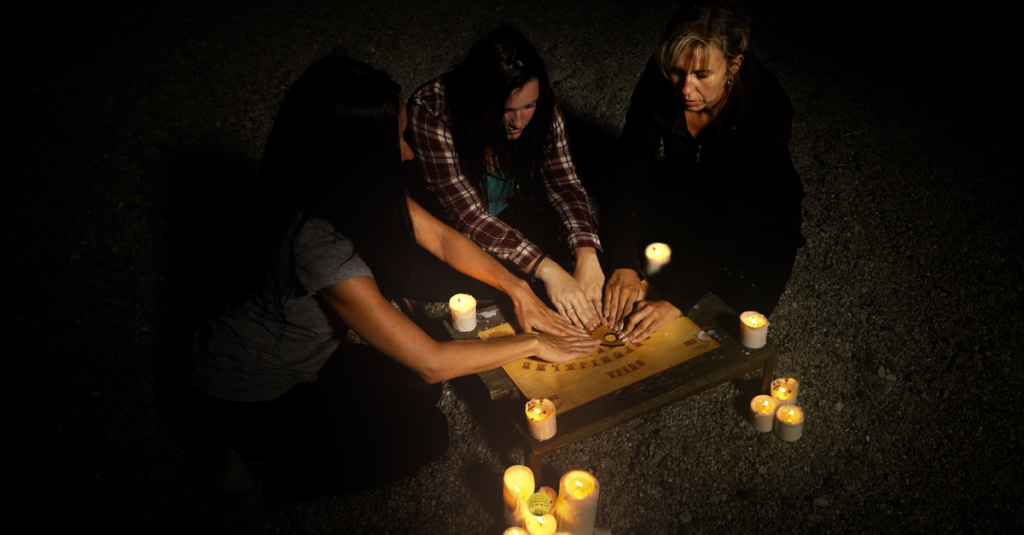
But look, we totally get it, and for the majority of people who use these boards, nothing at all is going to happen. If you are already facing some other type of problems, maybe your vibration is quite low at that time, and you interact with one of these tools, then you might open up some doors that you don’t wish to enter.
Pacts and the Problem of Changing Your Mind
Some people enter formal or informal agreements with spirits when they are desperate for a result. The request may be for love, money, success, protection, or relief from crisis. The spirit agrees, sometimes with conditions or time limits attached. Once the person receives what they wanted, or once their circumstances change, they often try to walk away from the arrangement.
This is frequently more difficult than they expect. A change of heart does not automatically cancel the agreement. Spirits do not operate on human timelines or human regret. Some people run to a priest or attempt a simple verbal cancellation and discover that the connection remains. Proper revocation is possible, but it usually requires more than words spoken once. The original terms, the length of the relationship, and the nature of the being involved all affect how complex the process becomes.
This is one reason we advise clarity before entering any formal pact. What feels temporary to a human may not feel temporary to the spirit.
Disrespect and Divided Systems
Disrespect is a consistent factor in many difficult cases. This includes treating spirits as tools, making demands without relationship, or approaching the work with arrogance and entitlement.
A particularly common pattern is people attempting to work with demons or spirits for results while continuing to operate inside a Christian or strictly “light” framework at the same time. They may request help from a spirit and then go to church asking for protection from that same being, or asking Jesus or God for the same outcome. This split creates instability. It signals to the forces involved that the person is inconsistent and unreliable. In some cases it produces friction, resistance, or deeper entanglement.
Many of the more serious cases that eventually reach priests appear to begin in exactly this kind of divided behaviour. The person has one foot in spirit work and the other in a system that condemns it. That internal conflict itself becomes a point of weakness.
Clarity and consistency are forms of respect. Trying to keep one foot in two opposing currents is one of the quieter ways people create lasting problems for themselves.
Visiting Charged or Haunted Locations
Going into places known for heavy or residual energy with the desire to experience something can function as an invitation. The person arrives open, curious, and often unprotected. Not every presence in such locations is a demon, but some are opportunistic. People who repeatedly seek out these environments without knowing how to shield themselves increase their exposure.
We have had many cases where people said they had a spirit follow them home from a hospital or from a cemetery. Yes, it can be true, but it really has more to do with that person and what they’re going through versus where they visited.
CHALLENGING REASONS
Depression, Depletion, and the Lowered Field
This is one of the most important factors and one of the least honestly discussed.
A person living with long-term depression, chronic anxiety, unresolved trauma, or deep emotional exhaustion often carries a depleted energetic field. The system is already under strain. Natural boundaries that would normally keep external influence at a distance become thinner and more porous. In that state it is easier for heavy residual energy, opportunistic intelligences, or organised external pressure to settle in and begin affecting mood, thought patterns, and behaviour.
What begins as familiar depression can slowly take on a different quality. Intrusive thoughts become more persistent and more alien. The sense of being weighed down starts to feel directed rather than purely internal. The person may not notice the shift clearly because it feels continuous with the suffering they already know. This is why long-term mental and emotional depletion is such a significant risk factor. It does not guarantee possession, but it creates an environment in which takeover becomes more possible.
We must also speak carefully about psychiatric illness. Not every case of schizophrenia, psychosis, or severe mental disorder begins as spiritual interference. Many have purely neurological or psychological roots. At the same time, there are cases in which an initial spiritual intrusion is later interpreted and treated only as psychiatric illness. The overlap is real. Some people are dealing with both at once. This is why accurate assessment matters so much. Assuming every intense internal experience is possession is unhelpful. Assuming none of them ever are is equally unhelpful.
Most people who explore the occult, read about spirits, or perform basic magical work never become possessed. Skill, respect, consistent boundaries, and the ability to close what you open make a real difference. The cases that escalate are usually those in which an opening was created and then left unattended, or in which the person approached the work with fear, desperation, or divided loyalty.
Honestly, sometimes it’s the wrong place at the wrong time…..
2 thoughts on “How do people become possessed?”
Leave a Reply
You must be logged in to post a comment.
Spirits can notice a person and still choose to ignore them. Attention alone does not automatically lead to entry or takeover. An open invitation changes the situation. When someone deliberately asks to be taken over, ridden, or possessed, they are removing the usual boundaries that keep contact limited. In structured magical work we invoke and evoke spirits inside a framework of preparation and control. The practitioner remains the one directing the exchange. What you are describing is different. An unrestricted request to be possessed removes that structure. What tends to respond is often a lower or opportunistic entity rather than a refined intelligence interested in a balanced working relationship. The result is rarely the intense or desirable experience people imagine. More commonly it leads to exhaustion, depletion, and a gradual loss of clarity and energy. Many who go down this route eventually look for help because the state becomes difficult to sustain. Controlled contact and uncontrolled takeover are not the same thing. One can belong to a disciplined practice. The other tends to diminish the person over time.
Also they ask the Demon into them. Good guy Demons Come into me please Take possession of me Take me captive Ride me my Masters