
 New Years Eve Ritual 2026/2027 with Savannah
Blog, Candle Work, Divination
Reading Candle Glass: Five Steps to Consistent Readings After a Burn
Feb
A candle glass reading tells you how a working is moving by combining three signals: what the flame does while it burns, how the smoke and soot behave, and what the wax and glass look like once the candle burns out. A clean glass with light residue usually points to an easy path; heavy soot, thick wax rings, or a cracked jar usually point to resistance. Readings are most trustworthy when you control for drafts, wick quality, and additives first, since those mechanical factors cause far more “signs” than most people realize.
Where Candle Glass Reading Comes From
Reading fire for meaning goes back centuries across dozens of traditions, but the version most witches use today grew out of vigil and novena candle work, Hoodoo, and other folk magick practices where a fixed glass jar became the standard container for petition candles. Three older methods feed into it: pyromancy studies the flame itself, capnomancy reads smoke, and ceromancy interprets wax. When you combine all three for a glass-encased candle, the practice is often called capno-ceromancy, or more plainly, candle glass reading.
Glass changes the picture. A jar traps soot against its inner wall instead of letting it disperse, holds heat differently than an open taper, and pools wax at the base rather than letting it drip away. That means a glass candle preserves a record of the whole burn in a way a freestanding candle never does, which is exactly why 7 day and vigil candles are the preferred tool for serious readings.
How to Prepare and Run a Candle Glass Reading
Getting a usable reading starts before you ever strike a match. Sloppy setup is the single biggest reason readings get muddled.
- Write and place your petition. Word it plainly, dress or fix the candle if that’s part of your practice, and set it where it will burn undisturbed for its full duration.
- Trim the wick. Cut it to about a quarter inch before lighting. Long or crooked wicks throw off carbon and mimic “resistance” signs that have nothing to do with the working.
- Control the environment. Kill drafts from vents, fans, and doorways, and keep the room temperature steady. If you’re burning more than one candle, decide beforehand whether you’re reading them as a pair or independently, and keep them the same distance apart each time.
- Observe on a schedule. Check the candle at set intervals rather than only at the very end. Photograph each check so you have a real timeline, not just a memory of “it looked different earlier.”
- Extinguish safely. Snuff rather than blow out when you need to pause a burn, and never leave a glass candle unattended near flammable material.
Pro Tip: Keep a burn log with the date, moon phase, candle type, and a quick sketch of the flame and wax pattern. Patterns only reveal themselves after you have several burns to compare, not one.
Wick condition, drafts, and scented additives are the usual suspects behind misleading soot and flame color, so rule those out before you read anything as spiritual.
What Does Flame Height and Movement Mean?
Flame behavior is the fastest signal to read and the easiest to misread, so check mechanical causes before you assign meaning.
Height matters most relative to the candle’s normal burn, not in isolation. A consistently tall flame often reads as strong momentum or force behind the work, while a low, struggling flame suggests slow progress or a working that needs more energy behind it. Before calling either one a sign, check the wick length and whether the candle is a low-melt-point wax that naturally burns lower.
Movement tells you about the energy in motion. A steady, upright flame is generally read as favorable and unobstructed. A flame that dances or flickers points to active energy, which could mean the situation is in motion or that something (a spirit, an outside influence) is stirring things up. A flame that jumps sharply or repeatedly usually signals instability, and it’s worth checking for a draft before reading it as anything else.
- Color: white or blue-tinged flames are commonly read as positive or as a sign of spirit presence; heavy black smoke trailing off the flame points toward resistance or opposition. Be careful here. Scented oils and dyed wax change flame color on their own, so a colorful flame from a heavily scented candle tells you about the candle, not the working.
- Split or dual flames: a flame that visibly splits into two tongues is often read as divided energy, or as two people or forces involved in the situation.
- Leaning: a flame that consistently leans one direction, with no draft to explain it, is frequently interpreted as forces aligning toward or resisting away from that direction.
Occultists who work with sound as a sign note that crackling or popping during a burn is sometimes read as a spirit attempting to communicate, or as friction in the work. Check the wick and wax additives first. A cheap wick or a bit of trapped moisture will crackle just as easily as anything spiritual will.
What Do Smoke and Soot Colors Mean?
Smoke and soot build a timeline you can read after the fact, which makes them more reliable than a single flame flicker you might have missed watching live.
- Black smoke or heavy soot generally reads as resistance, opposition, or obstacles working against the petition.
- White or light gray smoke tends to read as ease, assistance, or a working moving without much friction.
- Soot that starts black near the top of the glass and clears further down is read as resistance the working pushed through early on, eventually clearing the path (a pattern noted by magicians at Reading Glass Candles).
- Soot confined to one side of the glass often points to a localized obstruction, sometimes tied to whatever correspondence that side of the jar represents in your setup.
- Sudden puffs of smoke partway through a burn are frequently read as a spike in resistance or a moment of confrontation in the unseen work.
None of this means much if the candle itself is the problem. Loose herbs, glitter, or crushed botanicals dropped into the wax will smoke and char in ways that have nothing to do with spiritual resistance, and a cheap braided wick sheds carbon constantly regardless of how the working is going. Rule out the candle before you rule on the meaning.
Reading the Leftover Wax and Glass
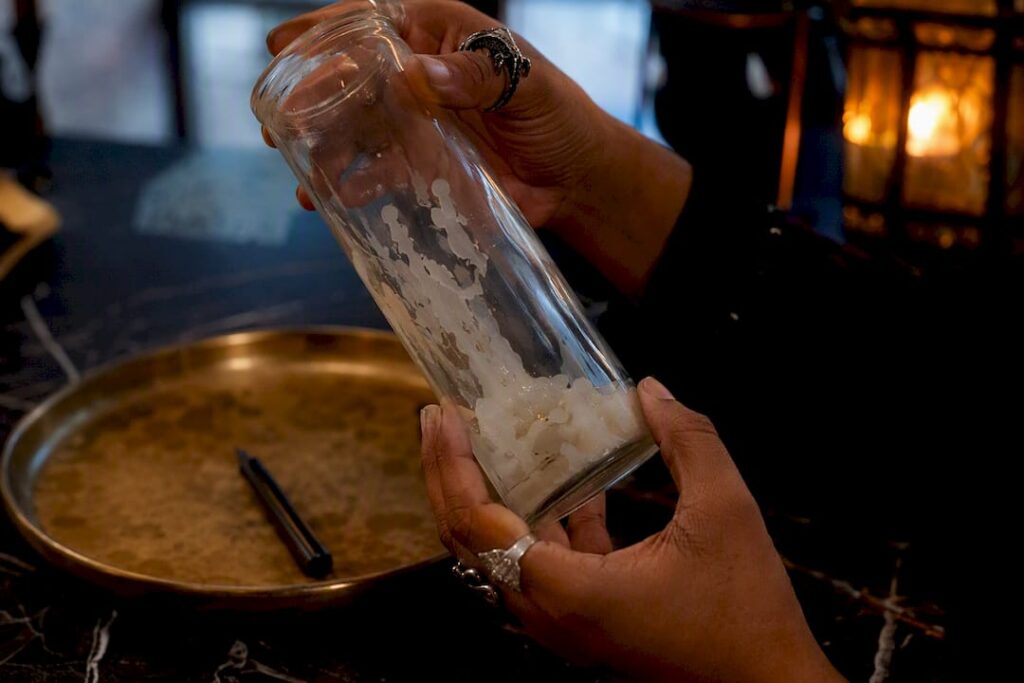
Once the candle burns down, the glass itself becomes the record. This is ceromancy applied to a container rather than to poured wax, and it’s arguably the most information-dense part of the whole reading.
Work top to bottom. Scan for rings, horizontal bands, and vertical streaks running down the inside of the glass, since each layer roughly corresponds to a stage of the burn and, by extension, a stage of the working.
- A clear glass with only a small residue of wax at the bottom is traditionally read as a favorable, clean burn, suggesting the petition moved with little to fight against.
- Thick wax clinging to one side of the jar suggests lingering resistance on that side, especially if it never fully melted down during the burn.
- Streaks running from top to bottom often get read as a path the energy took, worth comparing against where you placed correspondences (herbs, oils, images) inside or around the jar.
- A ring of unmelted wax at the very top that never came down can indicate a working that stalled early and needs reinforcement.
- Bubbles or air pockets trapped in the cooled wax are sometimes read as trapped energy or unresolved tension in the situation.
Cracked or broken glass deserves its own category, because it carries both a divinatory and a physical warning. A hairline crack that appears during the burn is often read as significant opposition or a sudden shift in the working’s resistance. Full breakage, glass actually shattering or splitting apart, is treated as a serious sign in most traditions and, more urgently, a real safety hazard. Clear the area, extinguish the flame safely if it’s still burning, and don’t try to salvage a reading from broken glass while it’s still hot or unstable.
How Do You Read Shapes and Numbers in Wax?
Shapes in cooled wax attract the most attention online and cause the most bad readings, mainly because so many sites treat symbol-spotting like a fixed dictionary: see a heart, get love; see a skull, get death. That approach falls apart fast in practice, since the same blob of wax can look like five different things depending on the angle you’re viewing it from.
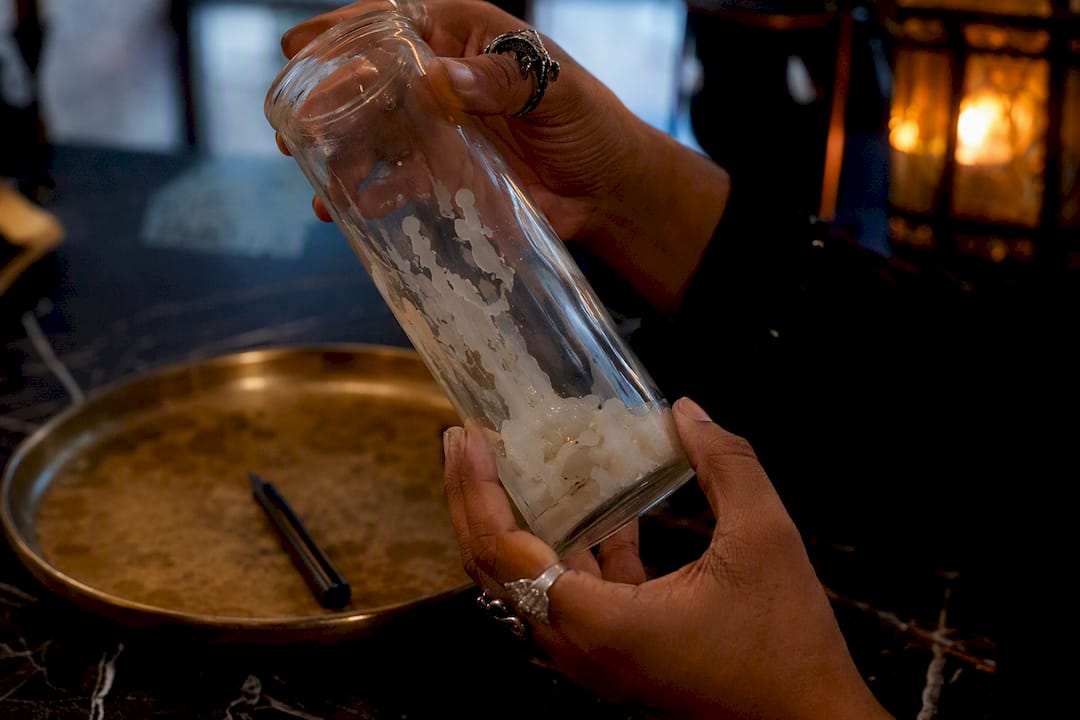
A better method starts with your intention, not the shape. Note what you see, then ask how it relates to the specific petition you set, not to some generic symbol list. From there, apply simple correspondences: elemental associations (wavy shapes for water/emotion, jagged shapes for fire/conflict) or basic numerology if you’re counting repeated marks, bubbles, or drip lines. Testing the same sign across multiple burns before trusting it matters more than any single dramatic shape.
A spiral often reads as a situation still unfolding or cycling. A tear-shaped drip near a name or photo suggests grief or loss tied to that person. Three repeated marks or bands might carry numerological weight specific to your system. Weigh each sign against the whole burn rather than fixating on one striking image.
Reading Paired and 7-Day Vigil Candles
Two candles burned together read as a conversation. If they burn evenly and finish close to the same time, that generally points to balance between the parties or forces involved. One candle burning noticeably faster, sootier, or more erratically than its partner suggests an imbalance, opposition, or one side dominating the situation.
For 7-day or long vigil candles, resist judging the whole working from one bad morning. Photograph the candle at intervals and read the finished glass as a complete story, top to bottom, rather than fixating on a single sooty patch you noticed on day two. A single dramatic sign, a crack, a sudden color shift, matters more when it’s consistent with everything else you’ve documented. When it stands alone against an otherwise clean burn, treat it as a footnote, not the headline.

Field Notes on Reading Candle Glass Reliably
After years of running these readings for our own clients and reviewing burns clients send us from their home altars, a few things stand out that generic guides tend to skip.
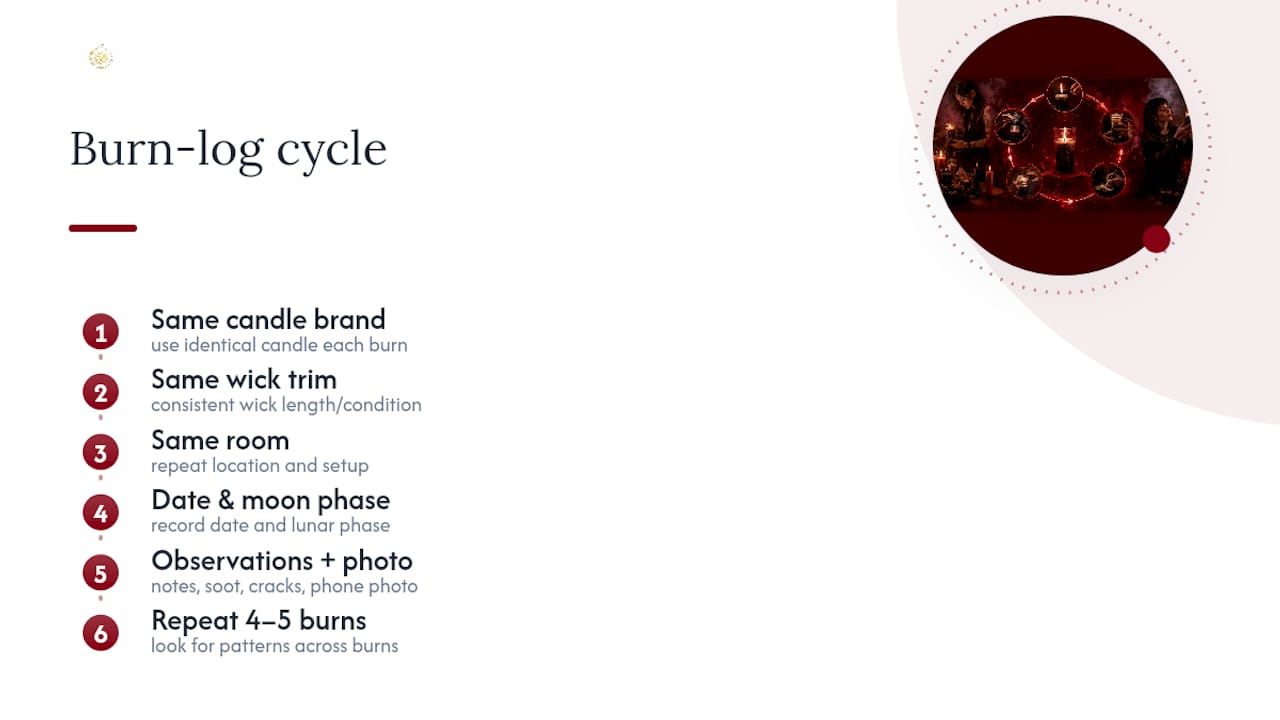
Replicate your conditions every time you read a candle. Same brand of candle, same wick trim, same room, when possible, because inconsistency in setup is the number one reason two readings of the “same” working look contradictory. A burn log solves this. Even a rough one, date, moon phase, what you observed, a phone photo, turns guesswork into pattern recognition after four or five burns.
On safety: never handle a cracked or shattered glass candle while it’s still hot, and never leave a multi-wick or glitter-dressed candle burning unattended, since those additives are common fire hazards as well as reading confounders.
On ethics and expectations, treat every reading as a sign to work with, not a guarantee. A clean glass tells you the energy moved without much friction; it doesn’t promise a specific outcome on a specific date. When a burn keeps coming back sooty, cracked, or unresolved across multiple attempts despite a clean setup, that’s usually the point to bring in someone with more hands-on experience rather than keep repeating the same ritual and hoping the glass clears on its own.
Where to Learn More About Candle Reading
Cross-reference a few sources and keep your own log to see which correspondences actually hold up for you over time. Your own burn records, kept honestly, will teach you more than any picture gallery.
Why Most Candle Glass Guides Get the Order Wrong
Most guides to candle glass reading front-load the symbol dictionary, the heart shapes and skulls and lucky numbers, because that’s the flashy part. That’s backward. The actual skill is ruling out mechanical noise first: wick quality, drafts, additives, glass shape, and only then reading what’s left as signal.
The conventional advice also treats a single dramatic sign, one puff of black smoke, one cracked glass, as the whole verdict. In practice, the pattern across several burns tells you far more than any one striking moment, the same way one bad quarter doesn’t define a business. A witch who burns the same petition three times and sees the soot clear a little more each time has better information than someone who panics over one sooty vigil candle and calls the whole working cursed.
If you’re serious about this practice, prioritize consistency over drama. Set up the same way every time, log what you see plainly before you interpret it, and only trust a sign once it repeats. The reader who does that will out-diagnose the reader chasing shapes in melted wax every single time.
— Black Witch Coven
When a Candle Reading Points to Deeper Resistance
A candle glass reading that keeps coming back sooty, uneven, or cracked despite a clean setup is usually telling you the resistance runs deeper than a single petition candle can clear. That’s often when more advanced ritual work may be needed, since the situations that show up as stubborn black soot burn after burn often require a stronger, custom-built working rather than another attempt at the same jar candle.
If your readings keep showing the same obstruction, read through common reasons a spell backfires to see whether the resistance you’re seeing in the glass lines up with known patterns. Consider seeking guidance to discuss what your readings might be indicating and what a targeted working could look like for your specific situation.
Sources
FAQ
How Do You Know If Your Candle Spell Is Working?
Look for a flame that burns steady and upright, light-colored smoke, and a glass that clears mostly clean by the end of the burn. Consistent black soot, an unusually low flame, or heavy leftover wax across more than one burn suggests the working is meeting resistance.
What Is Candle Reading?
Candle reading is the practice of interpreting a candle’s flame, smoke, soot, and leftover wax for divinatory meaning. When it’s done on a glass-encased candle by examining all of these signs together, it’s specifically called candle glass reading, or capno-ceromancy.
What Is the Spiritual Meaning of a Candle Burning Slowly?
A slow, low burn is generally read as sluggish progress or a working that lacks enough energy behind it, though a low melt-point wax or a short wick can produce the same effect mechanically. Rule out the candle type before reading it as a spiritual sign.
How Do I Read My Candle Flame?
Watch its height relative to a normal burn, whether it moves steadily or flickers and jumps, its color, and whether it splits or leans consistently in one direction. Combine what you see with the smoke color and the wax left behind for a fuller candle flame reading rather than judging the flame alone.
