
Blog, Demons, Working With Demons
Haures Demon (Flauros): History, Seal and How to Work With Him
Oct
Haures is the sixty-fourth spirit of the Ars Goetia, a Great Duke who commands 36 legions, appears first as a leopard and then as a man with flaming eyes. He is also the same spirit that Johann Weyer called Flauros in 1577. The Goetia says he gives true answers about the past, present and future, but only when he is constrained in the triangle, and it credits him with the power to destroy the magician’s enemies. Modern practitioners have taken that profile in two directions: some keep the old coercive method, and others approach him devotionally for justice, protection and clarity. His entry on our Haures Demon Directory page gives the summary. This article covers the names, the texts, the seal, the historical method, and how to build a working relationship with him today.
One spirit, several names
Haures also goes by Hauras, Havres, Flauros, Flavros and Flereous. The pattern looks confusing, but the textual record is simple. The 1904 Mathers and Crowley edition heads the entry with “Haures, or Hauras, or Havres, or Flauros”, and treats all four as names of a single spirit. The Goetic form Haures is the counterpart of Weyer’s Flauros, with Hauras and Havres appearing as variants in Lemegeton manuscripts.
The spread of spellings across the tradition is easy to chart. Flauros appears in Weyer, Scot and Sloane, Mathers gives the H-forms alongside it, and de Plancy gives Flauros or Flavros. The H-forms are generally explained as a scribal corruption of the older name. This matters for anyone doing research. When a modern writer treats Flauros and Haures as two different demons, with separate personalities and separate rites, the whole structure rests on a transcription difference.
One layer stands apart. In Traditional Demonolatry, the spirit is associated with a divinity called Flereous, and the tradition builds its own system of correspondences around that name. That is a living modern current with its own texts, not a fourth manuscript spelling. If you read a Demonolatry book, you are reading a different layer of the same figure, so note which layer each claim belongs to. Our Haures (Flereous) Oil is made for that devotional current.
What the Goetia says about him
The description in the Ars Goetia is short, which is part of why later practitioners have had so much room to interpret. Here is what the text commits to.
- Rank: Great Duke, sixty-fourth in the order of the seventy-two spirits.
- Following: 36 legions.
- Appearance: first a mighty, terrible, strong leopard, then, at the magician’s command, a man with flaming, fiery eyes and a terrible countenance.
- Office: true answers about things past, present and to come.
- Condition: he gives those answers only if he is forced into the triangle. Unconstrained, he lies and deceives the exorcist.
- Destructive power: the text says he can burn up the enemies of the magician. It also credits him with talk of the creation of the world and the nature of divinity, which is an unusual pairing of the philosophical and the martial.
Notice the structure. The Goetia does not describe a spirit who is friendly, neutral or helpful by default. It describes a spirit whose truthfulness is a function of the operator’s control. That is the central claim of the entry, and every later interpretation has to decide what to do with it.
Weyer’s version
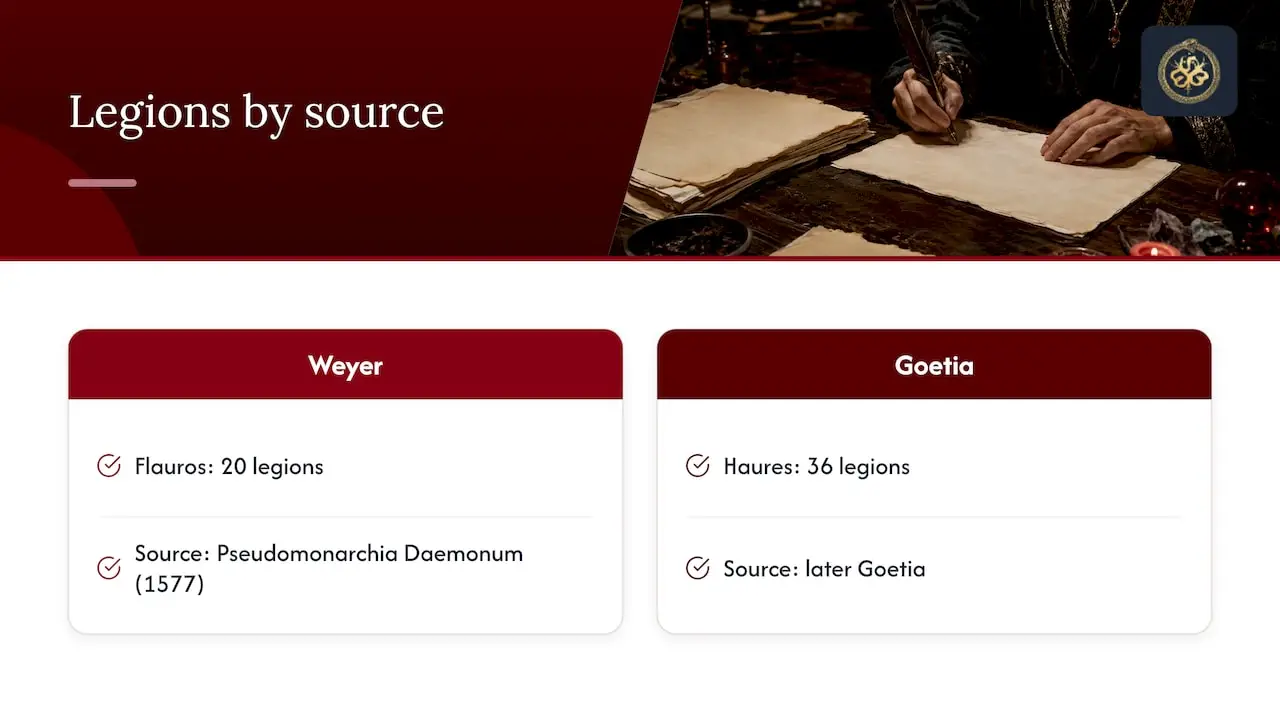
The older source gives a different headcount. Weyer’s Pseudomonarchia Daemonum of 1577 gives Flauros 20 legions, where the later Goetia gives 36. The difference is a useful reminder that the Goetia is a compilation, edited and expanded from earlier lists. If you want to understand what is original to the spirit and what is a later editor’s addition, compare the two entries line by line, noting the number of legions, the order of appearance and the added material about the triangle. An hour with both texts teaches more than any number of secondary summaries.
The seal and how it is used
Haures has a single seal in the Goetia. The Mathers edition reproduces it, and the instruction is that it be worn as a lamen. A lamen in this context is a piece of metal, parchment or paper worn on the chest during the operation as a badge of authority over the spirit.
This detail is easy to skip over. In the historical frame the seal is not an amulet that attracts the spirit or a logo for devotion. It is a credential. The operator wears it to show the spirit that he or she holds the authority to command. The modern habit of drawing the seal on an altar candle, engraving it on a talisman for personal protection, or setting it as a phone wallpaper reverses that logic. Those uses suit a devotional approach. Choose them on purpose, with the original function in mind.
If you are preparing a seal for your own use, copy it from the Mathers plate or from a manuscript facsimile, not from a redrawn image of unknown origin. Small errors in a redrawn sigil accumulate quickly, because each copyist smooths what he does not understand. Work at a scale large enough that you can draw each line deliberately, and keep the proportions consistent with the plate.
Why the triangle matters
The historical method rests on constraint. The magician stands in the circle, the spirit is called into the triangle outside it, and the operator compels him by divine names and the authority of the seal, as set out in the conjuring method from the Goetia. Haures is one of the spirits for whom the Goetia specifically says the triangle is the condition of honesty. Without it, you are talking to a liar.
This is the most interesting part of the entry. The text assumes that a spirit’s speech is unreliable unless the setting forces reliability. That is a verification problem, and any working magician has met it: the vision that flatters you, the message that happens to confirm what you wanted, the answer that cannot be tested. The grimoire’s solution is procedural. The modern solution is usually practical. Whichever you choose, the discipline is the same: make the answers checkable.
A method for checkable answers
- Write the question before the working, in a form that can be answered yes or no, or with a specific fact.
- Record the answer immediately, in the words you received it, before interpreting.
- Separate answers you can check within days from answers that concern the future.
- Check them. Score the spirit’s accuracy the way you would score any source.
- After a dozen workings, you have a track record. Rely on the spirit only as far as the record supports.
A practitioner who asks Haures about a lease dispute, for example, might ask which of three clauses the landlord’s lawyer will rely on. A week later the response letter arrives, and the answer is right or wrong. That is a small, honest test, and it does more to establish trust, or reveal its absence, than any amount of atmosphere in the room.
How contemporary practitioners work with him
The modern picture differs from the historical one. Contemporary practice often approaches Haures devotionally, with specific requests for justice and protection, where the grimoire method was strictly coercive. Modern demonolatry also uses an enn, “Ganic tasa fubin Haures”, which does not appear in the old grimoires.
In practice, the experience reports cluster around a few themes. Practitioners describe him as an intense, angry spirit, well suited to protection, baneful work and spiritual ascendancy. Others suggest pairing him with another spirit when the goal is to remove an enemy, with Haures supplying the offensive force and a second spirit supplying defense. These come from personal experience rather than the grimoire.
Three working profiles
Protection. The simplest modern use is protective. The spirit’s fire is directed outward at whatever threatens the household or the person. A working here is steady and repeated, not a single dramatic event. A candle, the seal, a short invocation and a plain statement of what you want guarded is enough, repeated on a schedule.
Justice and opposition. The Goetia’s line about burning enemies has made him a favorite for legal disputes, harassment and workplace conflicts. The sensible way to work this is to combine the ritual with documentation and counsel. A person facing a hostile boss who keeps a dated record of incidents, files a complaint, and runs a weekly Haures working is giving the working a channel to travel through. Ritual without a route tends to produce noise. Ritual with a route can produce a result.
Divination and truth-seeking. This is the closest to the historical office. You bring specific questions, you set up conditions that discourage self-deception, and you test the answers as above. This is also the profile that most clearly benefits from a consistent practice: ten sessions teach you what his communication feels like in your own perception, and what feels like your own wishful thinking.
Setting the room
A simple devotional session needs very little. Keep the space clean, keep the lighting low, and use a single flame as the focal point. The choice of candle matters more than people expect, because a cheap one smokes, sputters and distracts a mind that is trying to hold a long silence. Then proceed in order: ground yourself, light the flame, state your purpose plainly, speak the enn or a short invocation of your own, hold the silence for ten to twenty minutes, and close by thanking the spirit and extinguishing the flame deliberately.

Keep a journal for every session. Record the date, moon phase, your physical state, what you asked, and what happened in the following days. After a month you will have a record of your own to work from.
Documentary record and personal gnosis
It helps to be strict about which claims belong to which category. The descriptions in the Lemegeton are documentary material: they tell you what a seventeenth-century compiler wrote about the spirit from the older lists. Modern claims about his fiery presence and his concern with justice are personal gnosis, not historical doctrine. Both are valuable, but they are different kinds of evidence.
This distinction protects you from two common errors. The first is to present your own experience as what the grimoires say, which misleads readers who go looking for the passage. The second is to dismiss experience because the grimoires do not mention it, which ignores the fact that the grimoires themselves were assembled from practitioners’ reports. A useful habit is to label your own notes with a simple tag: T for text, E for experience, I for inference. When you later write up a working, the tags keep the record honest.
The same sorting applies to the origins people attach to Haures. The textual record gives you a name, a rank, a number of legions and an appearance. Claims of a pre-Christian or extraterrestrial origin for him come from gnosis, not from any manuscript, so file them under E.
Our perspective
We find Haures one of the most instructive spirits in the Goetia, because the text makes his honesty conditional. Most of the magicians we know who struggle with spirit work are not struggling with power. They are struggling with discernment. They cannot tell the voice of the spirit from the voice of their own hope, and the Haures entry names that problem in its first lines.
Our view is that the triangle, understood broadly, is any structure that forces clarity: a written question, a witness, a testable prediction, a record kept the same day. Whether you work in the old coercive style or the modern devotional one, build that structure first. A relationship with a spirit of this rank is worth having only if you can tell what it is telling you.
We also hold that his fire is best aimed at problems with a real-world handle. Burning an enemy’s influence means little if you never address the contract, the complaint or the conversation that gives that enemy leverage. Sovereignty, for us, means doing the ritual and the paperwork.
Black Witch Coven
Where to go from here
If you want a Haures working built around a legal or protective problem, our demon rituals and spells page lists the current daemonic workings, including a ritual for court and legal success and the Dragon’s Veil protection spell. For ongoing guardianship, there is the monthly protection maintenance subscription.
Frequently asked questions
Is Flauros the same demon as Haures?
Yes. The 1904 Mathers and Crowley text lists Haures, Hauras, Havres and Flauros as names of the sixty-fourth spirit, and Haures is the Goetic form of Weyer’s Flauros. The differences are spelling variants carried through manuscript copying, not separate entities.
What does Haures look like in the Ars Goetia?
He first appears as a mighty, terrible leopard. When commanded, he takes human form with flaming eyes and a terrible countenance. He is a Great Duke with 36 legions in the Goetia, while Weyer’s earlier list gives Flauros 20.
Do you need the triangle to work with him today?
The historical text requires it for truthful answers. Many contemporary practitioners work devotionally instead, making specific requests for justice or protection. If you choose that route, replace the triangle’s function with verification: written questions, same-day records and checkable predictions.
