
Blog, Demons, Working With Demons
Vepar Demon: History, Seal and How to Work With Her
Nov
Vepar is the 42nd spirit of the Ars Goetia, a great and strong Duke who commands 29 legions and appears in the form of a mermaid. The grimoire gives her charge over the waters, over ships, and over a slow, wasting form of harm, and later practitioners have extended that brief into emotional transition, protection of travel, and the management of grief. Below is what the primary text states, how her entry traveled from a sixteenth-century catalogue into the practical grimoire tradition, how a working with her is built, and what can and cannot be said about her origins. Her seal and correspondences are on our Vepar Demon Directory page.
What the Ars Goetia says about Vepar
The base text is the first book of the Lemegeton, the Goetia. There Vepar is the forty-second spirit, called a great and strong Duke, with twenty-nine legions under her. The entry says she appears like a mermaid.
Her offices fall into three groups.
- Waters and ships. She guides the waters and ships laden with armour. She can make the sea stormy and make it appear full of ships.
- Harm. She causes death in three days through putrefying wounds and worms in the afflicted.
- Reversal. The same entry indicates the afflicted may be healed, a pairing that shapes most later work with her.
The entry is short. There is no personality, no mythology, no offering, and no stated planetary or elemental attribution. Everything beyond the list above is later layering, and it pays to keep the two strata apart in your notes. When you write that Vepar is a healer of emotional wounds, you are writing a modern interpretation. When you write that she commands twenty-nine legions, you are quoting the text.
Name variants
The spelling shifts between texts. Vepar is the common form, and Separ appears as a variant in the same tradition, so reading only one spelling in manuscript catalogues and old printed editions will miss material. A practitioner building a dossier should record both forms from the start.
The Weyer lineage and what changed
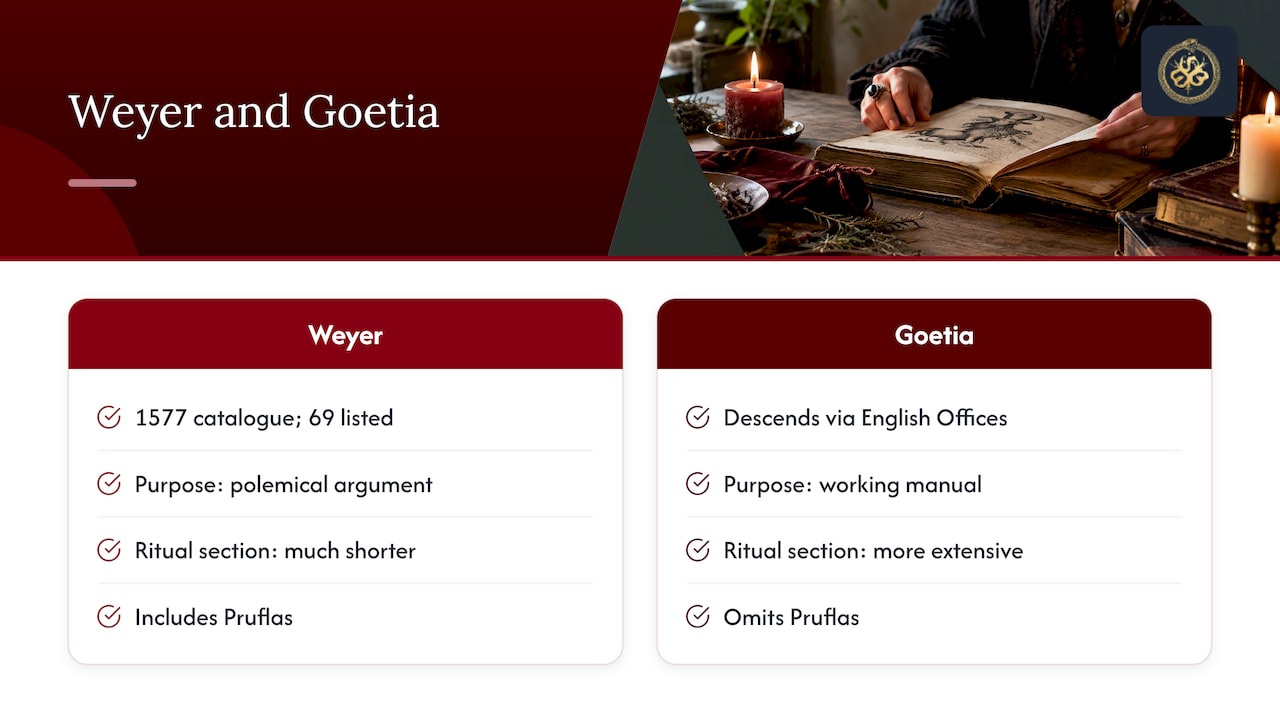
The Goetia did not appear whole. Its catalogue of spirits descends, through the English Offices of Spirits tradition, from Johann Weyer’s 1577 Pseudomonarchia Daemonum, which listed 69 spirits while referring to 72. The famous number was inherited as a framework and then filled.
Weyer’s text already gives Vepar as a siren or mermaid-like spirit tied to waters, armed ships, storms, and fatal wounds. The image you meet in the Goetia is older in print than the Goetia itself, and the two entries agree closely.
What differs is context and presentation. Weyer’s work was expanded in editions through 1583 and corresponds closely to the Goetia, with a different order and a much shorter ritual section. Weyer wrote as a physician and demonologist whose catalogue sat inside a polemical argument about the demonic. The Goetia reuses that catalogue as a working manual. The text on the page is nearly the same, and its purpose has been turned around: a catalogue written to expose the spirits became a manual for calling them.
There is also a transmission trail. The Lemegeton manuscripts vary in names, order, and contents, and the Ars Goetia adds spirits absent from Weyer while omitting Pruflas, a difference that came in through Reginald Scot’s 1584 Discoverie of Witchcraft. No single manuscript is the Vepar. There are several witnesses to one tradition.
From catalogue to practice: Mathers and Crowley
Most modern practitioners meet Vepar through the 1904 edition of the Goetia, edited from the work of S. L. MacGregor Mathers and associated with Aleister Crowley. That edition spread the text widely and added material, including Enochian evocations and Crowley’s introductory essay.
Crowley’s essay read the spirits as parts of the operator’s own mind. Black Witch Coven works with them as independent, intelligent beings, which is also how the Goetia itself addresses them, and that is the frame used in this article.
Reading the mermaid
The mermaid form is the doorway into everything else, because it is the one image the sources agree on across Weyer and the Goetia. It joins a human upper body to the body of a sea creature. The figure belongs to two realms at once. Water appears throughout her listed powers, as the medium she governs, the road ships travel, and the storm she can raise.
Three working themes follow from that. None is stated in the catalogue, and each grows from it.
- Thresholds. A being that lives at the surface between air and sea suits crossings: voyages, relocations, the passage from one emotional state to another.
- Wound and cure. The entry pairs injury that festers with the possibility of healing. A spirit who can cause a wound slowly can be addressed about wounds, which is why modern practitioners bring her old injuries of the heart and long transitions. That work usually uses cleansing, the seal, water or sea salt, and an enn.
- Illusion and appearance. Making the sea seem full of ships is a power over perception. It points toward glamour, misdirection, and the management of how a situation looks to others.
Choosing a theme before you begin keeps the working to one problem. A rite that tries to cover grief, travel, and an enemy at once will give you nothing you can evaluate afterward.
How a working with Vepar is built
The Goetia describes evocation, and the structure is consistent across the tradition: the operator stays inside a protective circle while the spirit is directed to a separate triangle, with seals, conjurations, protective names, and a closing license to depart. Our conjuring method from the Goetia gives the full sequence, and What Is Demonic Invocation? covers the gentler approach of calling a spirit into yourself.
The outline below follows that structure and leaves room for your own tradition. Adjust it as your practice requires.
1. Define the single objective
Write one sentence that states the outcome and a way to recognize it. Good: “Within one lunar month I will have settled the dispute over the shipping contract.” Poor: “Improve my life with water energy.” The Goetia’s own entry is narrow in scope, and your operation should be too.
2. Prepare the operator
Cleanse yourself and the space in whatever method your practice uses. Many practitioners work with water or sea salt for Vepar because the association is natural; the grimoire does not require it. Set the time of day, silence your devices, and decide in advance how long the working will run.
3. Make the seal and the instruments
The seal is drawn from the grimoire’s figure for Vepar. Copy it by hand on clean paper or metal instead of printing, since the act of drawing is itself preparation. Prepare the circle and the triangle of art as the tradition prescribes, and keep the triangle on the side of the room where the spirit will be directed.
4. Open with protection
Use the protective names and the framework you trust. The circle defines where you stand and what you hold. Decide your closing words before you begin.
5. Call, state, listen
Recite the conjuration for the spirit. State the objective in one sentence. Then stop and record. Write down her images, phrases, bodily sensations, and any sudden associations with water, ships, or wounds. Resist interpreting during the rite.
6. Close and ground
Give the license to depart, close the circle in the order you opened it, eat something, and drink water. The closing is where many beginners skimp and many veterans stay disciplined.
7. Review within 72 hours
The grimoire’s own timeline for her harmful operation is three days, and that interval is a convenient review window. Reread your notes, mark what you did in the physical world after the rite, and note what changed.
Typical uses
These are typical uses, not reports about specific people. They show how the single-objective principle works across different themes.
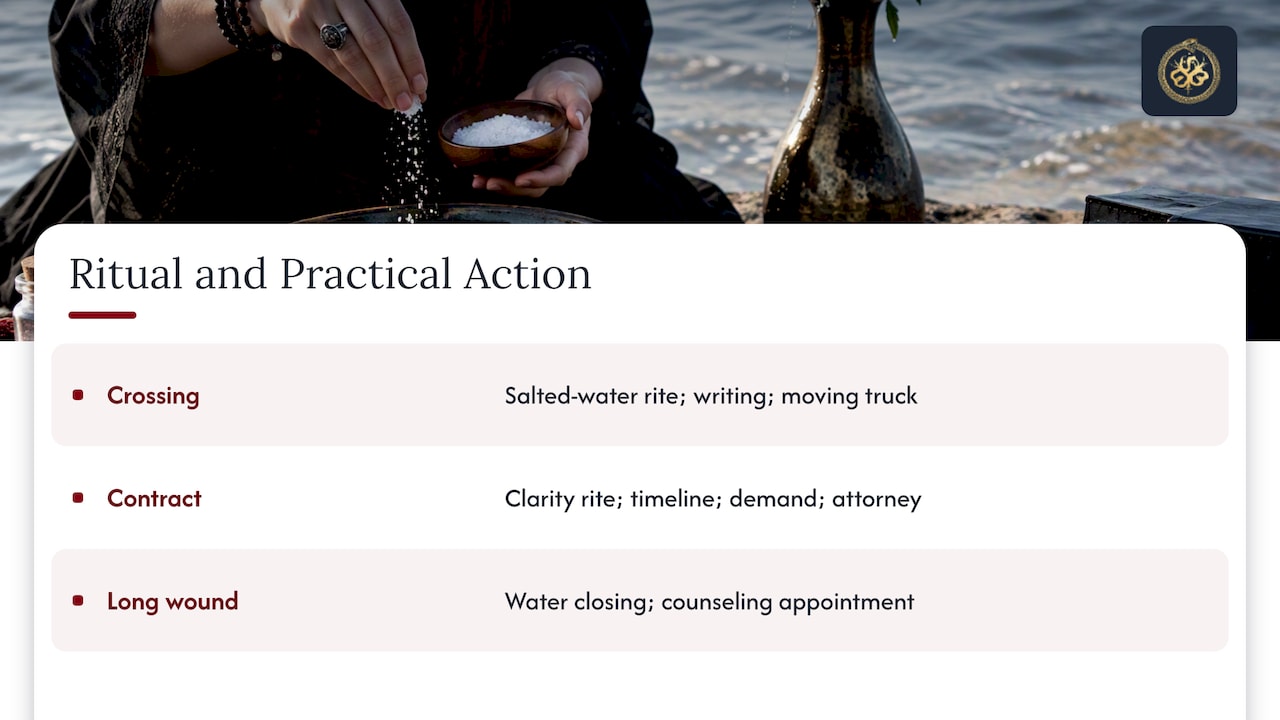
A crossing. A practitioner moving across the country for a new post has spent months in grief over the end of a long marriage. She chooses Vepar for the threshold theme. Her objective is narrow: to arrive in the new city without carrying the argument loop she has rehearsed every night. She performs the working on the last night in her old home, with a bowl of salted water on the altar, and spends the following week writing three lines each morning on what she has put down. Her measure is plain: she notes how many days she wakes already rehearsing the argument. The rite opens the crossing, and the moving truck carries her through it.
A hostile contract. A magician who ships goods by sea is caught in a dispute over a delayed container. The Goetia’s authority over ships and its power to create false appearances suggest two lines. He uses the rite to address clarity: he wants the other side’s real position to become visible. Alongside it he does the practical work, a documented timeline, a written demand, and a call to a freight attorney. He logs every shift in the other party’s account, so his notes show exactly what happened and in what order.
A long wound. A practitioner has carried a resentment against a former colleague for two years. The festering wound in Vepar’s entry gives her an image for it. She uses the rite to name the injury, pours the water of the closing away outside, and then arranges the conversation she had put off for months. Ritual and real-world action sit side by side.
The question of origins and evidence
Some readers ask whether Vepar, or any Goetic spirit, has an extraterrestrial or pre-human origin. The documented history does not say so. The earliest texts in the lineage are printed demonological catalogues and manuscript grimoires, and the line that can be traced runs through names, order, and wording from Weyer to the Goetia.
A siren of the sea is far older than any of those books, though. Sea spirits who raise storms, sink ships and wound sailors appear across the ancient Mediterranean, and Black Witch Coven regards the Goetic spirits as ancient gods and spirits recorded late by Christian writers. The catalogue gives you her office. Your own work with her, recorded session by session, tells you the rest.
Keep your records. Define outcomes before the rite. Separate what she showed you from what you added afterward. Origin stories that rest only on repetition belong in a separate column of your notes.
Perspective
We read Vepar as a figure of passage. The grimoire gives her the waters, the ships, and a wound that works slowly, and every one of those images describes a state of transition that has not finished resolving. That is why we pair work with her to a concrete decision in the physical world: a move, a negotiation, a conversation that has been postponed.
We also hold that the Goetia is best used by people who read it as a historian does and then act as a practitioner does. The line from Weyer to the Goetia to the 1904 edition shows a text repeatedly repurposed by people who needed it to do something. Left-Hand Path practice continues that habit, with the difference that the practitioner owns the result. You choose the spirit, the objective, and the measure of success.
The strongest workings we see have one problem, one rite, one review, and an action in the world beside them.
Black Witch Coven
Where to go from here
If you want a practitioner to carry out a working on your behalf while you handle the physical-world side, our daemonic spell casting services cover demonic workings for protection, prosperity, love, and legal matters, including the Dragon’s Veil Protection Spell and the Ritual to Lucifer. Vepar is not listed as a separate service, so write to us if you want a custom operation built around her.
FAQ
What is Vepar?
Vepar is the 42nd spirit of the Ars Goetia, described as a great and strong Duke with 29 legions. She appears as a mermaid and is associated with waters, ships, storms, and wounds. Her name also appears as Separ.
What are the abilities of Vepar?
The Goetia says she guides the waters and ships laden with armour, makes the sea stormy and apparently full of ships, and causes death within three days through putrefying wounds. Modern practitioners extend this to healing old wounds, emotional transition, and protection of travel. Those extensions are later practice built on the text.
Is Vepar male or female?
The mermaid form leads most modern practitioners to treat Vepar as female, and many practitioners address her as Duchess. The title in the Goetia is Duke, so both forms are in circulation. Pick one and use it consistently in your records.
Where does the Vepar entry come from?
The entry descends from Johann Weyer’s 1577 Pseudomonarchia Daemonum, which the English Offices of Spirits tradition carried into the Goetia. The 1904 edition associated with Mathers and Crowley brought it to a wide modern audience.
