
 New Years Eve Ritual 2026/2027 with Savannah
Blog, Demons, Working With Demons
What Is Demonic Invocation: A Practitioner’s Guide
Jul
About This Post
- Demonic invocation involves calling a spirit inward, making the practitioner a temporary vessel for its energy.
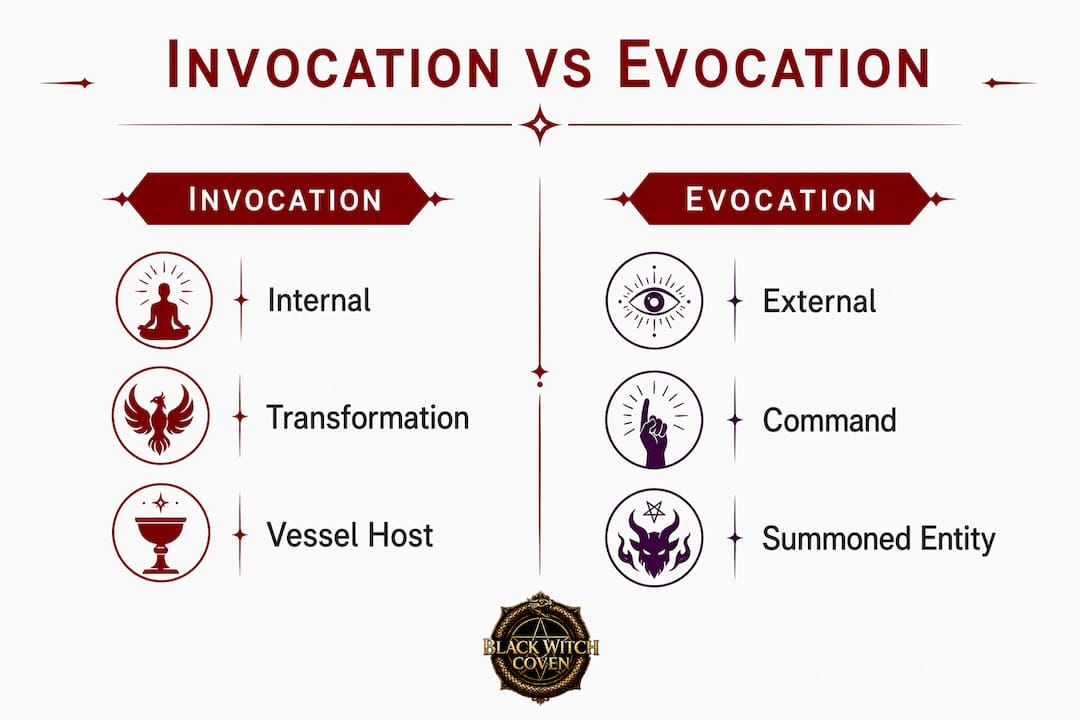
- It differs from evocation, which summons spirits externally while maintaining boundaries, affecting safety and control.
Demonic Invocation: Becoming the Vessel for Power
In the Black Witch Coven tradition, we do not approach demons as distant forces to beg from or command like servants. We seek sovereign alliances that amplify our own will. Demonic invocation is one of the most potent tools for this work. It is the deliberate act of calling a demonic entity inward, allowing it to move through you as a temporary vessel or channel for its energy, knowledge, and influence.
This practice stands in sharp contrast to demonic evocation, where the spirit is summoned externally into a defined space (triangle, mirror, or smoke) while you maintain separation and control. Invocation dissolves that boundary. The entity does not appear before you. It works through you colouring your perception, amplifying specific powers, and, in advanced practice, speaking or acting directly through your body and voice.
This is why invocation carries a fundamentally different risk profile. You are not directing traffic from a safe distance. You are opening the gates inside yourself. Done correctly, it produces profound personal transformation and real-world results. Done poorly, it creates chaos that can linger for weeks or longer.
What Demonic Invocation Actually Is
The word “invocation” comes from the Latin invocare, to call into. In our practice, it means consciously embodying a demonic force so its attributes become active within you. You are not losing yourself. You are expanding your capacity by aligning with a greater power that shares your goals.
Common outcomes include:
- Sudden surges in charisma and social magnetism (perfect for popularity workings).
- Heightened strategic insight or dominance energy.
- Deep gnosis and new knowledge that feels downloaded.
- Amplified ritual results when the entity’s power flows through your spells.
Invocation is especially powerful for practitioners who want to become more influential, attractive, or effective rather than simply asking for external help. It turns you into the conduit.
Invocation vs. Evocation: A Critical Distinction
Evocation keeps you firmly in control. Invocation requires strategic surrender while maintaining core sovereignty. This is advanced work.
The philosophical difference matters as much as the practical one. Evocation in the Goetic tradition often operates through command and hierarchical formulas. Invocation requires a different posture, you are opening yourself to receive. That shift changes everything about how you prepare and protect yourself.
| Feature | Invocation | Evocation |
|---|---|---|
| Entity Location | Internal — within you | External — in ritual space |
| Primary Purpose | Personal transformation & embodiment | Communication & task delegation |
| Practitioner Role | Vessel / Active Channel | Director / Negotiator |
| Risk Level | Higher (boundary dissolution) | Lower (clear separation) |
| Ideal For | Charisma, power embodiment, deep gnosis | Specific results, information gathering |
Traditional ceremonial magic definition
The philosophical difference matters as much as the practical one. Evocation in the Goetic tradition operates through command. The practitioner asserts authority through divine names and hierarchical formulas. Invocation requires a different posture. You are not commanding the entity to appear before you. You are opening yourself to receive it. That shift in posture changes everything about how you prepare and how you protect yourself.
Key distinctions practitioners should understand:
- Control. Evocation keeps the entity at a defined distance. Invocation dissolves that distance by design.
- Intent. Evocation is task-focused. Invocation is transformation-focused.
- Psychological demand. Invocation requires a stronger, more stable sense of self. If your identity is fragile, invocation amplifies that fragility.
- Hybrid use. Advanced ritualists combine both: invoking a high authority into themselves to establish sovereignty, then evoking a secondary spirit externally for negotiation. This layered approach produces results that neither practice achieves alone.
How Demonic Invocation Works: The Practical Process
Successful invocation follows a clear, time-tested structure.
We adapt the classical framework to our Luciferian and Left-Hand Path approach emphasizing partnership and sovereignty rather than medieval Christian hierarchies.
1. Preparation (The Foundation) This phase determines everything. Skip it or rush it and the working will fail or worse.
- Self-Cleansing: Bathe with salt and herbs. Fast or eat lightly. Clear your mind of distractions.
- Space Preparation: Cleanse the ritual area thoroughly. Cast a strong protective circle that defines your sovereign ground.
- Entity Research: Know the demon intimately its sigil, enn, attributes, preferred offerings, and sphere of influence. Build a relationship through evocation first.
- Personal Sovereignty: Strengthen your core self through grounding and banishing. A stable practitioner makes the best vessel.
2. The Call (Opening the Channel) This is the active invitation.
- Gaze at or draw the entity’s sigil.
- Recite its enn or conjuration with focused intent and vocal power.
- State clear boundaries: purpose of the working, duration, and what is/is not allowed.
- Enter a receptive trance state. Many practitioners use chanting, drumming, or focused breathing.
You will feel the shift a distinct change in energy, temperature, perception, or sudden clarity. The demon is now moving through you.
3. Integration & Use Direct the amplified energy toward your goal. Speak, act, or perform additional magick while the connection is strong. This is where the real power happens the demon’s influence works directly through your actions and words.
4. Closing & Release (Non-Negotiable) Formally thank and release the entity with a clear License to Depart. Perform a full banishing and ground heavily afterward. Eat, drink water, and return to ordinary activity. Journal what you experienced.
What is the historical and ritual structure of demonic invocation?
The tripartite structure of preparation, invocation, and binding traces back through medieval and Renaissance grimoires and appears in ritual traditions across multiple ancient cultures. This is not coincidence. It reflects a universal psychological and energetic logic: you prepare the vessel, you open the channel, and you close it properly.
The Ars Goetia’s tripartite invocation structure is the most studied model in Western ceremonial magick. Each phase carries specific requirements:
-
Preparation. This includes fasting, physical purification, mental alignment, and the construction of the ritual space. The Magic Circle is drawn to define the practitioner’s protected ground. The Triangle of Art, placed outside the circle, traditionally serves as the containment zone for an evoked entity. In invocation, the circle itself becomes the primary boundary. Sacred names, planetary hours, and the entity’s sigil are all confirmed before the ritual begins.
-
Invocation and conjuration. The practitioner recites the entity’s names, draws or gazes upon its sigil, and speaks the conjuration formula. This is not reading from a script passively. The linguistic formulas carry vibrational weight. Tone, intention, and mental focus determine whether the call lands. Experienced practitioners describe a distinct shift in the room’s atmosphere when contact is made.
-
Binding and license to depart. This phase is non-negotiable. The License to Depart is a formal command securing the entity’s exit from the ritual space. Skipping it is not a minor oversight. It leaves spiritual openings that cause residual negative influence, restlessness, or hauntings in the practitioner’s environment.
Pro Tip: Treat the License to Depart with the same seriousness as the conjuration itself. Practitioners who rush the closing phase because the ritual “felt successful” are the ones who report problems in the days that follow.
The Goetic tradition commands spirits through established hierarchies and divine names. Ritual authority is derived from those names, not from personal charisma or willpower alone. This is a critical point for anyone approaching invocation from a purely psychological framework.
Safety protocols and risks
Safety in demonic invocation is not about fear. It is about maintaining the ritual authority and psychological sovereignty that make the work effective. A practitioner who loses control during invocation does not just fail the ritual. They create conditions that are genuinely difficult to reverse.
Preparation is more critical than the invocation itself. Mental state and physical purification allow the invoker to establish the ritual authority needed for safe work. This is not metaphor. A practitioner who enters the ritual space distracted, emotionally destabilized, or physically depleted is not ready to hold the channel open safely.
Core safety protocols
- Protective circle. Draw it before anything else. The circle defines your sovereign space. Work within it without exception during the ritual.
- Banishing ritual. Perform a banishing before and after every invocation. The Lesser Banishing Ritual of the Pentagram is the most widely used formula in Western ceremonial magick. Practitioners working within Luciferian or Demonolatry frameworks use adapted banishing formulas that align with their spiritual authority. Black Witch Coven recommends reviewing protective ritual protocols before attempting any demonic working.
- Established ritual authority. Know the entity’s hierarchy, its sigil, its planetary correspondence, and its sphere of influence before you call it. Ignorance is not neutral in this work.
- License to Depart. Perform it every time without exception. Invoking without formally licensing the demon to depart leaves spiritual openings that cause residual negative influence in the practitioner’s environment.
- Post-ritual grounding. Eat, drink water, and spend time in ordinary physical activity after the ritual. This closes the energetic channel and returns the practitioner to baseline.
Risks:
- Psychological strain or identity confusion if unprepared.
- Lingering influences from incomplete closure.
- Amplified personal issues if your sense of self is unstable.
Practitioners who treat invocation casually report the most problems. Respect the process.
Pro Tip: If you feel the entity’s presence persisting beyond the ritual’s close, do not wait. Perform a full banishing immediately and follow it with a grounding practice. Lingering presence after a proper License to Depart is a signal that the closing was incomplete.
How do modern practitioners adapt traditional invocation for contemporary practice?
The original grimoires were written within a medieval Christian worldview. Their authority structures, their divine names, and their hierarchical formulas reflect that context. Practitioners working within Luciferianism, Demonolatry, or Left-Hand Path traditions face a genuine challenge: the source material assumes a theological framework they do not share.
Strictly adhering to dated Christian formulas without adaptation risks internal instability or failed invocations. This is not a theoretical concern. When a practitioner’s stated spiritual authority conflicts with their actual beliefs, the ritual loses coherence. The entity does not respond to words the practitioner does not mean.
Modern adaptation takes several forms:
- Updated authority structures. Luciferian practitioners replace Christian divine names with Luciferian hierarchical names, invoking authority through Lucifer, Hecate, or other entities they have established working relationships with.
- Personalized banishing formulas. Rather than using the Lesser Banishing Ritual of the Pentagram verbatim, practitioners adapt the formula to their own spiritual framework while preserving its structural logic.
- Partnership-based invocation. Demonolatry replaces the command model with a relationship model. Entities are approached as allies. The ritual structure shifts from compulsion to invitation, which changes the energetic dynamic significantly.
- Psychological integration. Some practitioners, influenced by depth psychology, treat invocation as a process of consciously engaging with archetypal forces. This does not replace the ritual structure. It adds a layer of psychological awareness that helps the practitioner maintain sovereignty during the working.
Aleister Crowley’s influence on modern invocation practice is substantial. His writings on ceremonial magick reframed invocation as a disciplined art requiring the practitioner’s full sovereignty, not passive surrender. That framing holds up. The practitioner who enters invocation as a supplicant is not invoking. They are petitioning, which is a fundamentally different act with fundamentally different results.
Lessons from Years of Practice
The most common mistake is treating preparation as optional. Practitioners research extensively but enter the ritual distracted or depleted. The work fails. They blame the entity. The problem was the vessel.
Sovereignty is built before you open the channel. The License to Depart is not optional ..it protects your space and mind. Invocation is not possession or passive prayer. It is controlled embodiment that requires discipline and honest self-assessment.
When approached with respect and preparation, demonic invocation becomes one of the most transformative tools in your practice. It is the path of becoming not worship, not begging, but sovereign expansion through alliance with greater powers.
I know this is a popular topic, so if you have questions for me, feel free to ask in the comment section below.
FAQ
What is the core difference between invocation and evocation?
Invocation draws a demonic entity inward, making the practitioner a vessel for its energy. Evocation summons the entity externally into a defined ritual space for communication or task delegation.
Is demonic invocation safe for beginners?
Demonic invocation carries genuine risks for practitioners who lack established ritual authority, psychological stability, and knowledge of protective protocols. Beginners are better served by building foundational skills in evocation and banishing before attempting invocation.
At Black Witch Coven, we do not recommend that you work with any level of higher entity if you feel vulnerable or have any level of mental health challenge
What is the License to Depart and why does it matter?
The License to Depart is a formal ritual command that secures the entity’s exit from the practitioner’s space at the close of an invocation. Skipping it leaves spiritual openings that cause residual negative influence, disturbed sleep, and persistent unwanted presence.
What grimoire is most referenced for demonic invocation structure?
The Ars Goetia, the most referenced grimoire in Western ceremonial magick, structures this process across three phases: preparation, conjuration, and binding.
The Ars Goetia catalogs 72 demonic entities, each linked to a specific sigil, planetary hour, and sphere of influence. Practitioners working with entities like Lucifer, Astaroth, or Clauneck use these correspondences to align ritual conditions with the entity’s nature before any invocation begins. The sigil is not decorative. It is the entity’s address, the focal point through which contact is established and energy is directed.
How do Luciferian practitioners adapt Goetic invocation?
Luciferian practitioners replace the Christian divine names in classical Goetic formulas with authority structures aligned to their own spiritual framework, invoking through entities like Lucifer with whom they have established genuine working relationships rather than using formulas that conflict with their actual beliefs.
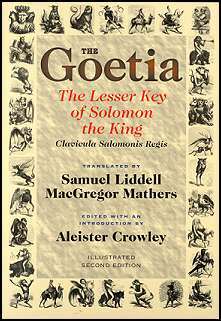
The Illustrated Goetia: Lesser Key of Solomon
The following 18 tools of evocation are explained in detail: 1. The Magic Circle 2. The Triangle of Manifestation 3. The candles, and candle holders 4. A large wooden box or bag to contain the tools, the “treasure chest” 5. The magic robe 6. The hazel wand 7. The sword 8. The Hexagram of Solomon 9. The talisman or “lamen” of the spirit in metal with the Pentagram of Solomon on the back 10. The lion skin belt 11. “Brass Vessel” incense, an incense burner, charcoal and a lighter 12. The wash basin with water in it 13. Anointing oil 14. The “Brass Vessel” 15. The black metal box, sulpher, assafoetidia, parchment, and pen 16. The Magic Ring of Solomon 17. The book of conjurations and a stand to rest it on while you work 18. The offering dish for a “flaming libation” to Belial or Paimon.
