
 New Years Eve Ritual 2026/2027 with Savannah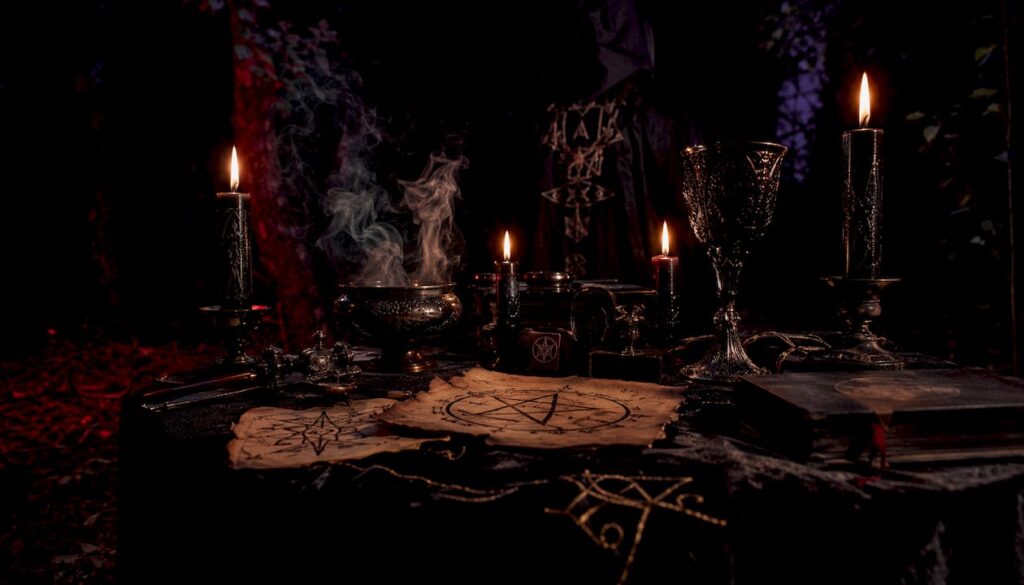
Bune’s Ritual Practices
Work with Bune falls into two broad approaches: the older Solomonic/ceremonial method and the more flexible modern methods used by most contemporary practitioners.
Traditional Solomonic Approach
In the classical grimoire system, Bune is approached through formal evocation. The magician works within a circle, places the spirit’s seal in a triangle of art, and uses the appropriate divine names, constraining prayers, and the seal given in the Ars Goetia. The tone is authoritative. The spirit is called, questioned, and licensed to depart.
This method assumes the operator is working under a hierarchical divine framework and is prepared to maintain strict control of the space.
There is nothing wrong with working with the formal Solomonic approach, and most of us here began with formal ceremonial magic rituals in summoning demons. Today, many of us here at Black Witch Coven feel disrespectful to summon using the traditional method. However, it is important to note that we have very strong relationships after many decades, so we can’t discount our own origins and journey working with what we call demons.
We will say that using a traditional approach will give you a lot of skill and respect. If you’re here for the long term, then it is highly recommended you learn the skills of traditional ceremonial magic.
Very few people today work with Bune in the full traditional Solomonic manner. When they do, the results are often described as formal, distant, and precise rather than relational.
Modern Correspondences for Bune
Most people currently working with Bune use simpler, more relational methods. These usually include some combination of the following:

The Enn
The most widely used key is the enn: Wehl melan avage Bune tasa (also written Whlc or Wehlc melan avage Bune tasa)
It is chanted to attune to his current, to open contact, and to close it.
Many practitioners repeat it three, six, or nine times at the beginning and end of any working.
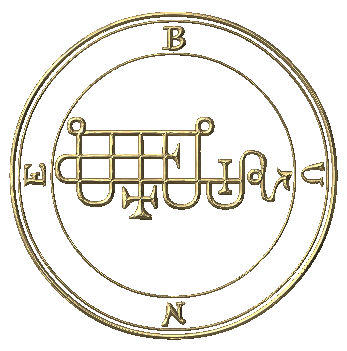
Bune’s Sigil
How to Interpret Bune’s Sigil
There is no traditional, line-by-line decoding of Bune’s sigil that comes from the original grimoires.
The seals in the Ars Goetia and related texts were transmitted as complete characters eg visual signatures of the spirit, rather than diagrams whose individual marks were meant to be read like an alphabet.
What the grimoires actually say
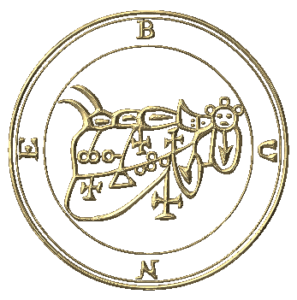
Bune has two seals in the Ars Goetia.
The text notes that either may be used, but that the first (or in some versions the last) is preferred.
Both are presented as the forms to which he owes obedience. That is the extent of the historical instruction. The sigil functions as a point of contact and recognition, not as a puzzle to be solved.
Modern attempts at interpretation
Contemporary practitioners sometimes read the shapes symbolically.
Common observations include:
- The central grid-like or boxed structure is taken by some as a sign of order, containment, or earthly structure, fitting a spirit who deals in wealth and the organisation of the dead.
- Curving or tail-like lines are occasionally linked to the dragon form described in the texts.
- Circular terminals and flourishes are seen as generic features shared across many Goetic seals, possibly marking rank or the boundary of the spirit’s office.
- The overall complexity is sometimes read as reflecting a spirit who operates across more than one domain (wealth, speech, the dead).
These readings can be useful as personal meditation aids, but they are modern projections rather than recovered tradition.
Different people see different things in the same lines, which itself suggests that the sigil works more as a living interface than as a fixed symbolic code.
Practical approach
Most people who work successfully with Bune treat the sigil in one of these ways:
- As a focal point for the eyes during the enn or meditation.
- As a mark of recognition the visual equivalent of speaking the correct name.
- As a place to put attention, offerings, or the candle flame so that the current has a clear location in the physical space.
- As a seal to be drawn, carved, or worn when a stronger or more permanent link is desired.
You do not need to understand every line before the sigil will function. Many practitioners report clean contact simply by gazing at it while repeating the enn, without any attempt at symbolic analysis. If you later feel drawn to meditate on particular parts of the design, that can deepen the relationship, but it is not a prerequisite.
Max – BWC Occultist
Two seals
Because two versions exist, some people experiment with both and notice a preference. Others stay with the version most commonly reproduced in modern books and online. Either is historically attested. The important point is consistency once you choose one for regular work.
In short, the sigil is less a text to be interpreted and more a door to be used. Learn its shape well enough to recognise and reproduce it, place your attention on it with clear intention, and let the contact itself teach you how it wants to be worked with.
Candles and Colour
- Gold and yellow candles are frequently used for wealth and expansion.
- Black is sometimes added when the necromantic or grave-related aspects are being emphasised.
- Green appears in some prosperity-focused work.
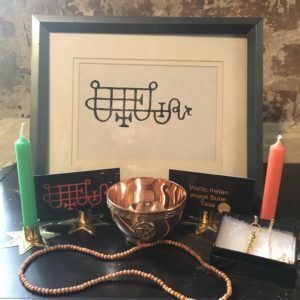
The candle is often carved with the sigil or placed directly behind it.
Incense
Sandalwood and oud are the most commonly recommended. Frankincense, cedar, and dragon’s blood also appear in modern practice.
The smoke is treated as both an offering and a medium that helps carry the call.
Offerings
Offerings vary widely. Common ones include:
- Coins, especially gold-coloured or copper
- Good quality chocolate, honey, dates, oranges
- Wine, rum, or dark spirits
- Tobacco or cigars
- Perfume or fine incense
- Written words of thanks or praise
- Many practitioners, including us, will sometimes leave oranges or mandarins
Many practitioners emphasise that the offering should feel like a genuine gesture rather than a bribe. Some prefer to share the experience of the offering (eating the chocolate, drinking the wine) so that the spirit partakes through the practitioner’s senses.
Timing
There is no single fixed day in the grimoires.
Modern practitioners often choose:
- Thursday (Jupiter) for expansion, wealth, and opportunity
- Friday (Venus) because Bune holds the rank of Duke
- Days or hours that feel personally aligned after divination
Structure of a Simple Modern Working
A typical contemporary session often looks like this:
- Prepare a clean space and place the sigil.
- Light candle and incense.
- Recite the enn several times.
- Speak the purpose of the contact clearly (honour, petition, thanks, or ongoing relationship).
- Sit in silence or light meditation, listening and observing.
- Present any offering.
- Close with the enn again and a clear statement of thanks or license to depart.
- Extinguish the candle or allow it to burn safely.
or
Chanting the ENN
- Prepare a clean space and place the sigil.
- Light your chosen candle and incense.
- Recite the enn: Wehl melan avage Bune tasa (three or more times).
- Speak your purpose clearly — honour, petition, thanks, or ongoing relationship.
- Sit in silence or light meditation and observe.
- Present any offering.
- Close with the enn again and a clear statement of thanks or license to depart.
- Extinguish the candle or allow it to burn safely.
Start with what you can do cleanly. Refinement comes through repeated contact rather than perfect preparation.
A Formal Invocation of Bune
This is a traditional-style working that follows the older ceremonial pattern: preparation, divine names, the call to Bune, the request or communion, and a respectful dismissal. It can be used as written or adapted once you are comfortable.
Preparation
Find a quiet space where you will not be disturbed. Sit or stand comfortably. Take several slow breaths and allow the body and mind to settle. Some practitioners spend a few minutes balancing the breath or bringing attention to the centres of the body before beginning.
Place Bune’s sigil before you. Light a candle (black, gold, orange, or green). Light incense (sandalwood is traditional). Have any offerings ready (food, drink, or other items you have chosen).
The Opening
Speak clearly and with intention:
I call upon the Most High, by the names that command the spirits of the air, the earth, and the deep places. By Beralensis, Baldachiensis, Paumachia, and Apologia Sedes, by the pure and living names that bind and loose, I open this space in order and in authority.
Let the light of understanding stand between me and all that would interfere. Let this circle (or this space) be clear and well-kept.
The Call to Bune
Gaze upon the sigil. When ready, recite the enn three times:
Wehl melan avage Bune tasa Wehl melan avage Bune tasa Wehl melan avage Bune tasa
Then continue:
Bune, Great Duke, Strong and Mighty, you who appear as a dragon with three heads, who speak with a high and comely voice, who move the place of the dead and gather the spirits under your command upon the sepulchres, who grant riches, wisdom, and eloquence, and who give true answers to those who ask,
I call you now into this space. Come in a form that is clear and tolerable to me. Come in peace and in order. I welcome your presence with respect.
Pause. Observe any shift in atmosphere, any sense of presence, any images, sensations, or thoughts that arise. Some practitioners watch the smoke of the incense or candle for signs. If you are working with a black mirror for necromantic purposes, this is the point at which you may turn your attention to it.
The Statement of Purpose
Speak your reason for the contact plainly. This may be:
- a request for wealth, opportunity, or improved conditions
- a request for clearer speech, wisdom, or judgment
- a request for assistance with the dead or ancestral work
- simple honour and the strengthening of the relationship
Be direct. Avoid unnecessary complication.
Offerings
Present what you have brought. You may say:
I place this offering before you in recognition and in thanks. Accept it as a mark of the respect I bring to this working.
Closing and Dismissal
When the communion feels complete, give thanks:
Bune, Great Duke, I thank you for your presence and for any aid you have given or will give. Go in peace now if you will, or remain in goodwill if it pleases you. Let there be peace between us.
Recite the enn three more times, or simply state:
The work is ended. This space is closed.
Extinguish the candle (or allow it to burn out safely). Dispose of offerings in a respectful manner according to your custom.
Notes for Use
You do not need to perform the full formal version every time. Once a relationship is established, many practitioners move to simpler contact using the enn, the sigil, a candle, and clear speech. The longer structure is useful when you want a more deliberate or ceremonial approach, when beginning the relationship, or when the work involves the dead.
Always dismiss cleanly. Leave the space as ordered as you found it.
Relationship Over Transaction
A consistent theme among those who report long-term success with Bune is the emphasis on relationship. Regular honoring, weekly or monthly return, and public or private praise are treated as part of the work itself, not as optional extras. Many find that consistent, respectful contact produces steadier results than occasional desperate petitions.
Bune is generally described as responsive to clarity, good manners, and follow-through. He is less responsive to chaos, entitlement, or attempts to treat him as a vending machine.
This combination of simple tools, the enn, the sigil, and consistent respectful contact forms the core of how most people work with him today.
Videos
Money Candle Magick – With Jupiter Energy & The Goetia Demon Bune
Location: Oahu Year 2019
Bune Meditation/Connection
Title: Bune of Goetia Invoke, Evoke with Sigil and Music (Very Beautiful)
Credit: Santera Lucera & Tata Lucero
How to use it: Put on headphones, gaze softly at the sigil while listening to the music, and repeat “Bune, Bune, Bune, Bune.”
Bune Q & A
This is a new section we’re adding too. If you have a burning question for us regarding Bune, or you would just like our opinion, feel free to drop us a comment below and we will answer it here.
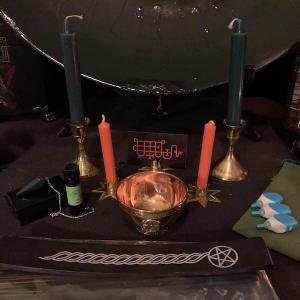
Q: you have taught us to use orange candles in rituals, but gold is often listed as the color. What is true?
BWC Answer:
Yes, orange candles are a solid and widely used substitute for gold when working with Bune.
Gold is the ideal colour for his wealth and success current because it directly tracks with value, visibility, and the beneficial/solar quality many associate with him. In practice, true gold candles can be harder to find or more expensive, so orange has become one of the most common and effective stand-ins.
Orange sits close enough on the spectrum to carry the same general tone: attraction, opportunity, movement of resources, and a warm, active prosperity current. Many practitioners who work with Bune regularly use orange without noticing any drop in responsiveness. It is especially practical for candle magic, multi-day burns, or when you want a colour that still feels rich and intentional but is easier to source.
Quick practical ranking for Bune wealth/prosperity work:
- Gold – strongest traditional match
- Orange – excellent and very common substitute
- Yellow – also workable, slightly lighter in tone
- Green – better when the emphasis is on growth or steady increase rather than pure attraction/visibility
If you are doing a simple candle working and only have orange available, use it with confidence. Pair it with the sigil, the enn, and a clear statement of purpose, and it will serve well. Many people end up preferring orange for regular work simply because it is reliable and accessible.