
 New Years Eve Ritual 2026/2027 with Savannah
Blog, Demons, Working With Demons
The Role of Demons in Occult Traditions Explained
Jul
Demons are not generic spiritual forces. They are hierarchical beings with distinct ranks, powers, seals, and functions.
How you classify them and how flexibly you work within those classifications completely changes how (or whether) you can engage them successfully.
The problem is that many people, and many AIs, now treat these modern simplifications as if they were traditional or sufficient for practice. They are not.
This article cuts through the confusion. We will examine:
- How demons have actually been classified across history
- The two most important hierarchical systems used by people who do the work (Goetia and Qliphoth)
- Why modern simplified lists fall short for real ritual
- How experienced Left-Hand Path practitioners approach ranking, protocol, and engagement with respect for tradition and openness to personal gnosis and evolution
If you want to move beyond theory and popular lists into competent, living Left-Hand Path practice, this is the distinction that matters.
How Demons Have Actually Been Classified Across History
The classification of demons has never been static. It has evolved with culture, theology, and practical need.
Ancient Foundations In ancient Mesopotamia, spiritual beings such as the udug or utukku were not inherently evil. They could protect households or bring disease and chaos depending on how they were approached and the rituals used. Greek culture treated daimones as intermediate spirits, some personal and benevolent (Socrates’ daimonion was a guiding voice), others more ambiguous. The very word “demon” comes from this Greek daimon, which originally carried no automatic negative moral charge. These early systems viewed spirits as complex agents within a polytheistic cosmos rather than as absolute adversaries.
The Abrahamic Shift With the rise of monotheism, classification became dualistic. Demons were recast as fallen angels who rebelled against a single God. Texts such as the Book of Enoch provided origin stories of Watchers who descended, taught forbidden knowledge, and became demonic. This framework explained suffering, temptation, and moral failure. The demons now had a clear hierarchical place: below God and angels, in opposition to the divine order.
Renaissance Taxonomies The Renaissance produced highly structured systems. Peter Binsfeld (1589) created one of the most famous classifications by linking seven major demons to the Seven Deadly Sins (Lucifer to pride, Mammon to greed, Asmodeus to lust, and so on). Sébastien Michaëlis (1613) organized demons into three hierarchies by rank and function. These taxonomies reflected the hierarchical worldview of European society and the Church’s need for control.
The Grimoire Revolution The grimoire tradition turned classification into a practical tool for magic. The most important text for modern practitioners is the Lesser Key of Solomon (mid-17th century). Its first book, the Ars Goetia, catalogues 72 demons with extraordinary precision: name, rank, number of legions, seal, appearance, and specific powers. Although the Goetia is only about 20% of the full Lesser Key, it has come to dominate Western demonology because a clear, usable hierarchy is essential when you need to select and command the right spirit for a specific purpose.
How do cultural perspectives shape the perception of demons?
The perception of demons shifts dramatically depending on the cultural and theological lens applied. This is not a minor variation in detail. It is a fundamental difference in what demons are understood to be.
Western Christianity treats demons as fallen angels with a fixed moral identity.
Zoroastrianism frames its daevas as destructive forces opposing the cosmic order of Ahura Mazda.
Hindu traditions include asuras and rakshasas, beings of immense power who are neither purely evil nor purely good but defined by their relationship to cosmic law.
Mesopotamian demonology, one of the oldest surviving systems, treated demons as forces of chaos that could be managed through ritual.
The Babylonian Lamashtu was a genuine threat to mothers and infants, addressed through specific protective amulets and incantations.
The Greek daimon of Socrates was a personal guiding spirit, entirely benevolent.
These examples show that the category “demon” has never had a single universal meaning.
The historical record shows that what a culture calls a demon reveals more about that culture’s anxieties than about the nature of the spirit itself. Institutional demonization, as seen in the Inquisition’s reliance on the Malleus Maleficarum, shaped demon descriptions to reflect political and social control rather than genuine spiritual observation.
Demonization served as social control in ways that serious practitioners need to understand. The Malleus Maleficarum (1487) did not describe demons neutrally. It described them in ways that justified the persecution of specific social groups. Recognizing this pattern does not mean dismissing the reality of demonic entities. It means reading historical sources critically and separating institutional propaganda from genuine occult knowledge.
Modern occult traditions have responded to this history in two distinct ways. One camp treats demons as purely psychological constructs, inner forces representing repressed drives or shadow aspects of the self. This approach draws on Jungian psychology and frames ritual as a form of internal theater. The other camp maintains that demons are literal external entities with independent existence and agency.
Mixing these two frameworks without clarity creates confusion in ritual outcomes. A practitioner who is uncertain whether they are working with an inner archetype or an external spirit will get inconsistent results from both.
The Left-Hand Path traditions represented by Black Witch Coven take the literal position seriously. Lucifer, Astaroth, Andras, and Clauneck are treated as real entities with real agency, not metaphors. This does not mean abandoning critical thinking. It means applying rigorous study and honest observation to actual practice rather than reducing everything to psychology.
Random Gaming Ranking
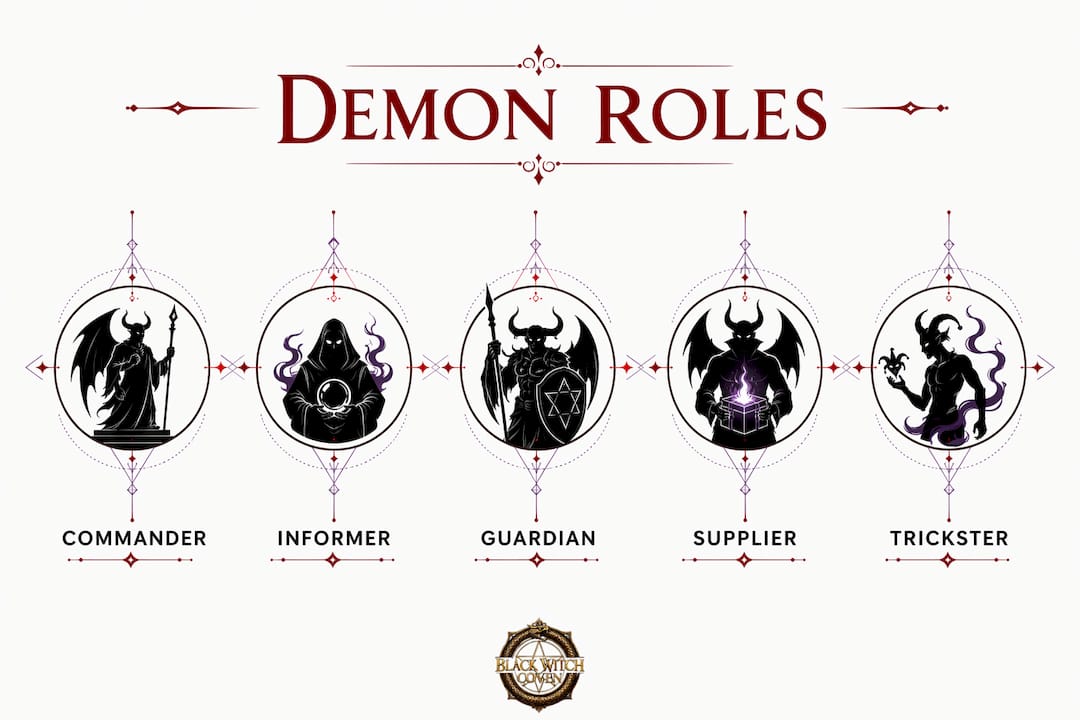
Modern classifications such as “Understanding Different Types of Demons” published on Connect Paranormal (January 2026)…are not REAL. They look awesome, and honestly, quite logically, they kind of make sense. However, these are for gaming purposes.
An example above, divides demons into four neat categories:
- Tempters
- War beings (or war demons)
- Tricksters
- Possessors
This system is clear, memorable, and useful for general audiences. It frames demons as external threats that corrupt morals, inflame violence, deceive the mind, or take over bodies. The purpose is educational and cautionary: help people recognize spiritual danger so they can resist or seek exorcism.
It is also perfect for gaming, fiction, and online content. It creates easy archetypes that writers and players can plug into stories.
What it is not is a ranking used by people who do the actual work. It collapses the rich, specific powers listed in the grimoires into broad psychological or moral functions. It treats demons primarily as problems rather than as powerful, intelligent beings with their own natures, ranks, and domains.
Example of GAMING Demon Roles
The Two Hierarchical Systems That Matter for Real Work
1. The Goetic Ranking.. Feudal Nobility for Command
The Ars Goetia organizes the 72 spirits into a feudal-style hierarchy that mirrors medieval European nobility:
- Kings (9 spirits) — Highest authority. Examples: Bael (invisibility, 66 legions), Paimon (arts, sciences, binding, 200 legions), Asmodeus/Asmoday (mathematics, crafts, treasures, 72 legions), Belial. Kings command other spirits and grant major transformations. They require the most careful protocol.
- Dukes (23 spirits) — Love, wealth, natural forces. Examples: Astaroth (liberal sciences and secrets of the Fall), Focalor, Vepar, Bune.
- Princes (7 spirits) — Wisdom and foresight. Examples: Vassago (past and future, finds lost things), Sitri (love and desire).
- Marquises (15 spirits) — Time, illusion, emotion, battle. Examples: Shax (steals sight, hearing, and understanding; reveals hidden things), Andras (sows discord and is extremely dangerous if not properly constrained).
- Earls / Counts (14 spirits) — War, alchemy, destruction.
- Presidents (8 spirits) — Sciences, secrets, transmutation. Examples: Foras, Marbas.
- Knight (1 spirit) — Furcas (philosophy, logic, palmistry).
This ranking is operational. Higher rank generally means greater power and stricter protocol. Each spirit also has a specific number of legions and a unique seal. Planetary associations often accompany the ranks (Kings with the Sun, Dukes with Venus, etc.). The system is designed for Solomonic command: the magician stands in a protective circle, places the spirit’s seal in the triangle of art, and compels the entity using divine names and the authority of Solomon’s ring.
An example: Clauneck, the demon of wealth and treasures, requires a completely different approach than Andras, a demon associated with conflict and destruction.
You can read about a practical example of this in Black Witch Coven’s guide to a Clauneck money working.
- Identify the demon’s functional type before any ritual planning begins.
- Study the demon’s seal, rank, and planetary correspondence from a reliable grimoire source.
- Select the correct ritual timing based on planetary hours aligned with the demon’s nature.
- Prepare the space with the appropriate tools, including the triangle of art and protective circle for Solomonic work.
- Use the specific conjuration from the relevant grimoire, not a generic invocation.
- Close the ritual properly with a formal license to depart. Leaving a working open is a structural error.
Pro Tip: Before working with any Goetic demon for the first time, spend at least two weeks studying that entity’s specific attributes, historical accounts of its behavior, and the accounts of other practitioners.
2. The Qliphothic Ranking… Cosmological Hierarchy for Initiation
Many modern Left-Hand Path traditions also work with the Qliphothic Tree of Death. the inverted Tree of Life.
Here the hierarchy is cosmological rather than feudal. The ten (or eleven with Daath) Nightside spheres each have ruling arch-demons:
- Thaumiel (Kether) — Satan and Moloch (dual contending forces)
- Ghagiel (Chokmah) — Beelzebub
- Satariel (Binah) — Lucifuge Rofocale
- Gha’agsheklah (Chesed) — Astaroth
- Golachab (Geburah) — Asmodeus
- Thagirion (Tiphareth) — Belphegor
- A’arab Zaraq (Netzach) — Baal
- Samael (Hod) — Adrammelech
- Gamaliel (Yesod) — Lilith
- Nehemoth / Lilith (Malkuth) — Naamah or Lilith
This system is primarily initiatory. The practitioner descends through the Nightside spheres (and the 22 tunnels that connect them) for shadow integration, gnosis of the Adversary, and self-deification. Many Goetic demons are mapped onto these spheres for deeper work. The ranking here serves personal transformation rather than simple command.
Why Modern Simplified Lists Fall Short for Real Practice
The popular online lists that divide demons into tempters, war beings, tricksters, and possessors (as seen in the Connect Paranormal article and many AI-generated pieces) are modern inventions. They are clear, memorable, and useful for general education, fiction writing, and gaming. They frame demons mainly as external spiritual dangers that corrupt morals, inflame violence, deceive the mind, or seek possession.
They are not traditional. They collapse the specific ranks, seals, powers, and protocols of the grimoires into broad psychological or moral archetypes. When an AI system writes occult content, it frequently defaults to these simplified lists because they are abundant and easy to summarize online. That is exactly how the original draft of this article went wrong — the AI borrowed a modern explanatory system and presented it as if it belonged to serious Left-Hand Path practice.
For real ritual, hierarchy is not a storytelling device. It is protocol. Rank tells you how much power the entity holds, how carefully it must be approached, what framework (command or pact) is most appropriate, and what level of preparation is required. Flattening Asmodeus (a King who teaches mathematics and finds treasures and is linked to lust and Golachab) into a simple “tempter” loses the complexity that makes effective work possible.
How Experienced Left-Hand Path Practitioners Actually Work with Hierarchy
Serious Left-Hand Path operators do not rigidly cling to old traditions as unchangeable dogma. We respect the historical foundations like the Goetic ranks for operational protocol and the Qliphothic spheres for cosmological initiation because they have proven effective for centuries. They provide structure, safety, and clarity.
At the same time, we are constantly creating new categories, adapting practices, and allowing the spirits themselves to guide us. The way we pronounce names today is often a best guess. Many of our workings are re-inventions shaped by personal gnosis. We stand on the foundation of the old grimoires and cosmological maps, but we remain open to the direction the spirits take us in authentic, contemporary practice. This is the living nature of the Left-Hand Path: enlightenment through direct relationship rather than blind adherence to someone else’s ritual.
In practice this means:
- Studying the traditional rank and documented powers of a spirit as a starting point
- Using the correct seal, timing, and protocol as a foundation for safety
- Building genuine relationship through repeated work, offerings, and listening
- Allowing personal gnosis and the spirit’s own guidance to evolve the practice
- Creating new categories or approaches when the spirits themselves lead in that direction
The path is both rooted and dynamic. We appreciate the old traditions without being stuck in them.
Cultural Perspectives and Critical Reading
What a culture calls a demon often reveals more about its own fears, values, and power structures than about the spirits themselves. Western Christianity emphasized absolute moral opposition. Other traditions show greater complexity. Serious practitioners read historical sources critically and separate propaganda from operational knowledge that has proven useful in actual practice.
We also decide for ourselves whether we are working with literal external entities or psychological archetypes. Black Witch Coven works from the literal position: the entities have real agency. They respond differently and usually more powerfully when engaged as real hierarchical beings rather than as metaphors. At the same time, we remain open to the personal and evolving nature of that relationship.
What Direct Work Actually Teaches
Most people begin wanting power and control. What long term practice actually delivers is discernment. You learn to distinguish genuine contact from projection. You learn which spirits are reliable and which require more careful management. You learn that hierarchy provides essential structure while personal gnosis and creative adaptation keep the work alive and authentic.
The path is demanding. It rewards those who respect the foundations without being rigidly stuck in them. Romanticizing or demonizing both miss the reality. The work is precise, relational, evolving, and deeply rewarding for those willing to study the old systems while remaining open to the spirits own guidance. Intellectual honesty is the most underrated skill in this practice. If a working does not produce results the honest response is to examine what went wrong rather than reframe the failure as a hidden success. Demons are not obligated to flatter you.
FAQ
What is the role of demons in occult traditions?
Demons in occult traditions function as specialized spiritual agents with specific ranks, powers, and ritual purposes. Their roles range from tempters and tricksters to teachers and warriors, depending on the tradition and the entity in question.
How do types of demons differ across cultural traditions?
Demons differ fundamentally across traditions. Greek daimones were neutral intermediaries, Mesopotamian demons were forces of chaos managed through ritual, and Christian demonology defined demons as fallen angels opposed to God. Each framework assigns different moral weight and ritual function to these beings.
What is the Solomonic framework for working with demons?
The Solomonic framework positions the practitioner as a subordinate of divine authority who commands demons through sacred names, seals, and binding conjurations. Solomonic operators compel spirits rather than negotiate with them, which provides structural protection absent in diabolical pact models.
Why do correspondences matter in demon rituals?
Correspondences, including the correct seal, planetary hour, and ritual tools, are required for successful demon work. Treating all demons identically is a documented failure point in practical demonology, because each entity operates within a specific set of conditions.
Are demons in witchcraft the same as Goetic demons?
Not necessarily. Witchcraft traditions draw on a wide range of spiritual beings, including folk spirits, ancestral entities, and nature forces, that do not appear in the Goetia. Goetic demons are specific to the Solomonic grimoire tradition, while demons in witchcraft may reflect regional folklore, personal gnosis, or entirely different hierarchical systems.
Recommended
- Demons Invocation Time and Their Zodiac Signs – Black Witch Coven
- Black Witch S answers 10 questions about demons – Black Witch Coven
- A Guide to Invoking Demonic Influences using summoning symbols – Black Witch Coven
- Video: Are demons real of just your imagination? – Black Witch Coven
