
 New Years Eve Ritual 2026/2027 with Savannah
Blog, Chaos Magic
What Is Chaos Magick: A Practitioner’s Real Guide

Jun
What is Chaos Magick?
Chaos magick is a practical system that treats belief as a flexible tool used for specific results. Practitioners adopt and discard frameworks based on effectiveness, emphasizing direct outcomes over fixed cosmologies. The practice involves techniques like sigil creation and entry into altered states of consciousness to influence reality without rigid tradition.
Chaos magick is defined as a system of practical magic that treats belief as a flexible, operational tool rather than a fixed truth. You do not adopt a cosmology because it is correct. You adopt it because it works, then discard it when it stops working.
Developed in 1970s England by Peter J. Carroll and drawing heavily on the earlier work of Austin Osman Spare, chaos magick treats the method itself as the system. Belief conditions perception and reality, and the chaos practitioner exploits that fact deliberately. This is not a path for people who need spiritual certainty.
It is a path for people who want results and are willing to question everything, including their own assumptions, to get them.
What is chaos magick and what does it actually stand for?
Chaos magick is a postmodern magical practice built on one core claim: nothing is true, everything is permitted. Scholar Hugh Urban frames this not as nihilism but as a tactical philosophical method. It means that no belief system holds absolute authority, and any belief can be adopted temporarily if it produces the desired effect.
That is a radical departure from most occult traditions, which ask you to accept a fixed cosmology before you can work within it.
Peter J. Carroll’s foundational text Liber Null presents magic as a technology of consciousness rather than a religious practice. The book argues that magical ability develops without any fixed symbolic system. What matters is the practitioner’s capacity to enter altered states and direct intent. That framing strips magic down to its functional core and removes the gatekeeping that comes with tradition-bound systems.
Austin Osman Spare contributed the philosophical groundwork decades earlier. His concept of the “death posture” and his theory of the subconscious as the actual seat of magical power directly influenced Carroll’s formulation. Spare believed that desire, once freed from conscious interference, could reshape reality. Carroll systematized that insight into a repeatable practice.
Chaos magick blends occult techniques with postmodern skepticism, rejecting any claim to absolute truth while remaining fully committed to practical results. The result is a system that looks radically different from practitioner to practitioner, because each person assembles the tools that work for them.
- Belief is a tool, not a conviction.
- Cosmologies are temporary frameworks, not permanent allegiances.
- Results determine whether a technique stays in your practice.
- No single tradition holds authority over the chaos practitioner.
Pro Tip:
Keep a working log from day one. Chaos magick lives and dies by results, and you cannot evaluate results you have not tracked.
Max
How do chaos magick techniques like sigil work and gnosis function?
Sigil work is the most common practical technique in chaos magick. The process is direct: you write a statement of intent, reduce it to an abstract glyph, charge it in a state of gnosis, and then forget it. Each step has a specific function. The statement clarifies what you want. The glyph removes the literal meaning from conscious view. The gnosis state bypasses rational interference. The forgetting severs the conscious mind’s grip on the outcome.
Gnosis is the operational state that powers the working. Peter J. Carroll defines it as an altered state of consciousness that can be reached through multiple routes. Meditative stillness works. So does intense physical exertion, pain, sexual arousal, or extreme emotional states. The common thread is that the ordinary, analytical mind goes quiet. That silence is the window through which intent passes into the subconscious.
The step-by-step process for basic sigil work runs as follows:
- Write your intent as a clear, present-tense statement. “I have the financial resources I need” is cleaner than “I want money.”
- Remove all repeating letters from the statement.
- Arrange the remaining letters into an abstract symbol. Overlap, rotate, and combine them until the original letters are unrecognizable.
- Enter a state of gnosis using whatever method works for your physiology and temperament.
- Focus intensely on the sigil during the peak of the gnosis state.
- Destroy or put away the sigil and make a deliberate effort to forget both the symbol and the original intent.
Forgetting the sigil after charging is not optional. Conscious monitoring of the outcome creates interference. The rational mind second-guesses, doubts, and obsesses. That activity works against the intent. Deliberate forgetting is a structural requirement, not a superstition.
Paradigm shifting is the larger-scale version of this same principle. A chaos practitioner might work within a Goetic framework for one operation, shift to a Lovecraftian model for the next, and use a purely psychological model for a third. The method is the system, not the cosmology. The cosmology is scaffolding that gets removed once the working is complete.
Pro Tip:
If forgetting feels impossible, write the sigil on paper, charge it, then burn it immediately. The physical destruction helps the conscious mind release the attachment.
How does chaos magick differ from traditional magical systems?
The sharpest distinction between chaos magick and traditional systems is the relationship to belief. Traditional systems, whether ceremonial magic in the Hermetic tradition, Thelema, or structured religious witchcraft, ask the practitioner to accept a specific cosmology as the framework for all work.
The entities, symbols, and rituals carry meaning because the tradition says they do. Deviation from that framework is either prohibited or considered a failure of practice.

Chaos magick inverts that entirely. Belief frameworks are disposable tools that get used and set aside. A chaos practitioner working with Enochian angels does not need to believe in the literal existence of those angels. The framework is adopted because it produces results for that working. When it stops producing results, it gets replaced. This is a fundamentally different relationship to tradition, and it makes many traditional practitioners deeply uncomfortable.
The table below shows the core differences clearly.
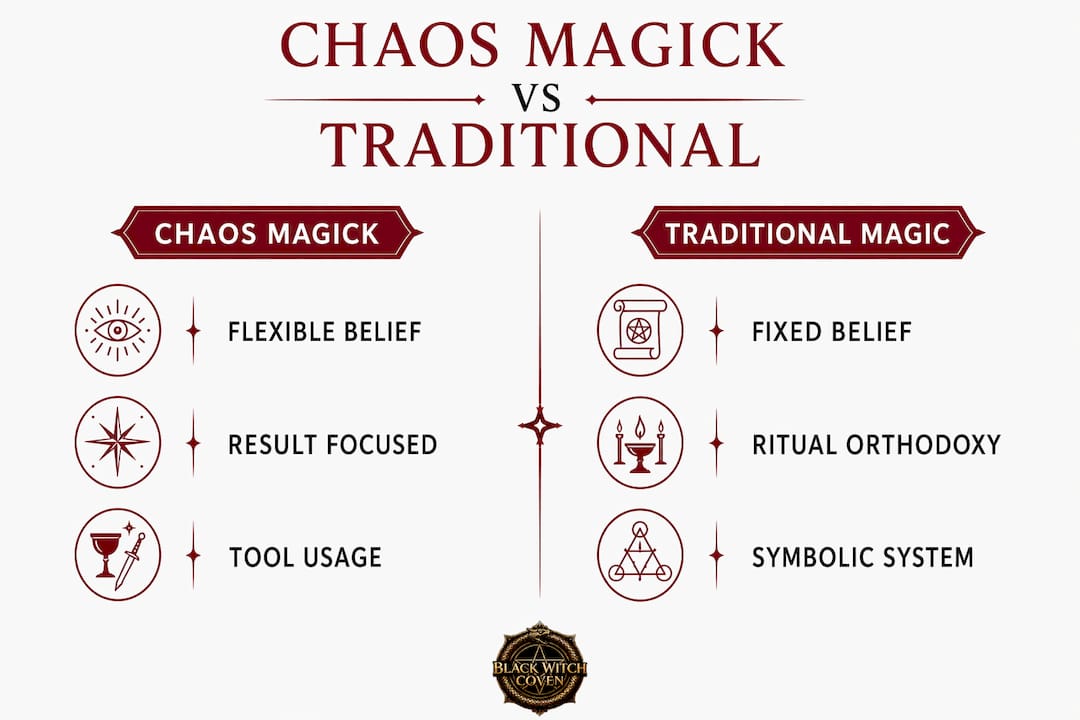
| Feature | Chaos magick | Traditional ceremonial magic |
|---|---|---|
| Belief requirement | Temporary and operational | Fixed cosmological commitment |
| Symbolic system | Expendable once used | Central and authoritative |
| Ritual structure | Flexible, self-designed | Prescribed and orthodox |
| Measure of success | Practical results | Correct performance of rite |
| Relationship to tradition | Borrowed as needed | Inherited and preserved |
| Entry requirement | None formal | Often initiatory |
Enochian magick, for example, carries an elaborate symbolic architecture developed by John Dee and Edward Kelley in the 16th century. A traditional Enochian practitioner treats that architecture as essential. A chaos practitioner might use the Enochian calls to enter gnosis and then discard the entire framework afterward. The technique is borrowed; the allegiance is not. You can read more about how structured ceremonial systems compare in Black Witch Coven’s breakdown of Enochian meta-structures.
Chaos magick techniques blend traditional occult concepts, psychology, and contemporary philosophy, making the practice adaptable in ways that fixed systems are not. That adaptability is its primary advantage. It is also the source of its most common failures.
What are the real risks and misconceptions in chaos magick?
The most common mistake in chaos magick is mistaking temporary belief adoption for permanent belief. A practitioner spends three months working within a Luciferian framework, gets results, and then starts identifying as a Luciferian. That is not chaos magick anymore. That is conversion. The operational value of belief-shifting depends entirely on the practitioner’s ability to pick up a belief and put it down without attachment. Once the belief becomes identity, the flexibility is gone.
The second major risk involves gnosis. Altered states of consciousness are not trivial. Pushing the body and mind into extreme states repeatedly, without discipline or preparation, creates psychological instability. Carroll’s own writing acknowledges that responsible practice requires discipline and clear intent. Treating gnosis as a recreational experience rather than an operational state is a reliable path to confusion and burnout.
The common pitfalls worth naming directly:
- Treating paradigm shifts as spiritual identity changes rather than operational choices.
- Neglecting the forgetting step and then obsessing over whether the working succeeded.
- Using gnosis methods that are physically or psychologically unsafe without adequate preparation.
- Assuming that because all systems are “equally valid,” no discipline or study is required.
- Romanticizing chaos magick as inherently transgressive rather than treating it as a serious technical practice.
The last point deserves emphasis. Chaos magick attracts practitioners who are drawn to its anti-authoritarian framing. That framing is philosophically accurate, but it does not mean the practice is casual. Careless experimentation with belief and altered states produces real consequences. Practitioners who treat it as a game tend to get results that reflect that attitude.
For a grounded look at managing obstacles in spell work, Black Witch Coven’s guide to overcoming spell casting obstacles addresses the practical side of what goes wrong and why.
How to start practicing chaos magick responsibly
Starting with sigil work is the correct entry point for most practitioners. It requires no tools, no tradition, and no prior initiation. It teaches the two core skills that everything else in chaos magick depends on: the ability to clarify intent and the ability to enter and exit gnosis reliably. Both skills take time to develop. Expect the first several workings to feel uncertain.
The following practices build a solid foundation:
- Start with sigils. Work one intent at a time. Keep the intent specific and realistic. Vague intentions produce vague results.
- Develop your gnosis method. Experiment with stillness, breathwork, physical exertion, and sensory deprivation to find what reliably shifts your state. Gnosis is a trainable skill, not a talent you either have or lack.
- Keep a working journal. Record the date, the intent, the method, the gnosis state used, and the outcome. Review it monthly. Patterns will emerge.
- Read the primary sources. Liber Null by Peter J. Carroll is the essential starting text. Austin Osman Spare’s The Book of Pleasure provides the philosophical roots. Both are short and direct.
- Engage with serious communities. The Illuminates of Thanateros is the major magical order associated with chaos magick. It operates on a results-based meritocracy rather than invitational membership, which reflects the practice’s core values.
- Respect psychological limits. If a gnosis method destabilizes you for days afterward, it is too much too fast. Build capacity gradually.
Chaos magick also integrates well with other occult practices. Practitioners working with Goetic entities, blood magick, or structured ceremonial systems can apply chaos magick’s belief-as-tool framework to those workings without abandoning the tradition entirely.
The question is always the same: does this belief, this framework, this symbol produce results? If yes, use it. If not, replace it.
For practitioners interested in how different magical systems can coexist, Black Witch Coven’s article on blending magickal systems is worth reading alongside the primary chaos magick texts.
What chaos magick taught me that most articles will not tell you
The experimental attitude in chaos magick is genuinely valuable. After years of working across multiple traditions, the chaos magick framework is the one that most honestly describes what actually happens in magical practice. Belief does condition results. The practitioner who approaches a working with full conviction gets different outcomes than the one who approaches it with doubt. That is not mysticism. It is observable.
What most introductions to chaos magick miss is the discipline required to make belief-shifting work. Picking up a belief system is easy. Putting it down cleanly is hard. The mind wants to hold on. It wants the comfort of a consistent cosmology. The chaos practitioner has to actively resist that pull, which requires more psychological self-awareness than most magical traditions demand.
The other thing worth saying plainly: chaos magick does not protect you from consequences. Because the system is self-designed and belief-based, there is no tradition, no elder, and no established ethics to catch you when you work carelessly. That freedom is real. So is the exposure it creates. Working with mutable reality models means you are responsible for what you build. Practitioners who treat that responsibility lightly tend to find out why it matters.
Chaos magick works best as a complement to deeper practice rather than a replacement for it. The flexibility is an asset when you have genuine skill to apply it to. Without that foundation, it becomes an excuse to avoid the hard work of developing real competence in any one area. The most effective chaos practitioners I have encountered are not people who know nothing deeply. They are people who know several things deeply and can move between them without losing their footing.
— Black Witch Coven
FAQ
What is the core principle of chaos magick?
Chaos magick is built on the principle that belief is a tool rather than a truth. Practitioners adopt belief systems temporarily to produce specific effects, then discard them when the working is complete.
Who founded chaos magick?
Peter J. Carroll systematized chaos magick in 1970s England, drawing heavily on the earlier work of Austin Osman Spare. Carroll’s Liber Null remains the foundational text of the practice.
What is a sigil in chaos magick?
A sigil is an abstract glyph created from a written statement of intent. It is charged during a state of gnosis and then deliberately forgotten to prevent conscious interference with the working.
Is chaos magick dangerous?
Chaos magick carries real risks, particularly around altered states of consciousness and belief manipulation. Careless practice without discipline can produce psychological instability and unintended consequences.
How does chaos magick differ from Wicca or ceremonial magic?
Chaos magick rejects fixed cosmologies and ritual orthodoxy entirely. Where Wicca and ceremonial magic require commitment to specific belief systems and prescribed ritual structures, chaos magick treats all frameworks as temporary and expendable tools judged solely by their results.
Recommended
- What Is Magick – Black Witch Coven
- Love Magick – Black Witch Coven
- The Ethics of Black Magic: A Personal and Practical Exploration – Black Witch Coven
- Blood Magick – For when you are serious about your spell work – Black Witch Coven
