
 New Years Eve Ritual 2026/2027 with Savannah
Blog, Demons, Working With Demons
Beelzebub: Origins, Meaning, and How to Work With Him
Nov
Beelzebub began as a regional god of the Philistine city of Ekron. By the first century he had become a name hurled at Jesus as the “prince of demons,” and by the early modern period he was a ranking lord of Hell in grimoires, exorcism manuals, and epic poetry. The popular gloss “Lord of the Flies” is old, but it may be a deliberate insult rather than the god’s real title. The scholarly picture is more interesting than the legend, and it matters if you intend to work with this spirit rather than just repeat what the internet says about him.
This article follows him in order: the name, the Hebrew Bible, the Gospels, the long process of demonization, the Testament of Solomon, the Renaissance and Romantic layers, and then a practical method for building a working relationship that separates the documented from the personal.
Table of Contents
- What the name actually means
- The god of Ekron in the Hebrew Bible
- Beelzebul in the Gospels
- How a god became a demon
- Beelzebub, Satan, and Belial: separating the identities
- The Testament of Solomon: the first demonology
- Beelzebub in the grimoire and literary tradition
- Working with Beelzebub: a method that respects the sources
- What is documented and what is personal belief
- Our perspective
- Working with spirits through a witch
- Frequently asked questions
- Sources
What the name actually means
The form most English readers know, Beelzebub, comes from the Latin Vulgate’s rendering of the Hebrew Baal-zebub. The Encyclopedia of the Bible explains that modern translations such as the RSV follow the best Greek manuscripts and write Beelzebul instead, while the KJV and ASV follow the Vulgate. So the two spellings are a manuscript question before they are a theological one.
The components are simple. Baal means “lord,” and was a title applied to many Canaanite gods before it became the name of one. The second element is where the argument sits:
- Zebub, “flies.” This is the ancient reading. The Jewish Encyclopedia notes that the name is commonly explained, after the Septuagint and Josephus, as “Lord of Flies.”
- Zebul, “dwelling” or “prince.” Recent scholarship leans here. A 2023 study in Religions describes the Old Testament form as a derisive twist on Baal-Zabul, “Baal the Prince,” or more likely Baal-Zebul, “Lord of the Dwelling,” perhaps meaning heaven.
- Zebel, “dung.” The Encyclopedia of the Bible lists “dung or filth” as a meaning of Beelzebul, which is the reading that later writers used to heap contempt on the name.
Put together, the likeliest sequence is this. A Philistine deity was known as something like “Lord of the Heavenly Dwelling.” Israelite writers, who regarded his worship as a rival to their own, bent his title by one letter into “Lord of Flies.” Later, the Gospel-era form moved the other way, back toward the original vowel, and acquired its association with filth and with the underworld.
The fly itself was not a random insult. The Jewish Encyclopedia observes that plagues were widely ascribed to flies in antiquity and that the fly was regarded as impure and demonic, citing the rabbinic image of the evil spirit lying like a fly at the doors of the human heart. A 1909 Schaff-Herzog entry offers a more generous reading: the god may have been lord of flies as a sun god, because flies are most numerous in midsummer, when the sun is hottest. That solar suggestion is a nineteenth-century hypothesis, not an attested cult fact, but it gives a magician an interesting angle on seasonal timing.
The god of Ekron in the Hebrew Bible
The only Hebrew Bible source for the name is 2 Kings 1:2-16. King Ahaziah of Israel falls through the lattice of his upper room in Samaria and sends messengers to ask Baal-zebub, god of Ekron, whether he will recover. Elijah intercepts the messengers and delivers a verdict: because the king consulted a foreign god instead of the God of Israel, he will not leave his bed. The Jewish Encyclopedia summarizes the episode the same way and notes that the name appears nowhere else in Jewish literature.
Two details here are useful for a witch.
He was an oracle. Ahaziah did not ask for a curse or a blessing. He asked for a prognosis. The text assumes that Baal-zebub gave answers about illness and survival. Schaff-Herzog points out that a fly-lord with an oracle can be understood as a substitution of effect for cause: the deity associated with disease-bearing insects is the one consulted about disease. Whatever one makes of that explanation, the biblical record presents the god as a source of divination and knowledge about health, not as a tormentor.
He had a following. A king would not send messengers across a border to a god who lacked a reputation. The narrative is hostile, but it is also evidence that Ekron’s god was credited with accurate information.
That is the entire documented Old Testament profile: a regional lord, an oracle, an illness consultation. Every later attribute is added afterward.
Beelzebul in the Gospels
The name returns in the Synoptic Gospels, and here it is no longer a god. In Matthew 12:24, Mark 3:22, and Luke 11:15, opponents of Jesus claim that he casts out demons by Beelzebul, the ruler of the demons. Matthew 10:25 uses the name in a related saying about the master of the house.
The Biblical Archaeology Society notes that no reference to Beelzebul survives in early Jewish literature or any other early literature outside these accounts, and that the popular consensus equating him with Satan goes back to the New Testament period. The Encyclopedia of the Bible adds that the title was evidently applied to Jesus by his opponents, and that it cannot be established whether it meant Satan himself or a lesser prince of demons.
Jesus’s reply in all three accounts is a logical one: a kingdom divided against itself cannot stand, and if Satan drives out Satan, Satan is divided. That argument quietly treats Beelzebul and Satan as the same office, which is how Christian tradition read it afterward.
A 2023 article by Jeremy Otten in Religions reads the scene as social strategy. In his analysis, the scribes in Mark 3 use “Beelzebul” to discredit and even prosecute Jesus under the Deuteronomy 13 framework for false prophets, and Jesus’s switch to the word “Satan” redraws the boundary between insiders and outsiders. Otten also proposes that the old name was revived in Jesus’s day as a pious circumlocution for Zeus and related Semitic gods, so that no one had to call them “Lord of Heaven.” If he is right, the Gospel scene is not a memory of the Ekron cult at all. It is an accusation vocabulary, built from an old god’s name and aimed at a living man.
How a god became a demon
No single text records the transformation. What survives is a set of scholarly reconstructions, and they agree on the mechanism more than on the dates.
The Schaff-Herzog entry says that Beelzebub was early identified with Baal-zebub and, as often happened, was turned into a bad demon in accordance with later Jewish ideas. It adds that since the seventeenth-century scholar John Lightfoot, it has been common to say that the form Beelzebul was deliberately made out of Beelzebub to express contempt and horror, “lord of dung” for “lord of flies.”
A 2017 paper by Janik, indexed at CEEOL, argues that the change was lengthy and tied up with several currents: monotheism’s struggle against Baal worship, religious syncretism, the Baal motif in the Old Testament, and dualism. In that account, a tradition outside the biblical text altered the name in an attempt to end idolatrous practice.
The 1911 Encyclopaedia Britannica is frank about the gap: it finds no trace of the name outside the Gospel passages and literature dependent on them, and if the two names are connected, nothing shows how the god became a devil. It also records a competing suggestion that the Aramaic b’el-debaba, “adversary,” may stand behind the names.
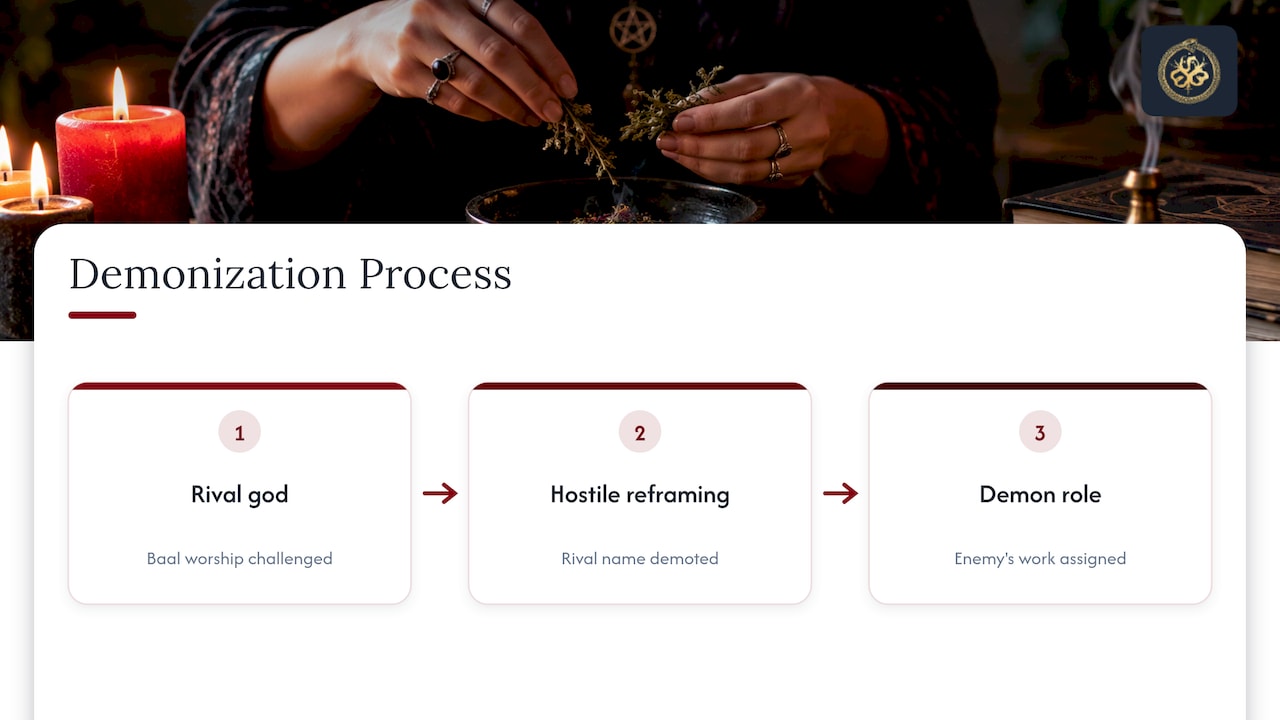
This pattern is general across the ancient Near East and the Mediterranean. When one religion absorbs or competes with another, the rival’s gods do not vanish. They get demoted, renamed, and assigned the work that the dominant religion needs an enemy for. For a magician interested in the real history of spirits, Beelzebub is a clean case study of that process: one name, one hostile reframing, and nearly two thousand years of accumulated assumption.
Beelzebub, Satan, and Belial: separating the identities
Popular writing treats the three names as interchangeable. The sources do not.
| Name | Earliest context | What the sources say |
|---|---|---|
| Baal-zebub | 2 Kings 1 | A god of Ekron, consulted as an oracle |
| Beelzebul | Synoptic Gospels | Ruler of demons, an accusation made against Jesus |
| Satan | Hebrew Bible and New Testament | The adversary, named by Jesus as the same ruler |
| Belial | Jewish texts of the period | The usual alternate name for Satan in that literature |
The Catholic Encyclopedia notes that Beelzebub does not appear in the Jewish literature of Jesus’s period, where Belial was usually the alternative name for Satan. It treats Beelzeboul in the Gospels as another name for Satan, and suggests that the role of arch-demon and exorcist was not a Palestinian belief but a change invented by Jesus’s enemies to discredit his exorcisms.
The practical consequence is that the Beelzebub of a modern grimoire is a composite. He draws from an Ekron oracle-god, a Gospel accusation, and a later slot in a ranked hierarchy of Hell. A witch who knows which layer a given attribute comes from can decide which layers to work with and which to set aside.
The Testament of Solomon: the first demonology
The richest early text is the Testament of Solomon, a pseudepigraphic work. In the translation hosted by Esoteric Archives, Solomon forces the demon Ornias to bring “the prince of all the demons,” who identifies himself as Beelzebub, exarch of the demons, adding that all the demons have their chief seats close to him and that he is the one who makes the apparition of each demon manifest.
This is a significant passage for operative work. It does not cast Beelzebub as a mere ruler in a pyramid. It casts him as the one who controls the manifestation of the others: an intermediary. The text also supplies the template that later ceremonial magick copied, in which a spirit is compelled by a seal-ring received through the angel Michael and made to reveal its powers and its opposing angel.
The 1901 Jewish Encyclopedia entry calls the book a crude formulation of demonic conceptions that were nearly universal in the Jewish and Christian world for centuries, written by a Greek-speaking Jewish Christian, and dated probably not far from 300 CE. Scholars also note that the text appears to have been edited and expanded in later centuries, so any given detail may postdate the core.
Beelzebub in the grimoire and literary tradition
Everything after late antiquity builds on the Gospel and Solomonic layers. According to the Wikipedia article on Beelzebub:
- The sixteenth-century physician and demonologist Johann Weyer reported that Beelzebub led a successful revolt against the Devil.
- The exorcist Sébastien Michaëlis, in his Admirable History of 1612, placed him among the three most prominent fallen angels, alongside Lucifer and Leviathan.
- John Milton, in Paradise Lost (1667), made him second only to Satan among the fallen angels. The grouping of Lucifer, Beelzebub and Astaroth as the three rulers of Hell comes from the grimoire tradition, notably the Grand Grimoire, rather than from Milton.
- Later lists describe him as one of seven princes of Hell, assigned to gluttony or envy depending on the scheme, and the Dictionnaire Infernal credits him with flight.
The Dictionnaire Infernal is worth one further note. Collin de Plancy first published it in 1818, and, as the Public Domain Review describes, the illustrated 1863 edition secured its status as a landmark compendium of demons. Much of the visual vocabulary people now associate with named demons, including the winged, fly-like Beelzebub, comes from that edition and its imitators rather than from any ancient source.
The sequence is useful when you read modern sources. Weyer, Michaëlis, Milton, and Collin de Plancy are all writing between roughly the 1500s and the 1800s, and each is working from the layers before him. A claim that Beelzebub “has always been” a prince of Hell, a master of gluttony, or a winged being is a claim that dates to this period.
Working with Beelzebub: a method that respects the sources
For a magician, the layers above are not an obstacle. They are a map of what the name can open. Each layer suggests a different kind of work, and a disciplined approach picks one rather than blending all of them at once.
Decide which Beelzebub you are approaching
There are four defensible entry points, each tied to a documented source:
- The Ekron oracle. Divination and questions about health, recovery, and outcomes, following 2 Kings 1. This is the oldest layer and the only one with a cultic use attested in the text.
- The lord of the dwelling. If the Zebul reading is right, the name points to a household or heavenly seat of power. This suits work on a home, a base of operations, or a position of authority.
- The exarch of the demons. The Testament of Solomon’s Beelzebub as the intermediary who makes other spirits appear. This is the layer for those who want him as a gatekeeper or introducer.
- The fallen prince. The Weyer, Michaëlis, and Milton layer: rebellion, sovereignty, independence from a ruling power. This resonates with Left-Hand Path themes of self-rule.
Write down which one you intend. The most common error in demon work is a vague approach that mixes the oracle, the prince, and the cartoon, then reads whatever happens as confirmation.
Read the primary texts first
Before any rite, read 2 Kings 1:2-16, Matthew 12:22-30, Mark 3:20-30, and the Beelzebub chapters of the Testament of Solomon. The whole set takes under an hour. You will notice what is absent: none of these texts gives him a sigil, a planetary hour, a color, an incense, or a prayer. Those come from the grimoires and from living tradition, including our own, set out further down. Note which attributions you adopt and label them in your journal as historical, grimoire, or personal.
Build a single-purpose operation
A clear working has one problem, one spirit, and one measurable outcome. Here are two illustrative scenarios, not client records, showing how the layers translate.
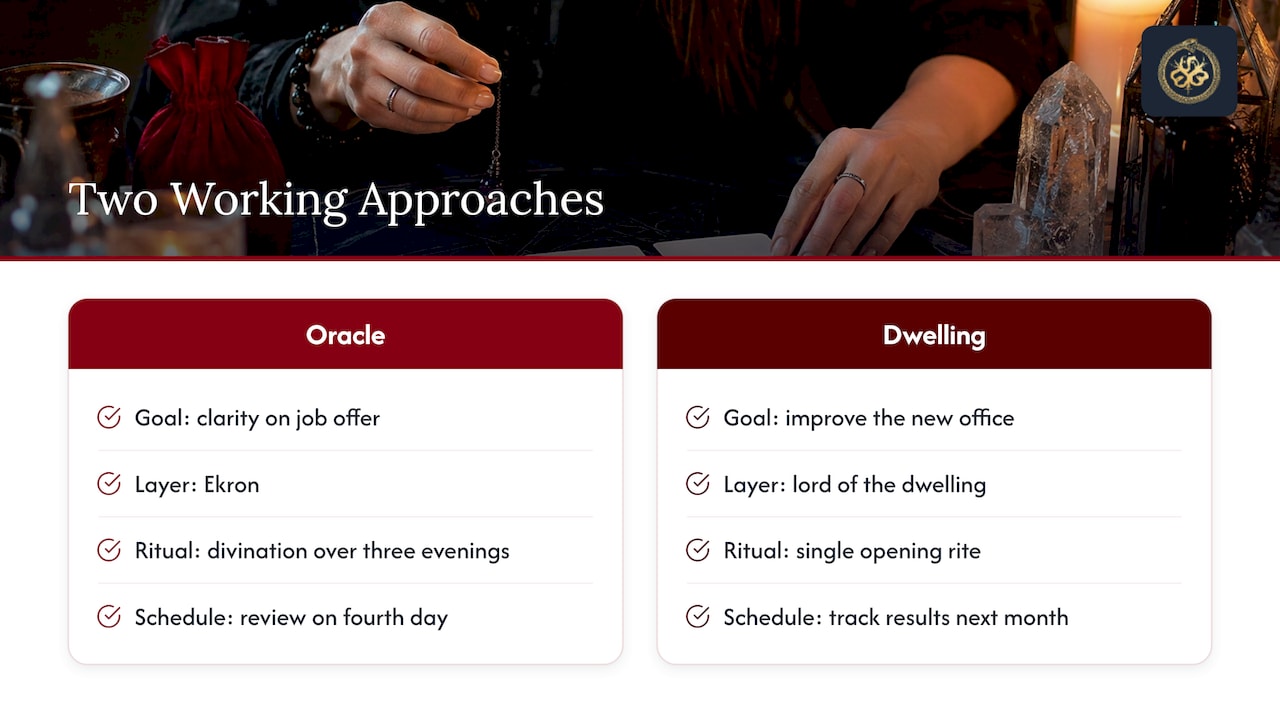
Scenario one: the oracle approach. A researcher facing a difficult decision about a job offer wants clarity rather than a result. She chooses the Ekron layer. Over three consecutive evenings she sets a fixed question in writing, makes a simple offering of her choosing, performs a divination method she already knows well, such as cards or a pendulum, and records the answer before any interpretation. On the fourth day she reviews all three answers for consistency. The documented parallel is Ahaziah’s question about recovery: a specific question, a defined waiting period, a recorded answer. The discipline of recording is what separates information from mood.
Scenario two: the dwelling approach. A business owner who has just moved her practice into a new office wants the space to work for her. She chooses the lord-of-the-dwelling reading. She cleans the space, defines its boundaries physically, and performs a single opening rite addressed to the spirit as the lord of that threshold. In the following month she tracks concrete markers: client inquiries, signed contracts, how she feels in the space, and whether disputes arise. She pairs the ritual with practical changes, a better lease negotiation, a reorganized floor plan, and updated signage, since a ritual with no real-world action has no way to show a result.
Structure the rite
A workable skeleton, adapted to your tradition:
- Preparation. Clean the space and yourself. Settle your mind with a short breathing practice. State your purpose aloud.
- Opening. Mark the working area. If you use a circle, triangle, or other boundary, set it before the invocation.
- Address. Call him by the specific name you have chosen, and by the specific title that matches the layer. Using “Baal-zebub,” “Beelzebul,” and “Beelzebub” interchangeably in one rite blurs the intention.
- Petition. State your single request in plain, complete sentences.
- Offering. Offer something you can verify and sustain. Documented ancient practice involved inquiry and sacrifice at Ekron, but the text does not itemize what was given, so the choice is yours.
- Silence. Hold a period of quiet attention for a fixed time, then close.
- Closing and record. Close formally, and write down what you perceived immediately, before explanation sets in.
Repeat on a fixed schedule for a set number of cycles, then review. A lunar cycle is a common unit, and the Schaff-Herzog solar suggestion gives a reason to try a midsummer cycle if you want the seasonal link.
What Black Witch Coven uses with Beelzebub
The ancient texts give him no seal, colour or incense. Grimoire and living tradition do, and this is what we work with in Black Witch Coven. It comes from our Beelzebub page in the Demon Directory, where you will find more of his lore.

- His seal: draw it by hand on clean paper and keep it on the altar for the whole cycle of the working. Spend a few minutes with it each day before you call him, so that the first formal call is not a first meeting.
- His enn: Adey vocar avage Beelzebuth. Chant it slowly and steadily until the air in the room changes.
- Correspondences: a black candle, fern, iron (or gold for workings of rule and authority), and fire. Many in our tradition also work with him through the Sun, which fits the old suggestion that the lord of flies was a midsummer god.
- How he tends to arrive: a sudden buzzing or the sense of a swarm, a change in air pressure, a heavy charged stillness or a turn in the weather. Many describe a raspy voice. Flies appearing out of season around the working are taken as a sign that he has noticed.
- What he is like: a high, old and strict power. He is lord of the air and of storms, a master of astrology and of entomancy (divination by the behaviour of insects). Those close to him know him as the enforcer of unity among those who walk with Satan: he does not tolerate dedicated Satanists cursing one another, and he will make that plain.
Approaching him through Satan. Many in our tradition first petition Satan to move Beelzebub to come, in words such as:
“Lord Satan, by your grace, grant me the power to conceive in my mind and to carry out that which I desire. I ask you to move Beelzebub to come before me, that he may give me a true and faithful answer and help me reach my desired end, provided it is proper to his office. This I ask in your name, Lord Satan.”
The coven’s invocation. For deep work, such as opening the Nine Locks of the Abyss, we use a direct invocation into the body as temple:
Beelzebub, I invoke thee.
Beelzebub, I summon thee.
Beelzebub, I conjure thee.
Come forth, Beelzebub, and manifest thyself
within this body, this temple which I have prepared.
Come forth, Beelzebub, and manifest thyself.
Invocation into the body is advanced work. Know the spirit through evocation and offerings first, keep your purpose single, and close fully afterwards. Whatever you promise him, deliver. As with all magick, results are never guaranteed.
Keep the record honest
Serious occultists who are also critical thinkers keep three columns in a journal: what you did, what you experienced, and what happened externally. Date every entry. Over time the record shows you how he answers you in particular: which signs come before a result, which offerings he takes well, and which parts of your method carry weight and which are decoration.
What is documented and what is personal belief
The reader who wants to know whether Beelzebub exists as an independent being will find that the scholarly sources are silent on the question. They address texts, names, and social functions, not metaphysics. What the evidence supports is narrower and still substantial: a god was worshipped at Ekron, his name was altered by hostile writers, the Gospel accusation made him a demon-ruler, and later authors elaborated that into a hierarchy.
Anything beyond that, including his personality, preferences, and the effects of a rite, falls under personal gnosis, shared practice, and the experience of the operator. That is not a weakness. It is the honest boundary between history and practice, and a witch who keeps it clear is harder to fool, including by himself.
Our perspective
We read Beelzebub as a case study in how a name travels. A regional oracle becomes an insult, the insult becomes an office, and the office becomes a personality that nobody in the ancient world ever described. The best magicians we know treat that as an opening, not a problem.
The sources show that the traditions most often repeated are the youngest ones. That means a magician has real room to build a direct relationship from the oldest layers: the oracle of Ekron, the lord of the dwelling, the exarch who makes other spirits manifest. Each layer supports a different kind of work, and each rewards the same discipline: one purpose, one spirit, one record.
We also believe that sovereignty means doing the reading yourself. Know which statements come from 2 Kings, which from the Testament of Solomon, and which from Weyer or Milton. Then make your own decision about what to adopt. Left-Hand Path practice is strongest when it is informed, deliberate, and paired with real-world action, because results you can trace are results you can repeat.
Black Witch Coven
Working with spirits through a witch
If you would rather have an experienced magician carry out a single-purpose demonic working on your behalf, our daemonic spell casting services cover prosperity, love, legal, and protection work, each written around one clear objective.
Frequently asked questions
Is Beelzebub in the Bible?
Yes. The name appears in 2 Kings 1, where it refers to the god of Ekron whom King Ahaziah consults, and in the Synoptic Gospels (Matthew 12, Mark 3, Luke 11), where opponents of Jesus call Beelzebul the ruler of demons. Translations differ on spelling: the KJV follows the Vulgate with Beelzebub, while the RSV uses Beelzebul, following the best Greek manuscripts.
Is Beelzebub the same as Satan?
The Gospels treat the two as the same office, and Jesus’s reply about a divided kingdom assumes it. The Encyclopedia of the Bible says it cannot be established whether Beelzebul meant Satan himself or a lesser prince of demons. In later demonology, Beelzebub is often a separate being ranked just below Lucifer.
What does Beelzebub mean?
The traditional reading is “Lord of the Flies.” Recent scholarship suggests the original title was closer to “Lord of the Dwelling,” perhaps meaning heaven, and that the fly form was a mocking alteration. A further variant, Beelzebul, has been read as “lord of dung” in contemptuous use.
Where does the Testament of Solomon place him?
In that text, Beelzebub is the prince and exarch of the demons, and says that the other demons have their seats close to him and that he makes each one’s apparition manifest. The work is probably from around 300 CE and appears to have been edited in later centuries.
Sources
- Beelzebub, Jewish Encyclopedia (1901)
- Solomon, Testament of, Jewish Encyclopedia (1901)
- The Devil in the Details: Beelzebul and Social Identity, Religions (2023)
- Beelzebub (Beelzebul, Baalzebub), Encyclopedia of the Bible
- Who the Devil is Beelzebul? Biblical Archaeology Society (1997)
- Catholic Encyclopedia: Beelzebub (1907)
- New Schaff-Herzog Encyclopedia of Religious Knowledge (1909)
- Beelzebub, 1911 Encyclopaedia Britannica
- Janik (2017), CEEOL article record
- The Testament of Solomon, Esoteric Archives
- Beelzebub, Wikipedia
- Defining the Demonic, The Public Domain Review
