
Blog, Demons, Working With Demons
Murmur Demon: History, Seal and How to Work With Him
Nov
Murmur is the 54th spirit of the Ars Goetia, a Duke and Earl who rides a griffin, arrives behind two ministers sounding trumpets, teaches philosophy, and compels the dead to appear and answer questions. He is the one Goetic spirit whose office is necromancy proper. This article follows him from the sixteenth-century manuscripts to a complete working: materials, timing, the petition word for word, the steps, the signs of his presence and the closing. His short entry is on the Murmur page of our Demon Directory.
What the primary texts say about Murmur
The oldest printed account is in Johann Weyer’s Pseudomonarchia Daemonum, appended to the fifth edition of De praestigiis daemonum in 1577. Entry 40 in the Latin text calls him a great duke and earl who appears in the form of a soldier riding a vulture and crowned with a ducal crown. Two ministers with great trumpets go before him. He teaches philosophy absolutely and compels souls to appear before the exorcist. Weyer drew on an older manuscript, the Liber officiorum spirituum, which was already old when he copied it.
Weyer gives no number of legions. Reginald Scot’s 1584 English version in The Discoverie of Witchcraft passed the catalog on in English, and the thirty legions entered the record from that line of transmission, since the count is absent from Weyer. The Goetia’s list of 72 derives from a variant of the Offices of Spirits by way of the English translation in Scot. The most striking difference between Scot and the Goetia is the order of the spirits, which looks scrambled, as in the Hockley manuscript (Wellcome 4665), where each spirit sits on its own leaf and many pages were later dislocated. That is why Murmur is number 40 in Weyer and Scot and number 54 in the Goetia.
In the Goetia text he is the 54th spirit. He is a Great Duke and an Earl, he rides a griffin, and the ministers with trumpets still precede him. He teaches philosophy perfectly and constrains deceased souls to come before the exorcist and answer his questions. He was partly of the order of Thrones and partly of Angels, and he rules thirty legions. The mount has changed from vulture to griffin between Weyer and the Goetia, a small shift that shows the later compilers copying and adjusting as they went.
The manuscripts spell the name several ways. Sloane 3648 and the Harley manuscript give Murmus, and the Mathers and Crowley text gives “Murmur, or Murmus, or Murmux.” The name is almost certainly the Latin word murmur: a hum, a whisper, a rumble, and the roar of a horn or trumpet. That one word contains his whole character: the low continuous hum of voices, and the blare that announces a duke.
From Weyer to Mathers: how the figure changed
Three layers of transmission matter if you want to work with the spirit as the sources describe him, and not as a later reader imagined him.
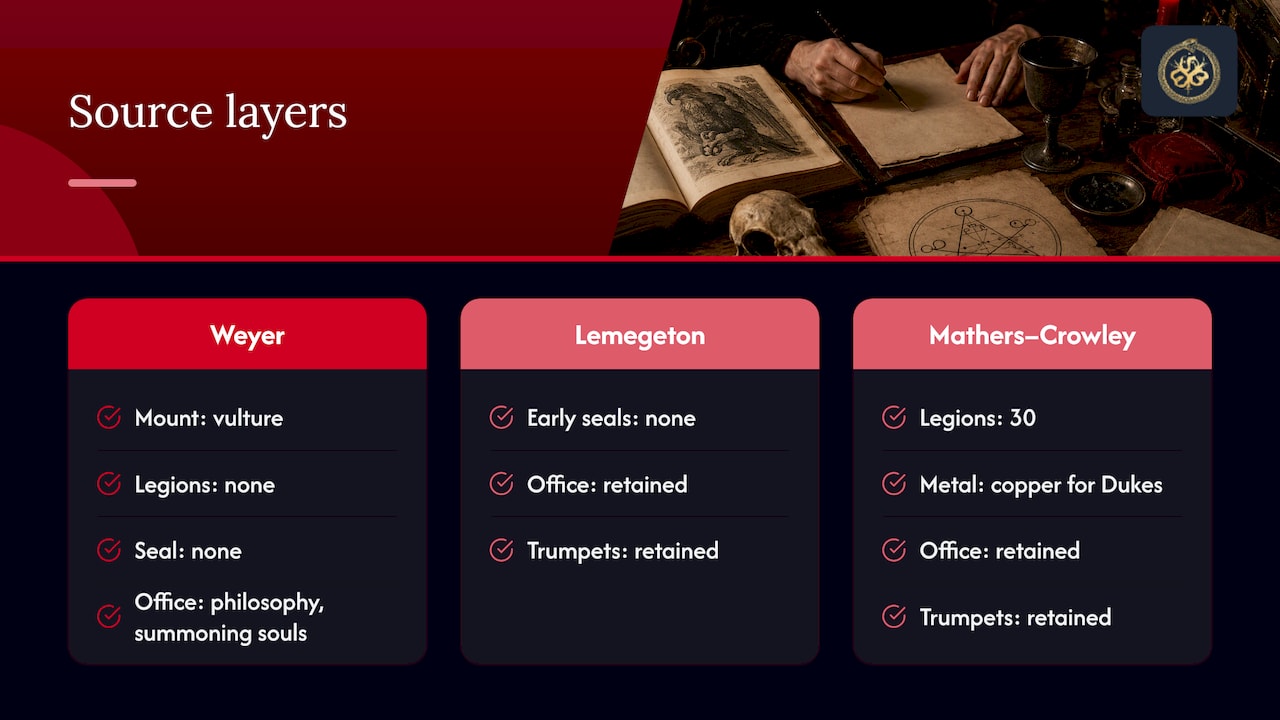
The Weyer layer (1577). A vulture, no legions, no seal. The spirit is defined by office: philosophy and the summoning of souls.
The Lemegeton layer (seventeenth century). The Lemegeton was compiled in the mid-seventeenth century, largely from material about two centuries older. Its first book, the Goetia, describes 72 spirits that Solomon is said to have evoked and confined in a bronze vessel. The early manuscripts that fed it contain no seals, so the seals are a later addition. The seal you draw for Murmur belongs to the Goetia tradition, not to Weyer.
The Mathers and Crowley layer (1904). Samuel Liddell MacGregor Mathers translated the text and Aleister Crowley edited and published it as The Book of the Goetia of Solomon the King. Most English-language working today starts from this edition. Its spelling of the name, its copper metal for Dukes and its thirty legions are what most modern books repeat.
The pattern is consistent. Each layer kept the office and the escort of trumpets and added decoration around them. When you work with Murmur, the office is what you can rely on. Everything else is a convention you choose to follow.
Rank, planet and the question of off-world origins
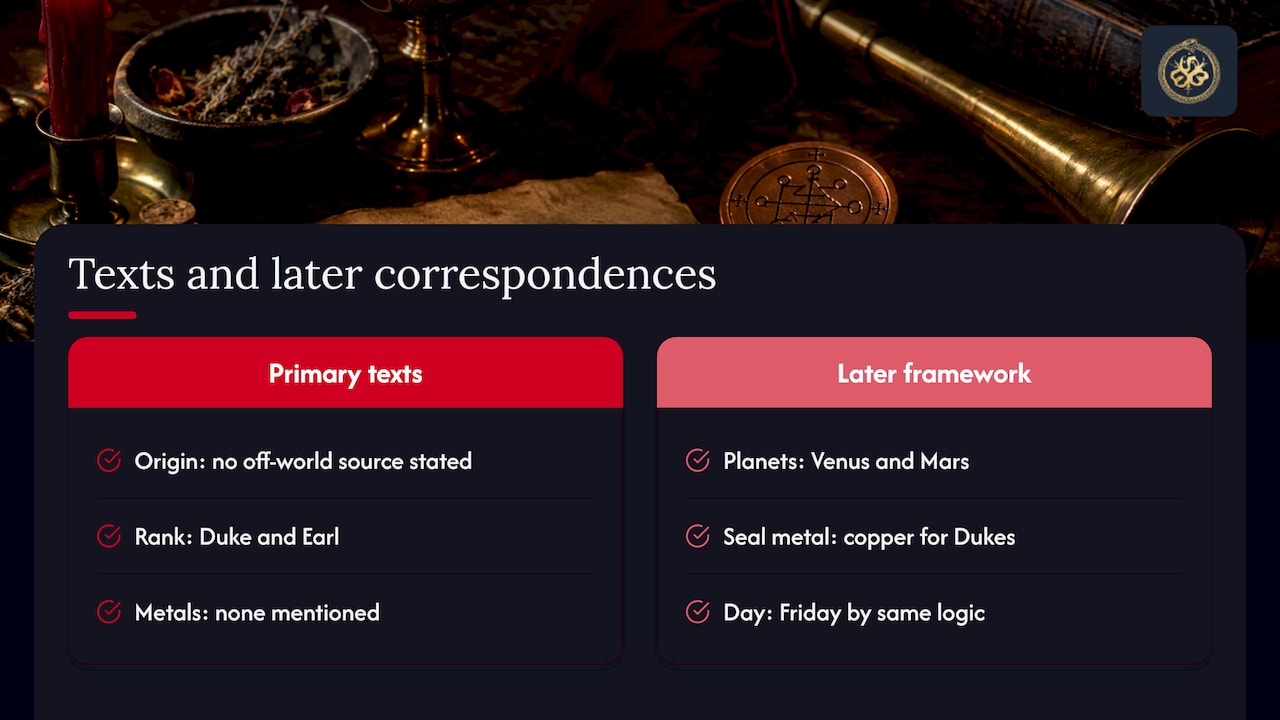
A recurring question is whether Murmur, or any Goetic spirit, comes from another planet or planetary system. The primary texts do not say so. Weyer’s entry, the Goetia and Scot describe rank, appearance, office and legions, and none of them places the spirit’s origin off the earth. The only celestial material attached to Murmur is astrological correspondence added later.
His dual title of Duke and Earl is associated in the Goetia ranking system with Venus and Mars respectively, and the classified list of the 72 spirits places him among the Dukes with copper as his seal metal. Copper is the metal of Venus. Those who add Friday as his day follow the same logic. The Goetia gives these planetary attributions by rank only, never in Murmur’s own entry, and later occultists drawing on Agrippa, the Heptameron and the Golden Dawn built them out into the days, hours and incenses used today.
If you want to explore the idea that these spirits are older than the grimoires, and that the Solomonic catalog is a medieval window onto beings known under other names in earlier cultures, the method is to compare offices across traditions and ask what the Goetia preserved. A spirit who calls up the dead to speak has counterparts in many ancient cults of the dead, from Greek nekyomanteia to the necromancy of the Papyri Graecae Magicae. Weyer and the Goetia remain your fixed point.
Murmur’s office: philosophy and the speaking dead
Murmur’s two gifts are connected. The Goetia gives him the teaching of philosophy and the compelling of souls to answer. Other Goetic spirits deal with the dead. Murmur is the one who makes them speak, and that makes him the specialist for a particular kind of question: one that only someone who has already died can answer.
Because of this, Murmur suits two kinds of work.
- Philosophical study. You are working through a difficult body of thought, such as Neoplatonism, Hermetic texts, the Papyri Graecae Magicae or the history of the Left-Hand Path itself, and you want a teacher who stands behind the work. The Goetia says he teaches philosophy perfectly.
- Consultation with the dead. You have a question for a particular ancestor, mentor or figure, and you want the conversation to be conducted under the authority of a spirit whose office is exactly this. The text says he constrains souls to come before the exorcist.
His appearance with the trumpets already tells you what kind of presence to expect. Modern demonolatry, as set out in S. Connolly’s The Daemonolatry Goetia, works with Murmur for necromancy and for the study of complex philosophical disciplines, and describes him as a solemn and intellectual presence. Expect formality and not warmth. Murmur is a duke, he arrives with an announcement, and the work rewards preparation.
A working with Murmur
The Goetia gives one operating method for all 72 spirits. The magician marks a circle and stays inside it, sets the Triangle of Art a few paces away where the spirit is to manifest, wears the lamen with the spirit’s seal, recites the conjurations, and gives the spirit license to depart only after the request is answered. Our conjuring method from the Goetia gives that procedure in full. The working below follows the same structure and adapts it for a modern offering-based relationship. At Black Witch Coven we treat the spirits as real, intelligent beings, and the working is written to address Murmur as a duke is addressed: with precision, with an offering and with a clear request.
Materials
- A lamen of Murmur’s seal, drawn from the Mathers and Crowley Goetia. The Goetia assigns copper to Dukes, so a copper disc engraved with the seal is the traditional form. Seal drawn in ink on parchment is an accepted alternative.
- A black chalk or ash circle large enough to sit in comfortably, and a triangle about three feet on each side, drawn or laid in cord a few paces outside it. Place a small dish in the center of the triangle.
- One black candle for the working, and one green or copper-colored candle for Venus placed at the apex of the triangle. Some dress both with Murmur Oil.
- Incense: sandalwood, which Goetic correspondence tables commonly pair with him, with a pinch of dragon’s blood resin.
- Offerings: a glass of dark red wine, a small dish of honey, and fresh water in a separate cup for the dead.
- A small bell or a horn, or a brass trumpet if you have one. His ministers carry trumpets and a sounded note opens the working in his own idiom.
- A journal and a pen for recording the session at once.
- If consulting the dead: a photograph or personal item of the person you wish to address, laid on the triangle.
Timing
Choose the timing by what you want from him.
- For philosophy and study: Friday, the day of Venus, in the planetary hour of Venus, with the moon waxing between the first crescent and the first quarter. Friday is the day Goetic correspondence tables commonly assign him, and the waxing moon suits learning and accumulation.
- For the dead: Friday night or Tuesday night, the Mars day matching his Earl title, near the dark moon, when the veil is understood to be thinnest. The hour of Venus on Friday, or the hour of Mars on Tuesday, is the most suitable.
The Goetia itself gives no orientation, planetary hour or offering specific to Murmur, so these choices are ours, drawn from his rank and from the correspondences that became attached to him. Work in the hour you choose and keep the same timing for repeat sessions so the relationship develops a rhythm.
The enn
The modern chant recorded for him is “Vefa mena Murmur ayer”. It is a modern enn and not a text from the Goetia, but it is widely used in contemporary demonolatry. Repeat it slowly, building to nine repetitions, letting the vowels carry the low hum his name suggests.
The petition
Speak this aloud after the enn, standing at the edge of the circle facing the triangle. Replace the bracketed phrase with your own request, stated plainly.
Murmur, Great Duke and Earl, rider of the griffin, crowned and preceded by trumpets, I call you by your name and by your office. You teach philosophy perfectly and you bring the dead before the one who calls. I am [your name], and I offer you wine, honey and my full attention. I ask you to teach me [the subject or question you are studying] / to bring before me [name of the dead] that I may ask what I need to ask. Come in peace and in your own authority, speak clearly, and let me hear and understand. I will receive what you give with respect and I will return what I owe.
If you are asking for philosophy, name the exact subject. Murmur’s office is teaching, and a request such as “help me understand the structure of Plotinus’s emanation” is something a teacher can act on, while “make me wise” is not.
Step by step
- Prepare the space. Mark the circle and the triangle, set the dish in the triangle, and lay the lamen across your chest or at the circle’s edge, seal facing outward.
- Light the candles. Light the green or copper candle at the apex of the triangle first, then the black candle at your position inside the circle, then the incense.
- Sound the bell or horn. One clear note, then silence. This opens the working in the manner of his trumpets.
- Say the enn nine times, slowly.
- Speak the petition. Pour the wine into the dish in the triangle and add the honey as you name them.
- Wait. Sit in silence for at least twenty minutes with your attention on the triangle. Do not fill the quiet. Murmur is a spirit of low sounds and the first signs are usually subtle.
- Ask your question or state your study. When you sense a presence, put your single question in plain words. If you have asked for the dead, address the person by name and give the dead their cup of fresh water, placing it beside the photograph.
- Listen and record. Write down what comes, in whatever form it comes, before you leave the circle. Impressions fade fast.
- Close (see below).
Signs of his presence
Murmur’s character gives the signs their texture. Look for the following:
- A low hum or murmuring that seems to come from the room and not from any source, or a faint brassy note at the edge of hearing, which fits his trumpeting ministers.
- The candle at the triangle’s apex burning taller, leaning toward the dish or flickering in a slow rhythm.
- A sense of formal, weighty attention, as if a senior figure has entered a room.
- A copper or metallic taste, or a sudden feeling of warmth at the lamen.
- Images of a rider, a crowned figure, a bird of prey or a griffin, either seen in the mind or in a dream that night.
- For consultations of the dead: a shift in the room’s temperature, the sense of a particular person’s manner, or words that arrive in a voice not your own thought.
The quality of the teaching is judged over weeks of study, not in one session.
Closing the working
The Goetia is explicit that the spirit is given license to depart only after the request is answered. Close in the same order every time.
- Thank him aloud: “Murmur, Great Duke, I thank you for your teaching and your attendance. Go in peace to your own place. Come again when I call you by name.”
- If you called the dead, thank them by name and tell them they may rest.
- Sound the bell or horn once more and let the note finish.
- Snuff the candles in reverse order, the black candle first and the apex candle last.
- Leave the offering on the triangle until the incense has burned out, then pour the wine and water onto earth outside and discard the honey.
- Finish writing in your journal. Note the date, the moon phase, the planetary hour and anything unusual. Record the day and hour so that repeat sessions build on the same pattern.
Typical uses: Murmur in a modern life
These are typical situations, not client cases.
The student of the papyri. A doctoral student in comparative religion wants to read the Papyri Graecae Magicae alongside the Goetia and keeps losing the thread. She works with Murmur on Fridays during the waxing moon for six weeks, each session with the same offering and a single request: that he guide her through one text at a time. She keeps a journal of what she reads between sessions and notes which passages seem to open and which stay closed. The sessions give her a structure for study, with the spirit’s office as the anchor.
The grandson with a question. A man whose grandfather ran the family business has a question about a decision the old man made, and no living person can answer it. He prepares a dark-moon working on a Tuesday night, lays his grandfather’s photograph on the triangle, and asks Murmur to bring him forward. He writes down every impression, keeps the question narrow, and closes by thanking both the duke and his grandfather. He repeats the working only when a new question arises, treating the dead with the courtesy owed to elders.
In both, Murmur is given a specific question, a steady rhythm and a written record.
Murmur in contemporary Left-Hand Path work
The modern Luciferian and demonolatry traditions read Murmur in different ways. For those who work with the spirits as real, independent beings, he is a teacher and a gatekeeper to the dead. For those who emphasize the self-accountability of the Luciferian path, he is a guide who answers a student prepared to do the reading. In both cases you arrive with a question, you bring an offering, you take what he teaches, and you stay sovereign over your own conclusions.
The working pairs naturally with the habits that make any Left-Hand Path study last. Keep one subject for the duration of a lunar cycle. Read the primary text before the session, not after. Write the question before you enter the circle.
Our perspective
We have worked with Goetic spirits for sixteen years from New Orleans, and Murmur is one of the clearest examples of why we begin with the primary texts. The Weyer entry gives you the office. The Goetia gives you the seal and the escort of trumpets. Mathers and Crowley give you the English most of us learned from. Knowing which layer says what lets you separate the spirit’s constant character from the decoration added by later compilers.
The second thing we hold to is that spirits are real, intelligent beings and that a working is a relationship. Murmur’s office is unusually specific. A duke who teaches philosophy and brings the dead to speak will respond best to a student who asks one precise thing, offers consistently and keeps records. That is the same discipline we bring to the pacts, protections and prosperity workings we perform for those who come to us.
Finally, we believe magick and real-world action belong together. A session with Murmur on a philosophical text only becomes knowledge when you read the text, and a conversation with an ancestor only becomes understanding when you act on what you were told.
Black Witch Coven
For those who want guidance with their own working
If you are preparing a working with Murmur or another spirit and want a second pair of eyes on your petition, timing or choice of spirit, we offer a Left-Hand Path Tarot Reading or Spirit Guidance session.
FAQ
Who is Murmur in the Ars Goetia?
Murmur is the 54th of the 72 spirits, a Great Duke and Earl who rules thirty legions and appears as a soldier on a griffin with a ducal crown and two trumpeting ministers. His office is teaching philosophy and compelling the souls of the dead to answer questions. The text says he was partly of the order of Thrones and partly of Angels.
Is Murmur the same as Murmus or Murmux?
Yes. These are manuscript and edition variants of the same name. Sloane 3648 and the Harley manuscript give Murmus, and the Mathers and Crowley text lists all three spellings together. In Weyer’s 1577 list the same spirit stands as entry 40 under Murmur.
What day and metal belong to Murmur?
The Goetia tradition gives Dukes copper, and Venus, the planet of copper, is associated with the Duke rank, with Mars attached to the Earl title. Friday is the day most often used for him, with Tuesday as the Mars alternative. The Goetia gives these by rank, and later occultists added the days and hours.
Can Murmur bring a specific dead person forward?
That is his office in the Goetia: he constrains deceased souls to appear and answer. Prepare a narrow question, lay a photograph or personal item of the person on the triangle, and give the dead a cup of fresh water. Record whatever comes in your journal at once.
