
 New Years Eve Ritual 2026/2027 with Savannah
Blog, Demons, Working With Demons
The 72 Goetic Demons: Manuscripts, Ranks, and Working Notes
Mar
Goetic demons are the seventy-two spirits cataloged in the Ars Goetia, the first book of the Lemegeton or Lesser Key of Solomon. Each spirit is listed with a rank, an office, a legion count, and a seal used to identify and address it in ritual. This article covers the textual origins, the rank system, the full catalog grouped by title, and how witches approach the material today.
Table of Contents
- Goetic hierarchy: ranks, legion counts, and correspondences
- The seventy-two spirits: grouped reference by rank
- Notable Goetic spirits and why magicians work with them
- Working perspective: integrating the Goetia into serious ritual practice
- Transmission, editorial variants, and modern interpretations
- Methods and rituals for summoning Goetic demons
- Historical and cultural context of Goetic demonology
- Variations in tools and paraphernalia across Goetic practice
- Interpretations of Goetic demons’ attributes and symbolism
- Influence of Goetic demonology on modern popular culture
- Primary sources and recommended references
- Author’s closing perspective
- Where to turn for guidance on working with these spirits directly
- Sources
- FAQ
Goetic hierarchy: ranks, legion counts, and correspondences
The seventy-two spirits are not a flat list. The Ars Goetia organizes them into a nobility structure borrowed from the same courtly logic used across Solomonic literature: kings, princes, dukes, marquises, earls, presidents, and knights, each rank implying a different scope of authority and a different number of subordinate legions.
- King: the highest rank in the catalog, implying command over other spirits and broad authority within an assigned domain, as with Bael or Paimon.
- Prince (sometimes duke-prince): a rank just below king, often paired with a specific expertise, as with Sallos or Vassago.
- Duke: the most populous single rank in the list, typically tied to knowledge, transformation, or specific skills, as with Dantalion.
- Marquis: associated with movement, discovery, or shape, as with Andras or Naberius.
- Earl (sometimes count): tied to more specialized or narrower offices, as with Botis.
- President: often linked to teaching, illusion, or animal forms, as with Marbas.
- Knight: the smallest category in the catalog, held by Furcas alone among the standard seventy-two.
Legion counts are the numeric detail most readers ask about, and they are recorded unevenly. Some entries state a specific number of legions a spirit commands, most commonly figures like 20, 26, or 30, while a handful of entries list no legion count at all. These numbers come directly from the grimoire text as reproduced in transcriptions like the Gutenberg edition, and they should be read as traditional attributions rather than verifiable facts: the grimoire presents them as given, without an internal explanation of how they were tallied.
Legion counts vary by rank and by individual entry rather than following a fixed formula, according to the Gutenberg transcription of the Lesser Key of Solomon, which reproduces the traditional per-spirit office and legion language. A king or duke does not automatically command more legions than a marquis or earl; the numbers are attached individually to each of the seventy-two entries.
Some later editors overlay astrological or elemental correspondences, tying particular spirits to planetary hours, zodiac signs, or cardinal directions. These attributions are not uniform across sources: they appear in some 20th-century compilations and occult guides but are absent from the earliest manuscript entries, which focus on office, appearance, and legion count rather than planetary timing. Anyone using a correspondence table should treat it as an editorial addition layered onto the base text rather than as part of the original grimoire.
The seventy-two spirits: grouped reference by rank
What follows is the standard catalog as transmitted through the Ars Goetia, grouped by rank, with common variant spellings, a brief office description, legion counts where the tradition specifies them, and a note on the seal. Spelling variants exist across manuscripts and later reference works, so alternate forms are noted where they are widely used.
Kings
Bael (Baal, Baël) rules the east and commands 66 legions. He appears with three heads, of a cat, toad, and man, and grants invisibility and cunning, according to the descriptions preserved in the Gutenberg transcription.
Paimon is among the more prominent kings, ruling with great obedience from Lucifer and commanding 200 legions, appearing as a man on a camel with a crown, attended by musicians and two other kings, Labal and Abalim.
Beleth rides a pale horse before a fanfare of trumpets and music, commands 85 legions, and is associated with causing love between men and women.
Purson appears as a man with a lion’s face, riding a bear and carrying a viper, commanding 22 legions, and knows hidden things and treasure.
Asmodeus governs games of chance and is depicted with three heads, of a bull, man, and ram, riding a dragon and carrying a lance and banner, commanding 72 legions.
Vine is listed as a king and earl, appears as a lion on a black horse holding a viper, and commands 36 legions, with knowledge of hidden things, witches, and the past, present, and future.
Balam has three heads, of a bull, man, and ram, rides a bear, and commands 40 legions, giving true answers about past and future.
Zagan appears as a bull with griffin wings before becoming a man, commands 33 legions, and turns metals to coin and water to wine.
Belial appears as two beautiful angels in a fiery chariot, commands 80 legions, and is described as one of the first created, requiring offerings and sacrifices to keep his favor.
Princes and dukes
Sallos (Saleos), a duke, appears as a soldier on a crocodile with a ducal crown, commanding 30 legions, and procures love between the sexes.
Vassago, one of the four additions to Weyer’s catalog, is a prince of a good nature who declares things past and future and discovers hidden or lost objects, commanding 26 legions.
Dantalion, one of the four additions, is a duke who appears as a man with many faces, male and female, holding a book, teaching all arts and sciences, and reading and changing thoughts, commanding 36 legions.
Vepar (Separ), a duke, appears as a mermaid and governs waters, guiding ships and provoking storms, commanding 29 legions.
Sabnock, a marquis, appears as an armed soldier with a lion’s head, building towers and fortresses and afflicting men with sores, commanding 50 legions.
Shax (Chax, Shaz), a marquis, appears as a stork with a hoarse voice, takes away sight, hearing, and understanding when commanded, and steals money from kings’ houses, commanding 30 legions.
Vual (Uvall), a duke, appears as a great dromedary before taking human form, speaking in Egyptian, procures love and knows the past, present, and future, commanding 37 legions.
Crocell (Crokel), a duke, appears as an angel, teaches geometry, and produces the sound of rushing waters, commanding 48 legions.
Furcas, the sole knight of the catalog, appears as a cruel old man with a spear, riding a pale horse, teaching philosophy, rhetoric, logic, and related arts, commanding 20 legions.
Balam, Raum, Focalor, Vepar, Sabnock, Shax, and dozens of other dukes and marquises round out the middle of the catalog with offices tied to knowledge, destruction, love, and elemental control, each carrying its own legion figure and seal as recorded in the grimoire.
Marquises and earls
Andras, a marquis, appears as an angel with a raven’s head, riding a black wolf and carrying a sharp sword, sowing discord, commanding 30 legions.
Naberius (Cerberus), a marquis, appears as a black crane speaking hoarsely, teaches rhetoric, and restores lost dignities and honors, commanding 19 legions.
Botis, an earl and president, appears first as a viper before taking human form with great teeth and horns, carrying a sharp sword, telling past and future and reconciling enemies, commanding 60 legions.
Ose (Voso), a president, appears as a leopard before taking human form, causes insanity or the illusion of transformation, and teaches liberal sciences, commanding 3 legions, a notably small figure compared to most entries.
Amy, a president, appears as a flaming fire before taking human form, teaches astrology and the liberal sciences, and grants familiars, commanding 36 legions.
Orobas, a prince, appears as a horse before taking human form, gives true answers about past, present, and future, and grants favor with friends and foes alike, commanding 20 legions.
Presidents
Marbas (Barbas), a president, appears as a great lion before taking human form, answers truly on hidden and secret things, causes and cures diseases, and teaches mechanical arts, commanding 36 legions.
Buer, a president, appears when the sun is in Sagittarius, in the form of a wheel-like figure with five legs, teaches natural and moral philosophy and heals infirmities, commanding 50 legions.
Foras (Forcas), a president, appears as a strong man, teaches logic and ethics, grants invisibility and knowledge of herbs and stones, and restores lost goods, commanding 29 legions.
Bune (Bime), a duke, appears as a dragon with three heads, one canine, one griffin, one human, changes burial sites, gathers spirits over graves, gives riches, and makes the witch eloquent and wise, commanding 30 legions.
Additional named spirits of note
The remaining entries fill out the standard seventy-two with a wide range of offices: teaching languages, revealing treasure, causing love or hatred, granting familiars, controlling weather, and building structures. Among them, Seere, another of the four additions to Weyer’s list, is a prince who serves under Amaymon, appears as a beautiful figure on a winged horse, and moves things swiftly across great distances, commanding 26 legions. Andromalius, the final of the four additions and often placed last in the catalog, appears as a man holding a great serpent, brings back thieves and stolen goods, and reveals hidden wickedness.
Witches and researchers comparing lists should keep in mind that the four additions, Vassago, Seere, Dantalion, and Andromalius, mark the clearest textual boundary between Weyer’s 1577 catalog and the later Ars Goetia, while the absence of Pruflas marks the clearest subtraction, a distinction confirmed in the Wikipedia entry on the Lesser Key of Solomon.
Notable Goetic spirits and why occultists work with them
A handful of spirits from the seventy-two come up far more often than the rest in occult discussion, and the reasons are practical rather than arbitrary.
- Bael: valued for his rank as king and association with invisibility and cunning, making him a frequent reference point for protective or concealment work.
- Paimon: one of the most cited kings, tied to teaching and revealing secret knowledge, and often discussed alongside his attendant spirits Labal and Abalim.
- Beleth: associated with love work, though his description as arriving with trumpets and demanding careful address has made him a fixture of cautionary anecdotes in occult circles.
- Astaroth: though technically outside some strict readings of the standard seventy-two in certain manuscript orderings, frequently discussed for treasure, knowledge of the past, and liberal science instruction.
- Asmodeus: linked to games of chance and often invoked in discussions of wealth and risk, owing to his office over gambling.
- Dantalion: sought for his office over thought, persuasion, and the arts, since a spirit said to read and change thoughts has obvious appeal for influence-focused work.
- Bune: approached for wealth and eloquence, with his triple-headed dragon form and grave-related imagery making him one of the more visually distinct entries.
- Seere: valued for speed and the recovery of lost or distant things, a narrower but frequently requested office.
- Andromalius: sought specifically for recovering theft and exposing hidden wrongdoing, a highly specific office that keeps him relevant despite his position at the end of the list.
Variant depictions affect ritual expectations more than most newcomers realize. A spirit described one way in the Sloane manuscript tradition and another way in a modern compiled encyclopedia can carry a different seal, a different attendant number, or a different emphasis in office language, and magicians who cross-reference only secondary sources sometimes work from a blended, inconsistent description without realizing it.
Pro Tip: When comparing seals across sources, check whether the illustration traces back to a manuscript tradition (Sloane 3825, Rudd) or to a modern redrawn compilation, since redrawn seals sometimes smooth over details present in the originals.
Working perspective: integrating the Goetia into serious ritual practice
Witches who work with the Ars Goetia at a professional level rarely treat it as a stand-alone manual. The grimoire lists offices, legions, and seals, but it does not supply the full ceremonial architecture around those elements, which is why serious operators pair it with theurgical or protective frameworks drawn from the broader Solomonic tradition, including material from the Key of Solomon and the Heptameron. This layering is consistent with how the Wikipedia entry on Goetia describes the practice: many occultists treat the Ars Goetia as one component within a larger ceremonial system rather than a complete procedure on its own.
Some magicians combine demonological knowledge with structured ritual planning rather than treating any single spirit’s entry as a complete operating manual. That approach reflects a broader pattern among experienced witches: preparatory study of a spirit’s office and historical variants, deliberate offering structures suited to that spirit’s recorded character, precise use of the seal as a focal and identifying tool, and attention to the linguistic register of commands and invocations, since the grimoire’s own phrasing carries formal, courtly language rather than casual address.
Many modern occultists treat the Goetia as part of a larger ceremonial system rather than a stand-alone manual, integrating theurgical protections as a common procedural emphasis.
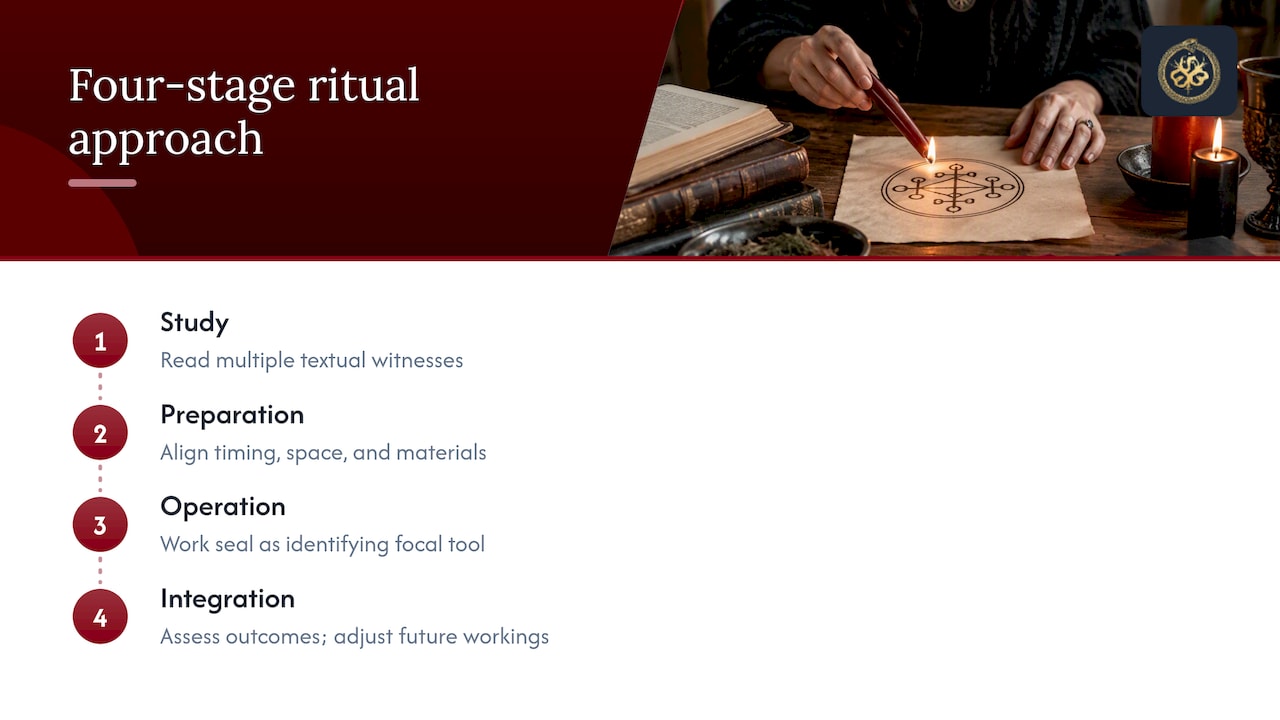
One conceptual way to think about how this work is approached, without treating it as a script, runs in four stages. Study comes first: reading multiple textual witnesses for a given spirit rather than a single paraphrase, since offices and legion counts vary by edition. Preparation follows: aligning timing, space, and materials with the character of the office being approached, whether that leans toward knowledge, wealth, love, or protection. Operation is the working itself, where the seal functions as the identifying and focusing device the grimoire assigns it. Integration comes last and is often the most overlooked stage: assessing outcomes against the stated office and adjusting future approaches to that spirit accordingly, rather than treating one working as definitive.
This is the layer that separates reference reading from operative practice. Anyone can memorize that Paimon commands 200 legions and rides a camel attended by musicians. Working with that description as part of a coherent operation, rather than as a fact to recite, is a different undertaking, and it is where experienced magicians spend most of their preparatory time.
— Black Witch Coven
Transmission, editorial variants, and modern interpretations
The Ars Goetia most readers encounter today has passed through at least three distinct layers: the 17th-century manuscript tradition, Crowley and Mathers’s 1904 printed edition, and a century of subsequent occult commentary built on top of that edition. Each layer changed how the material reads even when it left the underlying spirit list intact.
Crowley’s edition introduced interpretive framing not present in manuscripts like Sloane 3825, most notably the suggestion that the seventy-two spirits represent psychological faculties rather than external entities, a reading that reshaped 20th-century reception far more than it reflects the grimoire’s original courtly, demonological presentation.
Three broad interpretive camps have grown out of this layered transmission:
- Literal evocation: treats the spirits as discrete external entities to be addressed through ceremonial procedure, closest to the framing of the original manuscripts.
- Psychological or archetypal: reads the spirits as symbolic representations of internal faculties or unconscious material, a lens popularized by Crowley’s commentary.
- Syncretic ritualism: blends elements of both, treating the spirits as real forces engaged through symbolic and psychological technique simultaneously, a common approach among contemporary witches.
Which edition to consult depends entirely on the aim. Researchers reconstructing the historical text should prioritize manuscript transcriptions and note where Rudd or Sloane material diverges from printed editions. Occultists building ritual practice often work from a modern compiled edition for accessibility but benefit from cross-checking office language against the Gutenberg transcription to avoid inheriting later embellishments as if they were original.
Methods and rituals for summoning Goetic demons
Traditional Goetic evocation as described in the Lemegeton follows a structured sequence: preparation of a ritual space, often marked with a protective circle and triangle of art positioned outside it, construction or acquisition of the spirit’s seal, and recitation of formal conjurations addressed to the spirit by office and title rather than casual invocation.
The grimoire tradition treats the triangle as the point where the spirit is instructed to appear, with the circle serving as the operator’s working space, a distinction that runs through most Solomonic evocation material rather than being unique to the Goetia. Timing, incense, and specific materials associated with a spirit’s character are commonly matched to the working, following the broader correspondence practices found across Solomonic and ceremonial literature.
Command language in the grimoire is formal and repetitive by design, built around binding and licensing formulas that open and close the working. Magicians who integrate the Ars Goetia into a larger practice typically treat these formulas as a foundation to be combined with protective and theurgical elements drawn from adjacent texts like the Key of Solomon, rather than as a complete procedure in isolation, consistent with how the Wikipedia entry on Goetia frames the practice as part of a larger ceremonial system.
Historical and cultural context of Goetic demonology
Goetic demonology sits inside a much older European tradition of ranking and cataloging spirits, one that stretches back through medieval grimoire literature and earlier demonological writing. The term itself, from the Ancient Greek goeteia, originally referred to a lower, more ritualistic form of magick contrasted with theurgy, a distinction the Wikipedia entry on Goetia traces to the term’s classical roots.
By the time Weyer compiled the Pseudomonarchia Daemonum in 1577, cataloging demons by rank and office was already an established genre, one that borrowed its courtly hierarchy, kings, princes, dukes, from the feudal social structures familiar to its European authors. The Lemegeton’s compilers inherited that framework directly and folded in material from Agrippa’s occult philosophy and the Heptameron, producing a synthesis rather than an original invention.
This context matters for how the catalog is read today. The seventy-two spirits are not a freestanding mythology; they are a specific textual tradition shaped by Renaissance demonology, Christian angelology, and older Solomonic legend, all filtered through 17th-century compilers working from earlier printed and manuscript sources. Understanding that layered origin explains why variant spellings, added or omitted spirits, and shifting legion counts exist across different copies rather than pointing to a single, fixed original.
Variations in tools and paraphernalia across Goetic practice
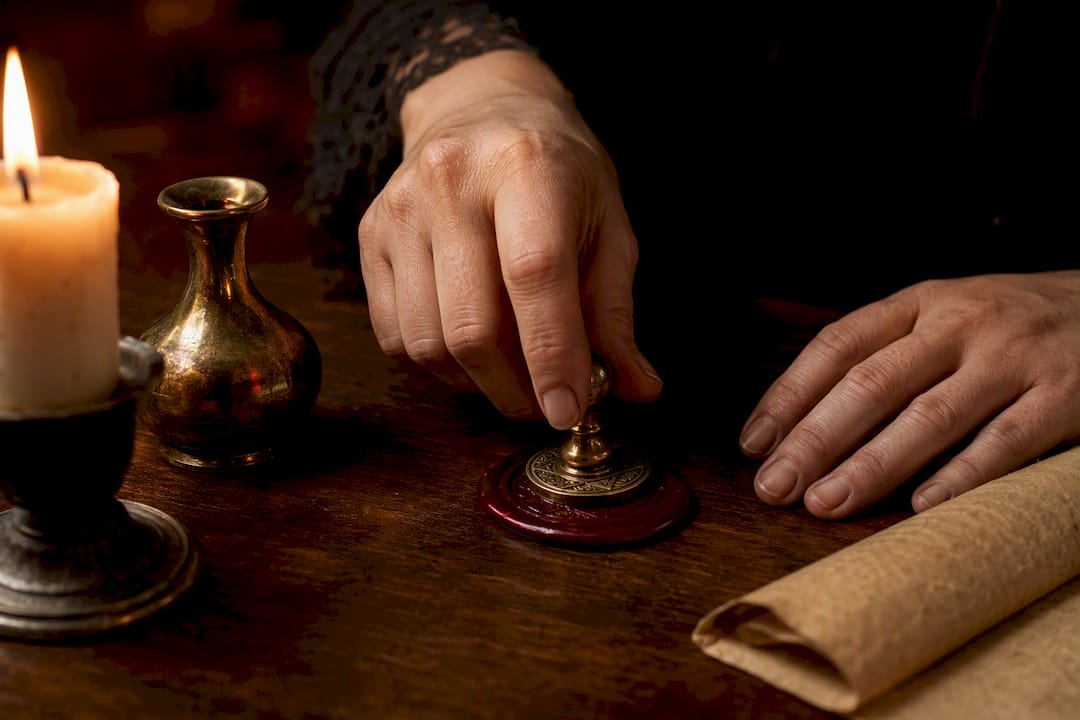
Tool choices in Goetic ritual work vary by edition and by tradition, though certain items recur across most Solomonic sources. The seal of each spirit, whether drawn, engraved, or printed, functions as the primary identifying and focusing object, and manuscript traditions differ on materials: some call for specific metals or virgin parchment, while later practical compilations simplify this to paper or wax.
The circle and triangle of art appear consistently across Solomonic literature, though their exact wording and accompanying divine names shift between the Key of Solomon tradition and the Lemegeton’s own instructions. Incense, candles, and ink specifications also vary: some manuscript copies specify particular substances tied to a spirit’s planetary or elemental association, while others leave material choice to the operator’s discretion.
Rudd’s manuscript tradition adds a distinct paraphernalia element absent from most other copies: pairings between each Goetic seal and a corresponding angel of the Shem HaMephorash, a detail that shaped how some witches structure protective elements within the working itself, as documented in the Wikimedia Commons collection of Goetic material. This variation across manuscripts is a reminder that there is no single fixed toolkit for Goetic work, only a family of related traditions with overlapping but not identical material requirements.
Interpretations of Goetic demons’ attributes and symbolism
The physical descriptions attached to each spirit, animal heads, mounts, attendant figures, weapons, carry symbolic weight beyond simple visual identification. A spirit depicted with a lion’s head or riding a specific animal often signals an aspect of its office: strength, speed, or dominion, echoing a broader medieval symbolic vocabulary where animal imagery encoded moral and functional meaning.
Crowley’s psychological reading treats these attributes as symbolic representations of internal states or faculties, a lens that reframed grotesque or frightening imagery as metaphor for aspects of the magician’s own mind. This interpretation, as the Wikipedia entry on Goetia notes, exists alongside a more literal reading that treats the descriptions as accounts of how the spirits genuinely present themselves when evoked.
Neither interpretation cancels the other in practice. Many contemporary occultists hold both readings at once, treating a spirit’s traditional form as meaningful symbolic information about its character and office while still engaging with it as a distinct entity in ritual. The seal, in this dual reading, works as both a literal identifying mark and a symbolic key to the spirit’s function, which is part of why seal accuracy across manuscript sources matters as much to psychologically oriented magicians as to those working in a strictly literal frame.
Influence of Goetic demonology on modern popular culture
The seventy-two spirits have moved well beyond occult literature into mainstream entertainment. Names like Paimon, Astaroth, and Beleth appear across horror films, television series, video games, and graphic novels, often stripped of their original office descriptions and reshaped into generic antagonist figures suited to a given story’s needs.
This crossover has had a mixed effect on public familiarity with the source material. Names circulate widely, but the specific offices, legion counts, and ranks documented in the Ars Goetia are frequently dropped or altered for dramatic purposes, meaning a reader who first encounters “Paimon” through a film or game may hold a version of the character far removed from the king described in the Lemegeton, riding a camel and commanding 200 legions.
For researchers and magicians, this gap is worth noting mainly as a filtering problem: popular culture references are not a reliable source for office language, seals, or hierarchy, even when they borrow a name directly from the grimoire tradition. The primary manuscripts and their direct transcriptions remain the only dependable reference point once a name has entered wider circulation through unrelated media.
Primary sources and recommended references
- The Lesser Key of Solomon (Wikipedia): background on compilation history and the relationship to Weyer’s earlier catalog.
- Goetia (magic) (Wikipedia): overview of the term’s origins and modern interpretive approaches.
- Gutenberg edition of the Lesser Key of Solomon: full transcribed ritual text with per-spirit offices and legions.
- Lemegeton (Wikipedia): detail on source texts folded into the compilation.
- Pseudomonarchia Daemonum (Wikipedia): Weyer’s earlier catalog for direct comparison.
Author’s closing perspective
The core fact is simple and worth holding onto: the Ars Goetia lists seventy-two spirits, each with a rank, office, legion count, and seal, compiled in the mid-17th century from Weyer, Agrippa, and older Solomonic material. Everything built on top of that, Crowley’s psychological gloss, modern correspondence tables, pop culture borrowings, is commentary layered onto a specific, traceable text. Readers who want to go further should start with the manuscripts and primary transcriptions before the paraphrases, and weigh working framing as one lens among several rather than the final word.
— Black Witch Coven
Where to turn for guidance on working with these spirits directly
Reading the catalog is one thing. Approaching a specific spirit with a defined goal, whether that is Astaroth for knowledge, Bune for wealth, or a protective working built around Andras, is a different undertaking that benefits from structured guidance rather than solo experimentation with a grimoire excerpt. Some witches combine demonological knowledge with practical ritual planning for clients who want a defined outcome rather than a reading exercise.
For readers drawn to daemonic work specifically, the daemonic spell-casting services cover prosperity, love and marriage, and court and legal matters, each built around a named spirit and a defined office rather than a generic template. Readers who want a lower-commitment starting point can begin with a tarot reading or spirit guidance session to clarify which approach fits their situation before committing to a full working.
Sources
The Ars Goetia did not appear from nowhere. It is the first of five books that make up the Lemegeton, or Lesser Key of Solomon, a grimoire compiled in the mid-17th century from older material rather than written whole cloth by a single author. Its spirit catalog draws heavily on Johann Weyer’s 1577 Pseudomonarchia Daemonum, itself an appendix to his De praestigiis daemonum, which listed demonic princes and their offices nearly a century earlier. The Ars Goetia expands that earlier list: it adds four spirits not found in Weyer’s catalog and drops one that was.
According to the Lesser Key of Solomon entry on Wikipedia, the Ars Goetia introduces Vassago, Seere, Dantalion, and Andromalius, spirits absent from the Pseudomonarchia, while omitting Pruflas, who appears in Weyer’s text but not in the later grimoire. This detail matters for anyone comparing editions, since a list that includes Pruflas or excludes one of the four additions is drawing on a different lineage than the standard Lemegeton catalog.
The manuscript record behind the printed Goetia is layered. Surviving witnesses include copies attributed to Thomas Rudd and the British Library’s Sloane 3825, both of which preserve variant spellings, seal drawings, and in Rudd’s case, a pairing of each Goetic spirit with an angel of the Shem HaMephorash meant to hold or govern it, a detail documented in manuscript collections such as the Wikimedia Commons Goetic demons category. These handwritten copies predate and diverge from the printed editions most readers encounter today, and differences between them account for much of the spelling and ordering variation seen across modern reference sites.
The material itself is a patchwork. The Lemegeton entry on Wikipedia notes that beyond Weyer, the compilers drew on Cornelius Agrippa’s Three Books of Occult Philosophy and the Heptameron attributed to Peter of Abano, blending demonological catalogs with planetary and angelic ritual frameworks already circulating in the 16th century.
Later editorial hands reshaped how the text is read rather than what it says. Aleister Crowley’s 1904 edition, produced with Samuel Liddell MacGregor Mathers, added interpretive framing, including the well known suggestion that the spirits are aspects of the human mind, a reading absent from the 17th-century manuscripts. The Golden Dawn’s broader ceremonial system also colored how 20th-century occultists approached the text. Scholars and careful occultists treat these additions as a distinct interpretive layer laid over the earlier manuscript tradition, not as part of the original compilation.
For readers deciding where to start:
- The Lesser Key of Solomon – Wikipedia
- Goetia (magic) – Wikipedia
- The Lesser Key of Solomon – Project Gutenberg
FAQ
What is a Goetic demon?
A Goetic demon is one of the seventy-two spirits cataloged in the Ars Goetia, the first book of the Lemegeton or Lesser Key of Solomon. Each entry lists the spirit’s rank, its office or area of influence, a legion count, and a seal used to identify it in ritual work.
Who are the 72 demons of Goetia?
The seventy-two spirits form a ranked catalog compiled in the mid-17th century, building on Johann Weyer’s 1577 Pseudomonarchia Daemonum with four additions, Vassago, Seere, Dantalion, and Andromalius, and one omission, Pruflas, according to the Lesser Key of Solomon entry. Names include figures like Bael, Paimon, Beleth, and Asmodeus, each with a distinct office and legion count.
What are the six types of demons?
Definitions vary across occult sources, and the Ars Goetia itself does not use a six-type classification; instead, it organizes its seventy-two spirits into seven ranks: king, prince, duke, marquis, earl, president, and knight. Readers looking for a “six types” framework are likely thinking of a different demonological scheme outside the Solomonic grimoire tradition.
Who is the most powerful Ars Goetia spirit?
The grimoire does not rank a single spirit above all others, but the kings, including Bael, Paimon, Asmodeus, and Belial, hold the highest formal rank in the hierarchy. Paimon is frequently singled out in occult discussion for commanding 200 legions and receiving obedience directly from Lucifer, one of the larger legion counts recorded in the catalog.
How do Goetic demon seals work in ritual practice?
Seals function as identifying and focusing tools tied to each spirit, used to address and recognize the correct entity during a working, a role confirmed by the Wikipedia entry on Goetia. Manuscript traditions vary in how seals are drawn, so magicians cross-check a seal against a primary transcription rather than relying on a single modern redrawing.
