
 New Years Eve Ritual 2026/2027 with Savannah
Invocation is one of the more demanding techniques in magical practice. It is placed in the advanced category for practical reasons, not for mystique.
What Invocation Actually Is
Invocation is the deliberate act of drawing a spirit, force, or intelligence into your own sphere of awareness. In some cases the presence is invited to occupy the same space as your consciousness. In deeper forms it may involve partial or temporary embodiment.
This is different from evocation. In evocation the spirit is called to appear or operate outside you. You remain relatively separate from it. In invocation the boundary is intentionally thinned or opened. You are no longer only addressing something “over there.” You are allowing it to move closer, sometimes inside the field of your own mind and body.
That difference is the core reason the technique is advanced.
Why the Stakes Are Higher
When you open that inner door, several things become possible:
- The presence can influence your thoughts, emotions, and perceptions more directly.
- Your sense of self can be temporarily altered or overshadowed.
- Any lack of clarity about what is “you” and what is “not you” becomes a real vulnerability.
- Emotional or psychological instability can be amplified rather than contained.
If the practitioner already has solid foundations, these risks are manageable and the technique becomes a powerful method of alignment, knowledge, and transformation. If the foundations are weak, the same technique can produce confusion, obsession, fragmentation, or longer-term disruption.
What Needs to Be in Place First
If your sense of self is steady and you can tell the difference between your own thoughts and something external, the technique can be powerful and useful. If those foundations are weak, the same technique can leave you confused, overwhelmed, or influenced in ways you did not intend.
Before using invocation you should already be able to:
- Raise and direct energy with control
- Protect and centre yourself when needed
- Tell your own mind apart from outside influence
- Stay functional if the experience is stronger than expected
- Close a working cleanly
These skills are the basic platform. Without them, invocation is simply riskier than it needs to be.
The same principle applies no matter what you are calling eg demon, god, or any other intelligence. The name does not make the method safer. Your preparation does.
Invocation Across Currents
The same underlying risks and requirements apply whether the force being invoked is a demon, a god, an angelic presence, or a philosophical intelligence. The technique does not become safer because the name sounds more respectable. The variable is the preparation of the operator, not the moral branding of the spirit.
Black Witch Coven Position
We place invocation in the advanced section because we treat it as a real operation with real consequences. We do not present it as a glamorous next step for beginners who have read a few pages and want to feel powerful. We present it as a precise tool that becomes available once the vessel is strong enough to hold what it is asking to receive.
Used with preparation, invocation is one of the most direct methods of contact and transformation available. Used without preparation, it is one of the fastest ways to create unnecessary difficulty. That is why it belongs here.
Examples of Invocation Across Different Systems
Invocation is used in many currents. The outer form changes, but the core action stays the same: the practitioner deliberately draws a presence into their own sphere of awareness.
Ceremonial Magic (Hermetic / Golden Dawn style)
The magician uses vibration of divine names, geometric forms, and structured speech to call a force into the circle and into their own consciousness. A classic example is the invocation of a planetary or elemental power, or of a god-form such as Hermes or Thoth. The operator often assumes the posture and mindset of the force being called so that the presence can speak or act through them.
Thelemic Practice
In Thelema, invocation is central. The best-known example is the Liber Resh or the more elaborate assumption of god-forms. The practitioner identifies with a deity (often Egyptian) through speech, visualisation, and posture until the boundary between self and the invoked force thins. The aim is both communion and the strengthening of the magician’s own will and consciousness.
Wicca and Modern Witchcraft
In many Wiccan and witchcraft traditions the gods or goddesses are invoked into the circle and sometimes into the body of a priestess or priest (Drawing Down the Moon is the clearest example). The presence is invited to speak, bless, or work through the human vessel for the duration of the rite. The language is usually devotional and relational rather than commanding.
Demonolatry and Theistic Satanism
Here invocation is used to bring a demon into close contact or temporary embodiment. The practitioner may recite an enn, chant a name, or use a personal call to open the way. The goal can be communion, possession-style mediumship, or direct partnership in magical work. Respect and clarity of relationship are emphasised more than theatrical command.
Folk and Traditional Witchcraft
In older and folk-derived practices, invocation may be simpler and less formal. A witch might call a spirit, ancestor, or familiar into the body or into a prepared vessel through repeated speech, song, or offering. The process is often pragmatic and results-focused rather than heavily ceremonial.
Common Thread
Across these systems the same basic movement occurs: the practitioner opens an inner space and invites a defined presence to occupy it. The difference lies in the relationship (worship, alliance, identification, or temporary embodiment) and in the amount of formal structure used.
The technique itself remains one of the more direct and demanding methods of spirit contact.
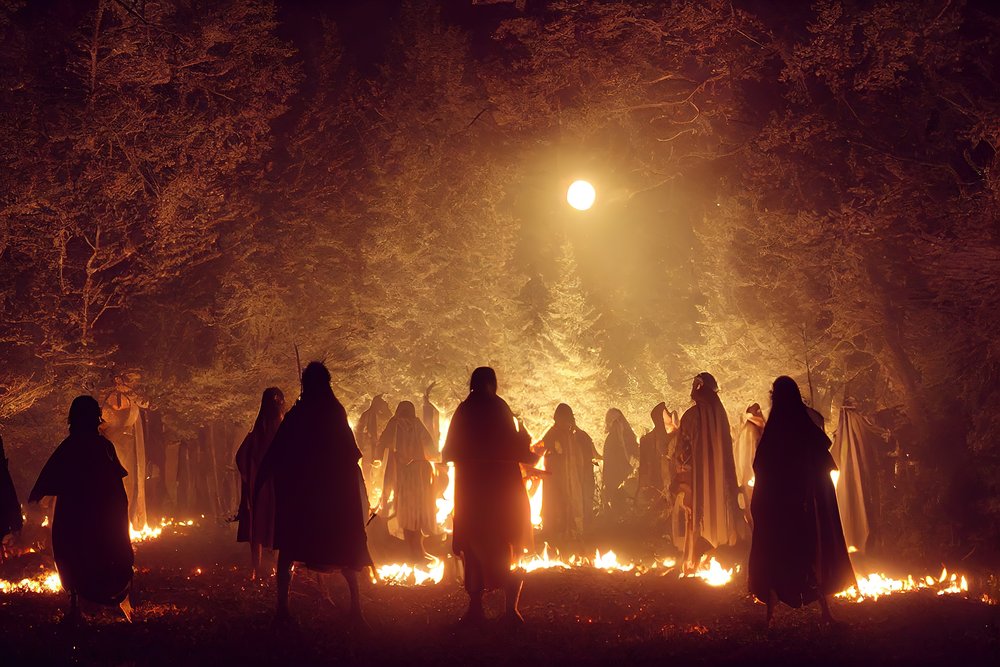
Drawing Down the Moon at Black Witch Coven
We still perform a version of Drawing Down the Moon every month. We do not use it as a Wiccan rite of inviting a Goddess into a priestess. We use it because it is one of the cleanest and most effective group methods for pulling down raw lunar force and opening a strong current of spirit into the working space.
In our hands the ritual is stripped of the devotional Wiccan framing. The aim is not to become a mouthpiece for a particular deity. The aim is to open the circle to the living power of the moon itself and to whatever intelligences move with that tide, then to let that force fill the space and the people in it.
Done properly, the result is a measurable rise in pressure, clarity, and available energy that the whole group can then direct.
Why We Keep It
It is inclusive in the best practical sense. People from different currents can stand in the same circle and participate without having to adopt Wiccan theology. The moon is real. Its pull is real. The technique of drawing that force down into a prepared group is real. That is enough. The ritual gives everyone present a shared, tangible experience of heightened energy without requiring them to share the same belief system.
It also trains the group in collective focus. When a circle learns to pull a current down together and hold it, the same skill later supports stronger forms of spirit contact, charging, and manifestation work.
Why Something So Simple Is Still Advanced
On the surface the ritual looks straightforward: a prepared space, a clear call, a receptive stance, and the intentional drawing of lunar force into the circle. The simplicity is deceptive.
What makes it advanced is the demand it places on the operators.
To draw a strong current down and not waste it or become overwhelmed by it, the people involved need reliable control. They must be able to open without leaking, hold the energy without scattering it, and close cleanly afterward. In a group setting this also requires the ability to stay coherent with other people while a noticeable force is moving through the space.
Traditionally it is a High Priestess who performs the Drawing Down. This is not a matter of title for its own sake. It comes from the practical requirement that the person opening themselves to the current must already have years of training in holding energy, recognising its quality, and keeping it distinct from other influences. Without that developed capacity, the force that arrives can be misread, diluted, or mixed with personal emotion, group fantasy, or unwanted presence.
The role is given to someone who has already proven they can carry the current cleanly and return from it intact. That level of preparation is another reason the work sits in the advanced category.
Many groups treat Drawing Down the Moon as a beautiful or symbolic act. When it is treated as an actual energetic operation, the standard rises. The difference between a pleasant moon ritual and a working that leaves the space charged and the participants altered is the difference between beginners going through the motions and practitioners who can handle real force.
That is why we keep it in the advanced category even though the outer form is simple. The technique is accessible. The capacity to do it well is not.