
 New Years Eve Ritual 2026/2027 with Savannah
Qliphoth: The Dark Side of Kabbalah
Origin and Meaning:
The Qliphoth (also spelled Qlippoth or Kelipot) come from Kabbalistic teachings and represent the “shells” or “husks” of the Tree of Life’s Sephiroth. They are the residual, dark, and chaotic forces that contrast with the divine emanations of the Sephiroth.
The Qliphoth are seen as the result of imbalance and are associated with evil, impurity, and destruction. They are the broken, corrupted aspects of creation, often linked to demonic forces.
The Tree of Death:
In some occult systems, the Qliphoth are organized into a structure called the “Tree of Death,” which mirrors the Tree of Life but represents the antithesis of divine order. Each Qliphothic sphere is associated with specific negative or chaotic forces, often linked to demonic entities.
Exploration and Ritual:
Some occultists explore the Qliphoth as part of a path to understanding the full spectrum of existence, including the darker, more chaotic aspects. This path, known as the “Left-Hand Path,” can involve confronting and integrating the shadow self, but it is often considered dangerous and difficult.
Luciferians & The Qlippoth
The Qliphoth and Luciferianism both explore the darker, more challenging aspects of existence and spirituality.
While the Qliphoth represent the chaotic and destructive forces in Kabbalistic cosmology, Luciferianism venerates the figure of Lucifer as a symbol of enlightenment, rebellion, and individual empowerment.
When these two concepts intersect, they form a potent path for those seeking to explore and integrate the shadow aspects of their being, ultimately striving for personal power, wisdom, and transformation.
Intersection of Qliphoth and Luciferianism
- The Left-Hand Path:
- Both the Qliphoth and Luciferianism are often associated with the Left-Hand Path in occultism, which focuses on individualism, self-deification, and the exploration of darker, often taboo aspects of spirituality. Practitioners of the Left-Hand Path may explore the Qliphoth as a way to confront and integrate their own shadow aspects, viewing it as a necessary step toward achieving true enlightenment and personal power.
- Lucifer as a Qliphothic Figure:
- In some interpretations, Lucifer can be seen as a figure who traverses or rules over the Qliphothic realms, embodying the light within the darkness. This view positions Lucifer as a guide through the chaotic and challenging aspects of the Qliphoth, helping the practitioner to navigate these forces and emerge stronger and more enlightened.
- Shadow Work and Integration:
- Both systems emphasize the importance of shadow work—confronting and integrating the darker parts of the self. In the Qliphothic context, this means engaging with the chaotic and destructive energies within oneself, while in Luciferianism, it involves embracing one’s own potential for rebellion, independence, and personal growth.
- Danger and Empowerment:
- Working with the Qliphoth and engaging in Luciferian practices is often seen as dangerous because it involves dealing with powerful, chaotic forces and challenging deeply ingrained beliefs. However, for those who are prepared, these paths are believed to lead to greater personal empowerment and a deeper understanding of the universe.
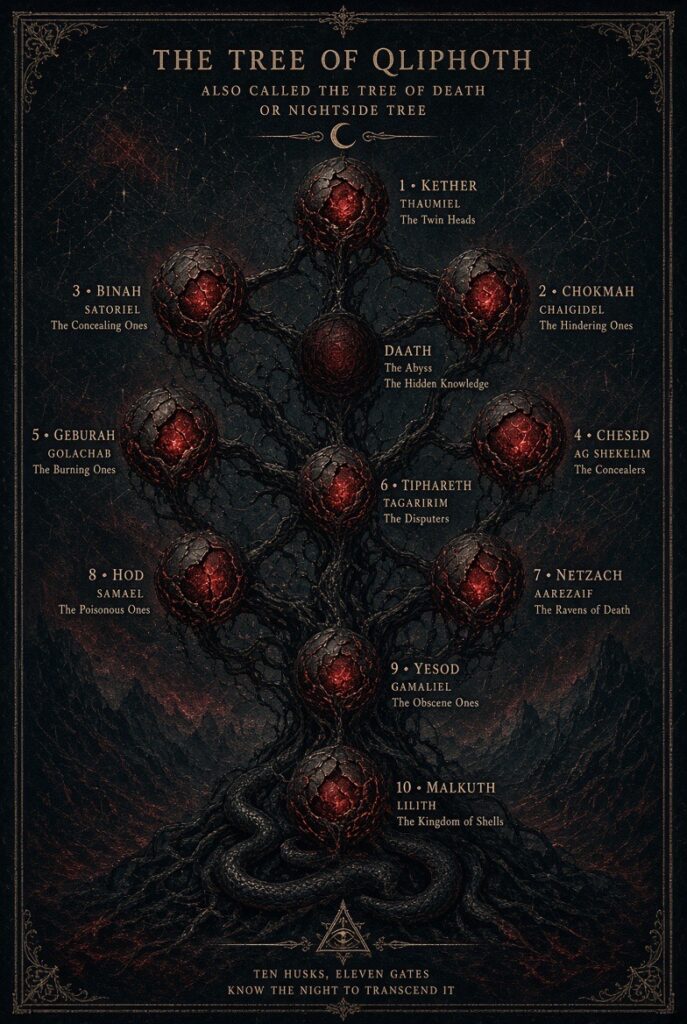
The Qliphoth
The picture is the Tree of Life with its other face showing.
The three columns matter.
The right pillar is force and giving.
The left pillar is form and severity.
The middle pillar is the spine between them.
Each husk is what that column does when it breaks or goes too far.
Daath is the hole under the top three. It is not a tenth husk. It is the gap.
1. Kether / Thaumiel
Kether is unity, the one point at the top. Thaumiel is that unity split in two. The title is the Twin Heads, or Dual Contending Forces. The old rulers are Satan and Moloch. Many Luciferians also read Lucifer here.
This is the crown of the Nightside. Two instead of one. A throne that will not resolve into a single God.
2. Chokmah / Ghagiel
Chokmah is raw wisdom, the first surge out of the crown. Ghagiel is the Hinderer. The ruler is often Beelzebub.
Force with no channel. Motion that will not become a path. Swarm and blockage.
3. Binah / Satariel
Binah is understanding, the form that can hold wisdom. Satariel is the Concealer. The ruler is often Lucifuge.
Knowing that hides as it arrives. A face you cannot look at straight on.
Daath
The abyss in the middle of the tree. Hidden knowledge, the crossing, the drop. Some name Choronzon here. Some leave it without a face. On the picture it sits in the gap, not on a pillar.
4. Chesed / Gha’agsheblah
Chesed is mercy, expansion, gift. Gha’agsheblah is that gift with no border. The ruler is often Astaroth.
Giving that smothers. Love or help that will not release.
5. Geburah / Golachab
Geburah is severity, strength, the necessary cut. Golachab is the Burning Ones. The ruler is often Asmodeus.
Fire with the brake taken off. Wrath, heat, the blow that does not stop.
6. Tiphareth / Thagirion
Tiphareth is the sun at the center: beauty, heart, the shining self. Thagirion is the Disputer, the black sun. The ruler is often Belphegor.
A light that does not warm. The center as argument, refuse, and glare.
7. Netzach / A’arab Zaraq
Netzach is feeling that endures, beauty, victory. A’arab Zaraq is the Ravens of Dispersion. The ruler is often Baal.
Desire that will not stay in one form. Passion as flight.
8. Hod / Samael
Hod is mind, speech, thought taking shape. Samael is the Poison of God. The ruler is often Adrammelech.
Intellect that strips and can corrode. Clarity with venom in it.
9. Yesod / Gamaliel
Yesod is the foundation under waking life: moon, dream, image. Gamaliel is the Obscene Ones. Lilith is often the ruler named here.
The life you live when no one is watching. Dream, fantasy, desire.
10. Malkuth / Lilith
Malkuth is the kingdom: body, house, earth, the day you are already in. Lilith, also called Nehemoth, is that same world with the other side showing. Naamah is often named at this threshold. Lilith is Queen of the Night over the gate.
On this chart she is 10 because she is the bottom. She is still the first place the Nightside touches.
How to look at the picture
Start at the top if you want to see how the tree was designed. Start at the bottom if you want to see where the Other Side meets you.
Every pair is one force in two conditions. The Sephira is the balanced name. The Qlipha is what remains when that force breaks, inverts, or will not stop. The demons on this tree are the faces of those leftover levels, not a separate list beside the tree.
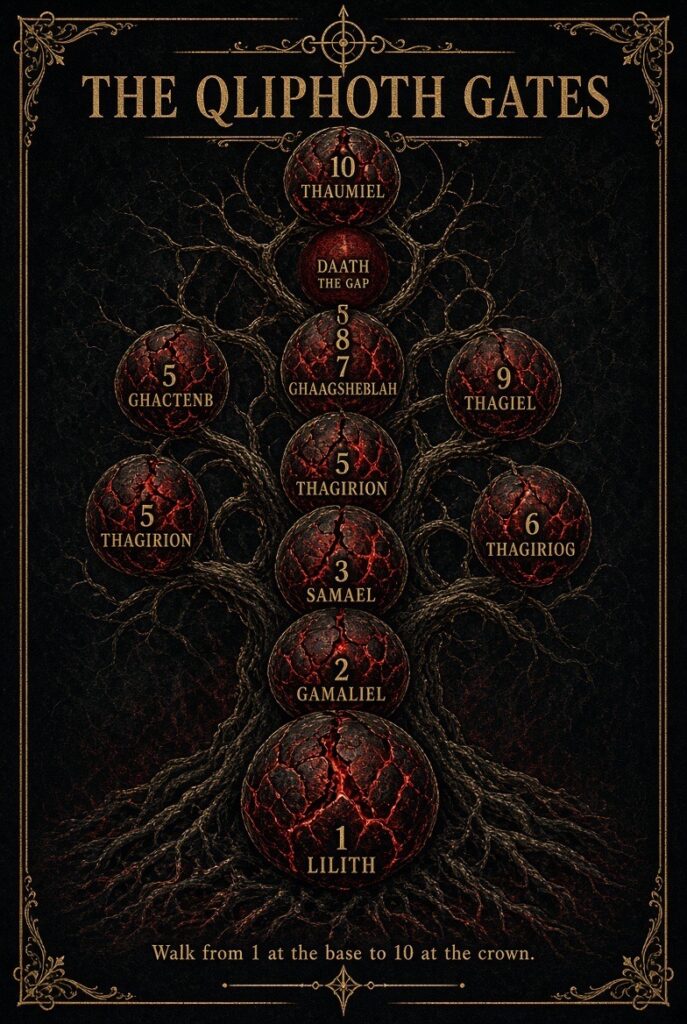
Read it from the bottom
Start at the root.
1. Lilith The first gate. The Nightside in the life you already have. Naamah is often at this door. Lilith rules the opening.
2. Gamaliel The next step up. Dream, moon, desire, the private life.
3. Samael The mind as poison. Thought that strips and can sting.
4. A’arab Zaraq Feeling that will not stay. The ravens, unrest, passion as flight.
5. Thagirion The black sun. A center that glares instead of warms.
6. Golachab Fire with no limit. Heat, wrath, the burning ones.
7. Gha’agsheblah Mercy that smothers. Gift without a border.
8. Satariel Concealment. Knowledge that hides.
9. Ghagiel Force with no path. The hinderer.
10. Thaumiel The last sphere. The split crown. Two heads where the dayside wants one.
Daath Still the gap, marked in the hole, not as a walking number. It is the crossing in the upper tree, not the first door and not a second crown.
QUESTIONS?
As you can see, this is a topic we could talk on for a long time, so if you’re interested and you have questions, feel free to drop a comment below!
One thought on “The Qlippoth”
Leave a Reply
You must be logged in to post a comment.
I have been drawn towards the concept of the Qliphoth and theistic Luciferianism; my goals are to gain knowledge and to experience the void; the darker path is so much more interesting than the light!