
Blog, Demons, Working With Demons
Marbas Demon: Lion Form, Seal and How to Work With Him
Sep
Marbas, also called Barbas, is the fifth spirit of the Ars Goetia and one of the most practically useful entities in the entire Lemegeton. He appears first as a great lion before assuming human shape on command, and the grimoires credit him with revealing hidden things, causing and curing disease, teaching mechanical arts, and altering the forms of men. This article pairs the primary-source record with the working knowledge Black Witch Coven applies when Marbas is the right spirit for the job.
Where Does Marbas Come From in Goetic Lore?
The Marbas record traces back to Johann Weyer’s Pseudomonarchia Daemonum (1577), a catalog of demonic hierarchy that predates and directly informs the Lemegeton’s Ars Goetia. Weyer lists Marbas as a great president of Hell, and the Ars Goetia preserves the same core description almost word for word: a spirit who appears as a lion, speaks in a human voice once commanded, and governs many legions.
Jacques Collin de Plancy’s Dictionnaire Infernal reproduces this grimoire tradition in French demonological scholarship and pairs it with the Louis Le Breton engravings that gave later generations their visual reference for Goetic spirits. Its Marbas entry shows how the lion motif carried across a French Catholic demonological framework, not just the Solomonic grimoire tradition it borrowed from.
A few textual notes matter for anyone comparing editions:
- Many modern summaries drop the “causes disease” clause and keep only “cures disease,” softening the entry into a purely benevolent healer figure.
- The Lemegeton’s Goetia section largely mirrors Weyer’s phrasing, with only minor variance in spirit rank language across surviving manuscripts.
- The Le Breton plate in Dictionnaire Infernal is descriptive rather than instructional. It documents the tradition rather than adding new occult data.
What Are Marbas’ Traditional Powers?
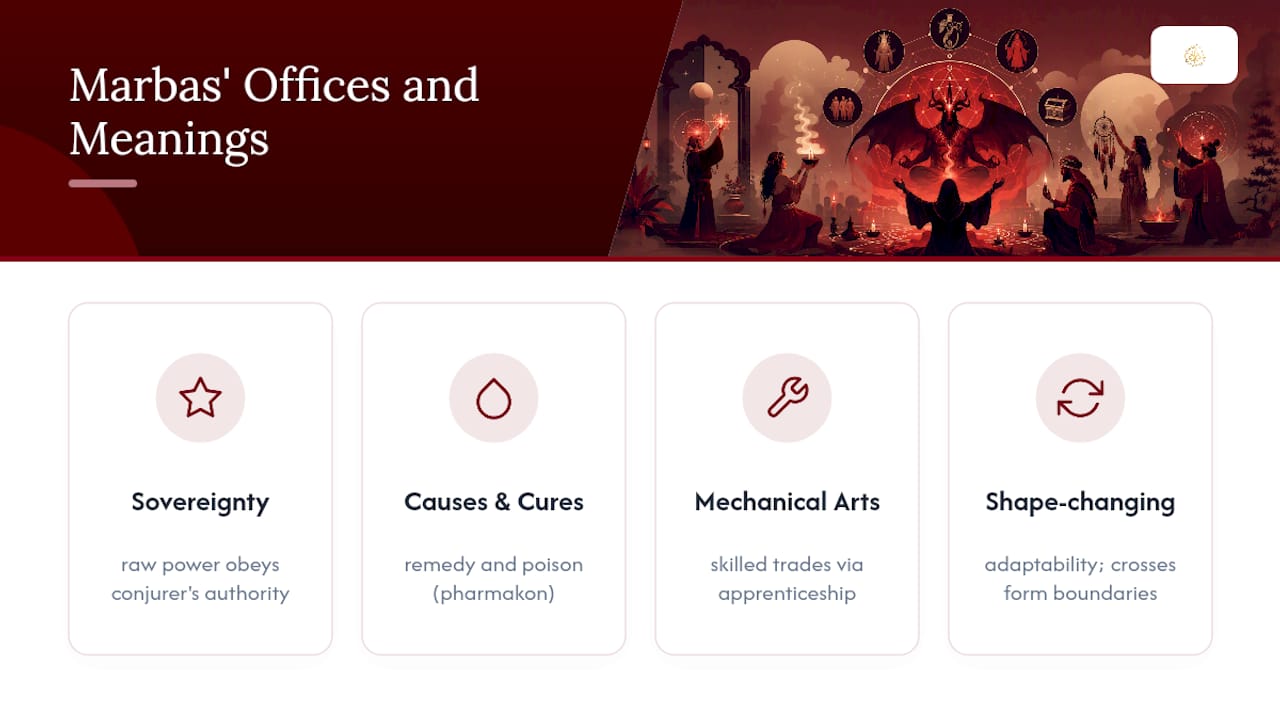
The grimoires assign Marbas four distinct offices, and each one carries a different practical weight depending on what a practitioner actually wants from the working.
- Revelation of hidden things. Marbas answers questions about concealed matters, a function closer to divination than to direct manifestation.
- Disease, both caused and cured. Weyer states plainly that Marbas can inflict illness and remove it, a pairing that unsettles readers used to softer modern summaries.
- Mechanical and hand arts. Marbas teaches craft skill, an office that reads oddly medieval until you consider how “mechanical arts” once covered everything from metalwork to engineering.
- Shape-changing. He can alter the forms of men, an ability the grimoires never fully explain but that lines up with his own lion-to-man transformation.
The pharmakon principle: Grimoire language routinely pairs a harm with its remedy, on the logic that mastery of a wound implies mastery of its cure. That framing, not a modern reinterpretation, is why Marbas’ healing reputation exists at all.
That dual “cause and cure” phrasing isn’t a scribal error. Early modern demonology worked on a pharmakon logic, where the same entity that inflicts an ailment necessarily holds the knowledge to reverse it. Modern writers lean into the healing half of that pairing, which is why so many contemporary practitioners now describe Marbas as a healer and forget the disease-bringer. His rank as a president governing many legions shapes how ritualists structure their conjuration hierarchy and what tone of address they use when opening a working.
Recognizing Marbas: Lion Form, Sigil, and Ritual Tools
The lion-then-man sequence is the single most reliable identifier across every source. In magickal tradition, the lion typically signals sovereignty and raw force before it settles into a more communicative, human-shaped register, which fits Marbas’ function as a revealer who has to be approachable enough to answer direct questions.
The canonical seal attributed to Marbas appears across the Lemegeton manuscript tradition and in later compendiums like Dictionnaire Infernal, though minor line variations exist between manuscript copies. Practitioners typically work with the sigil in various ways, such as drawing or printing it on parchment to place at the center of the working space, engraving it into a small tool, ring, or disc for repeated use, or tracing it onto a dedicated candle before lighting, tying the flame to the sigil’s consecration.
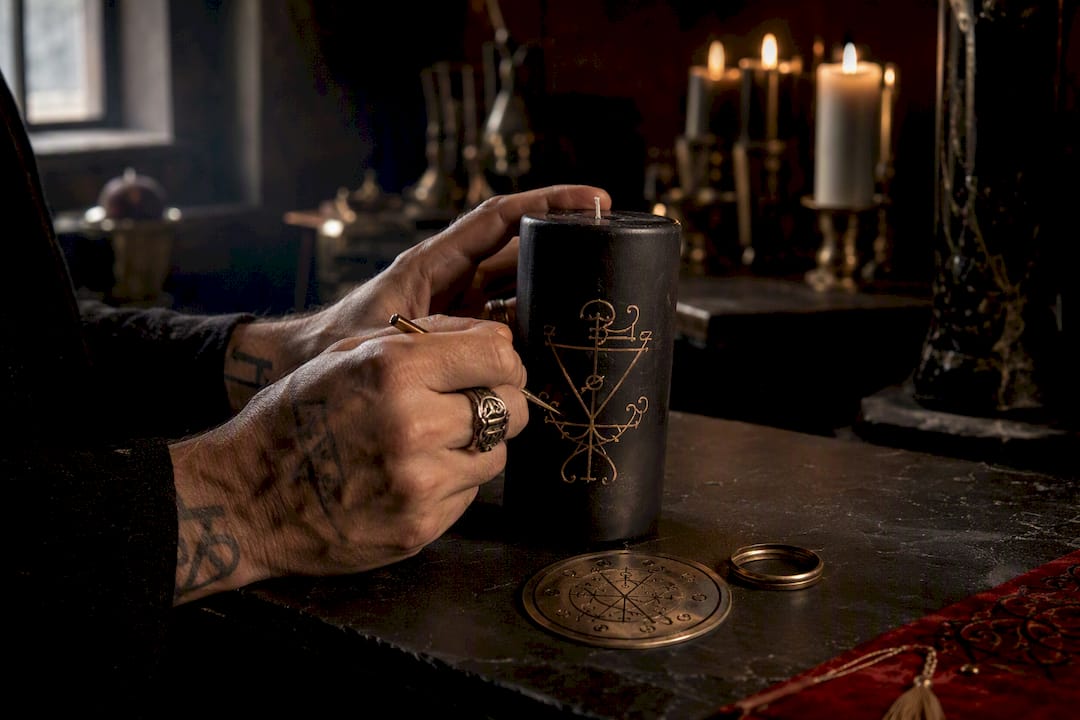
Pro Tip: Consecrate your Marbas sigil once, dedicate it to a single purpose category (healing insight, craft skill, or hidden knowledge), and reuse that same copy for follow-up sessions rather than redrawing it fresh each time. Continuity in the physical object builds a stronger working relationship than starting over every session.
How Do You Work With Marbas in Ritual?
Marbas fits workings built around three needs: uncovering concealed information, gaining insight into a craft or technical skill, or putting questions about illness to him, in line with the disease office the grimoire gives him. He is not the right spirit for pure domination work, straightforward wealth generation, or love-drawing rituals. Those goals belong to spirits tied to those domains (our guide to demons associated with specific powers sorts them by office), and Black Witch Coven’s daemonic spell casting services are built around matching the right spirit to the right outcome rather than forcing one entity to cover everything.
A workable ritual structure for Marbas looks like this:
- Prepare the space. Clean the room, set the sigil at the center of your altar, and have your tools (candle, incense, offering dish) arranged before you begin any invocation.
- Consecrate the sigil. Anoint or smoke-cleanse the seal, dedicating it explicitly to the purpose of this working.
- Make the call. Open with the Goetic conjuring method or your own invocation, then address Marbas directly, naming his office (revealer, healer, teacher) that matches your request.
- State the request in clear, bounded language. Vague requests produce vague results. Ask a specific question or name a specific skill you want insight into.
- Close and dismiss. Thank the spirit, extinguish or let the candle burn per your own practice, and record the session immediately afterward.
Common offerings reported by practitioners include frankincense or dragon’s blood incense, a small dish of wine or dark liquor, and items connected to craft or trade (a small tool, a coin, a written question). Track results the same way you’d track any experimental protocol: write down the request, the date, and any impressions or dreams that follow within the next several days. If the first session produces partial insight, a short follow-up working refining the question tends to outperform repeating the identical request.
What Do Modern Practitioners Report About Marbas?
Accounts shared among practitioners cluster around a few recurring themes, and they are most useful for what they teach about technique.
- Visual impressions of a lion or lion-headed figure preceding a calmer, more communicative human-seeming presence.
- Reports of unexpected technical insight, particularly around repair work, engineering problems, or craft troubleshooting.
- Answers to questions about illness that arrive as clarity about its cause.
- Advice, often secondhand, to approach him only through a structured working because of his dual harm-and-remedy nature.
The variance between accounts likely comes down to how specifically the practitioner framed their request. A vague “help me understand what’s wrong” petition tends to produce vaguer, harder-to-read answers than “show me what’s causing this specific mechanical failure.”
How Does Marbas Compare Across Grimoires and Traditions?
The core Marbas profile stays remarkably consistent from Weyer through the Lemegeton and into Dictionnaire Infernal, which is unusual in a field where spirit descriptions often drift or fragment across manuscript copies. Weyer’s original Latin catalog, the English Goetia tradition, and Collin de Plancy’s French compendium all agree on the lion-to-man transformation, the 36 legions, and the four core offices. That level of agreement across three separate textual traditions, spanning roughly three centuries and two language groups, suggests the Marbas entry was considered stable and important enough that copyists rarely felt the need to embellish it.
Where the traditions diverge is emphasis, not substance. The Latin and early English textual line treats the “causes disease” clause as morally neutral information about a spirit’s capabilities, consistent with the broader Solomonic view that spirits are catalogued tools rather than moral agents. French demonological writing, shaped by a stronger Catholic theological framework, tends to frame the same information with heavier emphasis on the spirit’s dangerous side even while reproducing the identical facts.
Modern writing introduces the real divergence. Contemporary practitioner-facing writeups often foreground the craft-teaching and healing functions, as those are the offices modern ritualists actually petition for. The disease-causing half of the entry gets mentioned but rarely emphasized, which says more about what today’s practitioners want from Marbas than about any change in the underlying source text.
What Do Marbas’ Attributes Actually Symbolize?
The lion-to-man sequence is the attribute doing the most symbolic work in the entire entry, and it rewards a closer read than most summaries give it. A lion in Western symbolic tradition typically represents raw sovereign power, untamed and pre-verbal. The shift into human form on command represents that power submitting to structure, specifically the structure of the conjurer’s authority and the ritual frame itself.
The paired “causes and cures” disease office symbolizes something practitioners rarely name directly: complete knowledge of a domain includes both its destructive and restorative applications. You can’t credibly claim mastery over healing if you don’t also understand how the same mechanism produces harm. That’s not a modern reinterpretation. It’s baked into the pharmakon logic of the original grimoire language, where the Greek root pharmakon itself means both remedy and poison depending on dose and intent.
The mechanical arts office symbolizes hidden or specialized competence, the kind of knowledge that looks like sorcery to anyone outside the trade. Medieval and early modern readers would have understood “mechanical arts” as covering skilled trades generally inaccessible without long apprenticeship, which makes Marbas a fitting patron for anyone seeking insight into a craft or technical domain they haven’t yet mastered.
Shape-changing, the fourth office, symbolizes adaptability and the instability of fixed categories. A spirit who can alter forms and who himself shifts from lion to man is thematically consistent from top to bottom. Every one of his listed powers involves crossing a boundary: between known and hidden, between illness and health, between raw skill and technique, between one shape and another.
What Is Marbas’ Archetypal Role in Esoteric Practice?
Marbas occupies the archetypal position of the initiator into hidden competence, a figure closer to Hermes or Thoth in function than to a purely destructive demon. He’s the spirit who grants access to knowledge that already exists but sits behind a barrier of skill, secrecy, or specialized training. That archetype shows up across nearly every tradition that has a trickster or teacher figure standing between the ordinary person and craft mastery.
The causes-and-cures pairing also matches a familiar truth about expertise: the person who can break something is frequently the same person best equipped to fix it. A mechanic who understands engine failure understands engine repair by the same logic. Marbas formalizes that intuition into a spiritual office rather than leaving it as an unspoken assumption.
The lion-to-man transformation also functions as an archetype of controlled power, a recurring image across esoteric traditions where raw force submits to disciplined form. Marbas holds hidden knowledge, and he also holds the means of making it usable.
Black Witch Coven’s Perspective: When and Why We Work With Marbas
Marbas earns his place in a working when the goal is technical insight, craft mastery, or the question of what lies behind an illness, as his grimoire office describes. He’s a poor fit for domination, love, or straightforward prosperity requests, where other Goetic spirits carry more direct authority. Within a larger ritual strategy, Marbas often functions as an early diagnostic step, revealing what’s actually happening before a second, more targeted working addresses it directly. His seal and correspondences are on our Marbas Demon Directory page.
Black Witch Coven
Working With Marbas Through Guided Ritual Support
Marbas rewards precision, and precision is exactly where a solo practitioner without formal grimoire training tends to stumble. Black Witch Coven built its daemonic spell-casting services around this exact problem: matching the right Goetic entity to a clearly defined goal, then structuring the conjuration, offering, and follow-up protocol around that specific spirit’s actual offices rather than a one-size-fits-all script. If your interest in Marbas centers on revealing something concealed, a Left-Hand Path reading is a direct way to get a read on the situation before committing to full ritual work.
For readers who want a bespoke ritual plan built around Marbas or another spirit suited to craft insight and healing-adjacent knowledge, engagement typically starts with a consultation to define the request, followed by a custom ritual plan and confidential execution. Every working is handled discreetly, whether the request involves a single focused session or an extended engagement. If you’re ready to move past research and into a directed working, start with a consultation and let the coven map the right entity and structure to your specific goal.
FAQ
What Is Marbas the Demon of?
Marbas is the demon of hidden knowledge, disease (both causing and curing it), mechanical and craft skills, and shape-changing. The Ars Goetia lists him as the fifth spirit, a great president governing 36 legions.
Is Marbas a Fallen Angel?
The grimoires don’t classify Marbas as a specifically named fallen angel the way some traditions treat entities like Lucifer or Belial. He’s cataloged as a president-rank demon within the Goetic hierarchy, with no primary-source claim tying him to a specific angelic fall narrative.
What Offerings Does Marbas Like?
Practitioners commonly report using frankincense or dragon’s blood incense, a small offering of wine or dark liquor, and objects tied to craft or trade work. These are practitioner-reported customs rather than fixed grimoire requirements, so treat them as a starting point rather than a rule.
Does Marbas Only Cause Disease, or Does He Also Cure It?
Both. The primary grimoire text pairs the two offices deliberately, following a pharmakon logic where mastery of harm implies mastery of remedy. Many modern summaries emphasize the curing half, but the original phrasing gives equal weight to both.
