
 New Years Eve Ritual 2026/2027 with Savannah
Black Magic, Blog, Occultism
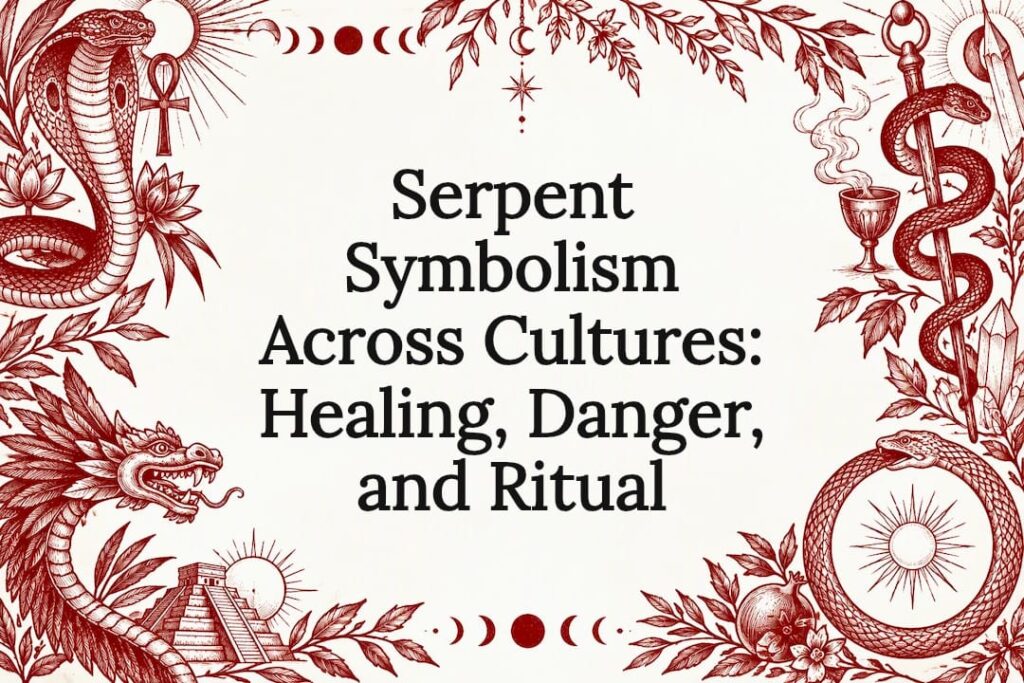
Serpent Symbolism Across Cultures: Healing, Danger, and Ritual
Aug
Serpents most often symbolize transformation, carrying meanings that are threatening and healing at once because their biology and behavior embody renewal, boundary-crossing, and hidden power. Across cultures, the serpent also stands for wisdom, danger, fertility, and the underworld, though the exact emphasis shifts from tradition to tradition. The sections below trace those variations through specific myths, emblems, and ritual practices.
Table of Contents
- Why Serpents Carry Opposite Meanings at Once
- How Serpent Symbolism Takes Shape Across World Traditions
- The Emblems That Carry Serpent Symbolism Forward
- What Scholars and Psychologists Say the Serpent Represents
- Bringing Serpent Symbolism Into Ritual Practice
- Serpent Symbolism Within the Left-Hand Path
- Serpent Imagery in Black Magick Ritual Work
- Serpents and Specific Goetic Entities
- Why This Symbol Refuses to Settle Into One Meaning
- Working With Serpent Symbolism in a Commissioned Ritual
- FAQ
- Sources
Why Serpents Carry Opposite Meanings at Once
The serpent’s symbolic duality is not arbitrary. It grows directly out of what the animal does and how it lives, which gave ancient observers a ready-made template for ideas about death, rebirth, and the crossing of boundaries.
- Skin-shedding produces the oldest and most widespread rebirth symbolism: a creature that appears to die and return to life in its own skin.
- Venom creates a built-in paradox, since the same bite that kills can also be processed into remedy, linking serpents to both poison and medicine.
- Habitat matters too: serpents live in burrows and crevices connected to the underworld, yet they also swim, climb, and in mythic form fly, making them natural mediators between earth, sea, and sky.
The Serpent Symbol in Tradition dissertation describes this mediating role directly: the serpent repeatedly functions as a boundary-crosser between the underworld and the sky or sea, which is why so many cosmologies cast it as a messenger between realms rather than a simple monster or simple ally.
Serpents appear among the oldest and most recurring mythological symbols across world cultures, consistently encoding rebirth, poison and healing, and chaos and order as paired opposites, according to the Wikipedia entry on serpent symbolism. That pairing explains why a single culture can revere the serpent as a healer in one myth and fear it as a chaos-bringer in the next. The two readings are not contradictions to resolve. They are the same symbolic engine viewed from different angles, and later sections show how specific cultures lean toward one side or hold both at once.
How Serpent Symbolism Takes Shape Across World Traditions
Every tradition that features serpents draws on the same raw material, rebirth, danger, healing, and threshold-crossing, but each culture emphasizes a different facet depending on its cosmology and its relationship to the land.
In Ancient Egypt, the serpent split into opposing roles. The uraeus, a rearing cobra worn on royal crowns, represented protective sovereignty and the pharaoh’s divine authority, while Apep (Apophis) embodied chaos itself, a vast serpent that the sun god Ra battled nightly to preserve cosmic order. Egyptian religious art also tied serpents to healing and regeneration, a thread that resurfaces in the ouroboros discussed below.
In Greece, the serpent Python guarded the oracle at Delphi before Apollo’s victory over it, linking serpents to prophecy and the chthonic power of the earth. More enduring is Asclepius, the god of medicine, whose single serpent-wound staff became the template for the medical emblem still used today.
In India and South Asia, serpents occupy an entire cosmological register. Nagas are semi-divine serpent beings tied to water, fertility, and guardianship; Shesha is the cosmic serpent upon which Vishnu reclines between cycles of creation; Vritra is a serpent-demon of drought defeated by Indra to release the waters. Kundalini extends this symbolism inward: in Hindu and yogic traditions, it is visualized as a coiled serpent resting at the base of the spine that, once activated, rises through the body to support spiritual awakening, according to Wikipedia’s survey of serpent symbolism.
In Mesoamerica, Quetzalcóatl (known as Kukulcán among the Maya) fuses serpent and bird into a single figure. The Britannica entry on Quetzalcóatl describes this feathered serpent as a union of earth and sky attributes, carrying renewal, knowledge, and priestly or royal authority within Aztec and broader Mesoamerican cosmology.
Indigenous North American traditions give serpents a ceremonial role as well. The Hopi Snake Dance, documented in the Wikipedia survey of snakes in mythology, uses live snakes in prayers for rain and agricultural fertility, treating the serpent as an intermediary with the forces that govern water and growth.
In Aboriginal Australian cosmology, the Rainbow Serpent is a primary creator being associated with water sources, fertility, and the shaping of the landscape itself, a role also detailed in that same survey of snakes in mythology.
In Norse mythology, Jörmungandr, the serpent so vast it encircles the entire world and grips its own tail, represents cosmic boundary and the tension that will ultimately break it at Ragnarök, pairing world-maintenance with world-ending violence in one figure.
The Emblems That Carry Serpent Symbolism Forward
Certain serpent images recur so often across eras that they have become shorthand for entire concepts, independent of any single myth.
- The ouroboros, a serpent eating its own tail, dates back to ancient Egyptian sources from the thirteenth and fourteenth centuries BCE and symbolizes unity, cyclicality, and the perpetual process of destruction and re-creation, according to Britannica’s entry on the ouroboros.
- The rod of Asclepius, a single serpent wound around a staff, became the enduring emblem of medicine because it compresses the poison-healing duality into one image: the same creature that can kill is mastered and turned toward cure.
- The caduceus, Hermes’ staff with two serpents and wings, is frequently confused with the rod of Asclepius in modern commercial use, even though its original associations were with commerce, messages, and boundary-crossing rather than medicine.
- The feathered serpent, exemplified by Quetzalcóatl, fuses a sky creature’s wings with an earth creature’s body to represent the reconciliation of opposing domains.
| Motif | Origin | Core meaning |
|---|---|---|
| Ouroboros | Ancient Egypt | Cyclicality, unity, death-rebirth |
| Rod of Asclepius | Ancient Greece | Healing, mastery of poison |
| Caduceus | Greek (Hermes) | Commerce, messages, often mistaken for medicine |
| Feathered serpent | Mesoamerica | Union of earth and sky, renewal |
These emblems get repurposed constantly in modern branding, tattoo art, and ritual design, almost always stripped of their original mythic context but still trading on the same core associations of cycle, healing, and threshold.
What Scholars and Psychologists Say the Serpent Represents
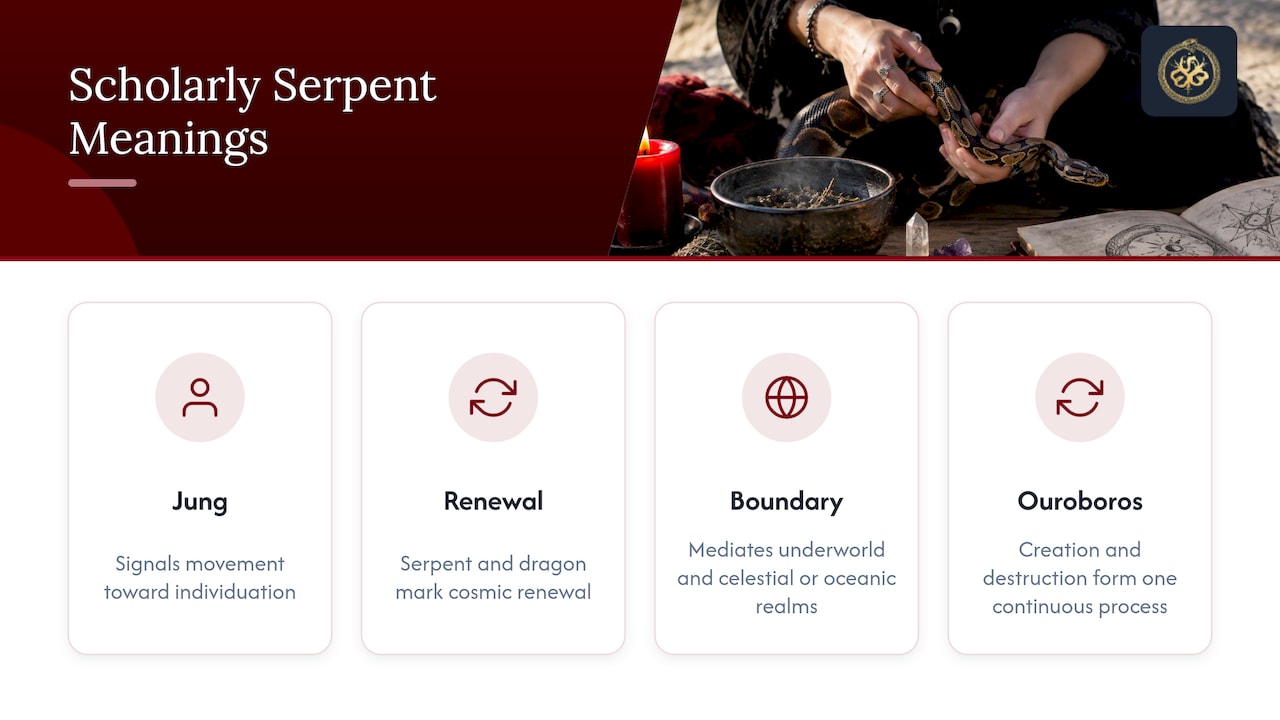
Carl Jung read the serpent as an archetype of the unconscious, a figure that surfaces in dreams and myths to represent instinctual material the conscious mind has not yet integrated. For Jung, encountering the serpent symbolically was often a signal of movement toward individuation rather than a simple warning.
Academic treatments extend this reading historically. The Serpent Symbol in Tradition dissertation argues that serpent and dragon symbolism across premodern traditions repeatedly encodes cyclicity and what the author calls the “spiritualizing” of matter, a reading consistent with how Mircea Eliade and other historians of religion treat serpent and dragon imagery as markers of cosmic renewal rather than mere animal fear.
The serpent functions as a boundary-crosser between worlds, mediating between the underworld and the celestial or oceanic realms in mythic cosmologies.
Alchemical tradition absorbed the ouroboros directly as a visual statement of the unity of opposites, the idea that creation and destruction are a single continuous process rather than two separate forces. Christian reinterpretation later narrowed much of this range, recasting the serpent primarily as a tempter, though the scholarly work on the serpent’s broader symbolic history notes that pre-Christian traditions linked the serpent more frequently to healing, eternal life, and wisdom than to evil.
Bringing Serpent Symbolism Into Ritual Practice
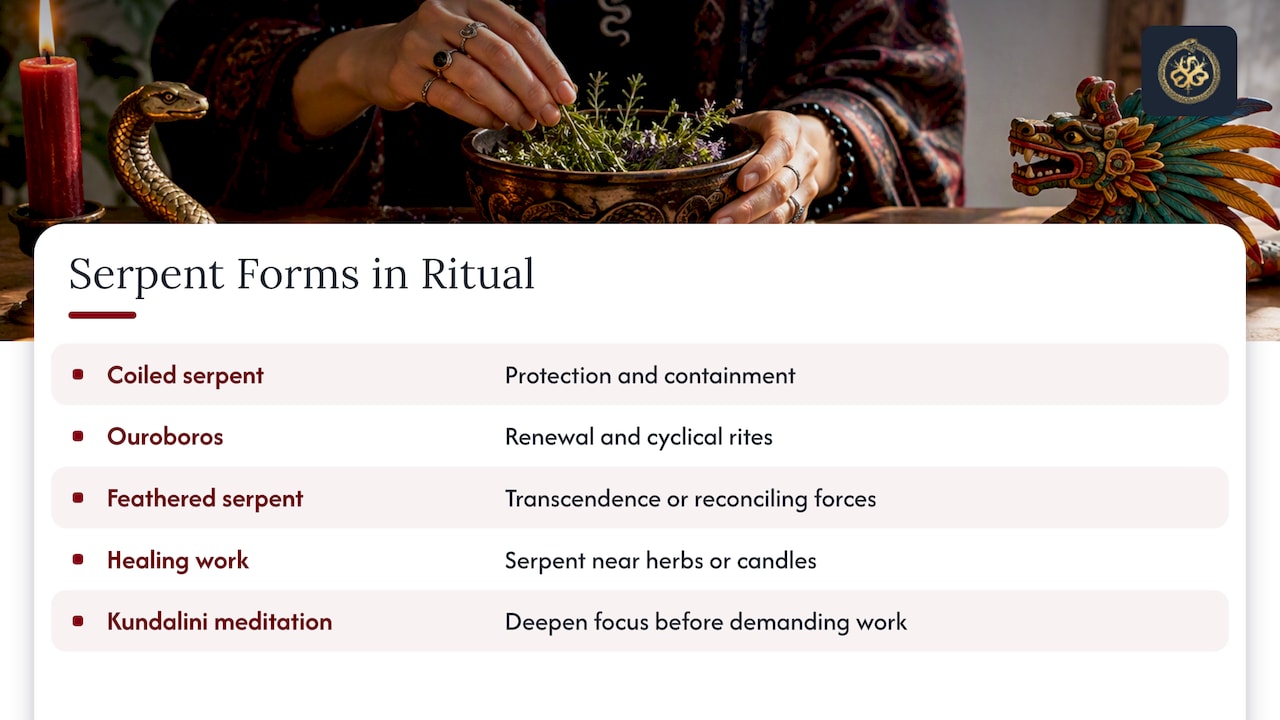
Witches who work with serpent imagery tend to choose the form that matches the working’s intention rather than treating all serpent symbols as interchangeable. A coiled serpent, body wound tightly around itself, is a common choice for protection and containment work, since the closed shape reads as a boundary that holds energy in or keeps intrusion out. The ouroboros, serpent devouring its own tail, fits renewal and cyclical rites, invoked when a witch wants to close one phase cleanly and open the next. A winged or feathered serpent form suits workings aimed at transcendence or the reconciliation of conflicting forces, drawing on the same earth-sky fusion found in Quetzalcóatl.
Altar imagery and sigil choices follow the same logic. A magician doing healing work might place serpent imagery near herbs or candles associated with the body, echoing the rod of Asclepius pairing of venom and cure. Meditation on the Kundalini current, visualizing the coiled serpent at the base of the spine rising through the body, is a long-standing technique for those seeking to deepen focus before more demanding ritual work.
Pro Tip: Match the serpent’s posture in your imagery, coiled, striking, or tail-eating, to the exact phase of the working: containment, confrontation, or closure.
Serpent Symbolism Within the Left-Hand Path
Left-Hand Path and occult traditions treat the serpent as a figure of self-deification rather than a cautionary symbol. Where mainstream religious narratives cast the serpent as a tempter to be resisted, Luciferian frameworks read that same episode as an act of illumination: the serpent offers forbidden knowledge, and accepting it is framed as the first step toward personal sovereignty rather than a fall. This reversal sits at the center of why the serpent recurs so often in Left-Hand Path iconography.
Demonic workings frequently draw on serpent imagery because the animal already carries the underworld and boundary-crossing associations described earlier. A serpent coiled around a sigil or a demonic seal visually reinforces the idea of a pact, power bound and held, moving between the witch’s will and the entity invoked. In Luciferian practice specifically, the serpent often stands alongside the light-bearer motif, pairing the themes of illumination and hidden wisdom into a single working image.
This is consistent with the scholarly point raised earlier about pre-Christian traditions: the serpent’s association with wisdom and healing long predates its demonization, and Left-Hand Path practice generally reclaims that older, more ambivalent reading rather than inventing a new one.
Serpent Imagery in Black Magick Ritual Work
In practical black magick, serpent imagery shows up across three recurring intentions: domination, protection, and prosperity, each drawing on a different facet of the symbol’s duality.
For domination and control workings, the serpent’s venom duality becomes the operative image: the magician frames the target relationship the way venom is framed, something potent that can be directed and mastered rather than feared. Serpent sigils or candle dressings in these workings often emphasize the strike, the moment the serpent commits to action, rather than the coil.
For protection work, the coiled serpent returns as a containment symbol, frequently layered with other warding elements to form a closed perimeter around the witch, the home, or the client. This mirrors the uraeus function in Egyptian royal iconography, where the cobra protected the sovereign by threatening anything that approached.
For prosperity and money workings, the serpent’s underworld connection becomes an asset rather than a liability: wealth, like the serpent itself, is treated as something that moves between hidden and visible states, and ritual imagery calls it up from where it is buried into the magician’s open hand.
Serpents and Specific Goetic Entities
Several entities commonly invoked in demonic and Goetic work carry serpent or underworld associations that make the symbol a natural fit for pact and petition work involving them. Lucifer, framed within Luciferian practice as the light-bearer, draws directly on the serpent-as-illuminator reversal described above, making serpent imagery a frequent visual companion to his sigil in ritual contexts. Andras, an entity associated with discord and retribution, pairs naturally with the serpent’s striking posture, since both carry the theme of sudden, decisive action against a target. Clauneck, petitioned primarily for wealth and financial workings, connects to the serpent’s underworld-to-surface movement discussed in the prosperity context above. Astaroth, frequently invoked in workings tied to hidden knowledge and influence, shares the serpent’s long association with forbidden or concealed wisdom.
These associations are not interchangeable across entities. A witch building a working around Clauneck for prosperity draws on a different serpent facet than one building a working around Andras for confrontation, even though both can legitimately use serpent imagery as part of the ritual’s visual and symbolic architecture.
Why This Symbol Refuses to Settle Into One Meaning
The serpent endures because it never resolves into a single tidy meaning, and that is precisely its usefulness. Every culture that has lived alongside serpents has had to hold two truths simultaneously, that the same creature can kill and can heal, that the same shedding of skin that looks like death is actually renewal. Occultists who work with serpent symbolism today are extending a continuous line of ritual use, not inventing a metaphor from scratch.
— Black Witch Coven
Working With Serpent Symbolism in a Commissioned Ritual
When serpent symbolism points toward a specific need, protection, renewal, domination, or prosperity, we build that imagery directly into custom ritual work rather than leaving it as a concept to meditate on alone. Our Left-Hand Path Tarot Reading or Spirit Guidance sessions can clarify which serpent-aligned working fits your situation, and our daemonic spell casting services extend that imagery into full ritual form tailored to your goal.
FAQ
What are snakes symbolic for?
Snakes most often symbolize transformation, rebirth, and the crossing of boundaries between worlds, alongside paired meanings of poison and healing and chaos and order, according to Wikipedia’s entry on serpent symbolism. The exact emphasis shifts by culture, from royal protection in Egypt to spiritual awakening in Hindu Kundalini practice.
What is the spirit of a serpent?
Across traditions, the serpent’s spirit is tied to mediation between realms, moving between underworld, earth, and sky or water, which is why so many cultures cast it as a messenger or threshold figure rather than a simple predator. The dissertation on serpent symbolism frames this boundary-crossing role as central to how premodern cosmologies used the serpent.
Why is the serpent a symbol of healing?
The serpent became a healing symbol because its venom carries a built-in paradox: the same substance that kills can be processed into remedy. This duality is captured directly in the rod of Asclepius, a single serpent wound around a staff that became the enduring emblem of medicine in Greek tradition.
What is a metaphor for a snake?
In ritual and psychological contexts, the snake is frequently used as a metaphor for hidden or unconscious power, something coiled and latent until activated, as in the Kundalini current described in Hindu and yogic traditions. It also works as a metaphor for cyclical time itself through the ouroboros, the serpent eating its own tail.
Sources
- Serpent symbolism — Wikipedia
- Quetzalcóatl — Britannica
- The Serpent Symbol in Tradition — Charles William Dailey (2020 dissertation)
