
 New Years Eve Ritual 2026/2027 with Savannah
Blog, Demons, Spirits & ghosts
Gods, Demons, and Spirits: Agrippa’s Three Entity Types on the Left Hand Path
Jul
The differences in entities come down to three things: origin, method of contact, and what the operator can reasonably expect in return. Celestial and angelic intelligences respond to petition and purification work. Demonic and ceremonial spirits respond to command, seals, and binding structures. Natural, elemental, and ancestral spirits work through reciprocity and offering. The category you’re working with should dictate your entire ritual approach, not the other way around.
Table of Contents
- What Are the Core Categories of Spiritual Entities?
- How Do Ritual Methods Differ Between Petition and Command?
- How Do Occultists Recognize and Classify an Entity in Practice?
- What Technical Markers Signal How to Treat an Entity?
- Spirit Profiles: Lucifer, Andras, Clauneck, and Astaroth
- Where Do These Classifications Come From Historically?
- What Do These Distinctions Mean Theologically and Philosophically?
- How Do Entity Differences Shape Modern Practice and Outcomes?
- A Coven’s Perspective on Classification and Client Outcomes
- Where to Get a Professional Working Done
- Sources
- FAQ
What Are the Core Categories of Spiritual Entities?
Renaissance occult philosophy organized non-physical intelligences into three broad orders, and that tripartite scheme still holds up as the working framework most magicians use today. Heinrich Cornelius Agrippa laid this out systematically in De Occulta Philosophia, mapping celestial, demonic, and natural orders to distinct ritual approaches and distinct metaphysical rankings. That taxonomy wasn’t academic hairsplitting. It told the operator exactly what kind of relationship to expect before a single word of the ritual was spoken.
The three categories break down like this:
- Celestial/angelic entities operate through hierarchy and revelation. Contact typically comes through purification, meditation, and petition rather than command, and the expected results lean toward insight, sovereignty, and internal transformation.
- Demonic/ceremonial entities operate through negotiated authority. Goetic and ceremonial magick treats these spirits as intelligences that respond to seals, names, and binding language, with results oriented toward tangible, worldly outcomes.
- Natural/elemental/ancestral entities operate through reciprocity. These spirits are tied to place, lineage, or natural force, and the relationship runs on offerings and ongoing tending rather than one-time commands.
Each category maps to a different kind of aim. Angelic work tends to produce revelation. Demonic work tends to produce material change: money, love, legal outcomes, protection. Natural and ancestral work tends to produce localized, relational support that renews over time rather than resolving in a single event.
How Do Ritual Methods Differ Between Petition and Command?
The operator’s stance is what separates a theurgic rite from a Goetic evocation, and that stance changes everything about how the ritual gets built. Angelic and theurgic practice orients the operator toward purification and revelation, treating the self as the object being refined. Demonic and ceremonial magick orients the operator toward achieving something, treating the entity as intelligence to be engaged, bound, and directed toward a result. Scholarly summaries of learned magick note that both systems share ritual vocabulary, even while their aims and their operator posture diverge sharply.
In practice, the contrast plays out across a few concrete variables:
- Posture toward the entity. Theurgic work petitions and waits. Evocation states intent, sets terms, and expects a response within a bounded structure.
- Instruments used. Names and seals function as tuning devices and authority markers in both traditions, but demonic evocation leans harder on binding language, sigils, and triangle work, while angelic ritual leans on purification, incense, and devotional repetition.
- Timing. Astrological correspondences show up in both approaches, but Goetic work often ties specific spirits to specific planetary hours to sharpen the connection and stabilize the container.
- Expected outcome window. Petitionary work often unfolds gradually, revealing insight over weeks. Command-based evocation is typically staged for a discrete, checkable result.
The instruments themselves don’t change meaning between traditions so much as the hand that wields them does. A name spoken in supplication and the same name spoken as a binding term produce very different ritual dynamics, even when the phonetics are identical.
How Do Witches Recognize and Classify an Entity in Practice?
Classification in the field rarely starts with theology. It starts with behavior. An experienced operator watches how an entity responds to seals, how consistent its communication is across multiple sessions, and whether its answers hold up against verifiable outcomes.
A few behavioral cues carry real diagnostic weight:
- Consistency across sessions. A reliable entity gives coherent answers over time rather than contradicting itself session to session.
- Response to containment. Genuine cooperation shows up as respect for the boundaries of the working, whether that’s a circle, a triangle, or a stated term.
- Tone and register of communication. Angelic contact tends to feel expansive and instructive. Demonic contact tends to feel transactional and direct. Neither feeling is proof by itself, but the pattern matters.
- Response to test questions. Asking something independently verifiable, then checking the answer against reality, remains one of the oldest verification tools in practical magick.
Pro Tip: Run a small, low-stakes test request before committing to a major working. If an entity can’t deliver reliably on something minor and checkable, don’t stake a $2,000 working on it delivering reliably on something major.
None of this is as clean as the textbook taxonomy suggests. Scholarship on ritual and textual entanglement shows that occultists have long mixed vocabulary, names, and timing across categories, meaning a working can pull angelic phrasing into a demonic operation without contradiction. The three-part model is a map, not a fence. Experienced magicians treat it as a starting orientation, then adjust once the entity’s actual behavior gives them better information than the category label did.
What Technical Markers Signal How to Treat an Entity?
Names, seals, and timing aren’t decoration. They function as both authority and calibration, tuning the ritual container while asserting the operator’s standing in the exchange. Encyclopedic treatments of historical magick describe how adjurations, names, and physical objects show up across both angelic and demonic operations, functioning as the connective tissue of the working rather than as separate toolkits for separate traditions.
The technical markers that matter most in practice:
- True names. A correctly used name isn’t a label, it’s a key, and grimoire tradition treats getting it right as a precondition for a stable connection.
- Seals and sigils. These act as a visual anchor for both entity and operator, stabilizing the connection during longer or more demanding workings.
- Containment structures. Circles, triangles, and bound spaces exist to hold the shape of the working, particularly in evocation where the entity is expected to manifest into a defined space rather than simply be petitioned from a distance.
- Planetary and lunar timing. Correspondences aren’t superstition dressing. They’re a scheduling framework that experienced operators use to align the working with the entity’s traditional domain.
Operator preparation is the variable that ties all of this together. Grimoire-level commentary on ritual markers treats seals, perfumes, and precise timing as functional technology: they stabilize the operator’s mental state as much as they signal anything to the entity on the other side. Skipping preparation doesn’t just risk a weak result. It risks a working that never actually establishes contact at all.
Spirit Profiles: Lucifer, Andras, Clauneck, and Astaroth
Named entities carry distinct functional profiles in ritual literature, and grimoire tradition assigns them specific domains, temperaments, and expected modes of engagement. Modern witches adapt these profiles directly from primary texts like the Goetia, which catalogs named spirits alongside their functions and prescribed approach.
- Lucifer is worked as a sovereignty and illumination figure, oriented toward initiation, self-liberation, and expanded personal authority. Workings addressed to him tend toward long-arc transformation rather than a single transactional ask, which is why rituals framed around light and sovereignty are usually built for depth rather than speed.
- Andras carries a warrior and discord archetype, useful in workings that require conflict, disruption of an opposing party, or forceful clearing of an obstacle. Containment discipline matters more here than with most entities, given the volatile nature of the domain he governs.
- Clauneck is worked almost exclusively for wealth and prosperity, and offerings and phrasing built around him tend to be direct and outcome-specific rather than devotional.
- Astaroth is approached for knowledge and hidden information, and occultists typically look for a different kind of proof than they would with wealth or love work: accurate, verifiable disclosure rather than a material shift in circumstance.
Where Do These Classifications Come From Historically?
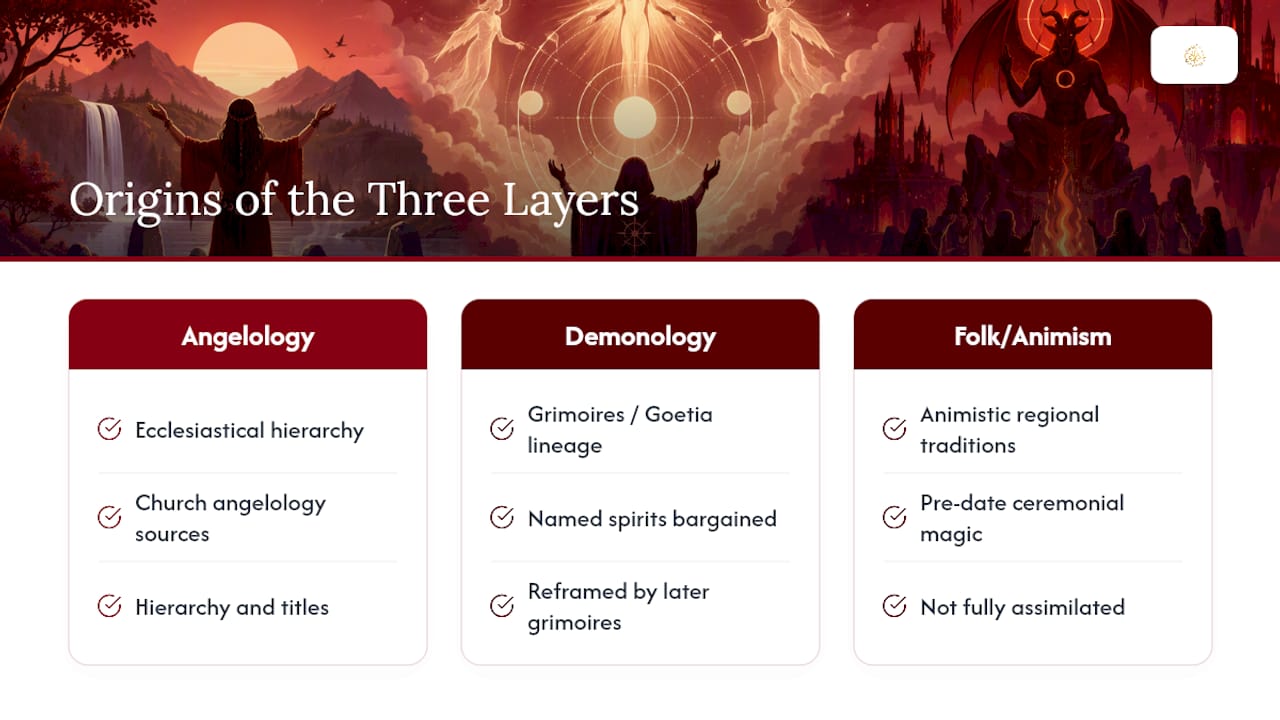
The tripartite model didn’t appear from nowhere. It emerged from a specific intersection of Christian angelology, Hermetic philosophy, and folk tradition, all converging in the learned magick of the late medieval and early modern periods. Agrippa wasn’t inventing categories so much as codifying distinctions that had already been circulating for centuries across grimoire manuscripts, church demonology, and regional folk practice.
That layered history explains why the categories don’t always sit cleanly next to each other. Angelology borrowed hierarchy from ecclesiastical structure. Demonology absorbed both church condemnation and independent grimoire traditions that treated named spirits as intelligences to be bargained with rather than purely feared. Natural and ancestral spirit work came from an entirely separate lineage: animistic and folk traditions that predate formal ceremonial magick by a wide margin and never fully assimilated into the Solomonic framework.
The result is a classification system built in layers, not designed in one sitting. Later grimoires like the Goetia inherited names and structures from earlier sources, reframed them for their own era’s theological anxieties, and passed the results forward. Modern magicians inherit all three layers simultaneously, which is part of why the boundaries between categories stay porous rather than fixed. Understanding that history isn’t academic trivia. It explains why a demonic name might carry angelic-sounding titles, or why a Goetic seal echoes a much older astrological glyph. The entanglement isn’t sloppy scholarship. It’s the actual archaeology of the tradition showing through.
What Do These Distinctions Mean Theologically and Philosophically?
Treating spiritual entities as a hierarchy rather than a flat field of interchangeable forces carries real philosophical weight. A tripartite model implies a cosmos with structure: intelligences ranked by proximity to divine order, distance from it, or independence from it entirely. That structural assumption shapes how a witch understands agency itself, both the entity’s and their own.
Working with a celestial intelligence implies a relationship of alignment, where the operator moves toward something. Working with a demonic intelligence implies a relationship of negotiation between two independent wills, closer to contract than communion. Working with natural or ancestral spirits implies something closer to kinship or obligation, a relationship sustained through reciprocity rather than command or alignment.
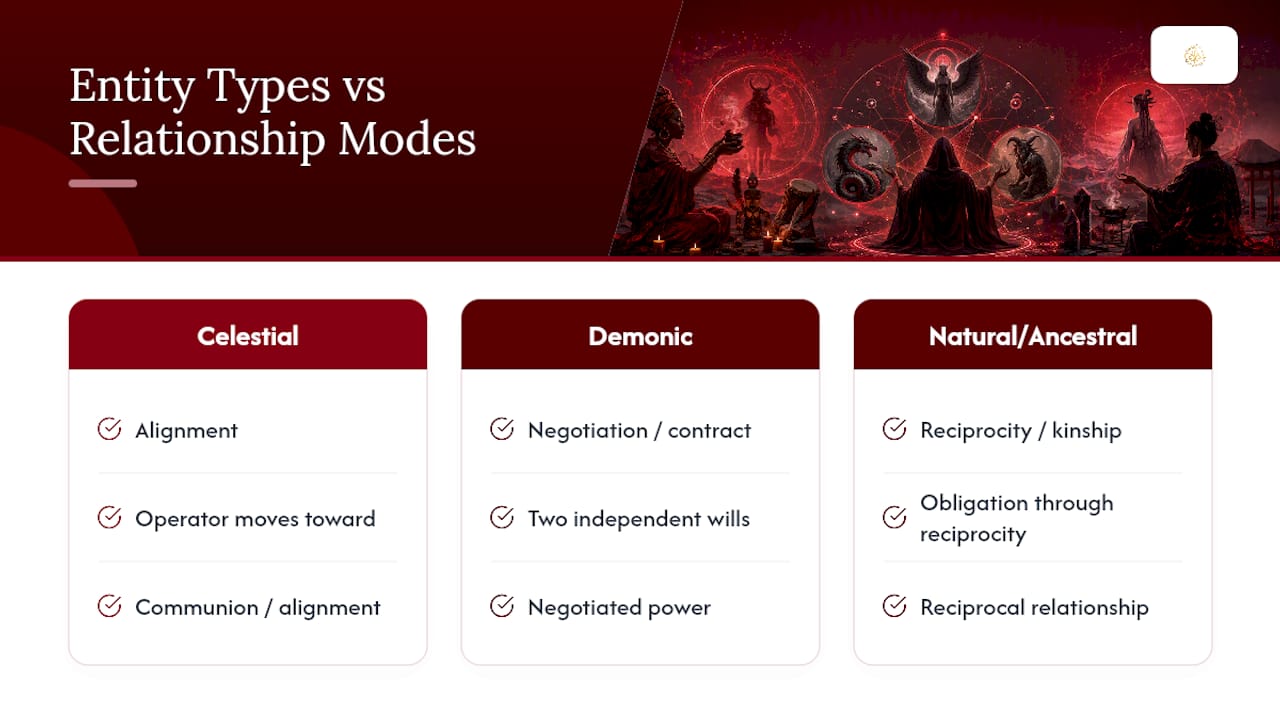
Left-Hand Path practice takes a particular position within this framework: sovereignty and negotiated power over submission and alignment. Choosing to command rather than petition is itself a philosophical stance, not just a technical one. It asserts that the operator’s will carries standing in the exchange, that spiritual power is a resource to be engaged rather than a hierarchy to be obeyed. That’s a meaningfully different theology from the theurgic model, where the self is refined in relation to something higher. Neither model is more “real” than the other. They’re different metaphysical bets about what a working relationship with a non-physical intelligence actually is.
How Do Entity Differences Shape Modern Practice and Outcomes?
Modern witches face a practical problem the old grimoires didn’t: they’re usually working alone, without a coven’s accumulated experience to fall back on when a working goes sideways. That makes accurate classification more consequential, not less. Applying a petitionary approach to a Goetic spirit tends to produce weak, inconsistent results, because the entity is being engaged in a mode it doesn’t operate in. Applying command-based ritual structure to angelic contact tends to feel hollow or produce no contact at all, for the same underlying reason.
The practical upshot is that outcome quality tracks classification accuracy more closely than it tracks ritual elaborateness. A precisely targeted, correctly staged working addressed to Clauneck for a specific financial outcome will typically outperform an elaborate, unfocused ritual that never settles on what category of entity it’s actually trying to reach. This is also where working with an experienced operator changes the outcome curve. Getting the classification wrong at the outset, then discovering it three sessions in, costs both time and momentum that a correctly diagnosed working never loses.
A Coven’s Perspective on Classification and Client Outcomes
Most classification failures happen before the ritual even starts, not during it. A client comes in wanting “protection” when what they actually need is a binding against a specific person, or wanting “love magick” when the real issue is a domination working aimed at loyalty. Getting the category right, before candles are lit, is most of the job.
A professional occult service approaches every request by identifying which order of entity actually fits the goal, then building the ritual structure around that classification rather than defaulting to a one-size approach. A prosperity request built for Clauneck looks nothing like a legal-success working built for Eligor, and treating them the same way is how results fall flat. Case examples from client work consistently show that specificity in classification, not ritual complexity, drives outcomes.
— Black Witch Coven
Where to Get a Professional Working Done
Classifying an entity correctly is one problem. Executing the ritual with proper containment, timing, and command structure is another, and that’s where a lot of solo occultists hit a wall, particularly with complex pacts or anything involving legal, financial, or relationship stakes that can’t tolerate a botched attempt. Effective ritual providers build every working around the specific entity and outcome needed, rather than running a generic template regardless of what’s actually being requested.
For demonic and ceremonial work specifically, the daemonic spell casting category covers everything from love and marriage workings to court and legal rituals built around named entities like Eligor. Clients focused on wealth and prosperity outcomes tied to Clauneck’s domain can look at the money magick offerings directly. Anyone still working out which category of entity actually fits their situation can start with a tarot or spirit guidance reading to get clarity before committing to a full ritual booking.
Sources
- Heinrich Cornelius Agrippa von Nettesheim (Stanford Encyclopedia of Philosophy/Winter 2016 Edition)
- Encyclopedia
- Scholarly article on ritual/textual entanglement (2023)
FAQ
What is the difference between angelic and demonic entities?
Angelic entities are approached through petition, purification, and revelation, while demonic entities are approached through command, seals, and binding structures aimed at practical results. The distinction comes from the operator’s stance, not just the entity’s nature.
Can natural or ancestral spirits cross into demonic work?
Yes. Magicians regularly blend vocabulary, timing, and tools across categories, and scholarship on ritual entanglement confirms this has been common practice throughout the history of learned magick rather than a modern shortcut.
How do I know if an entity is responding truthfully?
Test with a small, independently verifiable request before committing to a major working, and watch for consistency across multiple sessions. Reliable entities respond predictably to seals and containment; inconsistent or evasive responses are a red flag worth investigating before scaling up the working.
Does Black Witch Coven work with named entities like Lucifer or Astaroth?
Yes. Some ritual work includes named entities such as Lucifer, Andras, Clauneck, and Astaroth, each matched to specific outcomes like sovereignty, protection, prosperity, or hidden knowledge. Current pricing for specific rituals, including the Ritual to Lucifer, is listed on the site.
Why does classification matter more than ritual complexity?
Outcomes track how accurately the entity’s category was identified, not how elaborate the ritual was. A correctly targeted, simple working consistently outperforms an elaborate ritual aimed at the wrong type of entity.
