
 New Years Eve Ritual 2026/2027 with Savannah
Blog, Demonolatry, Demons
How Demons Perceive Human Morality and Ethics
Nov
Demons treat human morality as a catalogue of functional scripts, not a binding framework. They understand ethics conceptually, at a level exceeding most humans, yet they share none of the emotional architecture that makes moral rules feel obligatory. For practitioners working Goetic pacts or Luciferian rites, that distinction is the single most operationally important fact you can carry into a working.
Three immediate takeaways before you read further:
- Translate moral language into measurable clauses. When an entity invokes “justice,” “fairness,” or “mercy,” treat it as rhetorical leverage, not a commitment. Demand a verifiable, time-bound condition instead.
- Test consistency, not sincerity. Demons do not feel remorse or guilt. Inconsistency in tone or shifting terms mid-negotiation is a red flag, not a personality quirk.
- Establish safeguards before contact. Pre-established seals, witness artifacts, and a clear termination protocol are non-negotiable. Lucifer, Andras, Clauneck, and Astaroth each appear in the Ars Goetia with distinct dispositions; knowing those profiles shapes how you structure protections.
This article draws on the Book of Enoch, the Ars Goetia (Lesser Key of Solomon), Aquinas’s Summa Theologica, and Suárez’s philosophical analysis of demonic obligation, plus anonymized case notes from Black Witch Coven’s 16-plus years of practice.
Table of Contents
- What classical sources say about demonic intellect and origins
- How the demonic mind actually processes human ethics
- How demons use moral language to manipulate practitioners
- What this means at the ritual table: structuring exchanges
- Red flags and safeguards every practitioner must know
- Grimoire cases and anonymized practitioner outcomes
- Occult ethics for Left-Hand Path practitioners
- How human and demonic ethical frameworks actually differ
- What philosophers and theologians say about demon morality
- How cultural and historical context shaped folkloric demon morality
- How demonic moral perception shapes contracts and interactions
- Why anthropomorphism distorts your read of demonic ethics
- Key Takeaways
- The part most practitioners get wrong
- Professional Goetic work when the stakes are real
- Useful sources and further reading
- FAQ
What classical sources say about demonic intellect and origins
The cognitive model that explains demonic behavior toward human ethics is not modern speculation. It runs from the Book of Enoch through medieval scholasticism to the grimoire tradition.
| Source | Core claim | Operative implication for ritualists |
|---|---|---|
| Book of Enoch (1 Enoch) | Fallen Watchers retain superior intellect after descent | Entities understand your ethical system better than you do |
| Ars Goetia / Lesser Key of Solomon | Goetic spirits have defined ranks, powers, and dispositions | Spirit profiles predict negotiation style; consult them before contact |
| Aquinas, Summa Theologica (FP Q.64) | Angels and fallen angels apprehend universals through intellect; sensory passions are absent | No empathy, no remorse, no emotional leverage for the practitioner to exploit |
| Suárez, “Republic of Demons” | Luciferic hierarchy produces non-moral obligations among demons | Pact terms are structural, not conscience-driven; enforce them contractually |
The trajectory is consistent: angelic origin, confirmed intellect, altered will. The fall did not strip cognitive capacity. It fixed the will in a direction opposed to human moral goods, which is precisely why demons can articulate theology fluently while remaining entirely unmoved by it.
How the demonic mind actually processes human ethics
The core operative difference is the absence of emotional resonance. Demons think in concepts, suffer from knowledge of the divine order, and lack human-style passions entirely. That produces a specific cognitive profile.
| Dimension | Human processing | Demonic processing |
|---|---|---|
| Empathy | Drives moral motivation | Absent; replaced by strategic modeling |
| Obligation | Felt as conscience, social bond | Structural, hierarchy-based, non-moral |
| Promises | Carry emotional weight | Treated as contractual instruments |
| Remorse | Follows violation of values | Not possible; will is fixed |
| Long-term binding | Reinforced by relationship | Maintained only while strategically useful |
Demons know Kantian ethics, Thomistic natural law, and Aristotelian virtue theory. They can deploy any of those frameworks in conversation. The Kantian analysis is particularly sharp here: a being capable of full moral reasoning that systematically acts against it is not amoral. It is something more precise and more dangerous.
Pro Tip: When an entity uses philosophical or theological language, treat it as evidence of intelligence, not of alignment. The more fluent the moral speech, the more carefully you should examine what it is actually requesting.
How demons use moral language to manipulate practitioners
Mimicry is the most dangerous capability a demon brings to negotiation. It learns human moral vocabulary and deploys it to produce trust, lower defenses, and extract concessions. Promises in this context are strategies, not bonds.
Common rhetorical patterns to recognize:
- Appeals to “fairness” or “balance” when requesting an open-ended commitment from you
- Invoking “loyalty” while refusing to specify what loyalty requires in measurable terms
- Using “justice” framing to justify demands that serve the entity’s efficiency, not your outcome
- Calm, reasoned speech that produces false hope about the scope of what is being offered
The detection checklist is short. Watch for tone that stays perfectly consistent regardless of what you say, an absence of any emotional leakage when you push back, and requests for concessions that benefit the entity’s operational efficiency rather than your stated goal. A spirit that weaponizes moral vocabulary to control behavior will also resist specificity. Push for exact terms and watch the response.
Pro Tip: Field test: ask the entity to restate the offer in concrete, measurable language. A genuine offer survives that request. Rhetorical leverage collapses under it.
What this means at the ritual table: structuring exchanges
Theory becomes practice at the moment of negotiation. Here is the operational sequence:
- State your goal in measurable terms first. Define the outcome you want with a timeframe, a verifiable sign, and a scope limit before the entity speaks.
- Demand measurable outcomes in return. “Prosperity” is not a term. “A specific financial threshold within 90 days, confirmed by a named physical sign” is.
- Insist on fixed timeframes. Open-ended agreements give interpretive leverage to the entity. Every clause needs a deadline.
- Build in reversible conditions. Include a clause that specifies what happens if the agreed sign does not appear. Escrow-style logic: if X is not delivered by Y, the agreement terminates.
- Document everything. Record sessions, use dated sigils as witness artifacts, and translate verbal offers into written ceremonial clauses before closing the working.
Pro Tip: Exact, measurable clauses reduce interpretive leverage because they leave no room for the entity to redefine terms after the fact. “Within 30 days” cannot be stretched to mean “eventually.” That specificity is your primary contractual protection.
For deeper guidance on structuring demonic pact language, Black Witch Coven’s documented approach to Lucifuge Rofocale pacts illustrates how this plays out in practice.
Red flags and safeguards every practitioner must know
Red flags during contact:
- Goalposts shift mid-negotiation without explanation
- Demands for indefinite service or open-ended loyalty
- Pressure to cut ties with other practitioners or verification sources
- Secrecy demands that prevent you from documenting or witnessing the agreement
- Escalating urgency designed to bypass your deliberation
Safeguards to establish before contact:
- Pre-established seals specific to the entity you are working with
- A designated witness or documented record of the session
- A reverse-sigil step prepared in advance for termination
- A physical token or safe word that signals immediate disengagement
If a working escalates beyond your preparation, the high-level emergency protocol is: stop the session, preserve all documentation, and seek an experienced operator before re-engaging. For situations where a working has already gone sideways, breaking a spell you’ve cast is a documented option.
Note: This article is general information for experienced practitioners, not legal or professional advice. Confirm any actions with legal and qualified professional guidance for your specific situation.
Grimoire cases and anonymized practitioner outcomes
The Ars Goetia profiles are the closest thing the tradition has to entity-specific negotiation briefs. Astaroth’s entry describes a spirit that speaks freely about past and future, including theological matters, but the grimoire warns explicitly against allowing it to come too near due to its breath. That physical detail is a metaphor the tradition uses consistently: proximity to the entity’s preferred mode of communication is where manipulation occurs.
Clauneck, associated with wealth and treasure, operates on transactional logic. Practitioners who have worked Clauneck wealth pacts consistently report that the spirit responds to precision. Vague requests for “more money” produce vague results or none. Specific financial targets with defined conditions produce movement.
Andras is categorically different. The Ars Goetia classifies him as a Grand Marquis who sows discord. His negotiation style is not transactional; it is destabilizing. Practitioners who have worked with Andras through Black Witch Coven’s case archive describe a spirit that tests your resolve by introducing conflict into your immediate environment before delivering on any agreed outcome.
The lesson across all three is the same: the entity’s Ars Goetia profile predicts its preferred leverage point. Clauneck exploits vagueness. Andras exploits emotional reactivity. Astaroth exploits the practitioner’s desire to be understood. Know the profile before you open the circle.
Lessons-learned summary:
- What worked: specific, time-bound clauses; pre-session research into the spirit’s profile; documented witness artifacts
- What failed: open-ended agreements; emotional engagement with moral language; skipping the termination protocol
Occult ethics for Left-Hand Path practitioners
Left-Hand Path ethics are not the absence of ethics. They are ethics grounded in sovereignty, accountability, and informed consent rather than external moral authority.
Checklist for U.S.-based practitioners:
- Do not direct workings at individuals without their knowledge in ways that could constitute harassment or fraud under applicable law
- Document consent for any working that involves a third party
- Never work with or around minors without appropriate safeguards; see Black Witch Coven’s guidance on daemonic rituals around children
- Respect the autonomy of vulnerable people; coercive workings targeting someone in crisis carry both ethical and legal risk
Do/don’t scenarios:
- Do: structure a prosperity working with measurable personal goals and documented intent
- Don’t: use domination work to override another person’s legal rights or financial autonomy
- Do: escalate to a professional Goetic operator when a working involves high stakes or legal exposure
- Don’t: proceed with a pact if you cannot articulate the exit conditions in advance
How human and demonic ethical frameworks actually differ
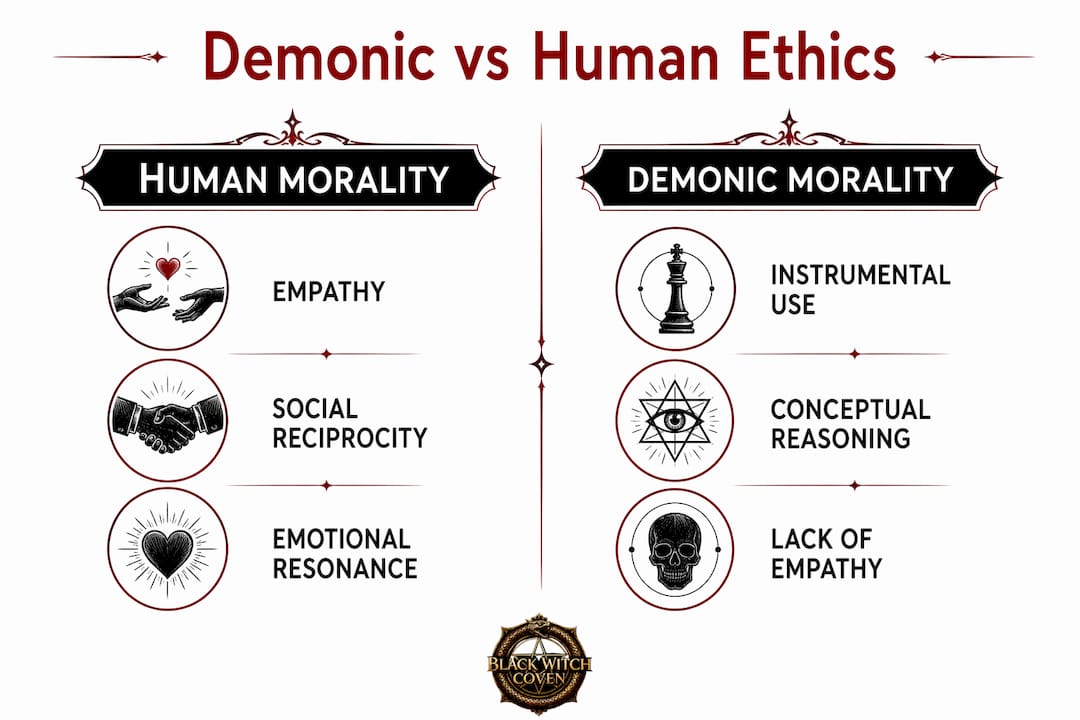
Beyond instrumentalism, the structural difference is this: human ethics are built on empathy, social reciprocity, and the felt weight of obligation. Demonic ethics, to the extent the term applies, are built on hierarchy, efficiency, and goal-directed rationality. Jean Bodin’s 16th-century demonological work, de la Démonomanie des sorciers, frames this precisely: humans exist in a state of free will that makes moral choice meaningful, while demonic agents operate within a fixed orientation that makes moral choice structurally irrelevant to them.
The philosophical literature on Whedon’s demonology makes a similar point through popular culture: demons in that tradition function as projections of human moral complexity, which is useful as a mirror but misleading as a model for actual entity behavior. Real Goetic work requires you to set that mirror aside.
What philosophers and theologians say about demon morality
The Kantian analysis is the sharpest available. A being capable of full moral reasoning that systematically acts against it is not simply amoral. Kant’s “race of devils” thought experiment in Towards Perpetual Peace describes rational beings who understand the categorical imperative and choose self-interest anyway. That is the operative model.
Kierkegaard and Anscombe add another layer: the demonic posture involves rejecting objective goodness not from ignorance but from a confirmed disposition of the will. This is not nihilism. It is a coherent, if inverted, rational framework. For practitioners, the implication is that you cannot appeal to a demon’s better nature because the better nature is not absent. It is present and deliberately set aside.
How cultural and historical context shaped folkloric demon morality
Demonic moral profiles shift significantly across cultures and historical periods. Medieval European demonology, shaped by Aquinas and later Bodin, emphasized hierarchy and the corruption of divine order. West African and Afro-Caribbean traditions, which inform Hoodoo and New Orleans practice, frame spirit entities with more transactional and relational moral logic. The Goetic tradition synthesizes multiple streams: Solomonic, Kabbalistic, and Neoplatonic.
That synthesis matters practically. The Ars Goetia’s spirit profiles reflect a specific cultural moment and a specific theological framework. A practitioner working from a Luciferian or Demonolatry framework may encounter the same entities through a different interpretive lens. The demonological perspective on spirit cognition varies by tradition, and knowing which tradition’s framework you are operating within shapes how you read entity behavior.
How demonic moral perception shapes contracts and interactions
Because demons treat human morality as instrumental, every interaction is a negotiation, not a relationship. The entity is always modeling your moral commitments as leverage points. If you value loyalty, expect loyalty language. If you value justice, expect justice framing. The demon archetypes and negotiation tactics that appear across traditions consistently show this adaptive quality.
The practical consequence: do not let the entity set the moral frame of the negotiation. You set it, in contractual terms, before contact begins. The entity then operates within those terms or reveals that it will not, which is itself useful information.
Why anthropomorphism distorts your read of demonic ethics
The biggest interpretive error practitioners make is projecting human emotional logic onto entity behavior. When a spirit seems “pleased” or “offended,” those are functional states, not emotional ones. Aquinas is precise on this: angelic intellect apprehends universals without sensory mediation, which means the categories of human emotional experience simply do not map.
The risk of anthropomorphism is not philosophical. It is operational. A practitioner who reads an entity’s calm, reasoned speech as warmth or goodwill has already lost the negotiation. That calm is not warmth. It is the absence of the emotional friction that would make manipulation harder.
Key Takeaways
Demons understand human ethics completely and share none of it emotionally, which means every moral utterance from an entity is a strategic instrument, not a commitment, and your only protection is contractual specificity before contact begins.
| Point | Details |
|---|---|
| Morality is instrumental to demons | Entities use ethical language as leverage, not as a binding framework; translate all moral offers into measurable clauses. |
| Intellect without empathy | Classical sources from Aquinas to the Ars Goetia confirm demons retain full cognitive capacity with no emotional restraint. |
| Mimicry is the primary risk | Demons deploy moral vocabulary adaptively; tone consistency and resistance to specificity are the key detection signals. |
| Contractual precision is your protection | Fixed timeframes, verifiable signs, and reversible conditions reduce interpretive leverage and protect the practitioner. |
| Black Witch Coven’s approach | Over 16 years of Goetic practice, Black Witch Coven structures pacts with measurable, documented clauses to prevent ambiguity and protect client outcomes. |
The part most practitioners get wrong
The conventional framing treats demonic amorality as a danger to be managed through protective ritual alone. That framing is incomplete. The real risk is not that a demon will harm you through brute force. It is that a demon will use your own moral commitments as the mechanism of manipulation. Your sense of fairness, your desire for reciprocity, your belief that a verbal agreement means something: these are the attack surface.
Sixteen-plus years of practice at Black Witch Coven, across thousands of client workings, consistently confirms one thing: the practitioners who get into trouble are not the ones who lack protective seals. They are the ones who engage emotionally with moral language during negotiation. The seal keeps the entity at the ritual boundary. Your contractual discipline keeps it from rewriting the terms of the agreement in real time.
When DIY is appropriate: if you have prior Goetic experience, a documented spirit profile, pre-established seals, and the ability to draft measurable clauses, solo work is viable for lower-stakes workings. When to hire a professional: high-stakes pacts, unfamiliar entities, or any working where the consequences of a misread clause are serious. The cost of a professional consultation is always lower than the cost of an open-ended agreement with an entity that has centuries of negotiating experience.
The one operational preference that consistently reduces ambiguity: write the exit conditions before you write the entry conditions. Know exactly how the agreement ends before you begin it.
Professional Goetic work when the stakes are real
Black Witch Coven offers structured demonic pact services, Goetic negotiation, and ritual safeguard design for practitioners who want professional-grade results without the interpretive risk of solo work. Every engagement begins with a goal assessment, entity profiling based on grimoire sources, suggested contractual clauses, and a documented agreement. The approach described throughout this article, measurable outcomes, fixed timeframes, and pre-established termination conditions, is the same framework applied in every client working.
For practitioners ready to move from theory to practice, the guide to invoking demonic influences covers invocation technique and secure approaches in detail. To discuss a specific pact or working, book a consultation and get a professional assessment of your goals, the entity involved, and the safeguards your situation requires.
Useful sources and further reading
- Book of Enoch (1 Enoch), R.H. Charles edition (1917). Primary source for fallen angel origins and retained intellect. Supports the cognitive model in the background theory section.
- The Lesser Key of Solomon (Ars Goetia), Joseph H. Peterson edition (2001). Primary grimoire reference for Goetic spirit profiles, including Lucifer, Andras, Clauneck, and Astaroth. Supports entity-specific negotiation guidance throughout.
- Aquinas, Summa Theologica, Part I, Question 64 (available via CCEL). Grounds the claim that demons retain angelic intellect without sensory passions.
- Suárez, “Republic of Demons: Could There Be an Obligation to Do Evil?” (Hebrew University CRIS). Supports the non-moral obligations framework and pact structure analysis.
- Kierkegaard/Anscombe vs. Velleman, PhilPapers. Supports the demonic rejection of objective goodness and the philosophical perspectives section.
- SpiritualDirection.com, “What Does a Demon Think About?” (2012). Supports the cognitive profile section on demonic intellectual suffering and absence of empathy.
- Mystiqora, “Why Demons in Frieren Will Never Truly Understand Human Emotions.” Supports the mimicry analysis and detection checklist.
- Frieren Merchandise, “Frieren Demons Explained: Philosophy, Lies, and Why They’re Dangerous.” Supports the instrumental use of moral vocabulary and rhetorical tactics section.
- McCraw & Arp, eds., Philosophical Approaches to Demonology (Routledge). Broad philosophical reference for the comparative ethics and theological perspectives sections.
- Black Witch Coven case archive. Anonymized client outcomes referenced in the examples section. Detailed case studies and testimonies available on request through direct consultation.
Archival texts are cited by canonical edition. Paraphrase is used throughout; no verbatim ritual instructions are reproduced. For detailed case notes or client testimonies, contact Black Witch Coven directly.
FAQ
How do demons perceive human morality and ethics?
Demons understand human moral systems fully but treat them as instrumental tools rather than binding obligations. They use ethical language strategically to influence human behavior, not because they share moral commitments.
Can a demon be held to a moral promise?
Not through moral appeal alone. Demons operate on structural, hierarchy-based obligations, not conscience. Enforceable pact terms require measurable, time-bound conditions, not moral language.
What is the biggest risk when a demon uses moral language?
Mimicry. When an entity invokes “justice” or “fairness,” it is modeling your moral commitments as leverage, not expressing shared values. Push for specific, verifiable terms and watch whether the offer survives that pressure.
How does the Ars Goetia help practitioners interpret demonic ethics?
The Ars Goetia provides individual spirit profiles that predict each entity’s preferred negotiation style and leverage points. Consulting those profiles before contact is the practitioner’s primary preparation tool.
When should a practitioner hire a professional Goetic operator?
For high-stakes pacts, unfamiliar entities, or any working where a misread clause carries serious consequences, professional guidance from an experienced operator like Black Witch Coven reduces interpretive risk significantly.
