
 New Years Eve Ritual 2026/2027 with Savannah
Blog, Divination, Occult Tarot
Tarot Timing: How to Read When Something Will Happen
Aug
Tarot can offer real divination for timing, but it gives you probabilistic windows, not guaranteed dates. The most reliable short method treats suit as your unit of measure and number as the quantity, so the Eight of Cups reads as roughly eight weeks, not a fixed calendar day. Cross-reference that with a second system, like Major Arcana month mapping, before you commit to a window. If a client demands an exact date, give them a follow-up plan instead of a false promise.
TL;DR:
- The suit as your unit of measure is most reliable when combined with numerology and cross-referenced with Major Arcana month mapping for better timing estimates.
- Court cards indicate stages or phases rather than specific dates, with Pages, Knights, Queens, and Kings representing start, middle, mature, and end phases, respectively.
- Urgent or volatile situations require compressing or expanding suit-based timing estimates, and tracking outcomes over time improves calibration.
- Layering astrology, such as Moon phases and planetary hours, can refine timing predictions but is not mandatory if tarot alone offers a clear answer.
- Framing questions as phase inquiries rather than fixed dates results in more reliable timing insights, with the emphasis on preparation and action rather than exact deadlines.
Core Systems for Divination for Timing
Every tarot timing method rests on one of three frameworks: suit-unit correspondences, numerological counting, or Major Arcana month mapping. Learn all three, because they rarely agree perfectly, and disagreement is actually useful information.
The Golden Dawn suit correspondences are the most widely taught starting point: Wands equal days, Cups equal weeks, Swords equal months, and Pentacles equal years. Some readers swap this for a seasonal model instead, where each suit governs a quarter of the year rather than a unit of duration. Either convention works as long as you stay consistent within a single reading.
Numerology does the multiplying. An Ace counts as one, a Ten counts as ten, and court cards get treated separately (more on that below). So the Three of Wands suggests three days, while the Nine of Swords suggests nine months. This is blunt math, but it gives querents something concrete to hold onto.
Major Arcana cards work on a different scale entirely. Cards one through twelve typically map to months of the calendar year, so the Magician (I) often points to January-adjacent timing and the Hanged Man (XII) to December-adjacent timing. Cards thirteen through twenty-one get read as one year plus the number of months past twelve, meaning Death (XIII) suggests roughly a year and one month.
When these systems clash, don’t force a resolution. A few working principles help:
- Weight the card that answers the actual question more directly (a Pentacle in a money reading outranks a Wand pulled in the same spread).
- Treat a Major Arcana card as a signal about phase or magnitude, not a literal countdown.
- When two systems land close together, trust that convergence over either one alone.
Practical Spreads for Timing Divination
Once you know the systems, you need a repeatable process for pulling cards and turning them into an answer.
Start with question phrasing. “What phase is this relationship in?” produces more usable data than “Will he call me by Friday?” Open, phase-based questions give the cards room to describe a trajectory rather than forcing a yes-or-no gamble on a specific day.
Single-card timing works for quick questions. Draw one card, identify the suit and number, convert to unit and quantity, and check the orientation. A reversed card usually signals a delay, an internal block, or a timeframe that stretches longer than the upright reading suggests.
The Three-Phase spread covers more ground:
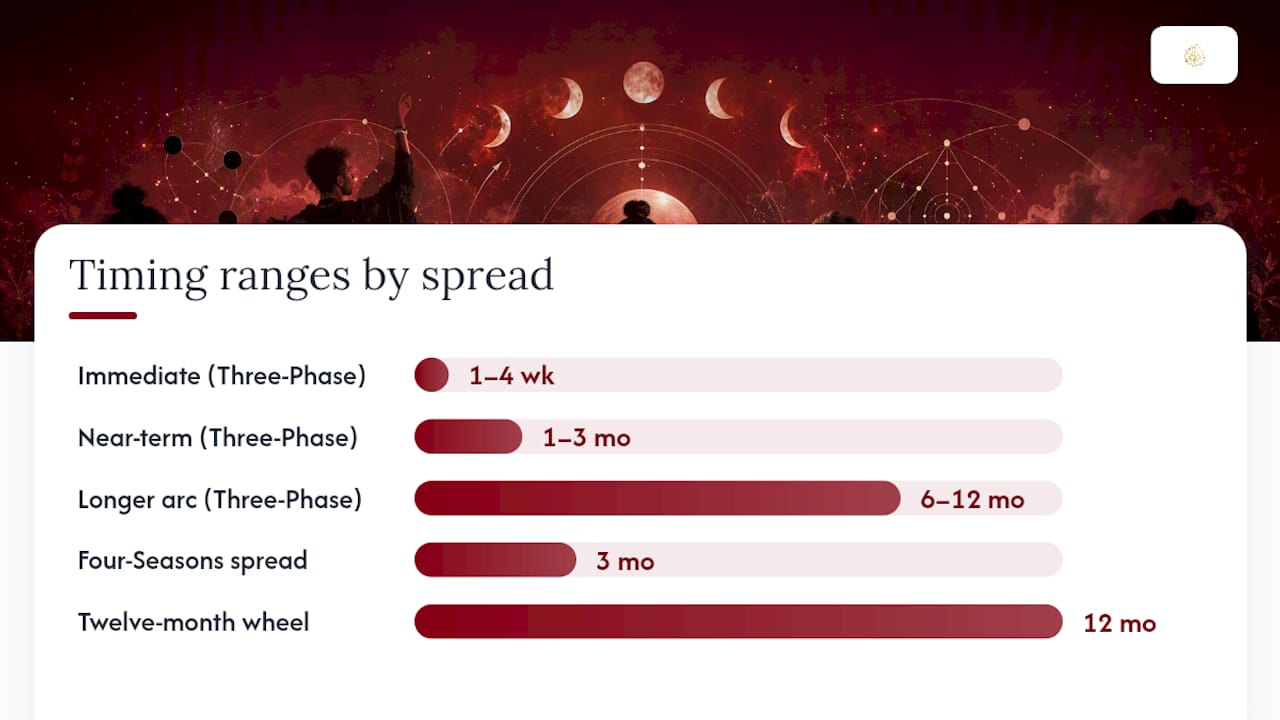
- Draw a card for the immediate phase, roughly the next one to four weeks.
- Draw a card for the near-term phase, roughly one to three months out.
- Draw a card for the longer arc, six months to a year.
Read each position for both timing and quality. If the immediate card is the Five of Pentacles and the near-term card is the Ten of Cups, tell the querent the rough patch is short and the resolution is real, even without naming a date.
For longer-range questions, the twelve-month wheel assigns one card per month and reads the whole year in a single layout. The four-seasons spread compresses that into quarters when a full year feels like overkill. Choose the wheel for detailed year-ahead work and the seasons spread when the question only needs a rough season, like “when does this job search turn around?”
Pro Tip: If a querent asks the same timing question twice in one sitting, stop and redraw only after a genuine pause; a repeated pull driven by anxiety rarely produces a cleaner answer, it just produces a different guess.
Court Cards and Major Arcana as Timing Markers
Court cards describe stage, not a fixed date. Pages generally mark the start of a phase, Knights the early-to-middle stretch, Queens the mature middle-to-late stage, and Kings the culmination or end. Layer this with seasonal suit correspondences, Swords for winter, Cups for spring, Wands for summer, Pentacles for autumn, and a court card starts to function like a compact calendar.
The Knight of Wands, for instance, suggests early-to-mid summer energy: fast, assertive, still building momentum. The King of Pentacles suggests late autumn: a matter reaching its harvest point.
Major Arcana cards resist this same treatment. When one turns up in a timing position, read it as a lesson or a threshold the situation must pass through, not a specific week. A reading that pulls the Ten of Wands (near-term, suggesting roughly ten weeks of burden) followed by the Wheel of Fortune in the longer-arc position tells a querent something true: the load lifts on a fairly short horizon, but a larger cycle turn is still coming, and that turn does not arrive on a schedule you can pin down.
Calibrating Your Timing Reads Over Time
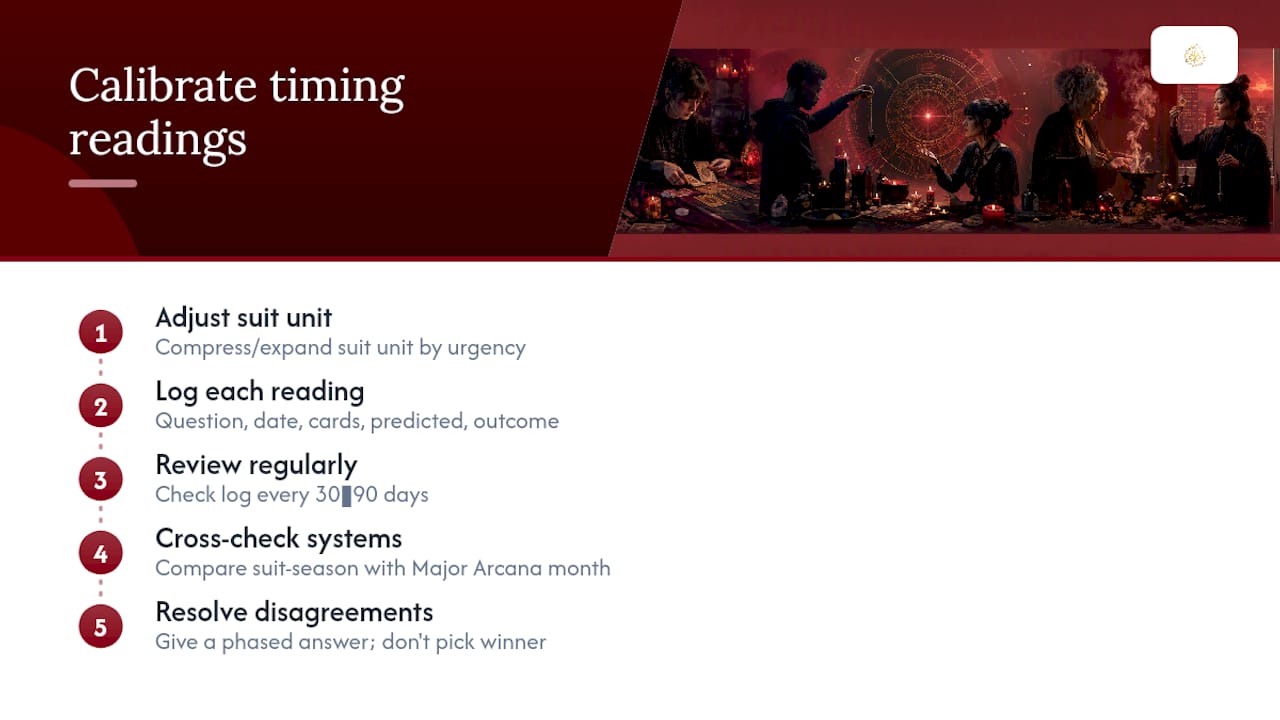
Raw suit-unit math breaks down fast when the situation is genuinely volatile. A pending lawsuit doesn’t wait a full “Pentacles year” just because a Ten of Pentacles showed up. This is where a sliding-scale approach earns its place in your practice: assess how urgent or unstable the matter is, then compress or expand the suit’s default unit accordingly. Compress Pentacles down to weeks for an urgent legal matter; expand Wands out to weeks instead of days for a slow-moving negotiation.
Build a simple log. For every timing reading, record the question, the date, the cards drawn, the predicted window, and the actual outcome once it lands. Review that log every 30 to 90 days. Patterns emerge fast, and you’ll notice which suits run consistently short or long for the kinds of questions you tend to read.
Pro Tip: Cross-referencing two systems, say suit-season plus a Major Arcana month check, before you commit to a window catches roughly half the outlier predictions before they leave your mouth. When the two disagree sharply, give a phase answer instead of picking a winner.
Astrology and Ritual Timing That Support Tarot
Tarot timing gets sharper when you layer in a few astrological basics, but treat astrology as a refinement tool, never as a system that overrides a clear card indication.
- The Moon’s phase matters: full moons favor culmination readings, waxing moons favor growth and beginning timelines, waning moons favor release and closure, and the dark moon favors readings about what hasn’t started yet.
- Planetary days and hours give you a window for ritual work tied to a reading’s intent; a Venus hour suits love timing questions, a Mercury hour suits communication and contracts.
- The void-of-course Moon is worth checking before outward-aimed spellwork. Postpone action-oriented rituals during that window and use it instead for reflection or a repeat draw to confirm an earlier reading.
Skip the astrology layer entirely if a tarot spread already gives you a confident, convergent answer. It’s a tiebreaker, not a requirement.
A Ritualized Timing Spread You Can Run Tonight
[author_bio]Light one white candle, ground for a minute, then phrase your question as a phase inquiry. Pull three cards for the Three-Phase spread, map suit and number to unit and quantity, apply the sliding scale if the matter feels urgent, and log the predicted window before you close the reading.
A Short Note on Responsibility
Timing readings should move a querent toward preparation and action, never trap them in a countdown. I’d rather hand someone a phase description they can act on than a date that becomes an anchor for anxious waiting. Log your predictions anyway. Refinement beats certainty every time, and a spell that outright fails deserves the same honest tracking as one that hits close to the mark, including how you handle it when a spell backfires or misfires on timing entirely.
— Black Witch Coven
Book a Timing-Focused Reading With Black Witch Coven
A DIY spread gets you a phase estimate. A calibrated session with Black Witch Coven gets you a reading built on years of sliding-scale adjustment across thousands of client questions, cross-referenced against ritual timing so the window you’re given actually accounts for lunar and planetary conditions, not just a suit-number formula. A timing-focused session includes a calibrated tarot read, a ritual component timed to the Moon and planetary hours where relevant, and written follow-up notes so you can track the outcome against the prediction. This suits anyone facing a decision with real stakes: a pending legal matter, a stalled reconciliation, a business move that needs a window, not just a yes or no. If you’ve read our notes on the unknown variables in spellcasting and want a professional read on your specific timing question, book a session and get a calibrated answer instead of a guess.
Sources
- Tarot card timings and timeframes — Backyard Banshee
- The problem of tarot timing — Parsifal’s Wheel Divination
FAQ
What tarot cards represent timing?
Suit cards represent timing through the suit-unit system (Wands as days, Cups as weeks, Swords as months, Pentacles as years) with the number indicating quantity, while Major Arcana cards one through twelve often map to calendar months.
How do you read timing with tarot?
Draw a card, identify its suit and number, convert suit to a time unit and number to a quantity, then check whether it’s reversed, which usually signals delay or an internal block on that timeline.
How do you ask tarot for a time frame?
Phrase the question as an open phase inquiry, like “What phase is this situation in?” rather than demanding an exact date, since anxious, closed questions tend to produce less reliable timing answers.
Why does timing in tarot stay probabilistic rather than exact?
Tarot timing systems rely on symbolic units and numerological counts rather than measurable data, so most experienced readers treat the results as ranges or phases instead of fixed calendar predictions.
How accurate is tarot for predicting when something will happen?
Accuracy improves when you cross-reference two systems, such as suit-season correspondences and Major Arcana month mapping, and log outcomes over 30 to 90 days to see which conventions match your own reading style.
