
 New Years Eve Ritual 2026/2027 with Savannah
Blog
The Lion’s Gate and the Star of Isis
Aug
The Lion’s Gate and the Star of Isis: From Ancient Egypt to Modern Witchcraft
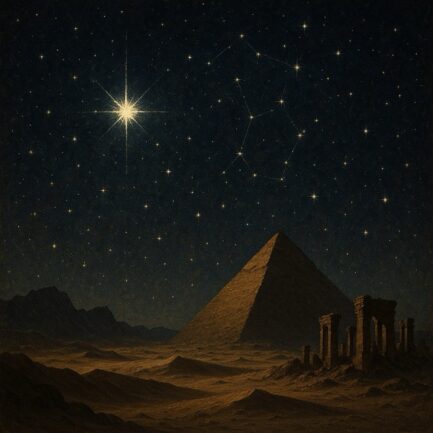
Every year in late July and early August, a celestial event unfolds that has fascinated humanity for millennia: the rising of Sirius, the brightest star in the night sky. Today, witches and mystics call this window the Lion’s Gate Portal, peaking on August 8th (8/8), and see it as a time of manifestation, abundance, and spiritual renewal. But this modern celebration has deep roots in the ancient world—most notably in Egypt, where Sirius was worshipped as the goddess Sopdet and later identified with Isis.
Sirius, the Nile, and the Egyptian New Year
In ancient Egypt, the heliacal rising of Sirius (its first appearance on the horizon before dawn after a 70-day absence) was the single most important astronomical event of the year. It coincided with the inundation of the Nile, when the river overflowed and fertilized the fields. This event was seen as divine renewal: what had been barren would bloom again.
The rising of Sirius marked the Egyptian New Year (Wepet Renpet, “Opening of the Year”). Festivals, hymns, and rituals celebrated this moment of rebirth, aligning the people with the cosmic cycles of fertility, abundance, and the eternal return.
“Hail to you, Sopdet,
You who appear in the east,
Who open the year,
Who awaken the Nile with your rising.”
— Festival Hymn, Ancient Egyptian Literature, Vol. II (Lichtheim, 1976)
The Sun in Leo and the Lion’s Power
The heliacal rising of Sirius occurred while the Sun was in the constellation Leo. For the Egyptians, lions already embodied solar power and divine rulership. The lion-headed goddess Sekhmet represented fiery strength, while the Sphinx, with its leonine body, gazed eternally toward the stars.
Thus, even if the Egyptians didn’t use the zodiac as we do, the season of Sirius rising was naturally tied to the Sun in Leo—the “lion’s gate” of solar and star power working together.
Rituals of Renewal
How might an ancient ritual have unfolded? At dawn, priests would purify themselves in sacred waters, burn incense of kyphi and frankincense, and carry statues of Isis (Sopdet) and Osiris from the sanctuary. The statues were bathed, anointed, dressed in fresh linen, and offered bread, beer, honey, and lotus flowers. Hymns were sung to awaken the gods and call for abundance.
One hymn praises Sopdet as the source of life itself:
“Sothis (Sopdet), giver of the Nile flood,
She shines in the sky,
Her water renews all life,
She makes the land green with her coming.”
— Hornung & Lorton, Conceptions of God in Ancient Egypt (1996)
Another links Isis’ mourning for Osiris to the rising waters:
“It is Isis who rises in the form of Sothis,
The Nile comes forth from her,
The flood is her tears,
Her power renews the world.”
— Griffiths, The Origins of Osiris and His Cult (1980)
These rituals were not “manifestation” in the modern sense, but they embodied the same principle: aligning human intention with divine cosmic cycles of renewal, fertility, and prosperity.
From Sirius to the Lion’s Gate
In antiquity, Sirius rose heliacally in Egypt around July 19–20. Today, because of the slow wobble of the Earth’s axis (precession of the equinoxes), the rising occurs later, in early August, overlapping with the modern Lion’s Gate window (July 26–Aug 12, peaking 8/8).
Modern mystics have added the numerology of 8/8—a symbol of infinity, balance, and abundance—to this ancient alignment. The result is a seamless weaving: the Sun in Leo + Sirius rising + rituals of abundance that the Egyptians once practiced now re-emerge as the Lion’s Gate Portal celebrated by witches worldwide.
Continuity of Magic
When modern witches gather on August 8th to set intentions for prosperity, spiritual growth, or rebirth, they are echoing the ancient Egyptians who welcomed Sirius with hymns, offerings, and joy. Both traditions recognize this time as a gateway—when cosmic energy surges, the earth is renewed, and abundance flows.
The Lion’s Gate may be a modern name, but the ritual logic is eternal: Sirius rises, the Nile flows, the Sun blazes in Leo, and the world is reborn.
? References
-
R. O. Faulkner, The Ancient Egyptian Pyramid Texts (1969).
-
Miriam Lichtheim, Ancient Egyptian Literature, Volume II: The New Kingdom (1976).
-
R. A. Parker, The Calendars of Ancient Egypt (1950).
-
Erik Hornung & B. Lorton, Conceptions of God in Ancient Egypt (1996).
-
Richard H. Wilkinson, The Complete Temples of Ancient Egypt (2000); The Complete Gods and Goddesses of Ancient Egypt (2003).
-
J. Gwyn Griffiths, The Origins of Osiris and His Cult (1980).
-
J. Belmonte, On the Orientation of Old Kingdom Egyptian Pyramids (2001).
