
 New Years Eve Ritual 2026/2027 with Savannah
Blog, Moon Magic, Spells
Signs a Spell Is Working: What to Watch For Over One Lunar Cycle

Nov
The clearest signs a spell is working show up as internal shifts, not fireworks: a calm detachment from the outcome, dreams carrying repeated symbols, small coincidences stacking up in a way that feels too specific to ignore, and minor real-world movements pointing toward your goal. These signs mean your energy is in motion, not that the work is finished. Timing varies by intention, and a rushed conclusion (good or bad) usually comes from checking too soon.
What Are the Signs a Spell Is Working?
Most people expect a spell to announce itself. It usually doesn’t. What actually happens is quieter, and if you don’t know what to look for, you’ll miss it entirely.
Internal energy shifts come first, almost every time. Right after casting, or within the following day or two, you might notice a strange sense of calm settle over a situation that used to keep you up at night. Some people describe it as detachment. The obsessive need to check your phone, replay the conversation, or worry about the outcome just loosens its grip. That’s not you giving up. Among the classic spell indicators, that drop in obsessive checking is itself one of the more reliable early signals, because clinging tightly to an outcome tends to create resistance rather than momentum. Alongside that calm, some witches report a sharper gut instinct, a clearer read on people’s motives, or sudden clarity about a decision they’d been avoiding.
Dreams shift next, often within the first week. Watch for vividness that feels different from your normal dream pattern, plus repeating images, colors, or people connected to your intent. A prosperity working might bring dreams about doors, keys, or finding money. A reconciliation spell might surface dreams featuring the other person in unusually warm or neutral settings, compared to how you’d normally dream about them. The Sleep Foundation’s overview of dream interpretation notes that dream content tends to reflect whatever is emotionally active in your waking life, which is exactly why a themed dream after a working deserves attention. Keep a notepad by the bed. Dreams fade fast, and a dream journal sharpens recall enough that you can actually spot the motifs that repeat instead of guessing after the fact.
Synchronicities are the sign people talk about most, and misread most often. One coincidence is just a coincidence. Seeing the same number three times in a day, hearing a song lyric that mirrors your intent, or running into a symbol connected to the entity or energy you worked with, once, doesn’t mean much. What matters is stacking: the same theme showing up through different channels within a short window. A breakdown of subtler spellwork signs points out that these small, repeated nudges are frequently the earliest indication that something has shifted, well before anything visible changes in your circumstances.
Physical and environmental cues are real, but they need context. A candle flame that jumps, sparks, or burns unusually fast or slow during a ritual. Electronics flickering or acting strange nearby. An animal, especially one associated with your working, suddenly showing up where it normally wouldn’t. Some occultists feel physical sensations during the casting itself, warmth in the hands, a light buzzing, a pressure behind the eyes. These are worth logging, but treat them as one data point, not proof on their own.
Small outer movements are the bridge between internal signs and actual results. This is where it starts touching your real life: a text you weren’t expecting, an opportunity that shows up sideways instead of head on, a stranger’s comment that answers a question you’d been sitting with. None of these are the finished outcome. They’re movement toward it.
- Internal shift: unexpected calm, detachment, or a louder gut feeling about the situation
- Dream shift: vivid or repeating imagery tied to your intent, especially in the first week
- Synchronicity: the same number, symbol, or phrase appearing through at least two or three unrelated channels
- Physical cue: candle or flame behavior, electronics acting odd, an animal appearing at a relevant moment
- Outer movement: a small opportunity, message, or interaction that leans toward your goal without fully delivering it
Pro Tip: Ask yourself one question before you get excited about any sign: does it match the theme of my intent, or am I stretching to make it fit? A specific, repeated signal beats three vague “maybe that counts” moments every time.
How Long Does It Take for a Spell to Show Signs?
Timing follows a rough pattern, even though no two workings move at identical speed.
- During or immediately after casting (minutes to hours): physical sensations, a sudden emotional release, or a flicker in candle behavior. This is the most immediate feedback you’ll get, and also the easiest to overinterpret.
- Short term (one to seven days): internal shifts, dream activity, and the first wave of synchronicities usually land here.
- Medium term (one to four weeks, roughly a lunar cycle): small outer movements start appearing, messages, minor opportunities, shifts in how people around the situation behave.
- Longer term (one to three months, sometimes longer): the actual result, the relationship change, the job offer, the legal resolution, tends to arrive here, built on everything that showed up earlier.
Intentions with more moving parts (a legal matter, a long-term relationship pattern) simply take longer than a simple clarity or confidence working, because more real-world variables have to shift into alignment. How attached you are to a specific outcome also slows things down; a death grip on one exact result narrows the paths the energy has to work through.
A practical waiting guideline: give a working at least a full lunar cycle before deciding it hasn’t worked. If you’re seeing zero signs, not even internal ones, after that window, that’s a red flag worth reviewing rather than a reason to immediately recast. Recasting too fast without understanding what went wrong just compounds confusion.
How to Test If a Spell Worked Without Guessing
Wishful thinking is the biggest obstacle to reading signs accurately, and the fix is boring but effective: write things down.
Keep a simple log with five fields: date, the intent behind the working, the sign you observed, how specific it felt on a scale of vague to unmistakable, and your emotional state when you noticed it. That last field matters more than people expect, because a sign noticed while you’re anxious and grasping reads very differently than one noticed while you’re calm and going about your day.
Build in a control test. Before you cast, jot down what your baseline looks like, how often that person normally texts you, how frequently that specific number shows up in daily life, how your sleep and dreams normally run. Signs only mean something relative to your normal pattern. You can also try a small, harmless test action tied to your intent, sending one low-stakes message, applying to one relevant opportunity, and see whether the environment responds in a way that fits the theme within a short window.
Four rules separate a real signal from noise:
- Stacking: multiple signs, not one, pointing the same direction
- Thematic fit: the sign actually relates to your intent, not just anything positive
- Timing: it shows up reasonably close to the casting, not months of silence followed by a stretch
- Emotional resonance: it lands with a jolt of recognition rather than requiring convincing yourself
Avoid checking your phone every ten minutes, rereading the same text for hidden meaning, or casting a second working “just in case” three days in. Constant checking creates the exact anxious grip that both working guidance and the calm-detachment pattern above warn against, and recasting before a working has had time to move just muddies the energy you already set.
Pro Tip: If you find yourself journaling five times a day, that’s not diligence, that’s obsession wearing a notebook. One entry per notable event is plenty.
What Magicians Get Wrong About Reading Signs
The single biggest mistake is treating a sign as a result. A sign is energy in motion. A result is the thing actually landing, the reconciliation happening, the money arriving, the legal outcome resolving in your favor. Mislabeling a promising dream or a good coincidence as “it worked” leads people to stop supporting the work, or worse, to make a real-world move (a confrontation, a big financial decision) based on incomplete information.
Rest matters more than most people admit. Intense ritual work, especially anything involving invocation or heavier energy, tends to leave you drained for a day or two afterward. That’s not a bad sign. Some witches describe a “disruption before flow” pattern, where things feel slightly off or stagnant right after a working, before the signs start appearing. Pushing through that dip by immediately recasting or adding more work usually adds noise rather than speed.
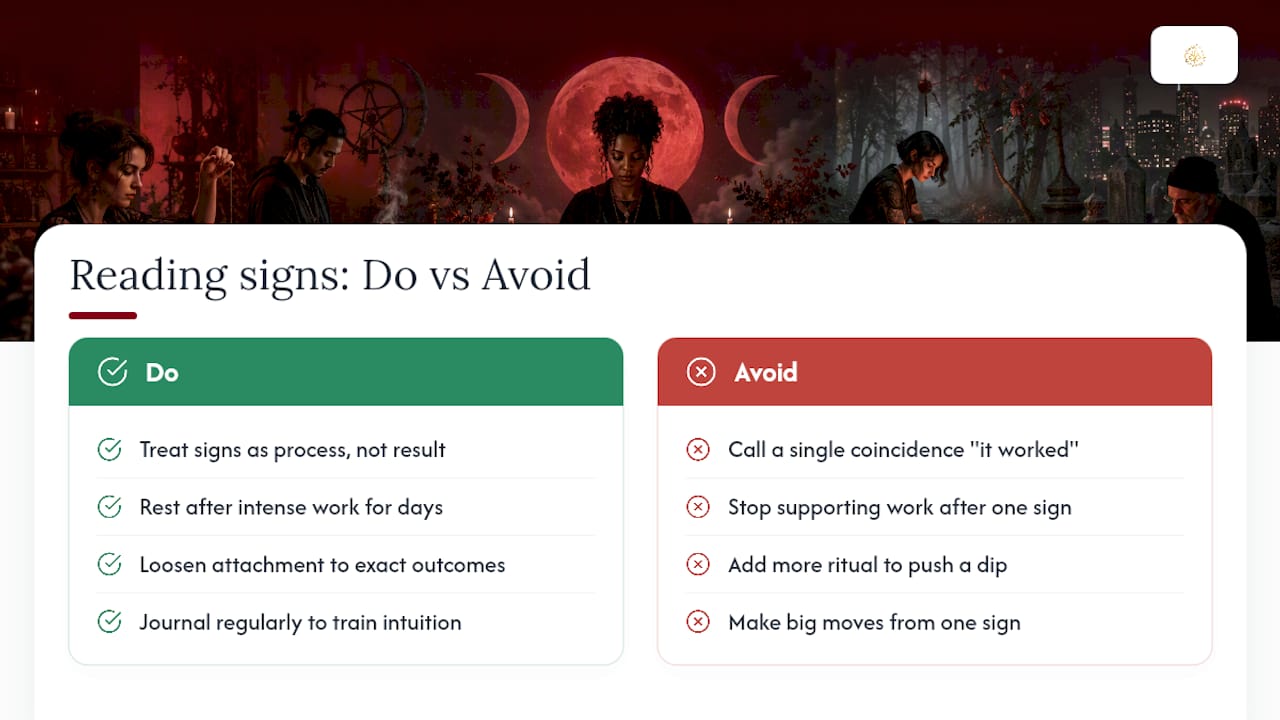
Attachment level changes everything about timing. The tighter you grip a single exact outcome, “this person, this job, this dollar amount, by this date,” the more the universe has to work around your own resistance to get there. Loosening that grip isn’t giving up. It’s what allows the small outer movements to actually surface instead of getting blocked by your own anxiety.
On the dream and intuition side, the guidance lines up with what Psychology Today’s coverage of intuition describes as a trainable cognitive process. Intuitive hits get sharper with focused attention and repetition, which is exactly why a witch who journals consistently starts noticing real signals faster than someone relying on scattered memory.
The clearest evidence isn’t a single dramatic moment. It’s the pattern that emerges when you stop obsessing over any one sign and start noticing how several small, specific ones point the same direction over a couple of weeks.
Tracking a Working: A Short Field Note
A reconciliation working I logged a while back is a decent example of how this plays out in practice. Day one brought nothing but a strange sense of relief, the kind where you stop rehearsing the argument in your head. I wrote it down and left it alone.
Three nights later came a dream with the other person in a setting that felt oddly warm, nothing dramatic, just neutral and calm. Logged that too, with a note on how specific it felt (fairly, since the tone was so different from how I’d normally dream about the situation).
Around day eleven, their name came up twice through mutual friends, unprompted, in the same week. That’s when the entries started stacking into something worth paying attention to rather than three isolated notes. I didn’t reach out first. I didn’t recast. I gave it the rest of the lunar cycle, reviewed the log, and let the small movements keep building before deciding anything.
When to Get a Professional Read on Your Working
If you’ve logged your signs and you’re still unsure whether what you’re seeing is real movement or wishful reading, a second, experienced set of eyes helps. Evaluations and consultations are available for those who want a clearer read on a working already in motion, along with bespoke ritual work when a situation calls for something beyond a solo casting. This is especially useful when signs seem contradictory, when a working feels stalled, or when you suspect interference rather than simple slow timing.
A consultation typically includes a review of observations so far, an assessment of whether the signs match a working in progress, and recommended next steps or supports suited to the specific situation.
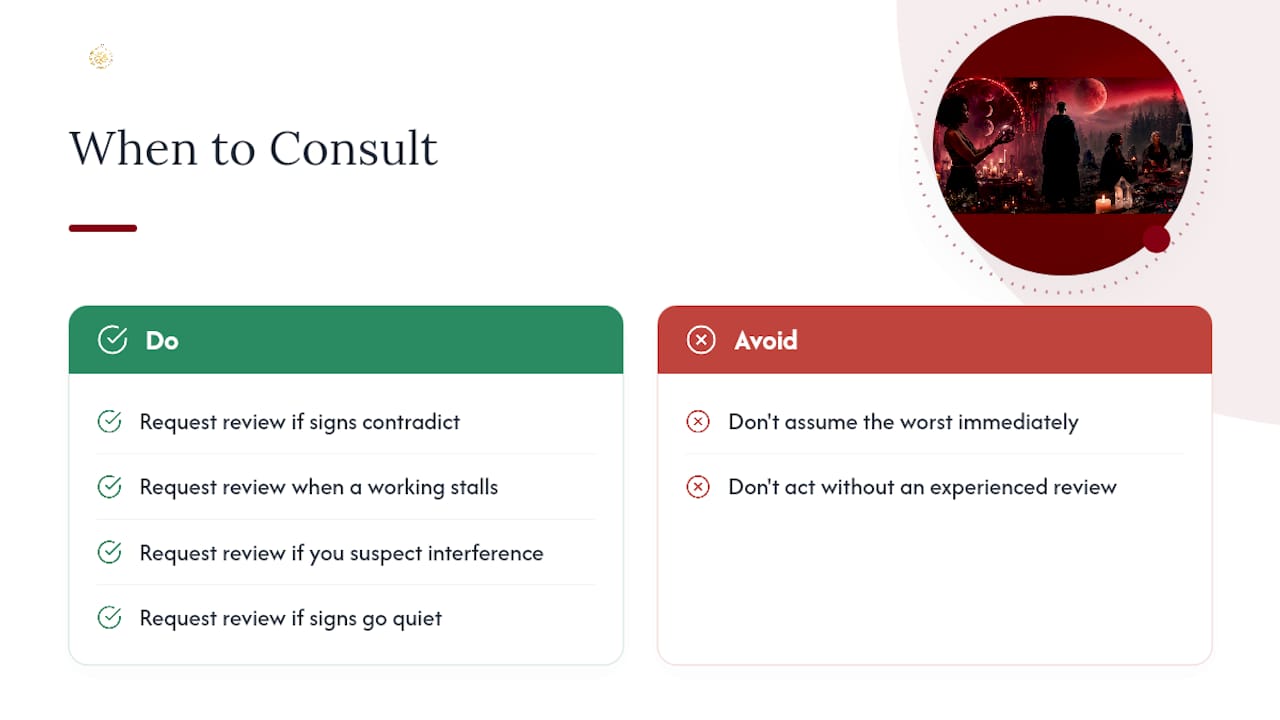
If your signs have gone quiet, or you’re worried something backfired rather than simply slowed down, Black Witch Coven’s page on spells that seem to backfire is a useful starting point before you assume the worst.
Sources
FAQ
How Long Before I See Signs a Spell Is Working?
Internal shifts and dream activity often appear within the first week, while small outer movements typically build over one to four weeks, roughly a lunar cycle.
Can a Spell Work Without Any Visible Signs?
It’s uncommon for a working to produce zero signs at all; more often, subtle signs are simply missed because no one is journaling or watching for them, which is why tracking matters so much.
Should I Recast If I Don’t See Signs Right Away?
No. Wait through at least one full lunar cycle and review your log first, since recasting too soon can create confusion in the energy rather than speeding anything up.
What’s the Difference Between a Sign and a Result?
A sign is movement, a calm feeling, a themed dream, a small coincidence, while a result is the actual outcome landing in your real life; treating a sign as a finished result is one of the most common mistakes occultists make.
How Do I Know If a Coincidence Actually Means Something?
Look for stacking (multiple related signs, not one), thematic fit with your intent, and timing close to the casting; a single coincidence rarely means as much as three related ones appearing within a couple of weeks.
