
 New Years Eve Ritual 2026/2027 with Savannah
Blog, Chaos Magic, Sorcery
Servitors: How to Build, Feed, and Dismiss a Thoughtform on the Left Hand Path
Dec
A servitor is a constructed thoughtform, an artificial pattern of will given a sigil or anchor, animated in gnosis, and assigned one job. The working protocol is short: program a precise intent, build a sigil or anchor to house it, launch it through a gnostic trance, then set firm lifespan and dismissal terms before you ever activate it. Everything else, feeding, monitoring, troubleshooting, is refinement of that core sequence.
Table of Contents
- What Is a Servitor in Practical Occultism?
- When Should You Actually Use a Servitor?
- How Do You Create and Program a Servitor?
- How Do You Set Lifespan, Permissions, and a Dismissal Trigger?
- How Do You Feed and Maintain a Servitor?
- How Do You Know If a Servitor Is Working?
- Field Notes: Coven Workflows Worth Copying
- Where Servitors Fit in a Working Witch’s Toolkit
- Where to Get Help Building or Commissioning a Servitor
- Sources
- FAQ
What Is a Servitor in Practical Occultism?
A servitor is a task-specific thoughtform you build on purpose, for one job, with a shelf life you control. It is not a spirit you contact. It is not a god-form you petition. It is a piece of your own directed will, given shape through a sigil or physical anchor, then set loose to execute a single function until you call it back.
That separates it clearly from two related constructs. A tulpa is typically built for companionship or long-term autonomy, often without a fixed expiration. An egregore is generated collectively, by a group’s shared belief and repeated ritual, and it outlives any single member. The thoughtform literature documents these mind-created entities across cultures and gives witches a useful frame for telling individual constructs apart from group-generated ones, and an egregore entry is worth a quick read if you want the group-mind comparison in more detail. One more note for search clarity: this article has nothing to do with the fictional cybernetic drones from tabletop gaming. This is ritual construction, not science fiction.
When Should You Actually Use a Servitor?
Servitors excel at narrow, well-defined jobs: an early-warning alert on a specific person, short-term protective screening around your home or workspace, targeted influence on a single decision, or repetitive tasks you’d rather automate than re-ritualize every week.
They are the wrong tool for anything that needs decades of commitment, deep negotiated power, or a relationship with an entity that has its own agenda. Long-term wealth architecture, court and legal battles with real stakes, or deep protective work against a determined enemy usually call for a daemonic pact or a sustained egregore instead.
A few working examples: a freelancer builds a servitor to flag promising client leads for 90 days. A magician tasks one to shield their apartment during a hostile divorce. A small business owner sets one loose to nudge foot traffic toward a storefront during a slow quarter. Each has a defined end date built in from the start.
How Do You Create and Program a Servitor?
The build has five parts, and skipping any one of them is where most novice work falls apart.
- Write the intent as a single sentence with no ambiguity. State the measurable outcome, the timeframe, and any conditions or exclusions. “Alert me within 24 hours when a client is ready to sign, only during business hours, expiring in 90 days” beats “help me get clients” every time. Vague language produces vague results, and a servitor will find the laziest interpretation of a sloppy command.
- Design the sigil. The classic method, drawn from Austin Osman Spare’s original technique, strips vowels and repeated letters from your intent sentence, then compresses what remains into a single stylized glyph. You charge it in trance, then destroy or forget the conscious record so the unconscious carries the programming forward without your waking mind second-guessing it.
- Choose an anchor. A notebook sigil is fast but fragile and easy to lose track of. A physical talisman (a coin, a small carved object, a piece of jewelry) holds charge well and travels with you. A digital file, an image saved to a private folder, works for those who prefer discretion and portability. A charged crystal gives the strongest sense of a “housed” presence but demands more upkeep. Pick the anchor that matches how often you’ll interact with the thing.
- Fill out the profile. Name it (even a working codename helps), define its form if you visualize one, list its permissions, set an energy budget so it isn’t drawing more than you can spare, and lock in a lifespan and dismissal trigger before you activate anything.
- Launch through gnosis. Trance, sigil-gazing, sex magick, sensory deprivation, or sustained drumming all work; what matters is that you cross into an altered state and deliver the command with real authority, not a hopeful request. Anthropological fieldwork on chaos magick consistently finds gnosis and altered states at the center of successful activation, and how you speak the command matters as much as the trance itself.
After launch: seal the working with a closing statement, log the date, the exact wording used, and the anchor’s location, then set a calendar checkpoint for the first monitoring review.
Pro Tip: Say the command out loud, once, in the imperative. “You will alert me” outperforms “please help me find clients” because chaos-magick scholarship treats the speech act itself, not the sentiment behind it, as what carries the authority to the construct.
How Do You Set Lifespan, Permissions, and a Dismissal Trigger?
Lifespan triggers come in three flavors: date-based (“dissolve on the new moon in 90 days”), task-completion (“dissolve once the named outcome occurs”), or conditional (“dissolve if no result within 30 days, extend once if progress is visible”). Pick one before launch, not after.
Permissions and forbidden operations belong in writing, even if that writing is a single line in your ritual notebook. “You may influence timing and attention. You may not affect health, safety, or free will beyond attraction.” That line matters more than it looks like it should.
Dismissal itself can be as simple as burning the sigil while speaking a release command, dissolving a digital anchor into a wiped file, or crushing and burying a talisman. The method matters less than doing it decisively. A servitor without a stated kill switch doesn’t just stop working quietly. It keeps drawing on your energy indefinitely, functioning as a low-grade psychic parasite until someone finally shuts it down.
How Do You Feed and Maintain a Servitor?
Feeding can be as small as a few minutes of focused attention, a whispered acknowledgment, or a token gesture like lighting a candle near the anchor once a week. Longer projects benefit from a short mini-ritual every full or new moon, timing that lines up naturally with a monthly ritual cadence if you’re already running one.

Balance the energy budget by feeding only what the task requires. Overfeeding an alert-style servitor wastes your reserves; underfeeding a protective one leaves gaps in coverage. Log every feeding session with the date and a one-line note on how you felt afterward. That log becomes your evidence trail when you’re deciding whether the thing is working or draining you for nothing.
How Do You Know If a Servitor Is Working?
Track concrete signals: successful hits per week, response speed, and whether the outcome matches the exact wording of the original intent. A servitor built to flag leads within 24 hours that consistently delivers on day three isn’t broken, it’s misprogrammed on timeframe.
Common failure modes: vague intent language, a weak or forgotten anchor, insufficient gnosis at launch, or no dismissal trigger at all. If the wording was sound and the anchor is intact, reprogram with tighter language before you scrap the build. If the anchor itself was compromised, lost, or never properly charged, rebuild from scratch rather than patching a broken foundation.
Field Notes: Coven Workflows Worth Copying
Working occultists default to blunt, declarative intent phrasing over anything hopeful or wishful, and log every servitor session the same way a business logs a transaction: date, wording, anchor status, result. Decisive command language and consistent secrecy about the anchor’s location both show up repeatedly in successful long-running builds.
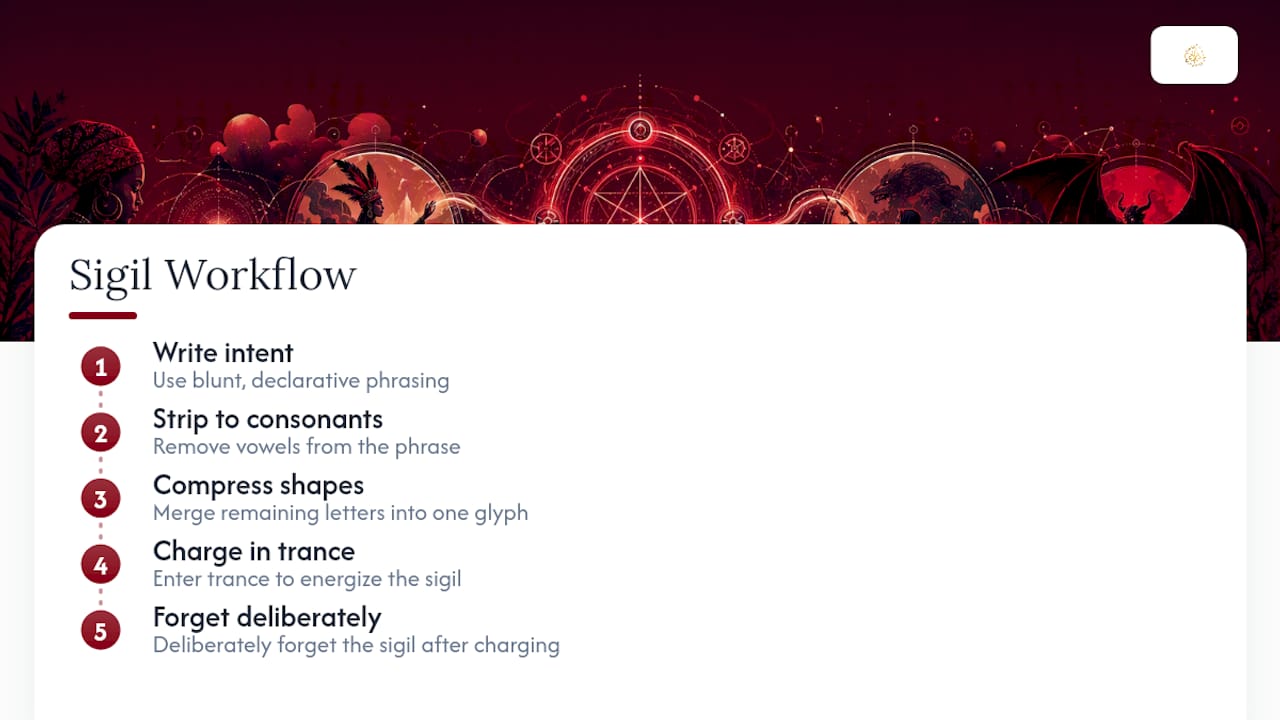
A simple sigil workflow worth copying: write the intent, strip it to consonants, compress the remaining shapes into one glyph, charge in trance, then forget it deliberately. That sequence, refined from Spare’s original method, still outperforms more elaborate modern variants for straightforward, single-task builds.
Where Servitors Fit in a Working Witch’s Toolkit
Servitors are tactical. They handle the immediate, narrow, time-boxed jobs where a long-term entity relationship would be overkill. Daemonic pacts and sustained coven-level work are strategic, built for outcomes that need years of leverage and negotiated power, not a 90-day sigil charge. Servitor work is treated as a fast, disposable tool, useful, cheap to build, easy to dismiss, and never confused with the deeper, longer commitments daemonic work requires. If you’re trying to figure out where a servitor ends and a real pact should begin, that’s exactly the kind of integration question worth bringing to a consultation.
— Black Witch Coven
Where to Get Help Building or Commissioning a Servitor
If you’d rather have an experienced hand build the sigil, run the gnosis, and hold the maintenance schedule, commissioned ritual design services are available that cover this kind of task-specific work. For servitor-adjacent operations that call for real entity backing rather than a self-built construct, our daemonic spell casting line covers prosperity, love, legal, and protective workings built around named entities rather than a raw thoughtform. Readers who want ongoing energy management instead of a one-time build should look at our VIP three-month programs for sustained love, money, or protection work, or the lighter monthly subscriptions if you just need consistent upkeep on an existing working. Anyone still deciding which route fits their situation can start with a consultation to talk through the specifics before committing to either path.
Sources
- Austin Osman Spare and His Theory of Sigils
- Thoughtforms
- Authority, information organization, and posthumanism in the rhetoric of chaos magic
- Modernity, selfhood, and the demonic: anthropological perspectives on ‘Chaos Magick’
FAQ
What Is the Difference Between a Servitor and a Tulpa?
A servitor is built for one narrow task with a defined end date, while a tulpa is usually developed for long-term companionship or autonomy without a fixed expiration. Both are constructed thoughtforms, but their intended lifespans and purposes diverge sharply.
How Long Should a Servitor’s Lifespan Be?
Most task-specific servitors run anywhere from a few weeks to about 90 days, tied to a date, a task-completion trigger, or a conditional review point. Setting that trigger before launch prevents the construct from lingering and drawing energy after its job is done.
What Happens If You Don’t Dismiss a Servitor?
Without an explicit dismissal or kill switch, a servitor keeps operating and drawing on your energy indefinitely, functioning as a low-grade psychic drain rather than a completed working. A clear dismissal ritual, burning the sigil, dissolving the anchor, or a spoken release command, closes that loop deliberately.
Can Black Witch Coven Build a Servitor for Me?
Magicians offer commissioned ritual design for task-specific workings, and clients who need entity-backed rather than self-built support can commission daemonic spell casting instead. Current pricing for custom and ongoing work is available on the client’s site.
Is a Servitor the Same as a Demon or Spirit?
No. A servitor is a construct you build from your own directed will, with no independent origin or agenda, while a demon or spirit is a separate entity you negotiate or pact with. That distinction is why servitors suit short, tactical jobs and entity work suits deeper, longer commitments.
