
 New Years Eve Ritual 2026/2027 with Savannah
Black Magic, Blog, Occultism
Antinomian Ritual on the Left Hand Path: Breaking Taboo With Purpose
May
The left-hand path is an umbrella term for esoteric traditions oriented around individual sovereignty, self-deification, and the deliberate transgression of taboo as a spiritual technique, rather than surrender to an external deity. The phrase traces back to the Sanskrit concept of vāmācāra in Tantric practice and was later imported into Western esotericism by Helena Blavatsky. Contrary to popular assumption, it is not a synonym for evil or Satanism. It is an analytic category covering a wide spectrum of theistic, atheistic, and philosophical currents.
Table of Contents
- What Does “Left-Hand Path” Actually Mean, and Where Did It Come From?
- A Reader’s Framework: Individualism, Apotheosis, and Antinomianism
- Sexual Magick, Ritual Inversion, and the Logic of Taboo
- Is the Left-Hand Path Evil? Why the Confusion Persists
- Thelema, the Temple of Set, and the Diversity of Modern Currents
- Building a Disciplined Left-Hand Path Practice
- A Witch’s View on What the Left-Hand Path Actually Requires
- Ready to Work With an Experienced Left-Hand Path Coven
- Sources
- FAQ
What Does “Left-Hand Path” Actually Mean, and Where Did It Come From?
The term did not originate in Europe. It comes from vāmācāra, a Sanskrit word describing a specific current within Tantra that used ritual transgression, meat, alcohol, cremation ground rites, and sexual ritual as tools toward liberation, in deliberate contrast to dakṣiṇācāra, the “right-hand” conservative path that avoided those substances and followed orthodox Vedic conduct. Both paths pursued the same soteriological goal. They simply disagreed on method: one worked through purity and restriction, the other through direct confrontation with what convention forbids.
Blavatsky imported the dichotomy into Western esotericism in her 1877 work Isis Unveiled, adapting vāmācāra into “left-hand path” language for an English-speaking Theosophical audience, according to historical analysis of the term’s origins. Her usage carried a pejorative edge from the start. Blavatsky and later commentators like Dion Fortune treated the left-hand designation as a warning label, something closer to spiritual malpractice than a legitimate alternative discipline.
That framing did not survive contact with 20th-century occultism intact. Aleister Crowley’s Thelema reworked the individualist core of the concept into “Do what thou wilt,” stripping away much of the moral panic while keeping the emphasis on personal will as the highest authority. Kenneth Grant pushed the Tantric and sexual-magick threads further into Western ceremonial practice. By the time Anton LaVey founded the Church of Satan and the Temple of Set emerged as its intellectual successor, “left-hand path” had shifted from an accusation into a badge, one that witches wore deliberately, on their own terms, and largely for its own Tantric ritual logic.
A Reader’s Framework: Individualism, Apotheosis, and Antinomianism
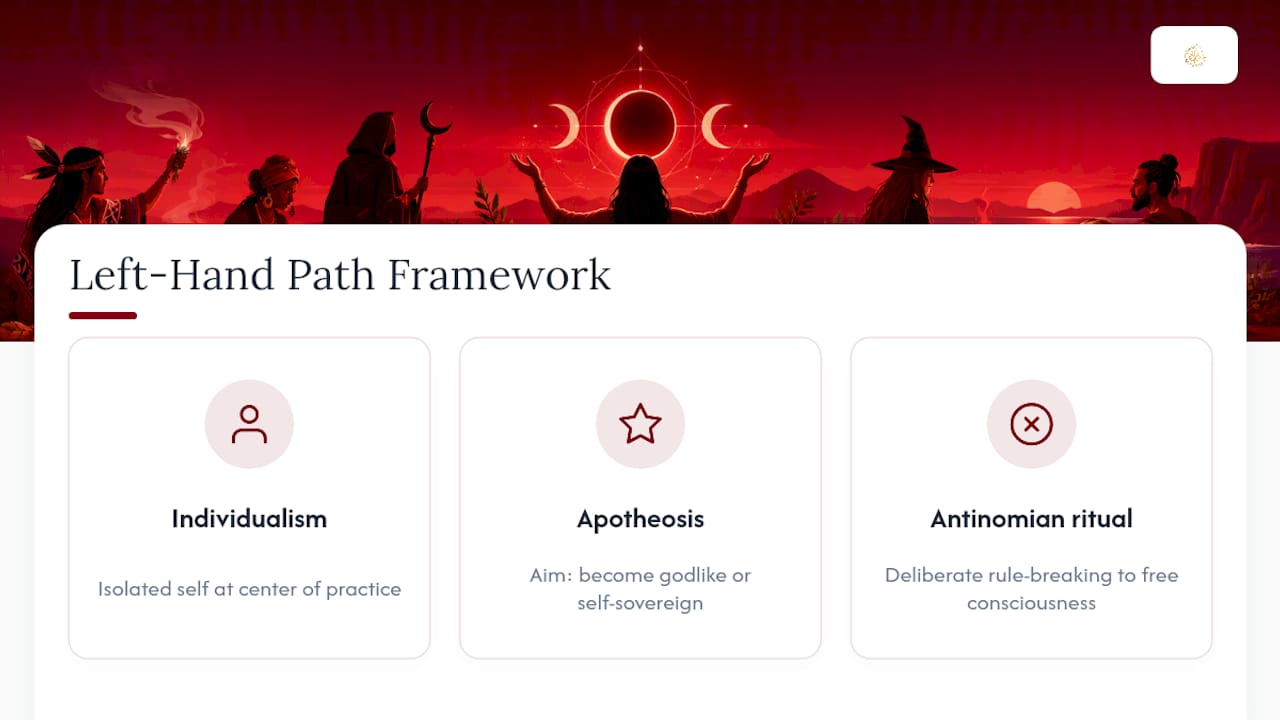
Scholar Kennet Granholm gave academics and magicians alike a clean way to read left-hand path material without smuggling in Christian moral categories. His tripartite model identifies three recurring features across LHP currents, and it works as a diagnostic tool for almost any text or group claiming the label, according to Granholm’s analysis of post-Satanism.
Individualism places the isolated self, not the collective or the divine other, at the center of the working. The magician is the protagonist of their own cosmology, not a supplicant within someone else’s. Self-deification, or apotheosis, names the goal: the witch aims to become godlike, or at minimum sovereign over their own existence, rather than dissolve into a larger divine unity. Antinomian ritual transgression is the technique, the deliberate breaking of moral, social, or symbolic rules as a means of loosening the grip those rules hold over consciousness.
Right-hand path traditions often use nearly identical tools, ritual, invocation, structured practice, but aim them at a different endpoint: union with or surrender to the divine, a dissolving of ego rather than its apotheosis. The techniques overlap. The destination diverges. That distinction, drawn from comparative scholarship on both paths, matters more than any surface-level checklist of “dark” versus “light” symbolism, because plenty of LHP ritual borrows structure directly from mainstream ceremonial magick.
Sexual Magick, Ritual Inversion, and the Logic of Taboo
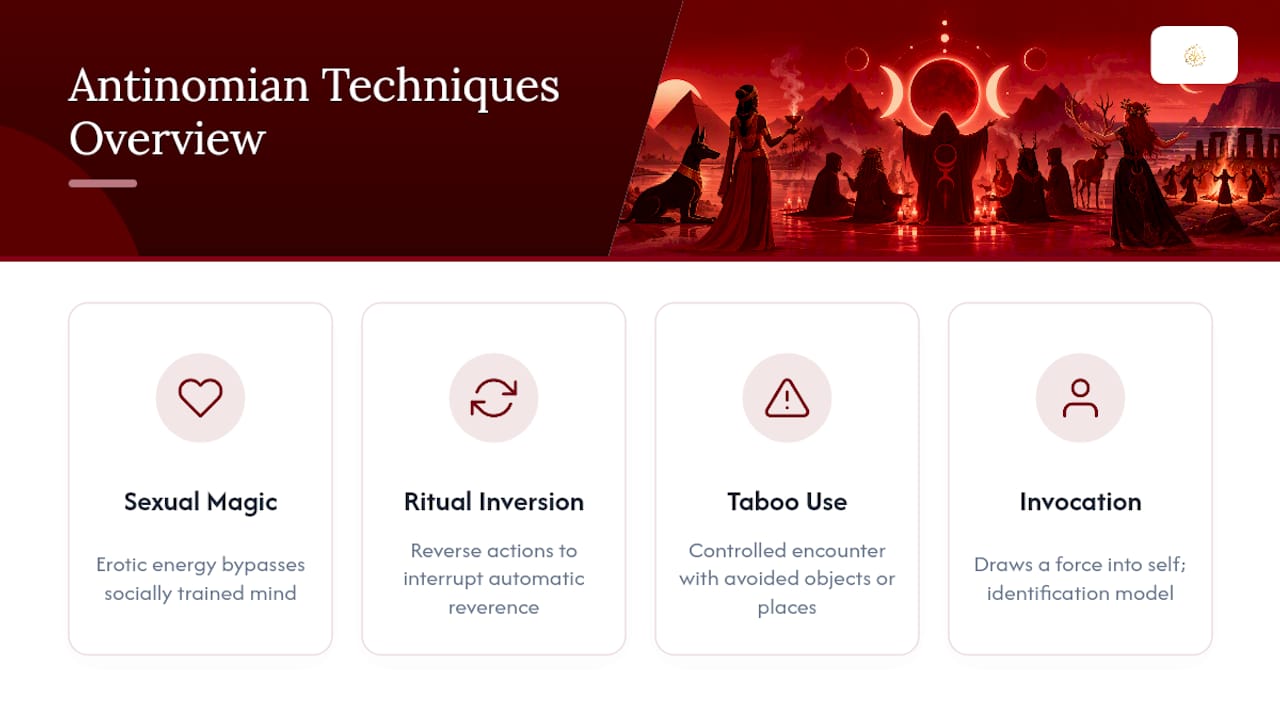
Antinomianism is not shock value. It is a technique with a specific job: dismantle the conditioned reflexes that keep a magician obedient to inherited moral architecture they never chose. Sexual magick, one of the oldest tools inherited from Tantric vāmācāra, uses erotic energy and ritualized transgression of sexual taboo to bypass the rational, socially trained mind and access a state where will, can act more directly on outcome.
Ritual inversion works on the same principle from a different angle. Reversing a prayer, walking a circle counterclockwise, or repurposing a symbol usually associated with virtue and turning it toward personal power all serve to interrupt automatic, unconscious reverence and replace it with deliberate, examined choice. Deliberate use of taboo objects or locations, graveyards, forbidden substances, socially unclean acts, functions the same way vāmācāra adepts used cremation-ground ritual: as a controlled encounter with what the mind is trained to avoid, on the theory that mastery of fear produces sovereignty.
Invocation and evocation split along a related axis. Invocation draws a force, entity, or archetype into the self, an identification model where the witch becomes the current they are working with. Evocation calls that force to appear as separate and commands or negotiates with it, a relational model that treats the entity as genuinely other. Left-hand path work uses both, often within the same ritual arc, depending on whether the goal is to absorb a quality or to transact with an intelligence.
Is the Left-Hand Path Evil? Why the Confusion Persists
No serious scholar treats “left-hand path” as synonymous with evil, and the confusion has a traceable history rather than a factual basis. Blavatsky’s own pejorative framing set the tone in the 19th century. Popular culture and the mid-20th-century satanic panic did the rest, flattening a genuinely diverse category into a single lurid image borrowed mostly from horror films rather than primary texts.
Academic treatment corrects that flattening. Nicholas Goodrick-Clarke’s analysis frames LHP as a heterogeneous set of doctrines and practices spanning theistic currents that work with named entities, atheistic and symbolic currents that treat those entities as psychological constructs, and purely philosophical currents that use the language of self-deification without any ritual entity work at all. Treating it as a single moral category rather than a spectrum of method and metaphysics is the actual error, not the practices themselves.
The internal diversity is the point. A Thelemite invoking Ra Hoor Khuit, a Setian working with Xeper as pure self-transformation, and a symbolic Luciferian who never addresses a literal entity are all doing “left-hand path” work by Granholm’s framework, and they would likely disagree sharply with each other on theology.
Thelema, the Temple of Set, and the Diversity of Modern Currents
Modern left-hand path movements do not agree on much beyond the tripartite core, and that disagreement is worth understanding on its own terms.
Thelema, founded by Aleister Crowley, centers on discovering and executing one’s “True Will” through a structured system of ceremonial magick, astrology, and Qabalah, with the magician’s own divine nature as the ultimate authority. The Temple of Set split from the Church of Satan in 1975 and represents what Granholm terms post-Satanism: an institutional move away from LaVey’s atheistic, symbolic Satan toward Set, an Egyptian-derived intelligence treated by initiates as objectively existing, with Xeper (self-actualization through isolate consciousness) as its central initiatory goal, according to Granholm’s documentation of the split. Luciferian currents vary widely by lineage, some treating Lucifer as a literal entity of illumination and rebellion, others as a purely symbolic archetype of individual awakening against imposed limitation.
These differences are structural, not cosmetic. Some orders run initiatory grades with formal membership and lineage transmission. Others function as loose networks of solitary occultists who never join anything. Assuming a single “LHP doctrine” misreads the entire field.
Building a Disciplined Left-Hand Path Practice
Individualism without structure tends to collapse into ego inflation rather than genuine transformation, and the occult literature on this point is consistent. Reflective accounts from experienced magicians identify a recurring failure mode: mistaking grandiosity for apotheosis, confusing feeling powerful with becoming capable.
Real shadow work leaves a trace you can verify against your own behavior over time. A witch doing genuine work integrates uncomfortable truths about their own motives and watches their decision-making change accordingly. Ego inflation, by contrast, produces certainty without corresponding skill, a person who feels chosen but cannot point to any concrete capacity they lacked six months earlier. A ritual diary that logs intent, method, and outcome, reviewed honestly and periodically against results, is one of the more reliable checks against that drift, a point reflective practitioner accounts return to repeatedly.
Study pathways matter as much as ritual repetition. Primary texts, Crowley’s own writings, Tantric source material in translation, Granholm’s academic framework, give a magician vocabulary and context that secondhand summaries cannot. Comparative study against right-hand path structure sharpens the distinction between technique and goal. Mentorship or lineage connection, where available, provides the accountability that solitary practice structurally lacks.
A Witch’s View on What the Left-Hand Path Actually Requires
The academic framing gets the taxonomy right and misses the lived texture. Granholm’s tripartite model is genuinely useful, individualism, apotheosis, antinomianism, but it describes what left-hand path work looks like from the outside. It says nothing about what it costs, or delivers, from the inside.
What separates a magician who gets real results from one collecting symbols and calling it a practice is intention married to follow-through. Left-hand path ritual work, whether it is a working aimed at prosperity, protection, or reclaiming leverage in a relationship gone sideways, only functions when the witch treats outcome, not aesthetic, as the measure of success. That is the orientation Black Witch Coven brings to Left-Hand Path spiritual services: confidentiality, technical precision, and an unapologetic focus on whether the working actually changed the magician’s situation.
Self-deification is not a slogan you repeat during ritual. It is a claim you have to earn through consistent, honest practice, and the gap between the two is where most solitary witches quietly stall out.
— Black Witch Coven
Ready to Work With an Experienced Left-Hand Path Coven
Reading the theory answers questions. It doesn’t cast a working, and there’s a real gap between understanding antinomian technique and having someone execute a ritual with the precision to move an actual outcome, a court case, a stalled relationship, a business that needs a push. This gap exists between understanding antinomian technique and having someone execute a ritual with the precision to move an actual outcome. Experienced occultists often work with entities such as Lucifer, Andras, Clauneck, and Astaroth on results-oriented pacts and ritual work, rather than generic spiritual coaching.
If you already know what you want changed, start with something concrete. The Ritual to Lucifer: Light of Liberation, Wisdom, and Sovereignty is priced at $190 and speaks directly to the self-sovereignty theme this article covers. For ongoing work, the Monthly Spell Casting Service at $350 gives serious magicians a standing line to consistent ritual support. Browse the full catalog and book a consultation to discuss which working fits your situation.
Sources
- Left-hand path and right-hand path — Wikipedia
- The Left-Hand Path and Post-Satanism The Temple of Set and the Evolution of Satanism — Kennet Granholm
- Left‑Hand Path: Magic and Animal Rights — Nicholas Goodrick‑Clarke
- Giansanti
FAQ
What Does the Left-Hand Path Mean?
It refers to esoteric traditions built around individual sovereignty, self-deification, and the use of ritual transgression as a spiritual technique, rather than submission to an external divine authority. The term originates in the Sanskrit vāmācāra and entered Western esotericism through Helena Blavatsky’s writing in the 1870s
Is the Left-Hand Path Evil?
No. Scholars treat it as an analytic category covering theistic, atheistic, symbolic, and philosophical currents, not a moral judgment, and warn against essentializing it as simply evil according to academic analysis of the term. The “evil” association traces back to 19th-century moralizing and later satanic-panic-era pop culture rather than the practices themselves.
What Is the Order or Structure of the Left-Hand Path?
There is no single order. It spans initiatory institutions like the Temple of Set, philosophical systems like Thelema, and solitary Luciferian or symbolic practice with no formal membership at all. What unites them is Granholm’s tripartite framework: individualism, self-deification, and antinomian ritual transgression.
What Is the Significance of the Left-Hand Path in Tantra?
In Tantra, vāmācāra adepts used ritual transgression, taboo substances, and sexual rites as tools toward liberation, in contrast with the orthodox restraint of the right-hand dakṣiṇācāra path. Both pursued the same spiritual goal through opposite methods, and that Tantric logic of taboo-as-technique directly shaped how Western occultists reinterpreted the concept a century later.
How Much Does Left-Hand Path Ritual Work Cost?
Pricing depends on the working. Black Witch Coven lists individual spells such as the Black Magick Money Spell at $295, and higher-touch quarterly programs like VIP Money Magick at 2300 $ per quarter, with current pricing listed on Black Witch Coven site.
