
Blog, Demons, Working With Demons
Andrealphus Demon: History, Seal and How to Work With Him
Oct
Andrealphus is a Marquis of the Goetic hierarchy, commanding 30 legions of spirits and appearing first as a peacock before taking human shape. Practitioners call on him for mastery of geometry, mensuration, and astronomy, and the grimoire tradition credits him with the power to transform a man into the likeness of a bird. What follows traces his manuscript origins, his sigil, and the practical steps serious operators use when working with his office. His short-form profile sits on our Andrealphus Demon Directory page.
Historical sources: where Andrealphus appears in the grimoire tradition
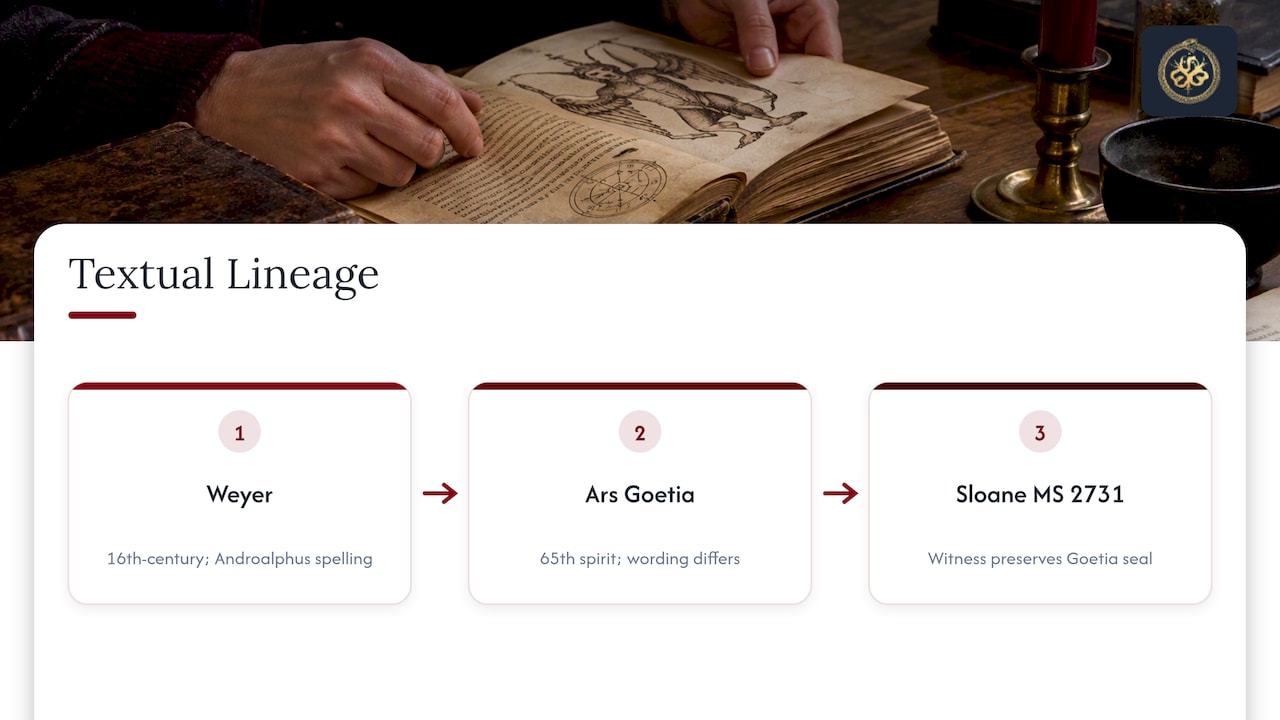
Andrealphus’s documentary trail runs through two primary texts. The earlier is Johann Weyer’s Pseudomonarchia Daemonum, a 16th-century catalog of infernal spirits that lists him under a variant spelling, and the later is the Ars Goetia, the first book of the Lemegeton (the Lesser Key of Solomon). The Ars Goetia entry names him the 65th spirit: a mighty Marquis who appears “in the form of a Peacock, with great noises,” then takes a man’s shape, and who “teacheth Geometry perfectly,” makes men “subtle in all things touching Mensuration” and in astronomy, and can turn a man into the shape of a bird.
The Sloane manuscripts carry the Goetia text itself. Sloane MS 2731 preserves his seal, his number in the Goetia sequence, and the instruction that his lamen may be worn by the operator. The Pseudomonarchia Daemonum predates the Ars Goetia and differs from it in sequence and in some descriptive details. His profile was assembled across a chain of copies and editorial choices, and was never fixed in one authoritative text.
Canonical attributes and offices of Andrealphus
The Ars Goetia assigns Andrealphus the rank of Marquis and places 30 legions of infernal spirits under his governance, a rank and legion count repeated across the editorial tradition that produced the modern Goetia. His teaching functions center on three linked disciplines: geometry, which he is said to teach “perfectly,” mensuration, meaning the practical art of measurement and admeasurements, and astronomy, where he makes practitioners “subtle” in the subject rather than simply informed about it. The Goetia presents these as offices he confers on the operator. A successful working leaves the practitioner sharper in these specific technical faculties.
His appearance follows a two-stage pattern common to several Goetic spirits but distinct in detail: he first manifests as a peacock accompanied by loud, unsettling noise, then settles into human form once addressed properly within the ritual structure. Beyond this transformation of his own shape, the grimoire credits him with the inverse power over the practitioner’s target, the ability to change a man into the likeness of a bird. This dual motif, peacock origin and avian transformation, is one of the clearest fingerprints that separates his office from superficially similar spirits in the same catalog.
Sigil, lamen, and ritual apparatus for Andrealphus
The Ars Goetia records a distinct seal for Andrealphus and explicitly permits it to function as a lamen, meaning the practitioner may wear the seal rather than only drawing it as a static diagram. This detail matters because not every spirit’s seal in the text carries that instruction, and it signals that physical, worn contact with the sigil is part of the sanctioned method for this particular working.
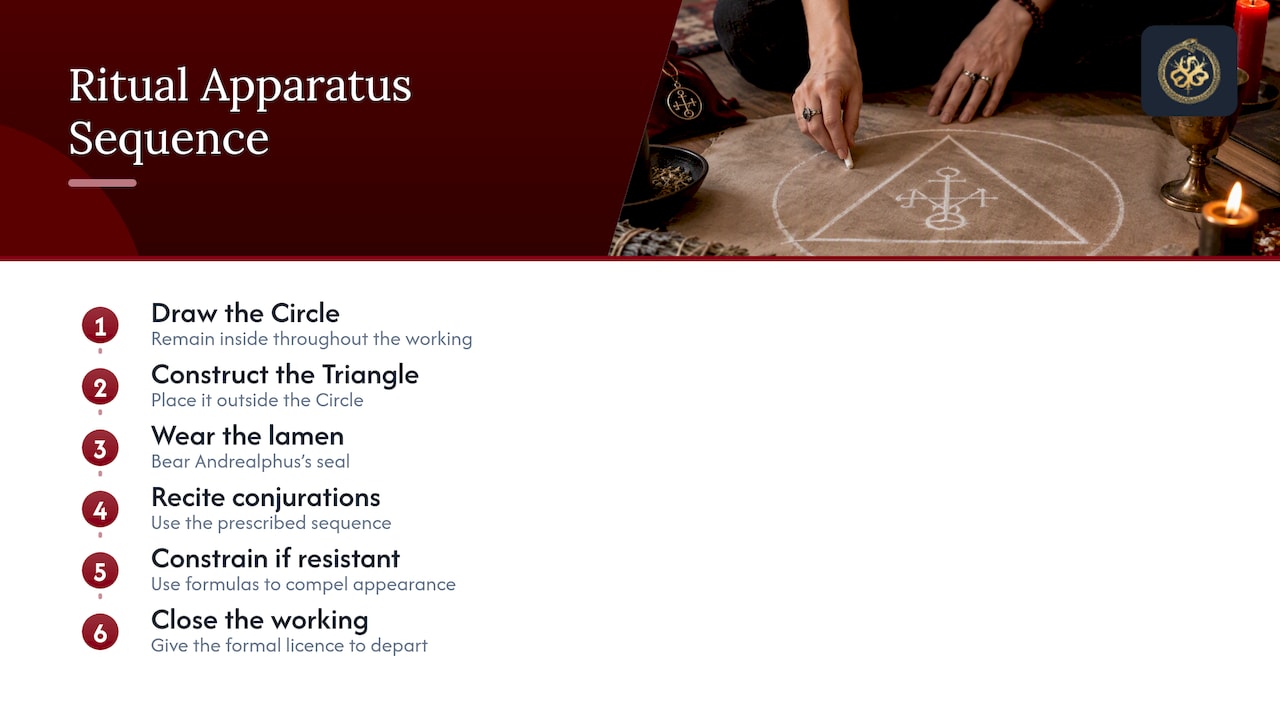
The surrounding ritual apparatus follows the standard conjuring method from the Goetia. The practitioner draws the Circle of Art and remains within its boundary throughout the working, constructs the Triangle of Art outside the Circle as the designated point of manifestation, wears the prepared lamen bearing the spirit’s seal, and recites the conjurations in the prescribed sequence. If the spirit proves resistant, the tradition provides constraint and curse formulas to compel appearance, and the operation always closes with a formal licence to depart, releasing the spirit and closing the working cleanly.
Sigil fidelity is a practical concern. Because the seal of Andrealphus reaches the modern practitioner through several centuries of hand-copied and later printed manuscripts, line weight, stroke order, and orientation vary between editions. The consensus among practitioners who work with his sigil is to prioritize facsimiles of well-regarded codices over generic or simplified reproductions found in secondary compilations, on the reasoning that subtle geometric details in the original transmission carry the traditional integrity of the seal. A redrawn sigil that smooths out those irregularities is treated as a different object from the one the manuscript tradition actually transmits.
Working with Andrealphus: source selection and practical aims
Source selection is the first decision in any Andrealphus working. His seal and descriptive text pass through several manuscript lineages, so a sigil copied from a facsimile of a recognized codex carries more confidence than one taken from a simplified modern compilation. The same applies to the conjuration text itself: cross-referencing the Ars Goetia wording against the Pseudomonarchia’s earlier description clarifies which traits are consistent across the tradition and which are later editorial additions.
A practical checklist for an Andrealphus working typically includes:
- Confirm the sigil against a manuscript facsimile or a well-sourced printed edition before transferring it to the lamen.
- Prepare the lamen to be worn during the operation, consistent with the Ars Goetia’s instruction for his seal.
- Draw the Circle of Art and remain inside it for the duration of the conjuration.
- Construct the Triangle of Art as the manifestation point outside the Circle.
- Recite the conjuration, apply constraints only if manifestation stalls, and close with a formal licence to depart.
Pro Tip: Transfer the sigil by hand rather than printing it; the act of tracing the geometry slows the practitioner down enough to catch transcription errors before the lamen is sealed.
The office of geometry, mensuration, and astronomy translates into concrete working aims. Practitioners commission or structure rites around learning a specific technical subject, sharpening analytical focus for a defined project, or working transformation rites tied to the bird-shape motif. A common integration is a short study-rite: the operator conjures Andrealphus at the outset of a defined learning period, such as mastering a technical certification or a complex design project, states the specific intellectual outcome sought, and closes the rite with the licence to depart. The working brackets a period of concentrated study.
Lineage and textual variation in Andrealphus’s profile
Weyer’s Pseudomonarchia Daemonum lists this spirit under the name Androalphus, describing him as a great Marquis with a peacock appearance who teaches astronomy and geometry and rules 30 legions, a description the later Ars Goetia inherits with adjustments to sequence and phrasing. Manuscript comparisons between Sloane witnesses and Weyer’s printed text indicate that transcription choices and reorganization across copies shaped the spirit’s modern profile rather than a single stable original dictating every later version.
Alternate name forms, including Androalphus and Andralfas, appear across these early attestations, and the spirit is absent from the earliest medieval demon catalogs entirely, emerging instead in the 16th-century Weyerian material before being consolidated into the 17th-century Lemegeton. For a working practitioner, this means naming the specific edition behind any ritual claim. No single text is the final word on him.
Andrealphus’s specific powers and their technical applications
The three teaching offices, geometry, mensuration, and astronomy, are technical faculties with distinct applications for a practitioner’s own work. Geometry governs spatial reasoning and structural design, making this office relevant to anyone working with architectural planning, sacred geometry construction, or the precise diagramming that underlies sigil and circle work itself. Mensuration, the art of measurement and admeasurements, extends that office into practical surveying, proportion, and the kind of exact spatial judgment that technical drafting or engineering work demands.
Astronomy rounds out the triad, and the Goetic text’s phrasing that Andrealphus makes a man “subtle” in these subjects rather than merely informed points to a working aimed at sharpening the practitioner’s own analytical capacity. This distinguishes his office from spirits associated with divinatory or intuitive knowledge: his domain is applied, technical, and measurable. A practitioner pursuing astrological calculation, chart construction, or calendrical timing work for other rites has a direct textual basis for invoking this office specifically, since the Ars Goetia ties astronomy to him by name rather than listing it as a vague secondary trait. The avian transformation power, while dramatic, sits alongside these teaching offices as the same spirit’s broader command over changing form and perception, a detail several practitioners treat as thematically linked to his capacity to change how a mind perceives spatial and celestial relationships.
Offerings, incense, and tools used in Andrealphus workings
Goetic operations built around Andrealphus follow the general apparatus the Ars Goetia specifies for the 72 spirits as a set, since the text does not assign him a unique incense or offering distinct from the broader operation.
Given his office over geometry and astronomy, practitioners commonly favor tools that reinforce precision: a compass and straightedge for constructing the Circle and Triangle with exact proportions, and astrological timing chosen to align the working with favorable planetary hours, a practice consistent with the broader Solomonic tradition that the Lemegeton belongs to. Incense selection tends to follow general Goetic convention rather than a trait unique to this spirit, with practitioners choosing blends associated with mental clarity and focus given his teaching office. The lamen itself functions as the primary dedicated tool for this specific working, prepared from the sigil and worn during the conjuration as the Ars Goetia instructs, making it the one piece of ritual apparatus most directly tied to Andrealphus rather than to the Goetic operation generally.
Manuscript fidelity and ritual structure
Experienced practitioners put manuscript fidelity first in any Andrealphus operation. His sigil and conjuration text exist across several manuscript lineages with documented variation, and working from a verified facsimile or a well-sourced edition reduces the chance of transcription errors compromising the lamen or the conjuration itself. Cross-checking the Ars Goetia wording against earlier sources, such as the Pseudomonarchia’s description, is standard practice for confirming that a given edition’s details are consistent with the broader textual tradition rather than an isolated corruption.
The structural elements of the Goetic operation, the Circle of Art, the Triangle of Art positioned outside it, and the formal licence to depart at the close of the working, give the practitioner a controlled, repeatable framework. Experienced operators keep that structure intact every time and do not skip steps under time pressure. Keeping the working time-bound and purpose-specific, such as bracketing a defined study period or technical project, also gives the practitioner a clear endpoint and a way to evaluate whether the working achieved its stated aim.
Andrealphus in contemporary Left-Hand Path practice
Contemporary Left-Hand Path practitioners generally retain the Ars Goetia’s structural framework for Andrealphus, the Circle, the Triangle, the lamen, and the licence to depart, while reframing the relationship with the spirit itself. Where the historical Solomonic tradition frames the operation as compelling a subordinate spirit through divine names and constraint, much of modern demonolatry approaches Andrealphus as an entity to be engaged through direct address and reciprocal working rather than coercion, shifting the tone of the conjuration without discarding its structure.
This shift shows up most clearly in intent framing: traditional Ars Goetia use of his office tends toward abstract knowledge acquisition, while contemporary practitioners more often tie the working to a specific, named project or skill goal, treating the rite as a focusing tool bracketing a period of applied work. The sigil and lamen practices remain largely unchanged, since manuscript fidelity is still treated as the standard for sigil accuracy whether the practitioner’s framing is Solomonic, Luciferian, or another Left-Hand Path approach. The mechanics stay the same; the stated relationship to the spirit changes.
Bringing Andrealphus’s office into focused ritual work
Andrealphus’s teaching functions translate cleanly into professional contexts: a practitioner preparing for a technical certification, a design project, or any work demanding precise spatial or analytical thinking has a textually grounded reason to structure a rite around this specific office rather than a generic focus spell. One workable sequence pairs the conjuration with a defined project window, naming the specific technical outcome sought at the opening and closing the rite with the licence to depart once that outcome is stated. The standard the tradition sets is manuscript fidelity, a properly sourced sigil, and a correctly prepared lamen, since those three elements separate a working grounded in the Goetic record from one built on guesswork. For other spirits whose offices cover learning and craft, see our guide to demons associated with specific powers.
Bringing a daemonic working to Black Witch Coven
Turning a manuscript-grounded operation like this into a precisely executed ritual takes time, and we offer that execution directly. Our daemonic spell-casting services cover tailored ritual work with powerful entities, carried out by our practitioners.
For readers who want guidance before committing to a specific working, our Left-Hand Path readings are a practical starting point for mapping out which spirit and which approach fits a given goal, be it technical mastery, a transformation working, or something else. Reach out through either page to commission a working or book a consultation.
FAQ
What rank and legions are attributed to Andrealphus?
Andrealphus holds the rank of Marquis in the Goetic hierarchy and commands 30 legions of infernal spirits, a rank and legion count consistent across the Ars Goetia tradition. This places him among the mid-tier Goetic offices rather than the higher-ranking kings or dukes of the same catalog.
What does Andrealphus look like when he manifests?
He first appears in the form of a peacock accompanied by loud noise, then shifts into human shape once properly addressed within the ritual. This two-stage manifestation is one of the more distinctive visual signatures in the Goetic catalog.
What is Andrealphus traditionally invoked to teach?
The Ars Goetia credits him with teaching geometry, mensuration, and astronomy, making practitioners subtle in these specific technical disciplines rather than offering general knowledge. He is also noted for the power to transform a man into the shape of a bird.
Can the seal of Andrealphus be worn during ritual?
Yes, the Ars Goetia instructs that his seal may be worn as a lamen by the practitioner during the conjuration. Practitioners generally prepare the lamen from a verified manuscript facsimile to preserve the sigil’s original line work and proportions.
