
Blog, Demons, Working With Demons
Amy Demon: Seal, Enn and How to Work With Him
Oct
Amy is a Goetic President ranked among the seventy-two spirits of the Lemegeton, governing liberal arts, hidden knowledge, and the discovery of buried treasure. His traditional lore ties him to Mercury-ruled matters of learning and discernment, and practitioners commonly pair his classical attributes with a modern enn and a stabilizing angelic correspondence for working purposes.
Where Amy appears in the tradition: primary sources and manuscript notes
Amy’s office is documented across the core texts of Western demonology, each contributing a slightly different layer to his profile. The classical compendia agree on his rank and general domain even where details of his appearance or retinue diverge.
- The Lemegeton (Lesser Key of Solomon) lists Amy, also called Avnas, as the fifty-eighth spirit, a Great President who appears first as a flaming fire and then takes the shape of a man. He makes one “wonderful knowing” in astrology and all the liberal sciences, gives good familiars, and can reveal treasure kept by spirits. He governs 36 legions.
- The Pseudomonarchia Daemonum, the earlier Weyer compilation that the Lemegeton draws from, records a similar office and rank under slightly different phrasing, and adds that he is partly of the order of angels and partly of the Potentates, and hopes to return to the seventh throne after 1200 years.
- Reginald Scot’s Discoverie of Witchcraft (1584) carries Weyer’s entry into English, and small differences between the Pseudomonarchia, the Lemegeton, and later compilations mean no single manuscript is the final word.
- Later editorial hands added details, descriptions, and systemization that do not appear in the earliest surviving copies.
Anyone compiling a personal grimoire entry on Amy benefits from cross-referencing at least two of these primary sources rather than relying on a single secondhand summary.
Amy’s attributes, symbolism, and astrological correspondences
Amy’s working portfolio centers on Mercury, the planet of intellect, communication, and commerce, which shapes both the requests practitioners bring to him and the timing they choose for ritual. The Goetia itself names no planet for him; the Mercury attribution comes from the later ceremonial convention that gives the Presidents to Mercury, and it drives most of the practical correspondences used today.
- Planetary ruler: Mercury, governing intellect, speech, and the uncovering of what is concealed.
- Core domains: liberal arts and formal learning, verbal skill and persuasive cunning, and the location of hidden treasure or overlooked resources.
- Color: mixed yellow and orange tones, consistent with Mercurial associations in ceremonial practice.
- Metal and herb: quicksilver as the metal correspondence, with mercury-ruled herbs such as lavender or fennel used in incense blends.
- Archetype: the scholar-trickster, a figure whose cunning serves discovery rather than open confrontation.
These correspondences give a practitioner a coherent frame for deciding whether a given request, research, negotiation, or treasure-seeking, fits Amy’s office before any ritual work begins.
Ritual correspondences: sigil, enn, offerings, and timing
Preparing an Amy working means assembling a short list of concrete elements rather than improvising on the spot. Modern practitioners commonly use a contemporary enn for Amy during evocations, a later addition to the tradition that supplements the classical texts and helps vocalize intent where the original manuscripts offer no vocal formula.
- Enn: recite the modern enn slowly, several times, treating it as a tool for focusing attention rather than a literal quotation from the grimoires.
- Sigil: draw or print Amy’s seal and place it at the center of the altar space, facing the practitioner, without needing to reproduce it elsewhere in the room.
- Offerings: dried lavender, a small dish of mercury-colored (silver or orange) candle wax, or a written question serve as straightforward offerings tied to his domain.
- Incense: a light, airy blend, lavender or lemongrass work well, keeps the Mercurial association consistent through scent.
- Timing: Wednesday, Mercury’s day, during its planetary hour, offers the most thematically consistent window for knowledge or treasure-related requests.
- Goal adaptation: a petition for hidden treasure leans on the metal and coin correspondences, while a petition for learning leans on the incense and vocal elements of the enn.
Adjusting these elements to the specific goal, rather than using one fixed script for every request, keeps the working tightly aligned with what Amy’s office actually governs.
Practical invocation steps for experienced practitioners
A clean, well-sequenced invocation matters more than an elaborate one. The following sequence assumes familiarity with basic Goetic ritual structure and adapts easily to a home altar setup.
- Prepare the space: lay out the sigil, incense, and any offerings, and state your intent in a single clear sentence before beginning.
- Establish the boundary: a drawn circle or a verbally stated working space gives the ritual a defined edge and keeps attention contained for the duration of the call.
- Call the spirit: recite the enn with deliberate breath control and vowel emphasis, repeating it until you notice a shift in the room.
- State the petition: phrase the request in plain, specific language tied directly to Amy’s domains, learning, discovery, or hidden resources, rather than a vague wish.
- Hold the working: sit with the petition stated, allowing silence or continued low recitation, until the sense of presence settles or fades naturally.
- Close and dismiss: thank the spirit by name, state the working as complete, and close the boundary with the same clarity used to open it.
The sequence is a home-altar version of the conjuring method from the Goetia, and readers who know our demonic invocation guide will find the structure familiar.
Pro Tip: Write your petition sentence down before the ritual begins; speaking a pre-written line keeps the request precise even if focus wavers mid-working.
Advanced energy management: pairing Amy with Ieialel for stabilization
Pairing Amy with the angel Ieialel, sometimes spelled Yeialel, follows the Thomas Rudd tradition of matching each Goetic spirit with a corresponding Shem HaMephorash angel. Rudd-influenced systems pair Goetic spirits with angelic counterparts to frame or stabilize the spirit’s influence during ritual work, and many practitioners treat this pairing as a practical energy-management tool rather than a theological requirement.
- Placing Ieialel’s sigil opposite Amy’s seal on the altar creates a visual frame that many practitioners use to keep the working contained.
- A short corrective phrase invoking Ieialel, spoken between repetitions of Amy’s enn, reinforces that framing without disrupting the main call.
- The pairing often softens the phrasing of petitions, shifting a demand into a request made within a held structure.
- After the working closes, a brief acknowledgment of Ieialel supports integration, helping the practitioner transition out of the ritual headspace cleanly.
Textual variations and common confusions to expect in sources
Compiling a reliable personal entry on Amy means expecting disagreement between sources rather than treating any one text as definitive.
- Names, titles, and spellings shift between the Pseudomonarchia, the Lemegeton, and later grimoire compilations, so cross-checking spellings before committing them to a working grimoire avoids confusion later.
- Enns are a modern addition to practice, not a feature of the original manuscripts, and should be treated as optional vocal tools rather than historically authentic text.
- When two sources disagree on a detail, noting both readings side by side in a personal grimoire, with their source cited, preserves the discrepancy honestly instead of forcing a false consensus.
What people bring to Amy
Amy’s office points toward outcomes that are intellectual and material at once: clarity in study or research, sharper verbal footing in negotiation or persuasion, and the uncovering of resources, financial, informational, or literal, that were previously hidden from view. Within Left-Hand Path practice, where results are expected to be concrete rather than purely symbolic, Amy tends to serve requests that reward patience and precision over immediate force.
A practitioner preparing for an academic exam, a licensing test, or a difficult research project often reports the clearest sense of alignment with Amy’s domain, since the office governs the liberal arts directly. Someone searching for an overlooked financial opportunity, a forgotten asset, an undervalued investment, or an inheritance detail that has gone unaddressed, fits the “hidden treasure” side of his office equally well. A third common use case involves cunning in negotiation: preparing for a contract discussion, a legal filing, or a business pitch where verbal precision and strategic framing matter more than confrontation.
Because Amy’s domain is Mercurial rather than purely material, results often arrive as insight first, a piece of information surfacing, a connection becoming obvious, a document turning up, rather than as a direct transfer of wealth. Practitioners who expect that pattern tend to report more satisfaction with the working than those expecting an immediate windfall.
Common pitfalls when working with Amy
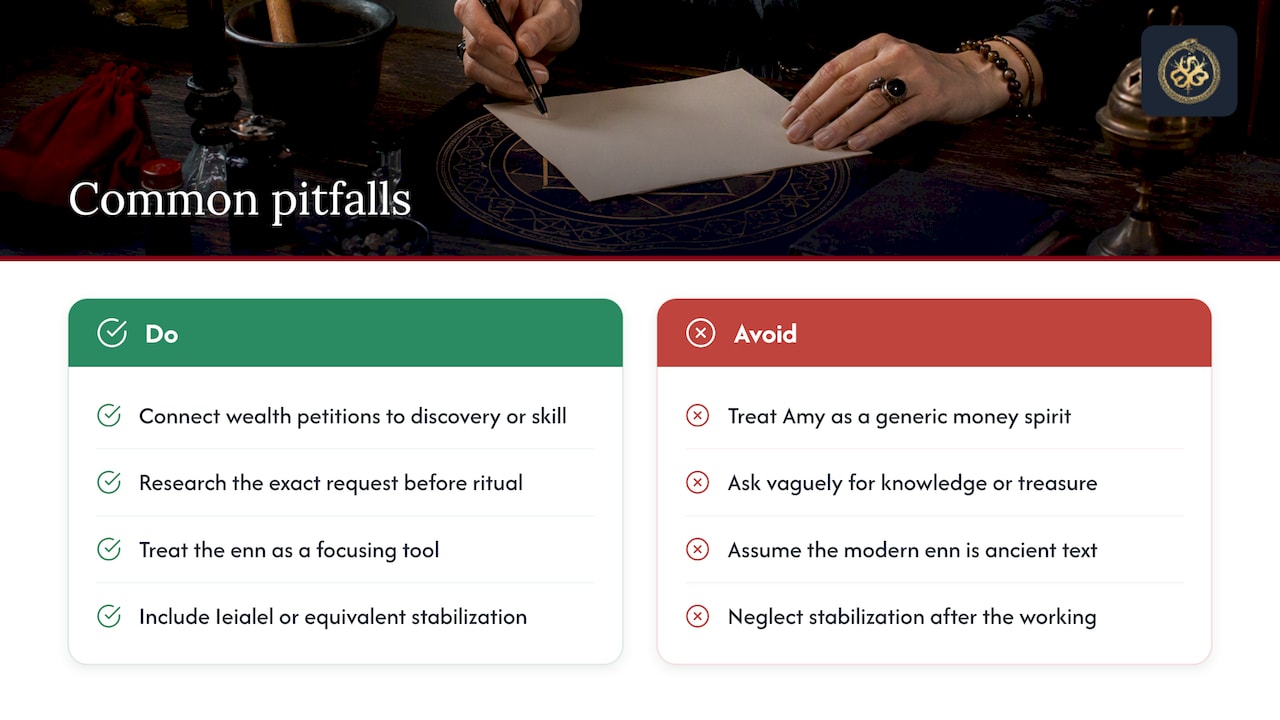
The most frequent mistake is treating Amy as a generic money spirit rather than recognizing that his office is rooted in discovery and intellect first. A petition phrased purely around acquiring wealth, with no connection to uncovering information or applying learned skill, sits outside his actual domain and tends to produce a weaker working.
A second common error is skipping the research step before the ritual itself. Amy’s domain rewards specificity: a petition naming the exact exam, negotiation, or search at hand works better than a vague request for “knowledge” or “treasure” in the abstract.
A third pitfall involves over-reliance on the modern enn as though it were ancient text. Treating the enn as a focusing tool rather than a historically verified incantation keeps expectations realistic and keeps the practitioner’s attention on intent rather than on the wording itself.
Finally, neglecting the stabilization step, the Ieialel pairing or an equivalent framing practice, sometimes leaves practitioners describing a diffuse or unfocused aftermath to the working. Building that corrective into the ritual from the start, rather than treating it as optional, tends to produce a cleaner close.
Prayers and invocations for Amy beyond the sigil and enn
Beyond the standard enn and sigil placement, practitioners sometimes compose a short spoken invocation that names Amy’s office directly and states the petition in formal language before the working proper begins. A typical structure opens with an address by title, “President of hidden learning and buried treasure,” followed by a statement of the practitioner’s specific need, and closes with a line of thanks spoken in advance of any sign of presence.
This kind of composed address functions differently from the enn: where the enn is treated as a vocal tool for attunement, a spoken invocation gives the practitioner a chance to state context and nuance that a short chant cannot carry. Some practitioners write this invocation once and reuse it for every Amy working, adjusting only the specific petition line each time, which builds a consistent personal liturgy over multiple sessions.
A closing address, thanking Amy by title and stating the working as complete, serves the same stabilizing function as the Ieialel pairing discussed earlier, reinforcing a clean end to the ritual rather than letting the working trail off without a defined close.
How Amy compares with similar spirits in the Goetic tradition
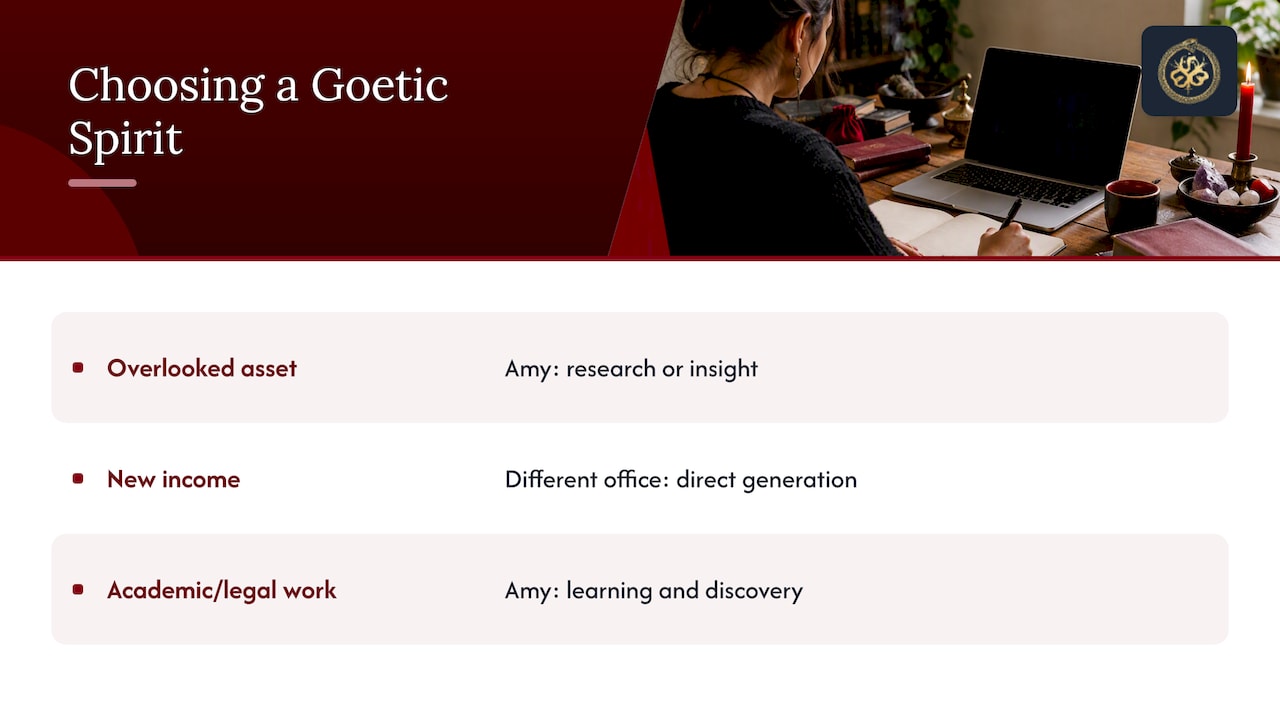
Amy shares his Mercurial, knowledge-oriented domain with a handful of other Goetic entries, though the details that distinguish them matter for choosing the right spirit for a given request. Spirits associated with teaching sciences or rhetoric overlap with Amy’s liberal-arts domain, but Amy’s addition of hidden treasure sets him apart from purely intellectual offices.
Where some Goetic Presidents govern treasure-finding through more direct or forceful means, Amy’s approach stays tied to intellect and discovery, meaning the treasure in question is often uncovered through research, insight, or a recalled detail rather than through brute acquisition. That distinction matters when a practitioner is deciding between spirits for a financial request: a working aimed at discovering an overlooked asset fits Amy, while a working aimed at generating new income more directly points toward one of the spirits in our guide to demons for money, business, gambling and wealth.
Compared to spirits whose domains are purely verbal or purely material, Amy’s dual portfolio, learning and discovery, makes him a flexible choice for academic, legal, or investigative workings where both skill and uncovering information play a role.
Amy alongside other entities in daemonic practice
A working focused on Amy’s domain of knowledge and discovery sometimes sits alongside separate workings aimed at different outcomes, since few practitioners limit an entire practice to a single spirit. A legal matter, for example, might combine research-oriented work with Amy and a separate working aimed at court outcomes with Eligor through our daemonic spell casting services, since the two offices address different stages of the same situation: uncovering facts versus securing a favorable ruling.
Similarly, a practitioner pursuing independent wealth might pair an Amy working aimed at locating an overlooked opportunity with separate prosperity-focused daemonic work aimed at growth once the opportunity is identified. Keeping each spirit’s office distinct, rather than asking one entity to cover ground outside its domain, tends to produce cleaner results across a multi-stage working.
A working practitioner’s view on integrating Amy into regular practice
Amy earns a place in ongoing practice for research-heavy periods: academic deadlines, due diligence before a financial decision, or any stretch where uncovering the right piece of information matters more than brute force. A single working suits a defined question; recurring Mercury-day attention suits an open-ended research project. His seal and correspondences are collected on our Amy Demon Directory page.
Professional support for Goetic and daemonic work
When an Amy working calls for more structure than a solo altar session provides, we offer daemonic spell casting and ritual services built around precise intent and experienced direction. For readers assembling a complete practice, our Left-Hand Path readings give a discreet starting point for clarifying which spirit and which approach fit a specific goal, including stabilization techniques like the Ieialel pairing discussed above.
FAQ
What rank and office does Amy hold in the Lemegeton?
Amy is the fifty-eighth of the seventy-two spirits of the Lemegeton, a Great President governing 36 legions, with an office tied to astrology, the liberal arts, good familiars, and treasure kept by spirits. His listing appears alongside similar material in the earlier Pseudomonarchia Daemonum, with some details varying between the two texts.
Is the enn used for Amy part of the original grimoire text?
No, the enn commonly used for Amy today is a modern addition to practice rather than a line found in the original manuscripts. Practitioners use it as a vocal focusing tool during evocation, not as a historically verified incantation.
Why pair Amy with the angel Ieialel during a working?
Pairing Amy with Ieialel follows the Thomas Rudd tradition of matching Goetic spirits with corresponding angels to frame or stabilize the spirit’s influence during ritual. Many practitioners treat this pairing as a practical energy-management technique rather than a theological requirement.
What is Amy’s planetary and symbolic correspondence?
Amy is associated with Mercury, reflecting his domains of intellect, speech, and discovery, which informs the colors, herbs, and timing practitioners choose for his workings. Wednesday, Mercury’s day, is commonly treated as his most thematically fitting ritual window.
