
Blog, Demons, Working With Demons
Alloces Demon: History, Seal and How to Work With Him
Oct
Alloces is the fifty-second spirit of the Ars Goetia, listed there as a Great Duke who commands a sizable number of legions, teaches astronomy and the liberal sciences, and grants familiars according to traditional texts. He appears across three primary grimoires under several spellings, most often depicted as a lion-faced soldier with a red complexion and flaming eyes, mounted on a great horse. The core sources for his identity are the Lesser Key of Solomon, the Pseudomonarchia Daemonum, and the Liber Officiorum Spirituum.
Names, Numbering, and Where Alloces Stands in Goetic Lists
The spelling of this duke’s name shifts depending on which manuscript tradition a reader consults, a pattern typical of Solomonic texts copied and translated across centuries. Scribal transmission, Latin-to-vernacular translation, and inconsistent orthography all contributed to the variation, so none of the forms below should be treated as more “correct” than another; they are manuscript artifacts rather than distinct entities.
- Alloces, the spelling used in most English editions of the Ars Goetia.
- Allocer or Allocen, alternate renderings found in related Goetic compilations.
- Allogor and Algor, the forms used specifically in the Liber Officiorum Spirituum.
Johann Weyer’s Pseudomonarchia Daemonum places this duke within its own numbered catalog of infernal hierarchy, a list that overlaps heavily with the later Ars Goetia but does not always assign identical ranks or numbers. Later compilers, including Thomas Rudd, cross-referenced Goetic spirits against opposing angels, and Alloces is commonly paired with the angel Imamiah in that angelic counterweight system.
What the Primary Grimoires Actually Say
Each grimoire preserves a slightly different account, and reading them side by side shows exactly where the tradition agrees and where it splits.
The Ars Goetia entry describes a Great Duke who appears as a soldier riding a great horse, his face resembling a lion’s, his complexion very red, and his eyes like flame. His office is to teach astronomy and all the liberal sciences, and he gives good familiars. He governs 36 legions of spirits.
The Pseudomonarchia Daemonum, Weyer’s sixteenth-century catalog that predates and informs the Ars Goetia, lists a closely related figure under its own numbering scheme, confirming the teaching office while differing slightly in rank placement from later Solomonic compilations.
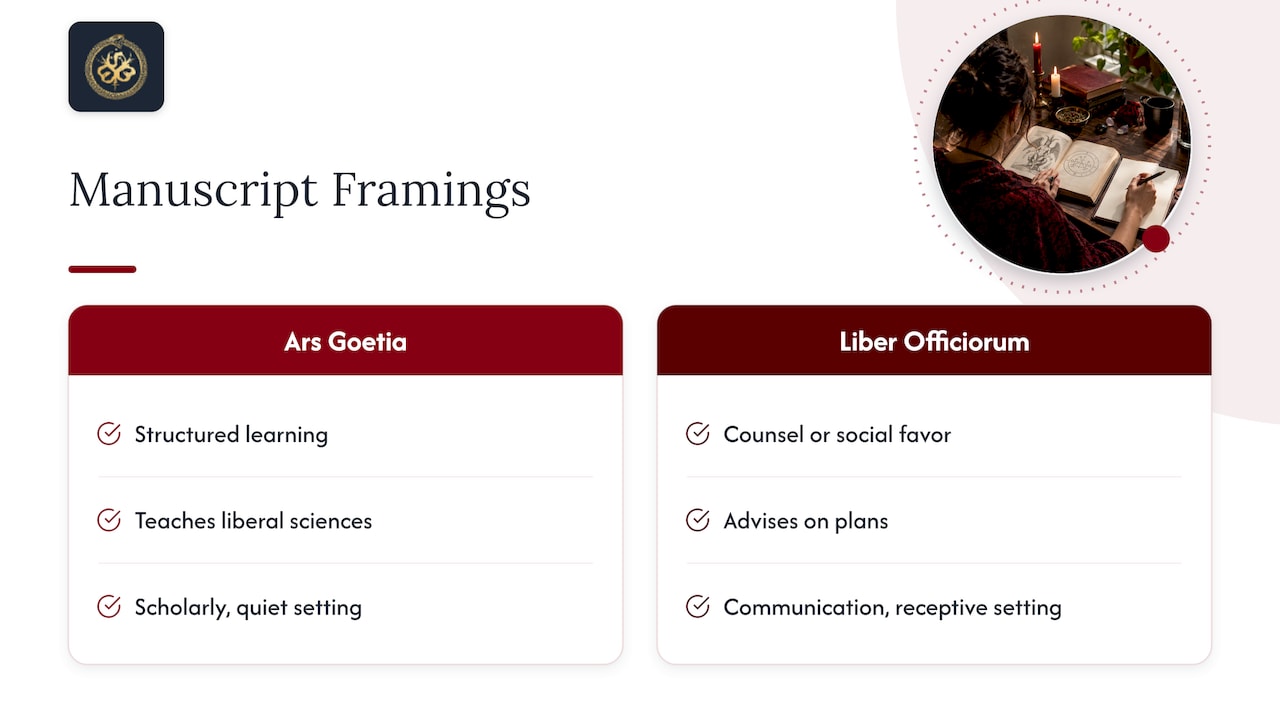
The Liber Officiorum Spirituum offers the most distinct variant. There, under the name Allogor or Algor, this spirit commands 30 legions rather than 36, and his attributed powers shift noticeably:
Alloces appears as Allogor or Algor, commanding 30 legions and possessing powers that include answering questions, providing advice for plans, and garnering the favor of nobles.
- Ars Goetia: 36 legions, teaches astronomy and liberal sciences, provides familiars.
- Pseudomonarchia Daemonum: closely parallel office, different internal numbering.
- Liber Officiorum Spirituum: 30 legions, answers questions, advises on plans, grants favor with nobles.
Appearance Descriptions and Their Symbolic Weight
The lion-faced soldier riding a great horse is the dominant image across sources, but the details carry meaning beyond physical description. A lion’s head paired with martial posture suggests an authority that is both intellectual and forceful, fitting for a spirit whose stated office is teaching rather than mere combat. The red complexion and flaming eyes reinforce a fire association common to Goetic dukes who occupy scholarly or advisory roles, linking illumination of the mind with the literal imagery of fire and light.
- Lion imagery signals command, dignity, and a teaching authority that demands respect.
- Flaming eyes and red skin tie the figure to fire symbolism, often read as intellectual illumination rather than destructive heat.
- A horse mount favors mobility, martial readiness, and solar associations.
- Where a crocodile mount appears instead in certain manuscript traditions, the symbolism shifts toward chthonic, earthbound, or fertility associations rather than solar ones.
Pro Tip: When building a visual focus for meditation or ritual work, choose the mount image (horse or crocodile) that matches the specific manuscript tradition you are drawing from, since mixing symbolism can muddy the intent of the working.
Abilities Attributed to Alloces and What They Mean in Practice
The teaching office attached to this duke is unusually specific compared to many Goetic entries, and it shapes what practitioners have historically sought from the working.
- Teaching astronomy and the liberal sciences, a Renaissance-era category that included grammar, rhetoric, logic, arithmetic, geometry, and music alongside astronomy, making this duke a patron of structured, intellectual knowledge rather than vague mysticism.
- Granting good familiars, meaning spirits said to assist the practitioner with ongoing tasks or guidance after the initial working.
- Answering questions and advising on plans, a power specific to the Liber Officiorum Spirituum variant, framing this duke as a consultative presence rather than purely an instructor.
- Favor with nobles, another Liber Officiorum attribution, suggesting a social or political dimension to requests made under that tradition’s framing.
The legion count a text assigns also shapes how practitioners historically read a spirit’s relative authority within the infernal hierarchy. A duke commanding 36 legions sits among the more heavily attended figures in the Ars Goetia’s structure, while the 30-legion figure in the Liber Officiorum reflects that text’s own internal scale rather than a demotion.
Why the Grimoires Disagree: Transmission and Editorial Choices
Contradictions between these texts are not signs of corruption so much as evidence of independent manuscript lineages, each shaped by its own copyists, translators, and regional conventions.
- Name conflation between Alloces, Allocer, and Allogor likely stems from Latin diacritic loss and inconsistent transliteration during copying.
- Legion counts of 36 versus 30 reflect separate numbering conventions rather than a deliberate reassignment of rank.
- Unique duties, such as the favor-with-nobles attribution found only in the Liber Officiorum Spirituum, suggest that compiler added material drawn from a different oral or written source than the one behind the Ars Goetia.
- The catalogs themselves are late: the earliest manuscript evidence for them dates to the medieval and early modern periods, whatever older material the compilers drew on.
Practical Considerations for Ritual Work Involving Alloces
Approaching a working tied to this duke starts with deciding which manuscript’s framing matches the intent of the request. A practitioner focused on structured learning, whether that means deepening occult study or sharpening analytical skill, aligns more naturally with the Ars Goetia’s teaching office. A practitioner seeking counsel on a specific plan, or looking to build favorable standing with influential people, draws more directly from the Liber Officiorum Spirituum’s variant attributions.
Timing and setting matter less for rigid rule-following and more for internal coherence: a working framed around astronomy and liberal sciences benefits from an environment that reflects that intent, whether through planetary correspondences (covered in our ceremonial, Solomonic and planetary magick lessons), scholarly tools on the altar, or simply a quiet space suited to concentrated study. A working framed around counsel or social favor benefits from a setup oriented toward clarity of communication and receptivity to answers.
Petition language historically favored concepts of illumination, skill, and clarity of plan rather than blunt material requests, matching the teaching and advisory offices the grimoires give this duke. Consistency between the appearance you invoke (lion-headed soldier on horseback, or the crocodile-mounted variant), the legion count you reference, and the specific ability you are petitioning for keeps the working symbolically coherent rather than a patchwork of mismatched manuscript details.
Sigils, Seals, and Symbolic Variations
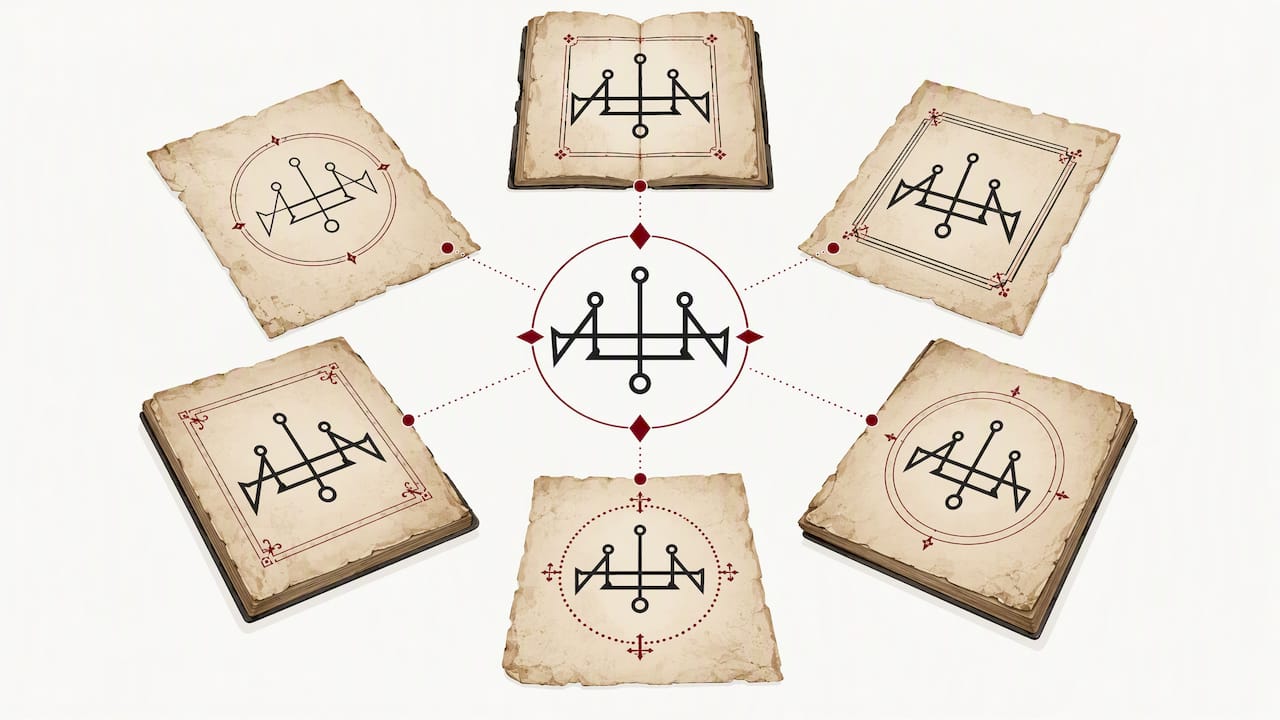
Goetic seals for this duke follow the same lineage split as the written descriptions. The seal most commonly reproduced alongside the Ars Goetia entry is the version tied to the 36-legion, teaching-office description, and it typically appears in published Goetia reproductions alongside the written office. Variant seals or seal descriptions tied to the Liber Officiorum Spirituum’s Allogor or Algor naming are less widely reproduced, reflecting that text’s narrower circulation compared to the Lesser Key.
Because seal artwork has been redrawn and reprinted across centuries of editions, minor stylistic differences exist between published versions, variations in line weight, minor proportion shifts, or added decorative framing, without changing the seal’s core design or attribution. Practitioners working from a specific printed or digital edition generally match the seal to the edition they are using rather than mixing elements from multiple printings, keeping the visual focus consistent with the textual source guiding the rest of the working.
The underlying design elements across versions tend to preserve the same geometric core: angular lines suggesting authority and structure, consistent with the martial-scholarly duality found in the written descriptions. Where a practitioner cannot locate a seal tied specifically to the Liber Officiorum variant, working from the standard Ars Goetia seal while adjusting petition language to match the Liber Officiorum’s attributed powers keeps the visual and textual elements aligned even when primary artwork for the rarer variant is not readily available.
Ritual Etiquette and Preparation Before Invoking Alloces
Preparation for a working tied to this duke follows the same discipline as any Goetic evocation built on the conjuring method from the Goetia: clarity about which manuscript’s framing is guiding the request, a petition that matches the specific office being invoked, and a ritual space set up with enough intention that the symbolism stays coherent from start to finish.
Matching your visual and verbal elements to a single source tradition, rather than blending the Ars Goetia’s horse-mounted, 36-legion soldier with the Liber Officiorum’s favor-with-nobles framing in the same working, keeps the request internally consistent. Reviewing the specific ability you intend to petition for beforehand, whether that is instruction in a liberal science, a familiar, or counsel on a plan, helps shape language that speaks directly to that duke’s attributed office rather than a generic request that could apply to any spirit in the hierarchy.
Documentation of the working, including the date, the manuscript source used, the specific petition made, and any response observed, gives a practitioner a record to compare against future workings involving the same duke, building a personal body of reference that complements the grimoire sources rather than relying on memory alone.
How We Read Alloces in Practice
The teaching office attributed to this duke across the Ars Goetia is one of the more specific functions in the entire catalog of Goetic spirits, and we treat that specificity as a reason to be precise rather than casual when a client’s intent touches on learning, skill acquisition, or structured knowledge. A request framed around deepening study or sharpening a particular craft maps onto this duke’s attributed role far more directly than a generic prosperity or binding request would, and we shape petition language accordingly rather than applying one template to every working.
Requests involving familiars or counsel get handled with the same attention to manuscript source: we track whether a client’s intent lines up with the Ars Goetia’s teaching and familiar-granting office or the Liber Officiorum’s advisory and favor-with-nobles framing, since the two traditions imply different outcomes. Manuscript fidelity, meaning the appearance, legion count, and attributed power all coming from the same source rather than a mixed composite, keeps a working symbolically coherent, and we have found that coherence matters as much as intention when a client wants results that feel aligned with the tradition they are drawing from. Clients working with us on demon-specific requests, including daemonic spell casting tied to Goetic figures, go through this same source-matching process before any ritual language is finalized. His seal and correspondences are on our Alloces Demon Directory page.
Black Witch Coven
FAQ
What rank does Alloces hold in the Ars Goetia?
Alloces is listed as the fifty-second spirit in the Ars Goetia, ranked as a Great Duke. He is said to command 36 legions of spirits in that text’s numbering.
Why do sources give different legion counts for Alloces?
The Ars Goetia lists 36 legions under this duke, while the Liber Officiorum Spirituum variant, naming him Allogor or Algor, assigns him 30. The difference reflects separate manuscript traditions rather than a change in rank.
What is Alloces said to teach?
Alloces is attributed with teaching astronomy and the liberal sciences, a Renaissance-era grouping that included subjects like grammar, logic, and arithmetic alongside astronomy. He is also said to grant good familiars to those who call him.
Which angel opposes Alloces in Goetic hierarchies?
Later compilations, including work by Thomas Rudd, pair this duke with the angel Imamiah as his opposing or balancing force within angelic hierarchy systems.
