
Blog, Demons, Working With Demons
Asmodeus Demon: Origins, Goetic Seal and How to Work With Him
Oct
Asmodeus is a demon king who runs through Jewish, Christian, Islamic and grimoire traditions. He begins as the spirit who kills Sarah’s bridegrooms in the Book of Tobit, becomes a figure tied to lust and Solomon’s court, and settles as the thirty-second spirit of the Ars Goetia, a king of seventy-two legions. This article traces his origins, key texts, occult reception and how practitioners work with him today. His short profile sits on our Asmodeus Demon Directory page.
Where the name Asmodeus comes from and how far back it goes
The name reaches us in several spellings, and each tradition tends to favor one:
- Asmodeus is the Latinized form used in the Vulgate tradition and most English-language scholarship.
- Ashmedai is the Talmudic Hebrew and Aramaic form, found in the Solomon stories.
- Asmodai and Asmoday are the spellings preferred in grimoire literature.
- Aeshma (Avestan Æshma) is the Iranian figure the name most plausibly descends from, which is a linguistic relationship and not a spelling variant.
The probable root is the Avestan aēšma, meaning wrath or fury, attached to the demon Aeshma-daeva of Zoroastrian texts. Jewish communities lived under Persian rule for generations, so borrowing a demon’s name is historically unsurprising. The trap is assuming that a shared name means a shared job. Scholars distinguish Avestan Æshma, a demon of wrath, from the Jewish Asmodeus, who is bound up with lust and marital discord. The linguistic parallels exist, but the Jewish figure most likely reflects a distinct development shaped by Persian belief.
For anyone working with the figure, this matters. If you read Aeshma’s wrath into Tobit’s bridegroom-slayer, or Tobit’s lust into a Zoroastrian text, you are importing meaning the sources do not carry. Treat the Persian root as the name’s ancestry, and treat the Jewish Asmodeus as a character who grew up in a different house.
What the Book of Tobit actually says about Asmodeus
Tobit is the earliest narrative attestation, dated to roughly 200–250 BCE, and it gives Asmodeus his defining role. There he is an evil spirit who kills the seven successive husbands of Sarah, daughter of Raguel, and who is rendered harmless when Tobias burns the heart and liver of a fish and the archangel Raphael binds the spirit.
The story unfolds in clear beats:
- Sarah is married seven times, and each husband dies in the bridal chamber before the marriage is consummated.
- Her household blames her, and her despair is as much a part of the plot as the demon.
- Tobias, guided by Raphael, catches a fish and keeps its heart, liver, and gall.
- On the wedding night Tobias burns the heart and liver, and the smoke drives the spirit out. Raphael pursues and binds him in the far reaches of Egypt.
- The seven deaths end, and Sarah and Tobias are married.
Translations differ here. The Greek and Latin textual traditions differ on what happens to the demon: he flees, he is bound, and in some renderings he is strangled or restrained. The character was fluid even in his first appearance, though every version ends with Raphael driving him into Egypt after the fish fumigation.
Notice what Tobit does not say. It never states that Asmodeus is a spirit of lust in the later grimoire sense. He is jealous of the marriage bed and lethal to bridegrooms, and later readers filled in the sexual interpretation. The motif of a spirit who attacks at the threshold of marital union became the seed of everything later tradition attached to him: desire, possession, and the disruption of marriage.
The Talmudic Ashmedai: king of demons, trickster, and occasional helper
Rabbinic literature gives us a very different Ashmedai. Here he is king of the shedim, and the stories center on his dealings with Solomon, mostly in the tractate Gittin. The portrait is ambivalent from the first scene.
The Solomon cycle runs roughly as follows:
- Solomon needs the shamir, the creature or substance that cuts stone without iron, so the Temple can be built without iron tools.
- Ashmedai holds the knowledge of where it is. Solomon’s servant Benaiah captures him by getting him drunk, chaining him, and bringing him to Jerusalem.
- In captivity Ashmedai behaves oddly. He weeps at a wedding, laughs at a man ordering shoes meant to last seven years, and exposes hidden truths about the people around him.
- Later he swaps places with the king: Ashmedai takes the throne while Solomon wanders as a beggar, a usurpation that becomes the pivot of the story.
What strikes a careful reader is the lack of simple malice. Read together, the legends give him a dual role, malicious in Tobit and useful in the Solomon cycles, which points to a figure of elemental power more than pure moral evil. He serves the Temple’s construction, yet he also deceives and dethrones.
Later Jewish folk and Kabbalistic texts add a marital thread. The Treatise on the Left Emanation and related Kabbalistic writings marry Asmodeus to a Lilith figure, often called a lesser Lilith, in narratives of demonic procreation. The motif of a greater and a lesser Lilith lets later authors pair the demon king with a queen without collapsing the older Lilith traditions into one.
The Testament of Solomon: Asmodeus as a catalogued, subjugated spirit
The Testament of Solomon reads like a working manual dressed as a narrative. Solomon, armed with a ring given by the archangel Michael, summons demons one after another and makes each reveal its name, its function, and the angel that thwarts it. Asmodeus appears in this procession and is put to labor on the Temple.
Two features give the text its lasting influence:
- Confession of vulnerability. The demon states what defeats him, and the answer echoes Tobit: smoke from the fish. The text preserves the older motif while converting it into usable counter-knowledge.
- Prophetic statements. Asmodeus speaks of kingdoms and of the fate of Solomon’s own realm, which positions him as a source of hidden knowledge as well as a laborer.
The format itself is the lesson. Demons are recorded with their attributes and antidotes, a structure later adopted by grimoires. The Testament did not invent ceremonial demonology, but it supplied a template: name the spirit, learn what it does, learn what constrains it, and put its knowledge to work. When you read a Goetic entry and see rank, appearance, powers, and a binding formula, you are reading a descendant of this genre. The Solomonic frame also keeps the ambivalence of the Talmud alive, since a bound Asmodeus can build and advise as readily as he can destroy.
Medieval and early modern demonology: classification, imagery, and the Goetic rank
Christian demonology did what classification systems do: it assigned the figure a place. By the early modern period Asmodeus had been fixed into hierarchies that paired demons with sins. Peter Binsfeld’s 1589 scheme linked Asmodeus with lust, and the association stuck so hard that popular writing now treats it as his permanent portfolio.
Imagery followed classification. The Dictionnaire Infernal illustration shows a composite creature, part animal, riding a beast and carrying a banner, and that picture influenced later visual treatments. In the Ars Goetia, a book of the Lesser Key of Solomon, he is the thirty-second spirit, a king commanding seventy-two legions.
Key points to carry forward:
- Binsfeld’s pairing of demon and sin made lust Asmodeus’s default association in Christian reading.
- The Dictionnaire Infernal supplied the composite, multi-headed image later artists copied.
- The Ars Goetia gave him a rank, a seal, and a legion count, which turned a literary figure into an operational one.
- These features migrated into popular occultism and from there into fiction and film.
The Goetic placement: Asmodeus is the thirty-second spirit of the Ars Goetia, a king with command over 72 legions and a composite form of bull, man and ram.
That one grimoire entry did more to fix the modern picture than centuries of narrative, because practitioners copied it, and copyists preserve what is easy to copy: a number, a shape, a list of powers.
Sakhr and the Islamic Solomon cycle
Islamic tradition does not name Asmodeus in the Qur’an, but it preserves a close narrative cousin. Commentary on Surah Ṣād, which mentions a body placed upon Solomon’s throne, produced stories of a jinn or demon, commonly called Sakhr, who steals the king’s ring and rules in his place while Solomon wanders in exile.
The recurring elements will look familiar after the Talmudic section:
- A powerful spirit is bound or imprisoned, in some tellings inside rock or a vessel.
- The spirit gains access to Solomon’s authority, whether through a ring or by taking the throne.
- Solomon falls into exile and humiliation before recovering his position.
- The spirit is eventually defeated, and order is restored.
Medieval Arabic and Persian storytellers moved easily between traditions, and tafsir literature absorbed narrative material from Jewish and Christian circulation. The parallels are real, but scholars generally treat Sakhr as a parallel adaptation of the Solomon–demon cycle and not as a simple renaming of Ashmedai. Different texts, different theological commitments, and different roles for the king all argue against collapsing the two.
For a practitioner or researcher, the point is practical. If a modern source says Sakhr simply is Asmodeus, ask which tafsir or folk text says so. A shared plot structure shows cultural exchange. It does not prove an identical spirit.
The Ars Goetia entry: rank, form, and reported powers
In the grimoire, Asmodeus is a king with a defined profile. He is the thirty-second spirit, he governs seventy-two legions, and he is described with three heads, one of a bull, one of a man, and one of a ram, a serpent’s tail, goose feet, and flame breathing from his mouth. He rides a dragon and carries a lance with a banner. The composite form is the grimoire’s own, and it differs sharply from Tobit’s unseen bridegroom-killer.
The reported gifts, as grimoire tradition lists them:
- He teaches arithmetic, astronomy, geometry, and the mechanical crafts.
- He gives true and complete answers to questions put to him.
- He is said to reveal where treasures lie and to guard them.
- He can grant the ring of virtues and render a person invisible, according to the common Goetic descriptions.
The conventions of evocation in this tradition require the operator to stand bareheaded, to hold the magick ring or seal, and to address the spirit with courtesy, since the entry notes that he should be treated respectfully. Modern practitioners differ widely in what they emphasize. Some use the Goetic template nearly as written. Others treat Asmodeus as a spirit of desire, passion, and the breaking of social constraint. Others treat him as a teacher of craft and strategy. Left-hand path readers often stress the sovereignty side: a king who gives knowledge and expects disciplined engagement in return. Our conjuring method from the Goetia sets out the full operation.
Pro Tip: Work from a full-text edition of the Goetia and compare its description of Asmodeus against the Dictionnaire Infernal image, so you can tell which details are grimoire and which are later artistic embroidery.
Asmodeus in literature
Literature carried Asmodeus out of the grimoire. Milton and later writers used him as a named presence among fallen spirits, and later authors reused the name for devilish wit, temptation, and satire. The figure became a literary shorthand for a sophisticated demon.
Modern fantasy gaming later recast him as a contract-bound ruler of hell, a portrait with no root in the older texts.
What the whole record suggests: syncretism, desire, and order
Step back from the individual sources and a pattern comes into view. The name travels from Iranian demonology, but the Jewish Asmodeus develops independently within late antiquity through syncretic processes and not a straight line of identity. Each later tradition adapts him to its own concerns.
Several motifs persist across the layers:
- Desire and lust. From Tobit’s marriage-bed attacks to Binsfeld’s classification, the figure keeps attaching to sexual passion and its disruption.
- Boundary and contract. Solomon binds him, grimoires bind him by seal and rank, and modern practice frames him around pacts and stated terms. In every era he is tied to an agreement that constrains him or that he enforces.
- Ambiguous agency. He kills, builds, deceives, teaches, and rules. No single moral label survives the full record.
These motifs shape how both scholars and practitioners read him. An academic uses them to map transmission and adaptation, asking which motif a given text emphasizes and why. A ritual practitioner can use them to decide what a working actually engages: the fierce guardian of thresholds, the teacher of crafts, the lord of desire, or the sovereign of contracts. Working clearly means choosing which Asmodeus you are addressing and knowing what source stands behind that choice.
Rituals and workings associated with Asmodeus in Left-Hand Path practice
In Left-Hand Path practice, workings with Asmodeus usually follow the Goetic frame and adapt it. The common structure can include preparation through fasting or abstention and a cleansed working space, an invocation or evocation addressed to him by title and rank, a sigil or seal as the focus, and a clearly stated petition.
The petitions tend to cluster around his traditional domains:
- Sexual confidence, the intensification of desire, or the reconciliation of passion within an existing bond.
- Knowledge of crafts, mathematics, and technical skills, drawn from the grimoire’s list of what he teaches.
- Strategic advantage and discovery of hidden resources, echoing the treasure tradition.
- Breaking of social or personal constraints that limit autonomy.
A worked example shows how this looks in practice. A practitioner who wants to master a technical discipline might read the Goetic entry, draw the seal on a prepared surface, light a single candle in his honor, address him with the formal courtesy the grimoire requires, state the specific skill sought, and keep a log of study sessions afterward. The log records what changes in the weeks after.
Our own demonolatry resources cover how practitioners approach daemonic entities as relationships, and our preparation guide for spell workings covers the groundwork these rituals assume.
Asmodeus in modern occult and demonolatry communities
Within contemporary demonolatry and Goetic circles, Asmodeus occupies a prominent and fairly stable place. He appears in most lists of kings summoned for knowledge, pleasure, and strategic counsel, and he is widely treated as one of the more approachable high-ranking spirits for practitioners who want a working relationship and not a one-time evocation.
His influence appears in several ways. First, the Ars Goetia entry remains the baseline text that nearly every practitioner consults before anything else. Second, popular fiction has pushed many newcomers toward a contract-centered view, so that they arrive expecting negotiation and clearly stated terms. Third, the lust association has made him a common choice for workings around attraction, passion, and relationship dynamics, the territory of our Daemonic Magick for Love & Marriage work.
Practitioner accounts in these communities tend to report similar themes: a courtly, demanding presence, an emphasis on precise wording of requests, and an expectation that the practitioner honor any offering or promise made. Practitioners who treat him as a sovereign and approach with discipline report better coherence between intent and working than those who treat him as a dispenser of favors.
How Luciferian, demonolatry, and Goetic approaches treat Asmodeus differently
The same name does different work in each current.
- Goetic magick treats him as a catalogued spirit of the Ars Goetia: a king with a seal, a rank, a legion count, and a list of powers, approached through evocation with a clear protocol.
- Demonolatry treats him as a deity or daemon in a devotional relationship. The emphasis falls on ongoing veneration, offerings, and communion more than on commanding a spirit by formula. Our Demonolatry and Left-Hand Path material works from this relational stance.
- Luciferianism tends to place him within a wider field of adversarial and illuminating forces, honouring him as a power of desire, will, and self-determination, approached through direct communion as often as through formal evocation.
These approaches differ on authority as well. The Goetic operator holds the seal and gives the commands. The demonolater submits to the relationship and negotiates within it. The Luciferian works with him as an ally in self-determination. A practitioner who blends them meets a real tension: command, devotion, and alliance make different demands and produce different kinds of experience.
Working with Asmodeus: preparation, conduct, and what to expect
Practical engagement starts with source work. Read the Tobit passage, the Talmudic Solomon material, and the Goetic entry before anything else, so you know which aspects of the figure you are addressing. Then prepare in concrete ways.
Preparation that fits the tradition:
- Cleanse and set the working space, and keep the workings private and uninterrupted.
- Prepare the seal of Asmodeus from a reliable edition of the Ars Goetia, and anoint seal and candle; our Goetia Kings Oleums are made for the Goetic kings.
- Write your petition beforehand in specific, limited terms, since the figure is associated with precision and with bargains.
- Decide in advance what you will offer in return and what you will not, because contract is central to his later character.
During the working, address him with the courtesy the grimoire prescribes, state the request plainly, and close the rite formally, with thanks and a license to depart. Afterward, record impressions, dreams, and events over the following weeks.
The grimoires speak of knowledge, answers, and revealed resources, and practitioners report shifts in confidence, opportunity, and attraction. The clarity of the request and the consistency of follow-through shape what comes. A vague petition produces vague results.
Asmodeus compared with other Goetic kings
Placing Asmodeus beside other Goetic spirits clarifies what is distinctive about him. Among kings of the Ars Goetia, he is unusual for combining knowledge-giving with a martial rank and a heavy mythic past: no other Goetic king carries a scriptural narrative as old as Tobit.
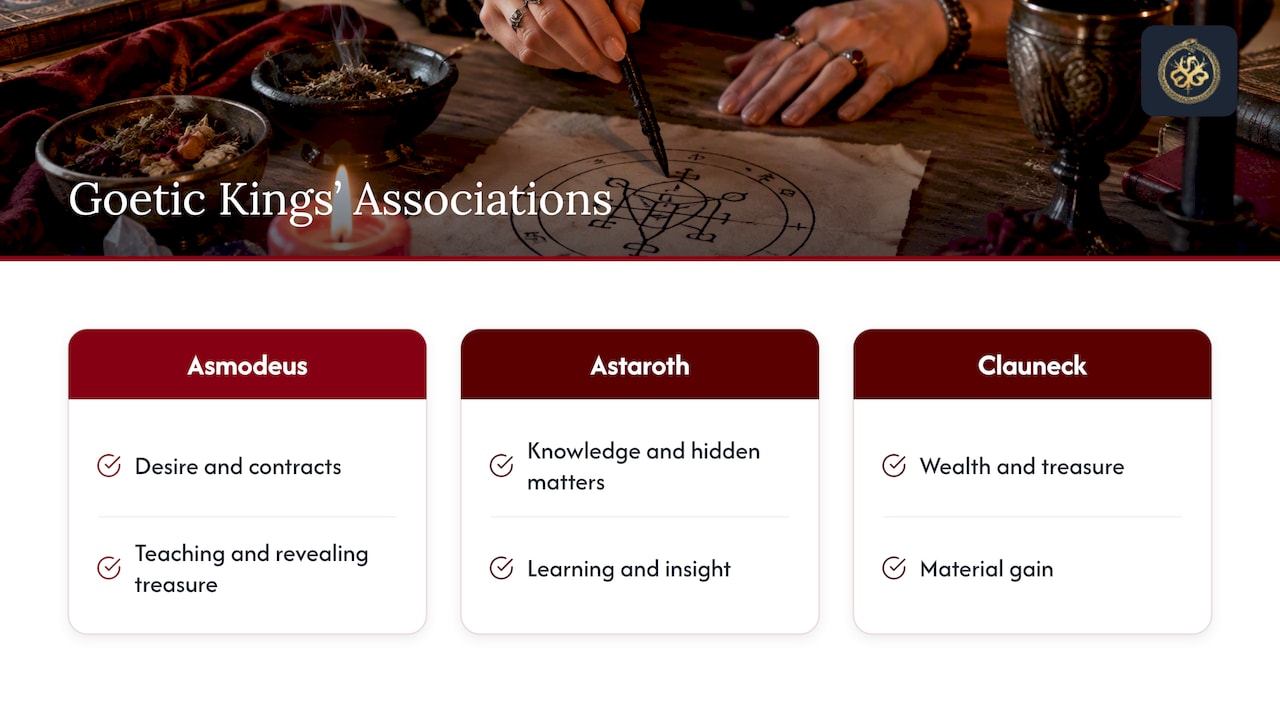
Our own ritual practice works with several entities, including Astaroth and Clauneck, and the contrast is instructive. Astaroth, a Great Duke of the Goetia, is approached for knowledge and the revelation of hidden matters, and his entry stresses learning and insight. Clauneck, a spirit of the Grimorium Verum rather than the Goetia, is associated with wealth and the acquisition of treasure, which is why we pair him with prosperity work, as in our Clauneck money spell. Asmodeus overlaps with both: he is credited with teaching and with revealing treasure, yet his strongest identity is as a king of desire and contract.
For a practitioner choosing between them, a reasonable rule follows from the sources. If the aim is hidden knowledge, the Goetic profile of Astaroth and Asmodeus both fit. If the aim is material gain, Clauneck’s association is more direct. If the aim touches passion, boundary-breaking, or a binding agreement, Asmodeus has the deepest textual pedigree for it. Choosing by documented attribute, and not by name recognition, makes the working more coherent.
FAQ
What is Asmodeus the sin of?
Asmodeus is traditionally associated with lust. Later tradition links him to that sin through demonological classification, though his earliest appearance in Tobit shows him killing bridegrooms and not tempting anyone.
Is Asmodeus Lucifer’s son?
No old text makes Asmodeus Lucifer’s son. Jewish folklore instead pairs him with Lilith as his queen, and Christian demonology classes him among the princes of hell associated with lust.
Who is Asmodeus to Lilith?
In later Kabbalistic and folk texts, Asmodeus appears as the husband of a Lilith figure, often called a lesser Lilith, within narratives of demonic procreation. This pairing belongs to later tradition and not to Tobit or the Talmud.
Who killed Asmodeus?
No central tradition records his death. The texts have him banished, bound, or tricked into servitude, as when Raphael binds him in Egypt after Tobias burns the fish heart and liver.
