
Blog, Demons, Working With Demons
Furcas Demon: History, Six Arts and How to Work With Him
Oct
Furcas is the fiftieth spirit of the Ars Goetia, the only spirit in the catalogue who holds the rank of Knight, and a teacher of philosophy, astrology, rhetoric, logic, cheiromancy and pyromancy. He commands twenty legions. He appears as a cruel old man with a long beard and a hoary head, riding a pale horse and carrying a sharp weapon. That is the whole of the historical record, and it is shorter than most modern write-ups admit. His entry in our Furcas Demon Directory gives the summary. This article separates what the grimoires say from what later writers added, traces how the entry changed, and then sets out how a practitioner can build a working relationship with him.
What the Goetia says about Furcas
The text most readers mean by “the grimoire” is the first book of the Lemegeton, the Ars Goetia. Its entry gives the core description. Furcas is a Knight. He appears as a cruel old man with a long beard and a hoary head, mounted on a pale horse, holding a sharp weapon in his hand. He teaches philosophy, astrology, rhetoric, logic, cheiromancy and pyromancy, and the text says he teaches them perfectly and in all their parts.
The entry is brief. It has no sigil narrative, no planetary hour, no list of offerings and no personality beyond the physical description. Everything else you read about his temperament comes from later interpretation, which we return to below.
The rank of Knight
The Goetia organizes its seventy-two spirits into kings, dukes, princes, marquises, earls, presidents and knights. Furcas is the only one in the last category, a fact stated in the classified list of spirits in the Lesser Key. A rank held by one spirit is a signal worth reading. A knight is neither a ruler nor a courtier. He is a trained fighter, a man who has been through a formation process and serves under authority.
Practitioners read the rank as a mark of hard training and discipline, which fits a spirit whose listed subjects are the rigorous mental arts. The grimoire itself only states the rank.
The six arts
The list of teachings is odd to modern eyes. Philosophy, rhetoric and logic belong to the medieval trivium and quadrivium, the core of university education. Astrology sat beside astronomy in the same curriculum. Cheiromancy (palmistry) and pyromancy (divination by fire) belonged to the arts that a learned person might study but a church authority might distrust.
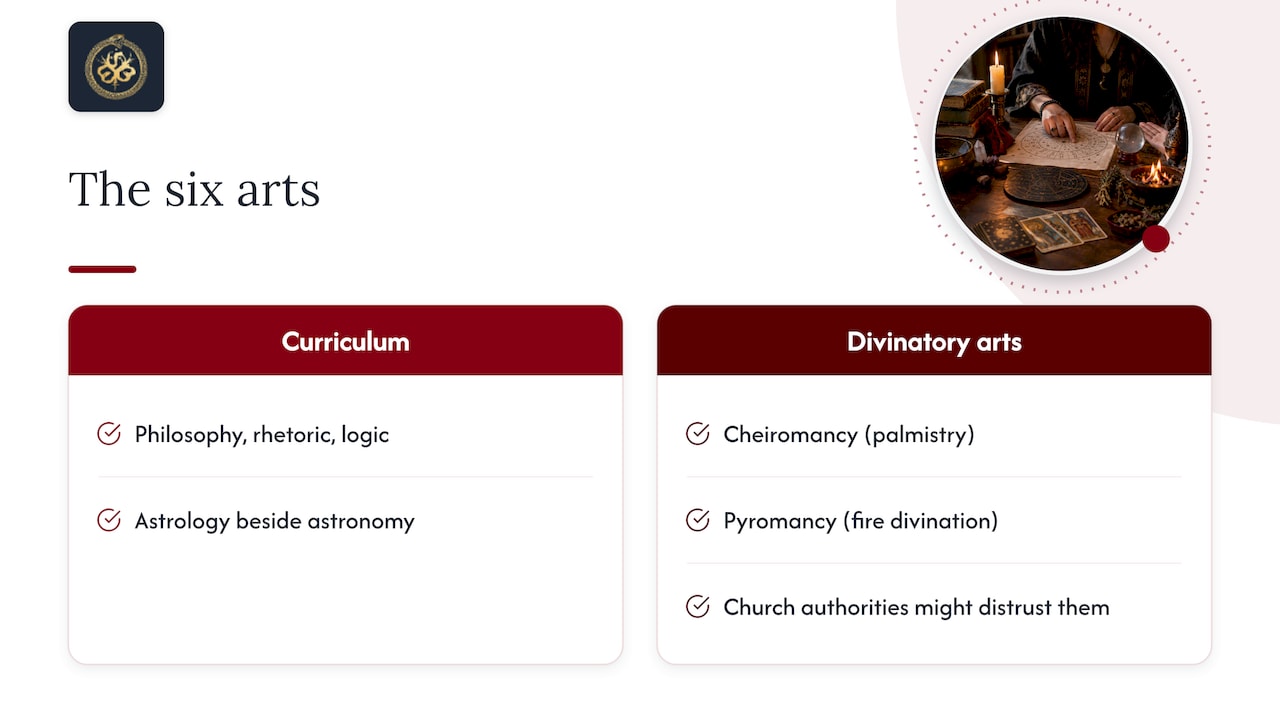
Putting them in one list reflects a period when the line between sanctioned academic study and suspect divination was less fixed than it later became. Furcas is the spirit who covers both sides of that line: the lecture hall and the fire.
Where the name and the figure come from
Furcas has no surviving myth-cycle of his own. His written trail is early-modern.
The earliest written trace is in the sixteenth-century demonologies. Johann Weyer’s Pseudomonarchia Daemonum, printed in 1577 as an appendix to his De praestigiis daemonum, lists Furcas as a knight who appears as a cruel, grey-haired man on a pale horse, teaches practical philosophy, rhetoric, logic, astronomy, chiromancy and pyromancy, and commands twenty legions. In Weyer’s numbering, Forras (also written Forcas) is entry 29 and Furcas is entry 39. The Goetia later maps those two entries onto Foras and Furcas. Reginald Scot carried the same entries into English in his Discoverie of Witchcraft (1584).
Furcas and Foras
The two names are close enough that the entries were tangled. Weyer gives the President as “Forras, or Forcas,” and the Knight as Furcas, so a copyist working from one name could easily land on the wrong spirit. The Goetia settles them as two: Foras, the President at number 31, and Furcas, the Knight at number 50.
This is why the older books show a tangle of spellings, and why a reader who sees “Forcas” in an older text should check which of the two spirits is meant. For a working practitioner the lesson is practical: confirm which text your edition derives from before you build a ritual on a detail.
The name
The name may derive from the Latin furca, a fork, or from a Greco-Roman term meaning a sepulchre or tomb. Neither is established, and the link to furca is best held as an interpretive etymology. The fork is attractive as an image, since it suggests a division or a choice, but it is an image and not a fact.
What is evidence and what is speculation
Here is what the written record supports, and what it does not.
| Claim | Status |
|---|---|
| Furcas is the 50th spirit of the Ars Goetia, a Knight with 20 legions | Stated in the grimoire |
| He appears as a cruel old man on a pale horse | Stated in the grimoire and in Weyer |
| He teaches philosophy, astrology, rhetoric, logic, cheiromancy, pyromancy | Stated in the grimoire |
| He is the only Knight in the Goetia | Stated in the grimoire’s classified list |
| He was confused with Foras in earlier editions | Documented textual history |
| He descends from an ancient deity or pre-Christian spirit | Not supported by surviving evidence |
| He is a biblical demon or had an ancient cult | Not supported |
| He has a Saturn association | A choice of particular modern systems, not the grimoire |
| He originates on another planet or planetary system | No textual basis |
The surviving grimoires do not record Furcas as an ancient deity, a pre-Christian spirit, a biblical demon or the object of an ancient cult. On paper he is a figure of the early-modern European grimoire tradition, and no record shows a public cult of him specifically. His written identity took shape through copying, rearrangement and reinterpretation, from Weyer and Scot to the Lemegeton.
Many practitioners hold that the spirits of the Goetia are far older than the books that name them, and that belief stands on its own as personal gnosis. In Furcas’s case the paper trail starts in the sixteenth century, so anything earlier comes from contact rather than from the manuscripts.
The planetary attributions work the same way. One modern system lists Furcas under Saturn, while another pairs the Goetic spirits with the zodiacal quinaries and their angels. These are layers of correspondence built on top of the original entry. They can be useful, but they are constructed, and two systems may disagree.
How modern practitioners understand him
The grimoire gives a cruel old man. Contemporary demonolatry gives something different. Practitioners who work with Furcas describe him as a strict and demanding teacher, and they reinterpret his cruelty as intellectual severity: a mentor who will not flatter, who marks your errors, and who expects the work to be done properly. He is approached to strengthen psychic ability and to master the divinatory arts, a common thread in demonolatry practice.
The strict-teacher personality comes from practice, not from the historical entry, which is too brief to give him much temperament at all. Those first-person accounts are worth having. Compare them, test them, and keep them in a separate column from the text.
The sharp weapon
The weapon in his hand is often read as a tool of logic, a blade that separates sound arguments from fallacies. The grimoire does not say so. As a working frame, though, it is productive. It tells you what kind of request suits him: questions that need cutting, distinguishing and judging.
Working with Furcas: a practical method
The grimoires do not give a full operating procedure for Furcas, so what follows is a method of practice built from the entry’s content, the spirit’s listed arts, and standard ceremonial structure. Treat it as a framework to adapt and record results against.
1. Define the subject
The entry gives you six arts, and a vague request will not engage them. Pick one: a logic problem, a rhetorical skill, a divinatory system, a body of philosophy. Write one sentence stating what competence you want in ninety days and how you would recognize it. A request that cannot be tested cannot be assessed.
2. Do the reading first
Because the teaching is described as covering these arts in all their parts, approach him as a student who has already started. Read the primary entries (the Goetia and Weyer) before any working. Then read in the discipline itself. If your subject is rhetoric, read a classical treatise. If it is palmistry, learn the standard line and mount vocabulary. If it is logic, work through syllogisms and common fallacies. An old man with a sharp weapon who teaches logic is unlikely to be impressed by a student who skipped the primer.
3. Build the setting
The description supplies the imagery: an aged figure, a pale horse, a weapon, fire as one of his mediums. Pyromancy is on his list, so a single flame is a natural focal point. A candle, a bowl of coals or a lamp will serve. Pale tones suit the horse. Keep the table plain and the room quiet. If you use a sigil, take it from the edition you have verified, since editions differ.

Before you begin, clear the space in the Solomonic manner: define the space, set a boundary, then proceed. The conjuring method from the Goetia gives the full traditional frame if you want to work it formally.
4. Open with a plain statement
Address him by rank and function: Knight Furcas, teacher of the six arts. State your name, your subject and your intent in short sentences. Avoid flattery, which his modern reputation suggests he would disregard, and avoid demands. A direct, structured statement matches both the historical description and the contemporary reports.
5. Study inside the working
This is the stage most practitioners underuse. After the statement, do the thing you asked to learn, in the room, for a fixed period. A palmistry student reads a set of hand photographs and records predictions. A logic student works problems. A rhetoric student delivers a short argument aloud. Then stop, sit in silence for several minutes, and write down whatever comes: images, phrasing, corrections, impressions. Record them without editing.
6. Close and review
Thank him, close the working, extinguish the flame. Within a day, reread your notes against the work itself. Mark what proved accurate, what was wrong and what cannot be checked. Over several weeks, a pattern of impressions that improves your measurable performance is evidence. A pattern that does not is also evidence. Keep a ledger.
Case examples
These are illustrative scenarios, not reported results.
The attorney preparing for oral argument. A litigator wants to tighten her cross-examination technique. Her subject is logic and rhetoric: finding the weak inference in a witness’s account. She spends two weeks reading on informal fallacies, then holds a weekly working in which she rehearses a mock cross, records herself and writes down the points where her reasoning slipped. The working supplies the discipline, the schedule and a ritual frame that makes her take the practice seriously. The improvement shows up in the recordings, not in the candle.
The reader building a palmistry practice. A tarot reader wants a second divinatory system. She chooses cheiromancy, one of the six arts. She learns the main lines, practices on friends, and logs each reading with a date so she can later check which statements held up. The working is a short monthly session of the same structure as above. Her record lets her measure her hit rate over a year.
The doctoral student with a stalled argument. A philosophy student has a dissertation chapter that will not hold together. He treats Furcas as a patron of severity: he sets one evening a week, lights a single flame and reads the chapter aloud, cutting any sentence he cannot defend. The spirit’s reputation as a harsh teacher gives him permission to be harsh with his own prose, and the chapter gets shorter and sharper.
The practitioner of pyromancy. Fire divination has little modern literature. A practitioner decides to rebuild the method by systematic observation, recording flame behavior, smoke direction and ash patterns across fifty sessions alongside the questions asked and later outcomes. Furcas is the natural patron. The log is what turns the art into something that can be studied.
The common feature is a concrete deliverable inside a fixed period. Real-world action and the working support each other.
Perspective: severity as a teaching method
We read Furcas as an instructive case for the whole Left-Hand Path because he exposes a confusion between harshness and harm. The grimoire calls him cruel in appearance. Modern practitioners who work with him report rigor. Those are two readings of the same text.
Our view is that the most useful way to approach him is as a figure of discipline. Sovereignty, which sits at the center of our practice, does not come from being comforted. It comes from being able to think clearly, argue well, perceive accurately and hold a standard when nobody is watching. A spirit whose entire curriculum is logic, rhetoric, philosophy and divination is a spirit of exactly those skills.
We also hold that the historical record should be kept clean. Furcas is an early-modern grimoire figure. Anyone who writes that he is a Sumerian god or a visitor from another star system is making a claim the manuscripts do not support. That does not forbid personal gnosis. It requires you to call it that. A practitioner who can say “the text says this, tradition says that, and I experienced this” has three separate columns, and the practice is stronger for it.
We also find that energy and ritual work function best when attached to a measurable discipline. Furcas is easy to pair with one, since his subjects are testable arts. Use that.
Black Witch Coven
Where to continue
If you want a guided reading with a Left-Hand Path practitioner on which spirit suits a particular goal, our Left-Hand Path readings cover exactly that. For ongoing structured work, the monthly ritual subscriptions run on a regular lunar cycle, and the demon work category gathers our daemonic workings in one place.
Frequently asked questions
Who is Furcas in the Ars Goetia?
Furcas is the fiftieth of the seventy-two spirits and the only one with the rank of Knight. He commands twenty legions and teaches philosophy, astrology, rhetoric, logic, cheiromancy and pyromancy. The grimoire describes him as a cruel old man on a pale horse holding a sharp weapon.
Is Furcas the same as Foras?
No, but the two were tangled in the early books. Weyer’s list has Forras or Forcas as entry 29 and Furcas as entry 39, and earlier editions sometimes linked or confused them. Later editions, and the Goetia, treat them as separate spirits.
Is Furcas an ancient god?
The surviving evidence does not show it. Furcas appears in early-modern European grimoires and demonological catalogues, with no securely established pre-Christian origin, biblical identity or ancient cult. Any older lineage comes from personal gnosis rather than the manuscripts.
What is Furcas associated with in modern practice?
Contemporary demonolatry practitioners approach him for divinatory skill, psychic development and the mental arts. They describe him as a strict, demanding teacher whose severity is intellectual rigor. That personality is a modern interpretation and not part of the historical entry.
