
Blog, Demons, Working With Demons
Foras Demon: History, Seal and How to Work With Him
Oct
Foras is the thirty-first spirit of the Ars Goetia, a Mighty President of Hell who commands twenty-nine legions and appears as a strong man in human shape. His gifts are unusual for the catalog. He teaches logic and ethics, explains the virtues of herbs and precious stones, and is said to grant eloquence, invisibility, and long life. He is the grimoire’s tutor more than its fighter. His full entry is on our Foras Demon Directory page.
Below: what the sources say about him, how he gets confused with Forcas, what each of his gifts means in practice, and a six-step method for working with him.
Who Foras is at a glance
| Detail | What the sources say |
|---|---|
| Position in the Goetia | 31st of 72 spirits |
| Rank | Mighty President |
| Command | 29 legions of spirits |
| Appearance | A strong man in human shape |
| Teaches | Logic and ethics in all their parts, the virtues of herbs and precious stones |
| Other attributed gifts | Invisibility, eloquence and wit, long life, finding treasure and lost things |
| Earlier spellings | Forras, Forcas (confused with a separate spirit), Forrasis |
The Goetia passage names him a Mighty President, describes his human form, and then lists what he can give: logic and ethics in all their parts, the virtues of herbs and stones, wit and eloquence, invisibility, long life, and the finding of treasure and lost things.
He has no planet assigned to him and no role as a destroyer. What the grimoire gives him is knowledge, and that tells you what kind of work he suits. He sits among the demons who help with stones, plants, and animals.
Where Foras comes from
Which version of a spirit you meet depends on which text you read, so it helps to know the paper trail.
The spirit names in the Lesser Key of Solomon come partly from Johann Weyer’s Pseudomonarchia Daemonum, printed as an appendix to the 1577 edition of his De praestigiis daemonum. Weyer was working from older manuscripts. A Cambridge manuscript (Trinity College O.8.29) shares 35 of its demons with Weyer and has 15 that Weyer doesn’t. The list was already changing before it was printed.
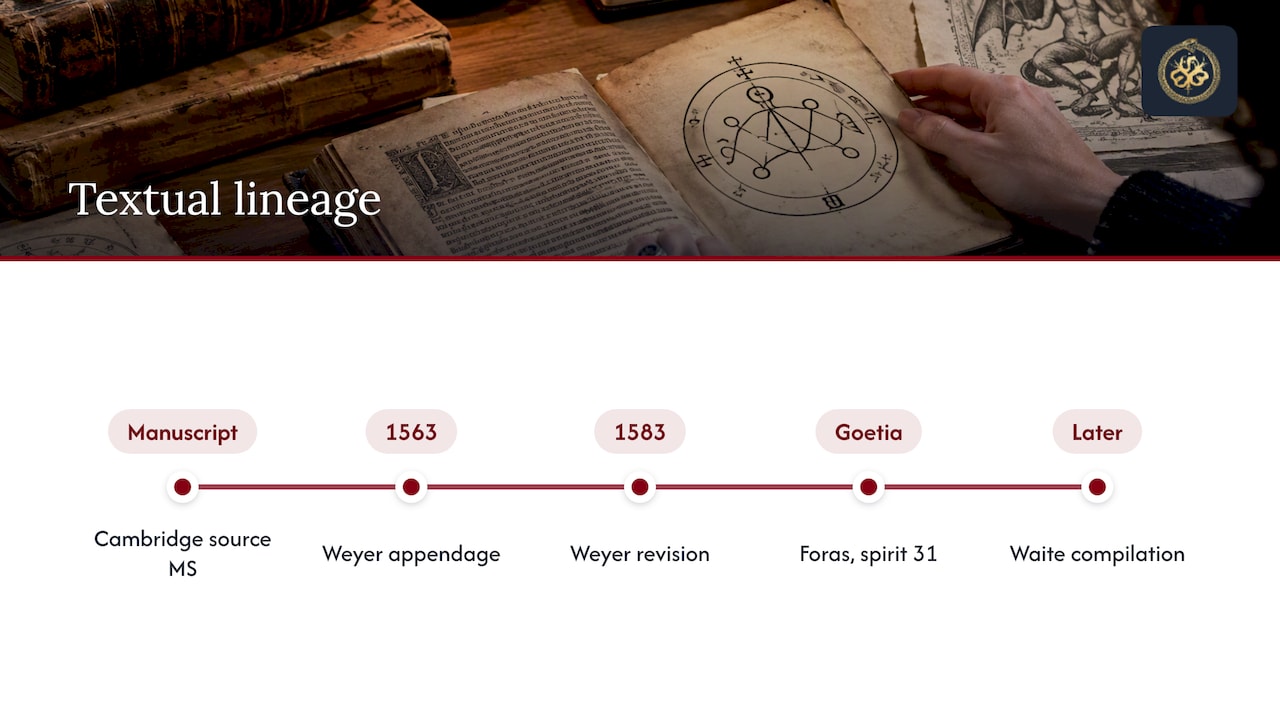
The Goetia most practitioners use today, the Mathers and Crowley edition, lists Foras at number 31, teaching logic and ethics and, if desired, making men invisible. A. E. Waite’s Book of Ceremonial Magic gives another version, with his seal.
Your working material, then, is the grimoire text, the seal, and the tradition of practice built on them. You can always point to the source of what you use.
The Forras, Forcas and Furcas confusion
Foras is often merged with Furcas (also written Forcas), the Knight of Hell. The names are close, their arts overlap, and the old books themselves mixed them up. Weyer heads the President’s entry “Forcas, or Forras,” then lists Furcas separately as a Knight teaching philosophy, astronomy, rhetoric, logic, palmistry, and pyromancy. Reginald Scot copied both entries into his Discoverie of Witchcraft in 1584, so the overlap travelled into English. Furcas has his own Demon Directory page.
- Foras: President, 29 legions, appears as a man, teaches ethics, logic, herbs, and stones.
- Forcas/Furcas: Knight (the only spirit with that rank), a wider set of arts including astronomy, palmistry, and pyromancy.
In your own records, note which text you were following when you made an offering or wrote down an experience. That way you won’t end up crediting the same contact to two different names.
What the gifts mean
Logic and ethics
He teaches both “in all their parts.” To a Renaissance reader, logic was the art of building an argument and ethics was the study of how to act. Together they describe a spirit who helps you think clearly under pressure: building a case, finding the flaw in a plan, deciding what you owe and to whom.
Call on him when clear thinking is what’s holding you back: a contract negotiation, a thesis, a dispute where emotion keeps overriding the facts. His gifts are about the quality of your own judgment, so he is not the spirit for love or for bending someone else’s will.
Herbs and precious stones
The hidden virtues of plants and minerals are the foundation of sympathetic magick. If you make candle work, mojo bags, oils, or jar spells, you are already working in the territory Foras governs. This is the most immediately useful part of his profile for anyone doing Hoodoo or folk magick.
Ask him to teach you correspondences through study as well as vision. Take one herb, learn its documented uses and its traditional magickal use, and compare what you find with what comes to you in the working.
Invisibility
In Renaissance magick, invisibility usually meant passing unnoticed: escaping the attention of enemies, creditors, or the law. Practitioners today use it for discretion work, such as lowering your profile, keeping a private matter private, or getting through a hostile workplace without becoming a target.
Eloquence, wit, and long life
He can make a person witty and eloquent, which suits speeches, interviews, sales, and negotiations. Long life belongs with the herbs and stones: the same knowledge was the basis of the period’s medicine and longevity lore.
Treasure and lost things
The Goetia also credits him with finding treasure and recovering lost things. Today that translates well into finding what you already have but have lost sight of: a forgotten contact, an unused skill, an overlooked line in a contract.
A worked method: approaching Foras for study and judgment
This method is built from his documented gifts. Adapt it to your own practice.
Step 1: Choose one problem in his territory
Good fits: preparing for a hard exam or certification, learning plant or stone lore, building a legal or business argument, or staying unnoticed in a difficult environment. Poor fits: anything that depends on another person’s will.
Step 2: Prepare the text and the seal
Read the Goetia entry and compare it with at least one other edition, so you know the wording you are relying on. The conjuring method from the Goetia gives the full ritual frame if you want it. Copy his seal by hand onto parchment or heavy paper. Copying by hand makes you attend to every line of the shape, and that attention is what charges a seal.
Step 3: Set the conditions
Work at the same time each session, in a clean space, with a single candle and an incense or herb you have studied and can name. Keep offerings small and sincere: water, wine, a plant, or a written promise to finish the study.
Step 4: State the request in his terms
Frame it as an exchange of knowledge. For example: “Show me the structure of this argument and where it fails,” or “Teach me the properties of these three herbs, and I will test them against the sources.” Be exact. Vague requests are the most common reason a working falls flat.
Step 5: Record and test
Keep a dated journal: what you did, what you perceived, what you did afterwards, and what changed. Then test what you received. If he gave you something about an herb, look it up. If he gave you an argument, run it past someone who will push back.
Step 6: Repeat on a schedule
Foras is a teacher, and you meet a teacher more than once. A weekly session for six to eight weeks shows you whether the relationship is working. Then stop and take stock.
Working with spirits of knowledge
The same method works for the other teaching spirits in the Goetia: read the primary text, compare editions, pick the one gift you need, and test the results. Our guide to demons associated with specific powers shows who holds which gift. To go deeper into the catalog, The Goetia Devils is a good companion.
If you would like guidance before choosing a spirit, or want to know whether Foras is right for your situation, book one of our Left-Hand Path readings.
Frequently asked questions
Who is Foras?
Foras is the thirty-first spirit of the Ars Goetia, a President of Hell with twenty-nine legions who teaches logic, ethics, and the virtues of herbs and stones.
Is Foras the same as Forcas?
No, though the early books confused them. Weyer gives “Forcas” as another name for the President Foras and lists Furcas as a separate Knight of Hell. Modern Goetia editions list Foras as a President and Furcas as a Knight, with different arts.
What can Foras help with?
Study, exams, arguments and negotiations, plant and stone lore, eloquence, and discretion. The Goetia also credits him with long life and finding lost things. He is not a spirit of love or destruction.
