
 New Years Eve Ritual 2026/2027 with Savannah
FORAS
Foras is the thirty-first spirit of the Ars Goetia, a Mighty President who rules twenty-nine legions and appears as a strong man in human shape. He gives understanding of the virtues of all herbs and precious stones, teaches logic and ethics in all their parts, and, if desired, makes people invisible, long-lived and eloquent. He also discovers treasure and recovers lost things. He is the grimoire’s tutor more than its fighter, and for anyone who works with oils, roots, stones and powders he governs the ground you already stand on.
Foras at a glance
- Number: 31st of the 72 spirits of Solomon
- Rank: Mighty President
- Legions: 29
- Appearance: a strong man in human shape
- Other spellings: Forras, Forcas (not to be confused with Furcas, the Knight)
What the Goetia says
The entry lists more gifts than most:
- The virtues of herbs and precious stones. Not just their names, but what they do.
- Logic and ethics, in all their parts. How to build an argument, and how to judge what to do.
- Invisibility, if desired.
- Long life and eloquence.
- Treasure and lost things. He discovers the one and recovers the other.
Weyer adds that he makes a man witty as well as eloquent. What is missing is just as telling. He has no destructive office, no power over love, and no talent for bending another person’s will. Everything he gives improves the magician: knowledge, judgment, speech, discretion, health. That tells you what kind of work he suits.
Where Foras comes from
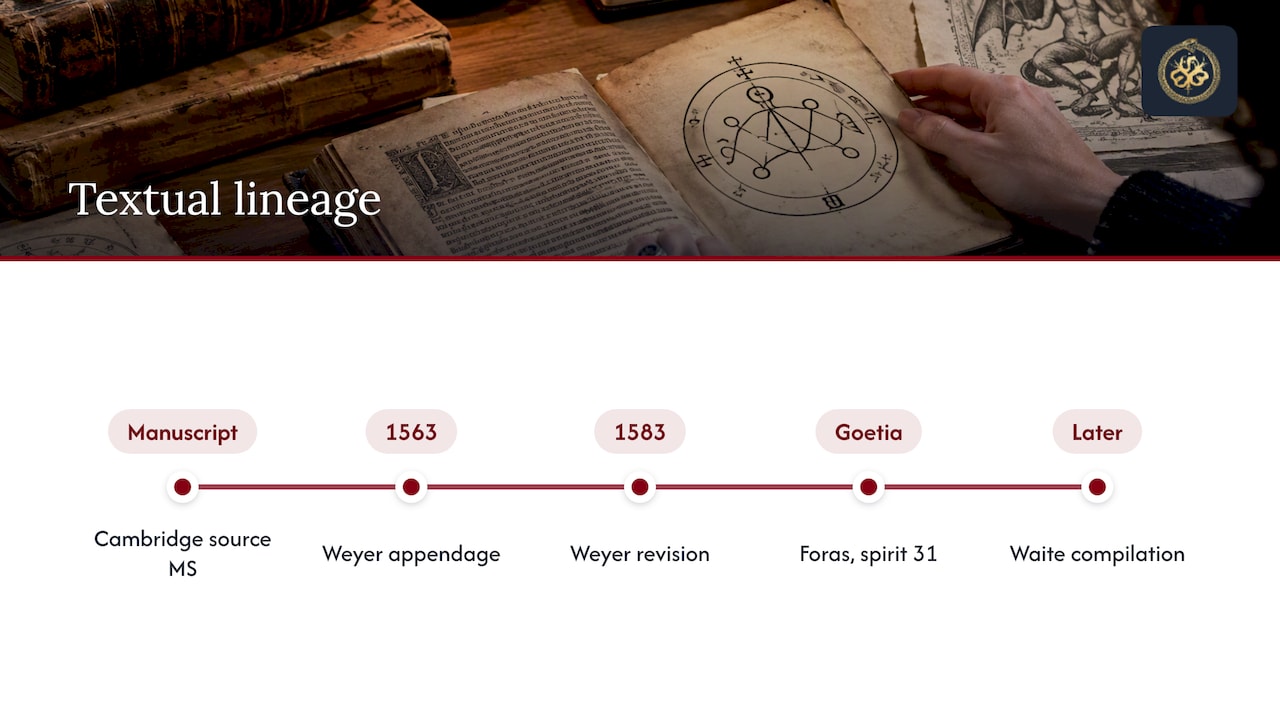
His first printed appearance is in Johann Weyer’s Pseudomonarchia Daemonum (1577), as “Forras, or Forcas”, a great president in the form of a strong man, followed by Reginald Scot’s English version in 1584. The Ars Goetia, the first book of the Lemegeton compiled in the seventeenth century, keeps the description almost word for word and places him at number 31. Weyer was working from older manuscripts, and the list was already shifting before it was printed: a Cambridge manuscript (Trinity College O.8.29) studied by Jean-Patrice Boudet shares thirty-five of its demons with Weyer and has fifteen that Weyer lacks.
Foras, Forcas and Furcas
Because Weyer gives Forcas as another name for Foras, and also lists a separate spirit called Furcas, the two are constantly merged. The names are close and their arts overlap, since both teach logic. The Goetia keeps them apart:
- Foras: number 31, President, 29 legions, a strong man; logic, ethics, herbs, stones, invisibility, long life, eloquence, treasure and lost things.
- Furcas: number 50, Knight (the only one), 20 legions, a cruel old man on a pale horse; philosophy, astrology, rhetoric, logic, palmistry and pyromancy.
When you record an offering or an experience, note which text and which name you were working from, so you do not credit one contact to two spirits.
What his gifts mean in practice
Herbs and stones. The hidden virtues of plants and minerals are the foundation of sympathetic magick. If you dress candles, make oils, fill mojo bags or build jar spells, you are already working in his territory. This is the most immediately useful part of his profile for anyone doing Hoodoo or folk magick. He is listed among our demons who help with stones, plants and animals.
Logic and ethics. To a Renaissance reader, logic was the art of building an argument and ethics the study of how to act. Call on him when clear thinking is what is holding you back: a negotiation, a thesis, a dispute where emotion keeps overriding the facts.
Invisibility. In the old magick this usually meant passing unnoticed: escaping the attention of enemies, creditors or the law. Today it is discretion work: lowering your profile, keeping a private matter private, getting through a hostile workplace without becoming a target.
Eloquence and long life. Eloquence suits speeches, interviews, sales and negotiations. Long life sits naturally beside the herbs and stones, which were the basis of the period’s medicine and longevity lore.
Treasure and lost things. Literally, the recovery of what is missing. In a working life, finding what you already have but have lost sight of: a forgotten contact, an unused skill, an overlooked clause.
Benefits people seek
- Knowledge of herbs, roots and stones for spellwork and oils.
- Clear judgment and sound argument for exams, disputes and negotiations.
- Eloquence and wit.
- Invisibility and discretion.
- Health and long life.
- Recovery of lost things and discovery of hidden treasure.
Working with Foras
The Goetia gives his seal and offices, not a modern ritual. The structure below is how we approach him.
1. Choose one problem in his territory. A hard exam, a body of plant or stone lore, a legal or business argument, a need to stay unnoticed, something lost. Poor fits: anything that depends on another person’s will.
2. Prepare the text and the seal. Read his entry in the Goetia and in Weyer, so you know the wording you are relying on. Copy his seal by hand onto parchment or heavy paper; the attention you give every line is part of what charges it.
3. Set the conditions. Work at the same time each session, in a clean space, with a single candle, his seal, and an herb, root or stone you have studied and can name. Keep offerings small and sincere: water, wine, a plant, or a written promise to finish the study.
4. Call him. Many in our tradition first approach him through Satan or Lucifer, with a petition such as:
“Lord Lucifer, light-bearer, by your grace grant me the power to conceive in my mind and to carry out that which I desire, the end I would reach by your help. I ask you to move Foras to come before me, that he may teach me truly and help me reach my desired end, provided it is proper to his office. This I ask in your name, Lord Lucifer.”
5. State the request in his terms. Frame it as an exchange of knowledge: “Show me the structure of this argument and where it fails,” or “Teach me the virtues of these three roots, and I will test what you give me.” Be exact; vague requests are the commonest reason a working falls flat.
6. Close and record. Thank him, give the offering and dismiss him with respect. Keep a dated journal of what you asked, what you perceived and what you did afterwards, then test it. If he gave you something about an herb, check it in the sources and in practice. If he gave you an argument, put it before someone who will push back.
7. Repeat on a schedule. He is a teacher, and you meet a teacher more than once. A weekly session for six to eight weeks shows whether the relationship is working. Then stop and take stock.
Black Witch Coven’s view
Foras is one of the most practical spirits in the Goetia for a working witch, and one of the most overlooked, because nothing in his entry is dramatic. But the virtues of herbs and stones are the backbone of every oil, powder and candle on an altar, and judgment is what separates a magician who gets results from one who repeats the same mistakes with better candles. Approach him as a student who has already started. Learn the plant, read the text, build the argument, and bring him the work you have done. A teacher responds to effort.
If you would like guidance before choosing a spirit, book one of our Left-Hand Path readings or a Demonic Tarot Reading. To study the catalogue more deeply, The Goetia Devils is a good companion, and our daemonic spell casting is there if you would rather have the work done for you. As with all magick, results are never guaranteed.
Similar spirits
- Furcas: the Knight, teacher of philosophy, logic and divination
- Buer: teaches philosophy and logic, and the virtues of herbs
- Marbas: teaches the mechanical arts, causes and cures disease
- Bifrons: knows the virtues of precious stones and woods
- Andromalius: recovers stolen goods and discovers hidden treasure
Sources
| Pseudomonarchia Daemonum, Johann Weyer (1577), in Reginald Scot’s English (1584) | “Forcas is a great president, and is seene in the forme of a strong man, and in humane shape, he understandeth the vertue of hearbs and pretious stones…” |
| The Lesser Key of Solomon (Goetia), ed. S. L. MacGregor Mathers (1904) | “The Thirty-first Spirit is Foras. He is a Mighty President, and appeareth in the Form of a Strong Man in Human Shape…” |