
 New Years Eve Ritual 2026/2027 with Savannah
FOCALOR
Focalor is the forty-first spirit of the Ars Goetia, a Great Duke, mighty and strong, who appears as a man with gryphon’s wings. His office is to kill men and drown them in the waters and to overthrow ships of war, for he has power over both winds and seas. Yet his own entry hands the magician the leash: he will not hurt any man or thing if he is commanded to forbear. He hopes to return to the Seventh Throne after a thousand years. He is raw, destructive water and weather that answers to a disciplined will.
Focalor at a glance
- Number: 41st of the 72 spirits of Solomon
- Rank: Great Duke, mighty and strong
- Legions: 30 in most lists; some versions give 3
- Appearance: a man with gryphon’s wings
- Other spellings: Forcalor, Furcalor
What the Goetia says
- He slays men and drowns them in the waters.
- He overthrows ships of war.
- He has power over winds and seas.
- He will harm no one if commanded to forbear. The restraint clause is part of his description, not an afterthought.
- He hopes to return to the Seventh Throne after a thousand years. Weyer adds that he is deceived in this hope.
Most Goetic spirits are described by what they give. Focalor is described by what he does and by what he can be told not to do. That puts the whole weight of the working on the magician’s clarity. The last line matters too: he is a fallen spirit with a long memory and an unmet expectation. He is patient, he is bound to a timeline, and he wants something. Take that seriously when you bargain with him.
Where Focalor comes from
His first printed appearance is in Johann Weyer’s Pseudomonarchia Daemonum (1577) under the spelling Forcalor, followed by Reginald Scot’s English version in 1584. Weyer already has the man with gryphon’s wings, the drowning, the overturned warships, the power over winds and seas, and the hope of the Seventh Throne. The Ars Goetia, the first book of the Lemegeton compiled in the seventeenth century, carries the entry over with the spellings Focalor, Forcalor and Furcalor and fixes him at number 41. Colin Campbell has argued that the Goetia itself is stitched together from three separate manuscript sources, and the copies disagree in small ways, including the legion count and the wording about the ships. Read at least two witnesses side by side before you draw his seal.
Focalor and Lucifuge Rofocale
A persistent modern claim says that “Rofocale” is an anagram of Focalor, making the two the same spirit. The letters are close, but there is no documented link. Lucifuge Rofocale belongs to the Grand Grimoire, a French black magick handbook, and does not appear in the Goetia at all. Work Lucifuge through the Grand Grimoire’s own procedures and Focalor through the Goetia and Weyer. Mixing the two because the names rhyme gives a muddled rite.
What Focalor is for
Elemental command. In his own century, winds and seas meant weather, passage, shipwreck and the fortunes of anyone who depended on water. In a modern life the same logic covers flows: shipping, trade, travel, logistics, anything that moves through a medium you cannot control directly.
Destruction. The grimoire gives him killing and drowning in plain words, and the ruin of an enemy’s fleet. He is called on to sink what an enemy has launched: their campaign, their venture, their advance.
Destruction on a leash. A spirit who can sink a fleet and can also be told to spare it is a spirit whose most valuable work may be force applied exactly where you say and nowhere else. Some modern writers extend the forbearance clause into protection: turning hostile forces aside like a swell around a breakwater. That is a reasonable extension, but it is an extension, and the grimoire does not mention psychic defence.
Correspondences. Modern systems disagree. Some give him Venus on account of his ducal rank; others prefer Mercury or Neptune-ruled Pisces for his fluid, maritime nature. None of this is in the grimoire. Choose one system and keep it consistent so you know what you are testing.
Benefits people seek
- The ruin of an enemy’s venture: their ships, literally or otherwise, overturned.
- Control of passage: shipments, travel and anything that moves by water or wind.
- Turning aside hostile forces, in the protective reading.
- Precise, contained force, using the clause that lets you limit his harm.
- Moving through upheaval, in the modern Pisces reading.
Working with Focalor
The Goetia gives his seal and offices, not a modern ritual. The structure below is how we approach him.
1. Frame one narrow request. Passage, obstruction, an enemy’s venture sunk, a hostile force turned aside. One problem at a time, in one concrete sentence with a time limit.
2. Prepare the seal. Copy it by hand from a manuscript-based source, in a single sitting, and write his three spellings on the same sheet.
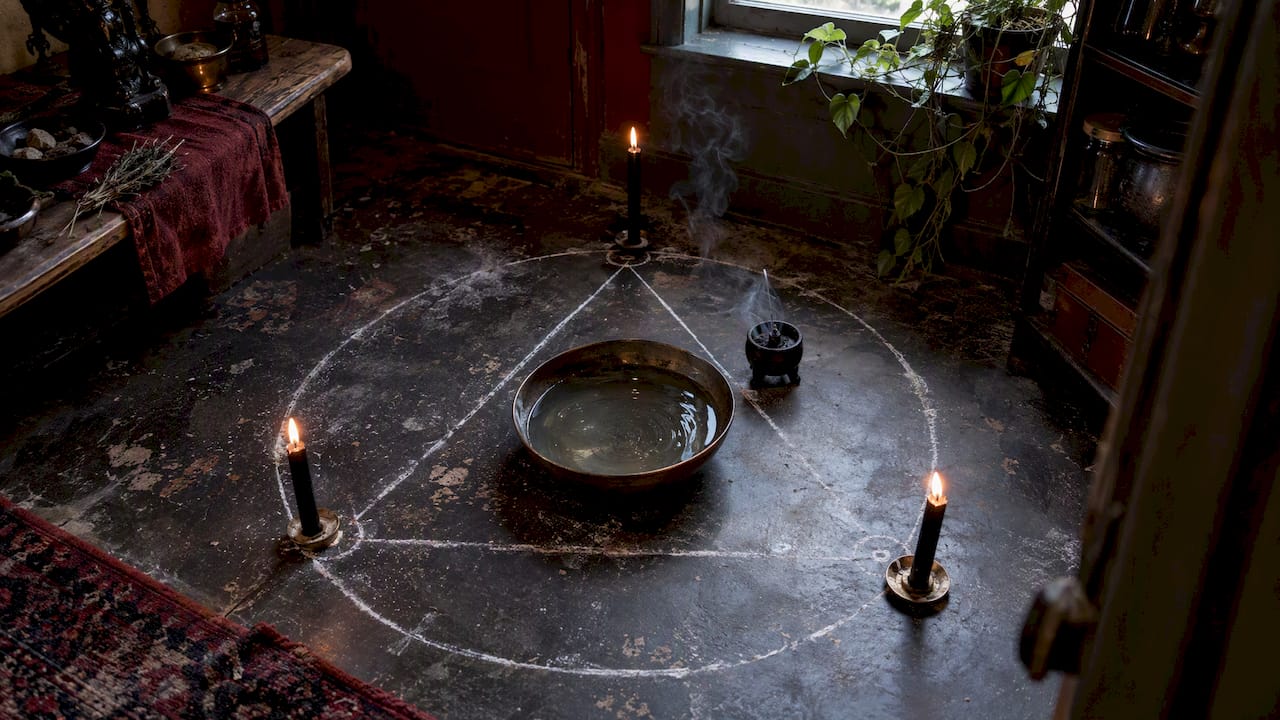
3. Prepare the space. Mark a triangle for him outside your working area with the seal inside. Keep a candle, incense and a bowl of water on the altar: a small sea in the room, and a fitting focus for this spirit. A black mirror suits scrying.
4. Call him. Address him by rank and names: Focalor, Forcalor, Furcalor, Great Duke. Know the form you expect, a man with gryphon’s wings, so you notice what does not match. Many in our tradition first approach him through Satan or Lucifer, with a petition such as:
“Lord Satan, by your grace, grant me the power to conceive in my mind and to carry out that which I desire, the end I would reach by your help. I ask you to move Focalor to come before me, that he may turn his winds and waters to my end and spare all that I do not name, provided it is proper to his office. This I ask in your name, Lord Satan.”
5. Set his limits first. This is the step his own text builds in. Before you state the request, say plainly what he is to leave untouched: you, your household, and anyone not named. Then aim him.
6. State the request and the terms. One sentence, concrete, with a time limit, and what you give in return. Record impressions, images and sensations during the rite, not afterwards.
7. Dismiss and review. Thank him, give the offering and license him to depart. Read your notes within the hour. After the time limit, compare outcomes against the request, and pair the rite with action in the world.
How it looks in practice
These are illustrations, not client cases.
- The logistics manager facing repeated delays at a port asks that one set of shipments move without interference for four weeks, logs container release dates, and compares them with the four weeks before.
- The man under attack from a rival commands Focalor to forbear against anyone not involved, asks for the rival’s pressure to be overturned, and at the same time documents every incident and locks down his accounts.
- The woman leaving a career and a marriage in the same year works with the modern Pisces reading, asking not to force an outcome but for clarity on which commitment to release first, and records one decision made after each session.
Black Witch Coven’s view
We approach Focalor as a spirit of controlled force. What makes him workable is the one clause that says he does what he does unless told otherwise. A vague magician gets a vague storm. A clear one gets the wind exactly where it was aimed. That is sovereignty in practice: you set the terms, you name what is spared and what is not, you dismiss him, and you review what happened. And know his history: his name runs through Weyer before the Goetia, the manuscripts disagree, and the Rofocale link is conjecture. Do not build a practice on borrowed certainty.
If you would rather have the working done for you, see our Protection Reversal Magick, our Chaos Magick Ritual for Cursing and the rest of our daemonic spell casting. As with all magick, results are never guaranteed.
Similar spirits
- Vepar: governs the waters, raises storms at sea and guides ships of war
- Crocell: speaks of hidden things and makes the sound of rushing waters
- Leviathan: the great serpent of the sea
- Haures: burns up the magician’s enemies
- Lucifuge Rofocale: the Grand Grimoire’s prime minister, often wrongly merged with Focalor
Sources
| Pseudomonarchia Daemonum, Johann Weyer (1577), in Reginald Scot’s English (1584) | “Forcalor is a great duke, he commeth foorth in the likenes of a man, with the wings of a griphen, he killeth men, and drowneth them in the waters…” |
| The Lesser Key of Solomon (Goetia), ed. S. L. MacGregor Mathers (1904) | “The Forty-first Spirit is Focalor, or Forcalor, or Furcalor. He is a Mighty Duke and Strong. He appeareth in the Form of a Man with Gryphon’s Wings…” |