
 New Years Eve Ritual 2026/2027 with Savannah
VASSAGO
Vassago is the third spirit of the Ars Goetia, a Mighty Prince who rules twenty-six legions. The grimoire calls him “of the same nature as Agares” and “of a Good Nature,” and gives him two offices: to declare things past and to come, and to discover all things hidden or lost. He has no destructive or binding office. He is a spirit you consult, which makes him one of the best spirits to begin with and one of the most useful to return to before any larger working.
Vassago at a glance
- Number: 3rd of the 72 spirits of Solomon
- Rank: Prince
- Legions: 26
- Appearance: not described in the Goetia
- Other spellings: Usagoo, Vsagoo, Vzago
What the Goetia says he does
The entry is among the shortest in the book, and three details stand out.
Rank. A Mighty Prince sits in the upper tier of the Goetic hierarchy, with his own twenty-six legions and a defined sphere of service.
Nature. “Of a good nature” is rare in the Goetia. Most entries stress danger, deception or the need for firm control; his does not. This describes how he behaves towards the magician, not a human moral code, and it does not mean he will do whatever you ask. What it does mean, in our experience, is that he answers plainly within his offices.
Office. Both functions are about information: telling what was and what will be, and finding what is missing, whether an object, a document, a truth or a person’s real motive.
Where Vassago comes from
Vassago is not in Johann Weyer’s Pseudomonarchia Daemonum (1577) or Reginald Scot’s English version. Joseph Peterson’s notes on the Goetia record the variant Vsagoo in the Folger manuscript, and the later Lemegeton tradition includes him as spirit number three. His documented history is therefore a manuscript lineage of the seventeenth century and after, assembled from older material. Claims that the name descends from a Babylonian or Hebrew god have no textual support.
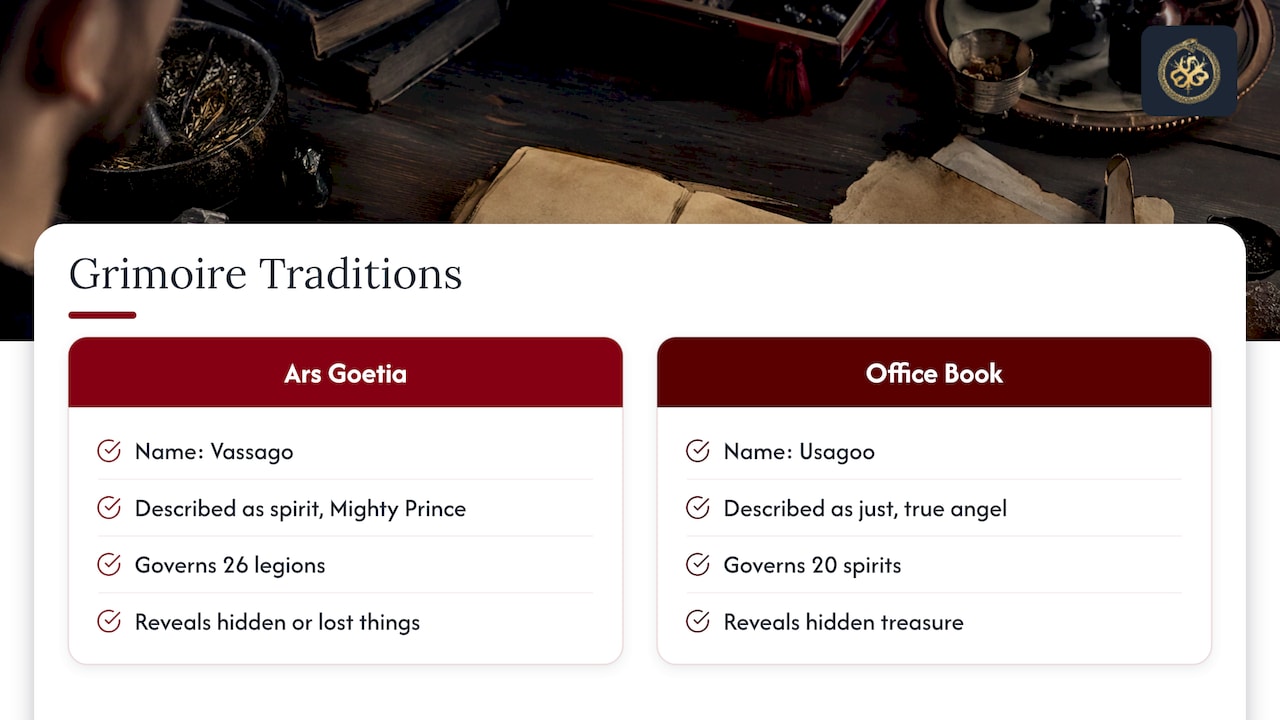
A related text, the Book of the Office of Spirits, describes a figure named Usagoo as an angel, “just and true,” who governs twenty spirits, reveals hidden treasure and can incite the love of women. The numbers, the moral language and some offices differ from the Goetia. Whether these are one spirit filed under two labels or two traditions that merged, the texts cannot settle. They do show that “angel” or “demon” in this literature often depends on the compiler, not on the spirit.
The crystal tradition
The most useful historical document for working with Vassago is not the printed Goetia. It is the “Experiment of the Spirit Vassago” in Sloane MS 3824, a collection of copies made by Elias Ashmole, which calls him to appear in a crystal or glass. That fits his office exactly: a spirit of revelation is naturally called into a reflective surface, where answers arrive as vision, impression or voice. If your aim is to consult him rather than force a visible appearance in a triangle, you are working in line with this manuscript.
Benefits people seek from Vassago
- Divination of past events and likely futures.
- Finding lost things: objects, records, money, a missing piece of a puzzle.
- Uncovering what is hidden: secrets, motives, what is really behind a situation.
- Developing clairvoyance and skill in scrying.
- Clarity before action, so that later workings aim at the right target.
Working with Vassago
The method below draws on the crystal tradition of Sloane MS 3824, the Goetic use of the seal, and our own practice.
1. Define one question. His offices are narrow, so make the question narrow and checkable. “What does my future hold?” is weak. “Where is the signed contract I last had in spring?” or “What did I fail to see about the dispute with my business partner?” is strong.
2. Prepare the instruments. His seal drawn by your own hand; a scrying surface such as a crystal, a black mirror or a bowl of dark water; and a notebook with the date, hour, moon phase and question written at the top before you begin.
3. Prepare the space. Work undisturbed with candles and incense, the seal displayed beside the scrying surface.
4. Call him. Gaze at the seal and call him into the glass. Many in our tradition first approach the Goetic spirits through Satan or Lucifer, with a petition such as:
“Lord Satan, by your grace, grant me the power to conceive in my mind and to carry out that which I desire, the end I would reach by your help. I ask you to move Vassago, Mighty Prince, to come before me, that he may give me a true and faithful answer and reveal what is hidden from me, provided it is proper to his office. This I ask in your name, Lord Satan.”
5. Ask once, then wait. State the question a single time and stop talking. For the next fifteen to forty minutes keep your gaze soft on the surface and write down whatever arrives: images, words, sensations, a sudden certainty. Do not interpret yet.
6. Close properly. Thank him, give the offering you promised, and dismiss him with respect.
7. Review and check. Reread your notes a few hours later and again the next day. Separate raw impressions from your commentary, and check what can be checked. Keep every session in one notebook; after ten entries you will see which kinds of questions bring you reliable answers. Weekly sessions, or one at each new moon, are enough for most people.
How it looks in practice
These are illustrations, not client cases.
- The lost record. An accountant whose client is disputing the scope of work cannot find the signed engagement letter. In a single session she sees a blue folder and a drawer by a window. The next day she checks the one place that fits, and the folder is there.
- The repeated failure. A researcher keeps losing grant applications at the same stage. Over three weekly sessions he asks what he is not seeing, and keeps getting an impression of a paragraph near the end. Rereading, he finds his budget contradicts his timeline.
- The quiet session. A business owner deciding whether to renew a lease sees little in the glass, but writing the question makes her realise she has never asked her landlord about planned construction. Not every session brings a vision, and the preparation often holds the answer.
Black Witch Coven’s view
We treat Vassago as the entry point for anyone who wants to work with spirits on a footing of knowledge rather than hope. Nearly every serious working we have seen starts with a question that was not fully understood. Find out first with Vassago, then decide, then act with the right spirit or method. Divination that is checked against reality becomes a skill, and that skill makes every later working stronger.
If you would rather have a reader consult the spirits for you, see our demonic tarot reading, and for the work that follows once the question is clear, our daemonic spell casting. As with all magick, results are never guaranteed.
Similar spirits
- Agares: the first spirit, whose nature Vassago shares
- Andromalius: recovers stolen goods and uncovers hidden dealings
- Balam: answers truly of past, present and future
- Amon: tells of things past and to come
- Orobas: gives true answers of past, present and future
Sources
| The Lesser Key of Solomon (Goetia), ed. S. L. MacGregor Mathers (1904) | “The Third Spirit is a Mighty Prince, being of the same nature as Agares. He is called Vassago. This Spirit is of a Good Nature…” |
| Sloane MS 3824 (copies by Elias Ashmole) | “An Experiment of the Spirit Vassago”: a procedure for calling him into a crystal or glass. |