
 New Years Eve Ritual 2026/2027 with Savannah

CAIM (CAMIO)
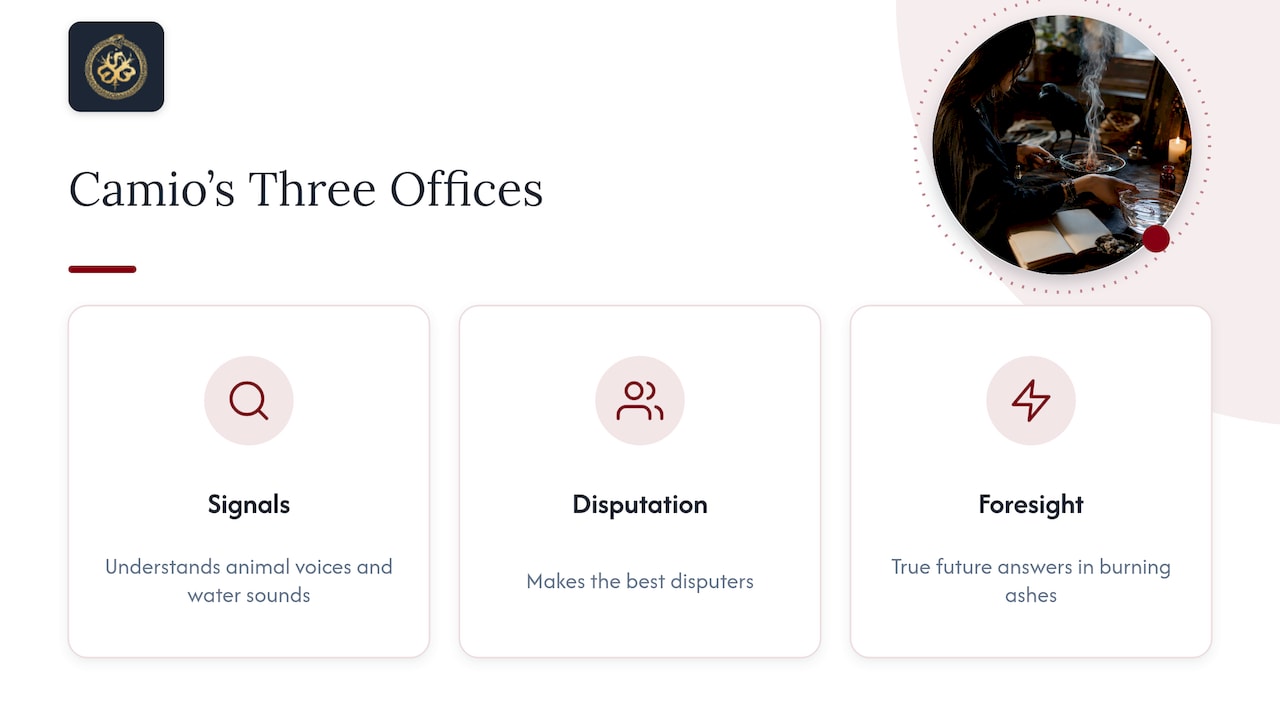
Caim, also written Camio or Caym, is the fifty-third spirit of the Ars Goetia, a Great President who rules thirty legions. He appears first as a thrush and then as a man carrying a sharp sword, and he seems to answer standing in burning ashes or coals of fire. He makes the best disputers, gives understanding of the voices of birds, the lowing of bullocks, the barking of dogs and other creatures, and of the noise of the waters, and he gives true answers of things to come. The grimoire adds that he was of the Order of Angels. His offices come down to three: perception, argument and foresight.
Caim at a glance
- Number: 53rd of the 72 spirits of Solomon
- Rank: Great President
- Legions: 30
- Appearance: first a thrush (a blackbird in some retellings), then a man with a sharp sword, answering in burning ashes or coals
- Other spellings: Camio, Caym
- Former order: Angels
- Enn: Tasa on ca Caim renich (see our demonic enns page)
Correspondences used by many modern magicians (these come from later zodiacal systems, not from the Goetia itself): 20 to 24 degrees of Sagittarius, strongest December 12 to 16; Ten of Wands; Mercury; nocturnal; mercury as his metal; storax incense; green and orange.
What the Goetia says
His entry gathers into three groups, and each suggests a different kind of work:
- Perception. The understanding of birds, cattle, dogs and other creatures, and of the voice of the waters. This is an office of reading signals from the living world and the elements: omens, patterns, the feel of a place. It does not describe commanding animals.
- Argument. He is a good disputer and, in Weyer’s words, makes the best disputers. Structuring a case, anticipating objections, answering under pressure.
- Foresight. True answers of things to come, given from the burning ashes. His prophetic office is tied to fire, which matters when you design the working.
Several claims that circulate about him, including on older versions of this page, are not in the grimoire. He is a President, not a King. He appears as a thrush, not a crow. The Goetia does not give him invisibility, astral flight or shape-shifting into beasts; those come from later writers. One encyclopedia adds that he sometimes appears as a man adorned with a tuft and a peacock’s tail, and that Martin Luther reportedly had an encounter with him. Treat both as later lore.

Where Caim comes from
His first printed appearance is in Johann Weyer’s Pseudomonarchia Daemonum (1577) as Caym, followed by Reginald Scot’s English version in 1584. Weyer already has the thrush, the man with a most sharp sword, the answers in burning ashes, the best disputers, the voices of birds, bullocks, dogs and waters, the order of angels and the thirty legions. The Ars Goetia, the first book of the Lemegeton compiled in the seventeenth century, heads the entry “Camio, or Caim” and fixes him at number 53. Collin de Plancy’s Dictionnaire Infernal (1818, revised 1863) repeats the bird-to-man transformation.
The lineage has practical consequences. The offices are older than the ritual frame: the circle, triangle and lamen came later, in the seventeenth-century compilation. And the seal you draw belongs to the Lemegeton tradition, reproduced in the Mathers plates; it is not part of Weyer’s description. Read Weyer, then Joseph Peterson’s edition of the Goetia, then Mathers, and note the differences. For Caim they are small. His core profile is unusually stable.
Caim and Cain
Many modern occultists identify Caim with Cain, the first murderer of Genesis, and build a lineage of craftsman, outcast and wanderer on top of it. Some early lists do give forms like Kayne. But the Genesis story has nothing about bird augury or the voice of the waters, and the name and the offices seem to have developed separately before copyists drew them together. Older demonological dictionaries also offer an etymology from “Chamos”, supposedly a name of Baal Peor, which the inscriptions do not confirm. Use the Cain identification as a devotional frame if it speaks to you, but know that it is an interpretation, not a documented origin.
Benefits people seek
- Winning arguments: debate, negotiation, testimony and legal matters.
- Divination and true answers about the future, especially through fire and ash.
- Reading omens in birds, animals and water.
- Understanding animals and the natural world around you.
- Sharper perception of a place, a person or a situation before a decision.
Those who work with him often report more birds around them, and unusual bird behaviour, in the days after a working.
Working with Caim
The Goetia gives his seal and offices, not a modern ritual. The structure below is how we approach him.
1. Choose one office. Perception, argument or foresight. A working that asks for all three has no direction.
2. Build the altar from his entry. His seal, drawn by hand. A fire or ash element: a heatproof dish with charcoal or burnt herbs, since he answers from burning ashes. A bird correspondence: a black feather from a legal source, or a drawn thrush. A blade for his sword. A bowl of water if you are working the perception office. Storax, frankincense or myrrh as incense, and black and red candles.
3. Call him. His seal is said to draw him wherever it is drawn. Work at night, speak his enn until the atmosphere changes, and, as many in our tradition do, approach him first through Satan or Lucifer, with a petition such as:
“Lord Lucifer, light-bearer, by your grace grant me the power to conceive in my mind and to carry out that which I desire, the end I would reach by your help. I ask you to move Caim to come before me, that he may give me a true and faithful answer from the burning ashes and help me reach my desired end, provided it is proper to his office. This I ask in your name, Lord Lucifer.”
4. Choose your model, command or exchange. Weyer’s entry is a description; the Lemegeton wraps it in a command-based rite of circle, triangle and lamen. Many on the Left-Hand Path prefer an exchange: a clear request, a clear offering, a clear time frame. Both are documented choices. Know which one you are using.
5. Run three sessions. First: introduction, the office you are engaging, an offering, and a simple divination to see whether contact is established. A week later: the request itself, tied to a defined situation and deadline. Finally: a review comparing what happened with what you asked for and what you perceived.
6. Close properly. Thank him, leave the offering and dismiss him with respect. Keep three records: your source comparison, your working log, and a scored tally of his predictions. A prophetic office that cannot be scored is a story, not a practice.
Offerings when money is short
A reader once asked us what to do if they could not afford frankincense or myrrh. The intent and respect you bring weigh more than the price of the resin. Any fragrant resin, wood or herb you can burn will serve; salt and water will cleanse the space; a personal offering, such as a poem written for him or a feather you found yourself, is accepted by many spirits. If you are unsure of your preparation, waiting until you are ready is never a mistake. And if you cannot burn incense where you live, our Monthly Demonic Praise Subscription makes the offerings on your behalf.
How it looks in practice
These are illustrations, not client cases.
- The litigator before a hearing keeps a small altar with his seal and a dish of ash for two weeks, rehearses the opposing argument aloud each evening, then her own, and notes which points feel weak.
- The buyer reading a neighbourhood spends three early mornings at a building he means to buy, notes the birds, the sound of water in the drains and who comes and goes, and writes his impressions before he reads the inspection report.
- The ornithologist who has lost the trail of a rare species works with Caim’s office of the voices of birds, then goes back to the field with recorder and notebook to test what came through.
- The writer in a block burns a sheet of paper bearing her question, reads the ash as a prompt, and writes for twenty minutes without stopping.

How Caim compares
- Paimon teaches all arts and sciences and arrives with a noisy retinue. Caim is a specialist: perception and argument.
- Phenex shares the bird form but is a poet of rebirth. Caim’s thrush is a working bird, decoding the world.
- Forneus also gives rhetoric and languages, but among humans, turning enemies into friends. Caim bridges human and animal speech.
Black Witch Coven’s view
Caim is one of the most practical spirits in the Goetia, because his offices are information and speech, the two things people lack most when a decision is hard. The thrush, the sword and the ashes are the packaging; the substance is perception, argument and foresight. Take one office, one problem and one time frame. Pair the rite with ordinary preparation, because the lawyer who rehearses and the buyer who walks the site are doing the part of the work you can check. And choose your model, command or exchange, knowing where it came from, rather than inheriting it by default.
For an outside read on whether Caim is the right spirit for your situation, book a Demonic Tarot Reading or one of our Left-Hand Path readings. For ritual work done on your behalf, see our daemonic spell casting. New to evocation? Start with how to summon demons. As with all magick, results are never guaranteed.
Similar spirits
- Phenex: another bird spirit, teacher of the sciences and poetry
- Paimon: teaches all arts and sciences and secret things
- Furcas: teaches logic, rhetoric and divination by fire
- Vassago: tells of things past and to come, finds what is lost
- Amon: tells past and future, reconciles friends and foes
Sources
| Pseudomonarchia Daemonum, Johann Weyer (1577), in Reginald Scot’s English (1584) | “Caym is a great president, and taketh the shape of a thrush, but when he putteth on mans shape, he answereth in burning ashes, carrieng in his hand a most sharpe swoord…” |
| The Lesser Key of Solomon (Goetia), ed. S. L. MacGregor Mathers (1904) | “The Fifty-third Spirit is Camio, or Caim. He is a Great President, and appeareth in the Form of a Bird called a Thrush at first…” |
- Camio (53), Goetia (Hermetic Library)
- Lemegeton, Part 1: Goetia (Esoteric Archives)
- 53. Seal of Camio (From Old Books)
- Caim (Divinity Atlas)
- Ars Goetia (Occult Encyclopedia)
- Caim (Wikipedia)
2 thoughts on “Caim (Camio)”
Leave a Reply
You must be logged in to post a comment.
Hi! I was planning to summon Caim but i don’t have Frankincense or Myrrh available right now, and i don’t currently have the money to buy it. I’m still relatively new to this, so i was wondering if there’s an alternative way to purify the area or it’s safer to wait for some time until i have the money to get the items.
Hey – as this is a common problem when we first get into occultism, I decided to jump into a little more detail for you. Please see the content above for my answer to your question.