
 New Years Eve Ritual 2026/2027 with Savannah
Blog, Learn Witchcraft, Spells
Spell Results Timeline: What to Expect and When
Nov
Most workings show a first sign within days to a few weeks, and the traditional checkpoint for judging a working is four weeks, or one lunar cycle. Learn Religions puts traditional accounts anywhere from a day or two to several weeks, and many Pagan traditions revisit a working at the four-week mark. Reconciliation work, which moves through another person’s will, usually runs longer than that and unfolds in stages. This guide gives you a working timeline by type of operation, a method for logging what happens so you are not guessing, and a plan for deciding when a working is finished and when it needs another pass.
Table of Contents
- Why spell timing is never one number
- The reported ranges, and what they tell you
- A working timeline by type of operation
- Reconciliation spell timing, stage by stage
- How to tell a result from a coincidence
- How long do spell results last
- When to reassess a working that has not moved
- Perspective: why the wait is part of the work
- Putting it into practice
- The work we do
- FAQ
- Sources
Why spell timing is never one number
People search for a single figure because they want to know when to stop watching. The honest picture is a set of ranges that depend on what the working is asking reality to do.
Three variables do most of the work.
The distance between the current state and the requested state. Clearing a stuck feeling in your own home is a short gap. Rebuilding trust with someone who left eighteen months ago is a long one. The longer the gap, the more intermediate events have to happen first.
How many people and systems must move. A protection working around your own household involves your behavior, your habits and your environment. A court working involves a judge, opposing counsel, a docket and a calendar that nobody in the room controls. A reconciliation working involves another person’s emotions and decisions. Each additional party stretches the timeline.
The designated period of the working itself. Learn Religions notes that spell type and the ritual period a working is built around can affect timing. Hoodoo and rootwork are the clearest example: a seven-day candle spell is worked over a set period, and results are expected within a stated window after it completes. The clock starts at completion, not at the first match struck.
A fourth variable is less discussed: what you do in between. We return to that below, because it is the most controllable part of the whole timeline.
The reported ranges, and what they tell you
The published record on spell timing is mostly anecdote, and it helps to read it for patterns rather than promises.
- Traditional guidance gives a day or two up to several weeks, with four weeks, one full lunar cycle, as the usual point to reassess (Learn Religions).
- A U.S. Etsy weather-spell customer interviewed by Elle was told to allow three to four weeks for full manifestation. After two days she judged it had worked “mostly,” with rain arriving at convenient times and the sky clearing for wedding photos.
- Witches quoted by Astrology.com describe a house cleansing that took over seven hours to finish, a home manifestation that took six to nine months, and a love-related outcome that took about two years.
- Commercial listings are the least reliable guide. A Guardian reporter who bought a $9 beauty spell found marketplace claims ranging from same-day results to permanent effects, while the spell’s own materials said weeks.
The pattern is consistent. Short, self-contained workings (cleansing, a single clearing, a weather request with a clear endpoint) resolve in hours to weeks. Anything involving a relationship, a home purchase or a long-running problem is reported in months, sometimes years. A claim of instant results for a complex human situation is a marketing figure, not a magical one.
The Elle account is also worth noticing for how it was judged. The customer assessed the result after two days against a three-to-four-week brief, and described it in partial terms. Evaluating early and by degrees is a skill, and we will build it into the method below.
A working timeline by type of operation
The table below is a planning tool built from the reported ranges and from the traditional four-week checkpoint. Treat the columns as expected windows for first movement and for a reasonable judgment, not as guarantees.
| Type of working | First sign | Reasonable judgment point | Notes |
|---|---|---|---|
| Cleansing and clearing | Same day to a few days | One to two weeks | The effect is felt in your own state first: sleep, mood, the feel of a room |
| Protection | Days to two weeks | One lunar cycle | Success is often an absence, so the log matters more here |
| Money and prosperity | One to three weeks | One to three months | Look for openings (offers, contacts, recovered funds) before income itself |
| Court and legal | Tied to the docket | The next procedural event | The calendar sets the pace, not the working |
| Reconciliation and love | Days for internal shifts; weeks for contact | Six to twelve weeks | See the staged breakdown below |
| Long-horizon goals (home, career change) | Months | Six to nine months or longer | Matches the longer anecdotes reported for home manifestation |
Two notes on the table. First, the “first sign” for money and love is rarely the headline result. It is a precursor: an email you did not expect, a name that resurfaces. Second, for court work, anchor your timeline to events that actually exist on the case schedule. A hearing, a filing deadline or a ruling date gives you a real checkpoint, and judging the working against a vague “soon” will only make you anxious.
Reconciliation spell timing, stage by stage
Reconciliation is the most asked-about timeline and the one with the least checked data behind it. What follows is our working framework, not a published statistic. It rests on one idea from Learn Religions that holds up well in practice: in love workings, a change in feelings can come before any observable action.
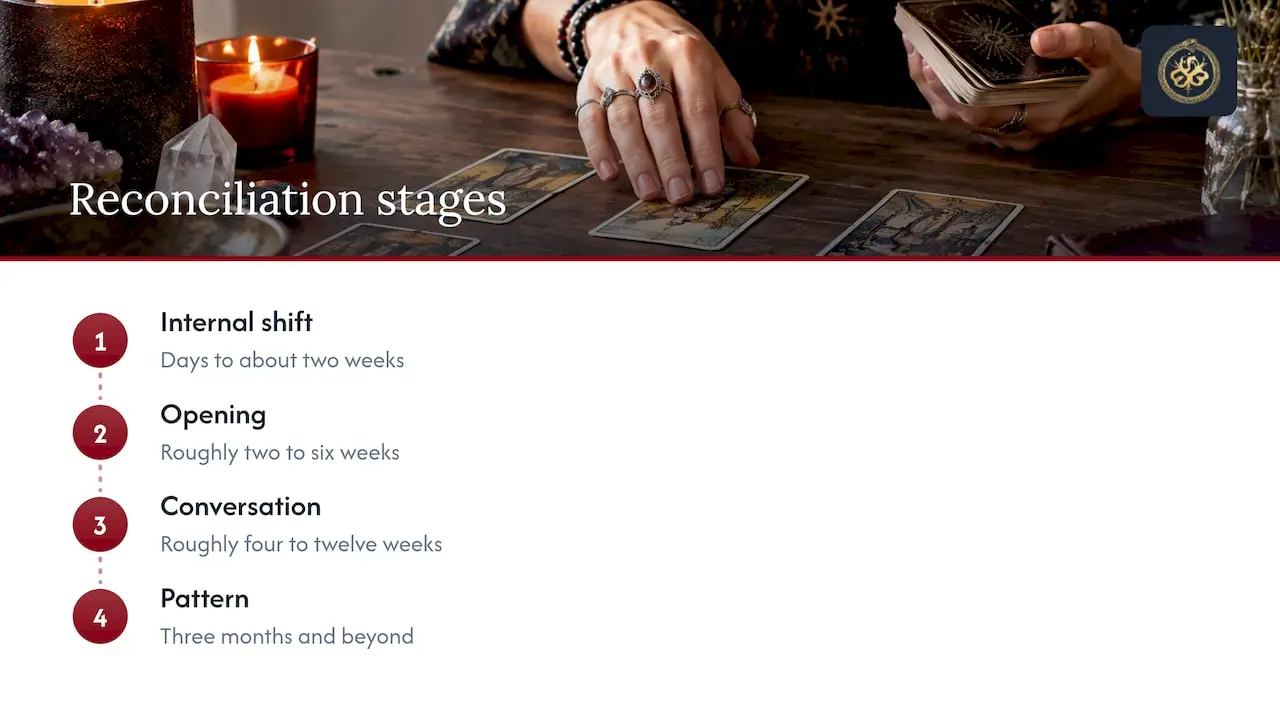
That gap between inner shift and outer behavior is the whole timeline. A person can soften internally for weeks before anything visible occurs, particularly if pride, a new relationship or a hard separation sits between you.
Stage one: the internal shift (days to about two weeks)
You will not see this stage from the outside. If you see anything, it is indirect: the person appearing in your dreams, a mutual acquaintance mentioning them, a song, an old photo surfacing. Do not read these as proof. Record them and move on. Their value is cumulative, not individual.
Stage two: the opening (roughly two to six weeks)
The first observable behavior tends to be low-cost and deniable: a like on a post, a short message about something practical, a reply that arrives faster than before, a loosening of tone. Low cost is the point. People test the water before committing to a conversation they might regret.
Your job here is to respond at the same temperature. Match a two-line message with two lines. Answering a small signal with a paragraph of longing teaches the other person that opening the door is expensive.
Stage three: the conversation (roughly four to twelve weeks)
A direct exchange, an apology from either side, a request to meet. This is the stage most people mean when they say “it worked,” and it is the first one that depends heavily on what you say. A working can create willingness. It cannot write your half of the dialogue.
Stage four: the pattern (three months and beyond)
One good conversation is an event. Consistent contact over weeks is a pattern. Reconciliations that hold are usually judged at this stage, and it is where the longer anecdotes, including the two-year love outcome reported by Astrology.com, sit.
A worked example
Take a woman, call her Dana, whose partner moved out after a bitter argument about money. She performs a reconciliation working on a new moon, which is day one.
- Day 4: She dreams about the old apartment. She logs it and does nothing.
- Week 2: He likes a photo of her dog. She logs it and does nothing.
- Week 3: He texts a question about a shared subscription. She answers in one line, with no emotional content.
- Week 5: He adds a second message, unprompted, asking how her job interview went. She replies warmly but briefly.
- Week 8: He proposes coffee. She agrees, and she has already decided in advance which two topics she will not raise.
- Week 12: They have met four times. She now treats the working as having done its job and shifts her energy to the practical conversation about money that started the break.
Notice what Dana did not do. She did not contact him during the first three weeks to “check if it was working,” which would have confused cause and effect. She did not escalate when the early signs were small. And she reached a judgment at week twelve, not week two.
How to tell a result from a coincidence
An audience of critical thinkers will want a method, because the weak point of any timeline is attribution. The tools here are old and simple.
Keep the journal the tradition recommends
Learn Religions describes the standard practice: record what you did, when you did it, the circumstances, and what happens afterward. Do it in the same notebook, with dates, from before the working begins. A log started after the first sign is contaminated by hindsight.
Use a fixed template:
- Date and moon phase.
- What was performed, with materials and duration.
- Your state: mood, sleep, stress level, one line each.
- The stated intention, in one sentence you will not edit later.
- Observed events, logged daily, whether or not they seem relevant.
- A weekly score, from zero to five, of movement toward the stated intention.
The score matters because it forces you to commit to a judgment while the evidence is fresh. After a month, you have a curve instead of a feeling.
Write the prediction before the event
Before the working, state what would count as a hit and what would not. For reconciliation, “he contacts me about anything” is too loose, because shared obligations produce contact anyway. “He initiates a message with no practical reason” is a better bar. Specific criteria written in advance protect you from reading every ambiguous event as confirmation.
Establish a baseline
How often did this person contact you in the three months before the working? How often did money arrive, or the neighbor complain, or the legal letters come? Without that baseline you cannot tell a change from the normal noise of your life.
Respect what the controlled research found
In a randomized, double-blind delayed-intervention study from the University of Northampton, published in the Journal of Alternative and Complementary Medicine and indexed on PubMed, 44 participants were measured weekly through week four. Well-being improved over the study, but the authors found no group difference showing that the spell-casting itself caused the improvement. For a witch this is useful rather than discouraging: it shows exactly why a journal and a baseline are needed. Time, attention and a structured routine all change how people feel, and your records are how you separate those effects from the working’s own.
Notice subtle change
Learn Religions stresses that early signs are small and sometimes subtle. A tool that helps some occultists here is an outside read on the pattern, such as a new moon tarot reading used at the start of a cycle to set what you will watch for, then compared against your log at the end of it.
How long do spell results last
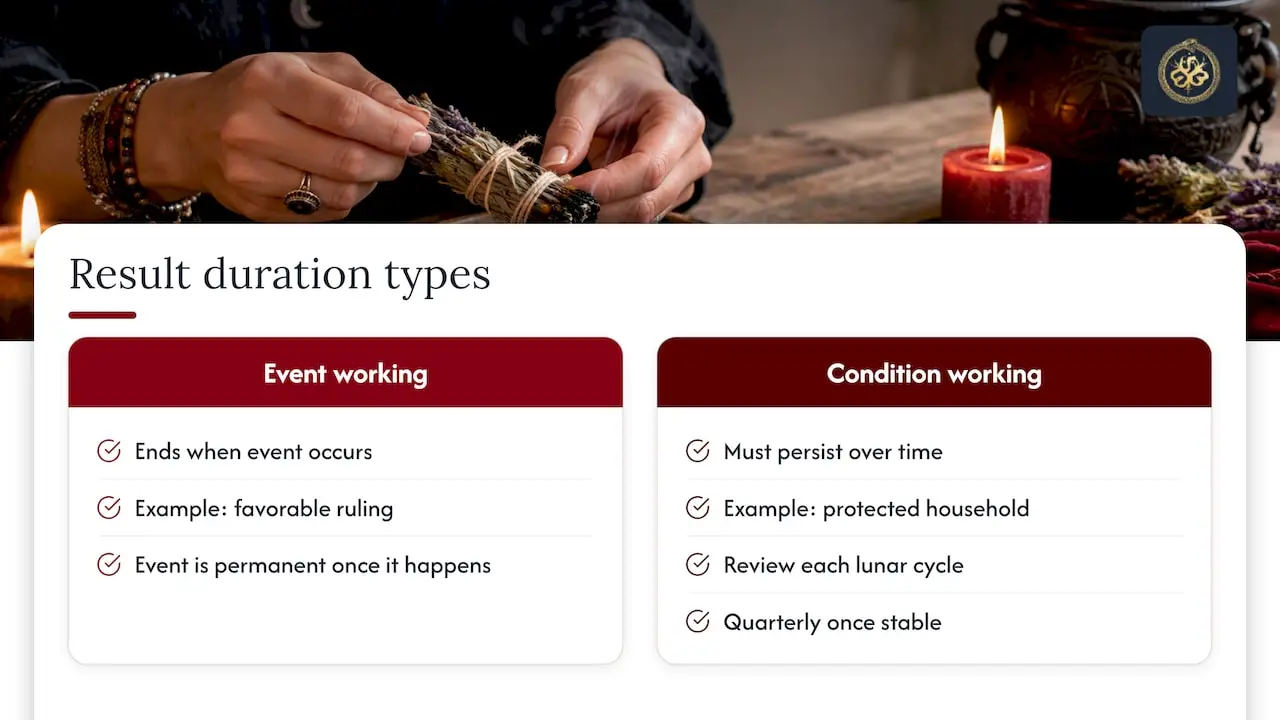
This question has no checked data behind it, so what follows is practice-based reasoning. Duration depends on whether the working changed a condition or only an event.
An event working (a favorable ruling, a one-time payment) is complete when the event occurs. A condition working (a protected household, a steady income, a relationship that stays repaired) has to persist, and conditions are maintained by what surrounds them.
Three things influence whether a change continues.
Behavior. A reconciliation that restores contact but leaves the original argument unresolved will drift back toward the original state. The working opened the door. The conversation you have afterward decides what room you walk into.
Maintenance. Protection in particular is treated by most traditions as a recurring act, renewed on a cycle (the lunar month is the common unit) rather than done once and forgotten. The same logic applies to money workings that depend on continuing attention.
Record keeping. Writing down the changes and revisiting them regularly keeps you aware of drift. A change you stopped noticing is one you stop reinforcing.
A rough expectation: event results are permanent in the sense that the event happened; condition results should be reviewed every lunar cycle, then quarterly once stable.
When to reassess a working that has not moved
The traditional rule is simple. Learn Religions gives four weeks, one lunar cycle, as the point to revisit a working if nothing has begun to manifest. Hoodoo and rootwork operate differently, with a designated work period and a results window afterward. Respect whichever system you are using. Do not apply a four-week rule to a seven-day candle operation and then count the results window twice.
At the checkpoint, ask four questions in order.
- Did I complete the working as designed? Cut-short operations and skipped steps are the most common reason for no movement.
- Was the intention specific and testable? “Things improve” cannot fail or succeed. “He replies to my message within a day” can.
- Does the log show any movement at all? A weekly score that is rising slowly is a different situation from one that is flat at zero.
- Is something in the real world blocking it? An unpaid debt, an unanswered email, a mistake you have not addressed. These need action alongside ritual.
The decision tree that follows from the answers:
- Incomplete or vague: redo the working with a tighter intention and a fresh log.
- Complete, specific, slow upward trend: continue to the next lunar cycle without altering anything.
- Complete, specific, flat at zero: change one variable, such as the operation, the timing or the entity worked with, and run another full cycle. Change one thing only, or you will not know which change mattered.
- Blocked by a real-world factor: resolve that first.
The discipline of one variable at a time is what makes a practice cumulative. Over a year of logged cycles you learn which of your operations run fast, which run slow, and which need support.
Perspective: why the wait is part of the work
We treat the waiting period as an active phase of the working, not a gap in it. The clients who get the clearest results are rarely the ones who cast most often. They are the ones who define the outcome narrowly, keep a dated record, and use the interval to do the real-world work that makes the outcome possible to hold.
Our experience with reconciliation and love work is that the inner shift arrives well before the outer behavior, and that most people abandon a working at the exact point where the quiet stage is about to end. We plan around the four-week lunar checkpoint and build further reviews at the quarter mark for anything meant to last, which is why we structure longer programs in three-month cycles.
We also ask clients to solve one problem at a time. A working with a single, testable intention gives a readable timeline. A working asked to fix love, money and a legal matter at once gives noise.
Black Witch Coven
Putting it into practice
If you are starting a new working this week, here is the sequence we would use.
- Write the intention in one sentence and the success criteria in another.
- Record your baseline for the previous three months.
- Choose the working’s start date, ideally at a new moon if you plan to use the lunar checkpoint.
- Start the journal with the template above before casting.
- Log daily and score weekly.
- Review at four weeks. Apply the four-question check.
- For anything meant to last, schedule a second review at three months and a third at six.
This takes ten minutes a day and turns spellwork from a hope into a body of evidence you can learn from.
The work we do
For readers who want a working cast on their behalf, our Daemonic Magick for Friendship, Reconciliation, and Popularity working is built around the staged timeline described here, and Bring back an Ex-Partner with Demon Sallos is listed at $390 one-off in our daemonic spell casting category.
FAQ
How long does a spell take to work?
Traditional accounts range from a day or two to several weeks, and many Pagan traditions use four weeks, one lunar cycle, as the point to review. Simple cleansings resolve fastest. Workings that depend on other people, such as reconciliation, commonly run from several weeks to a few months.
How long does a reconciliation spell take?
Expect staged movement: an internal shift in the first days to two weeks, a first observable opening around two to six weeks, and a real conversation anywhere from four to twelve weeks. Judge the working at about twelve weeks, not at two. Written criteria set before you begin make the call far more reliable.
How do I know my spell is working?
Look for small, early changes and record them in a journal with the date, what you did, the circumstances and what followed. Compare them with your baseline from before the working. A weekly zero-to-five score shows whether the trend is moving, even when no single event is decisive.
What if nothing has changed after a month?
Revisit the working at the four-week mark. Check that it was completed as designed, that the intention was specific enough to test, and that nothing in the real world is blocking it. Then change one variable and run another full cycle.
Sources
- How Long Does It Take for a Magic Spell to Work? (Learn Religions)
- Testing the Pagan Prescription: Using a Randomized Controlled Trial (PubMed)
- I spent $9 on a beauty spell (The Guardian)
