
Blog, Demons, Working With Demons
Vassago Demon: History, Seal and How to Work With Him
Nov
Vassago is the third spirit of the Ars Goetia, a Mighty Prince who rules twenty-six legions, whom the text calls good-natured, and whose offices are to declare things past and to come and to discover what is hidden or lost. That is the documented core. Everything else, from his supposed temperament to his modern devotional forms, is built on those few lines and on a small group of manuscripts. Below, the record comes first and later interpretation second, followed by the practical question of how to work with a spirit whose whole function is revelation. His seal and correspondences are on our Vassago Demon Directory page.
What the Ars Goetia says about Vassago
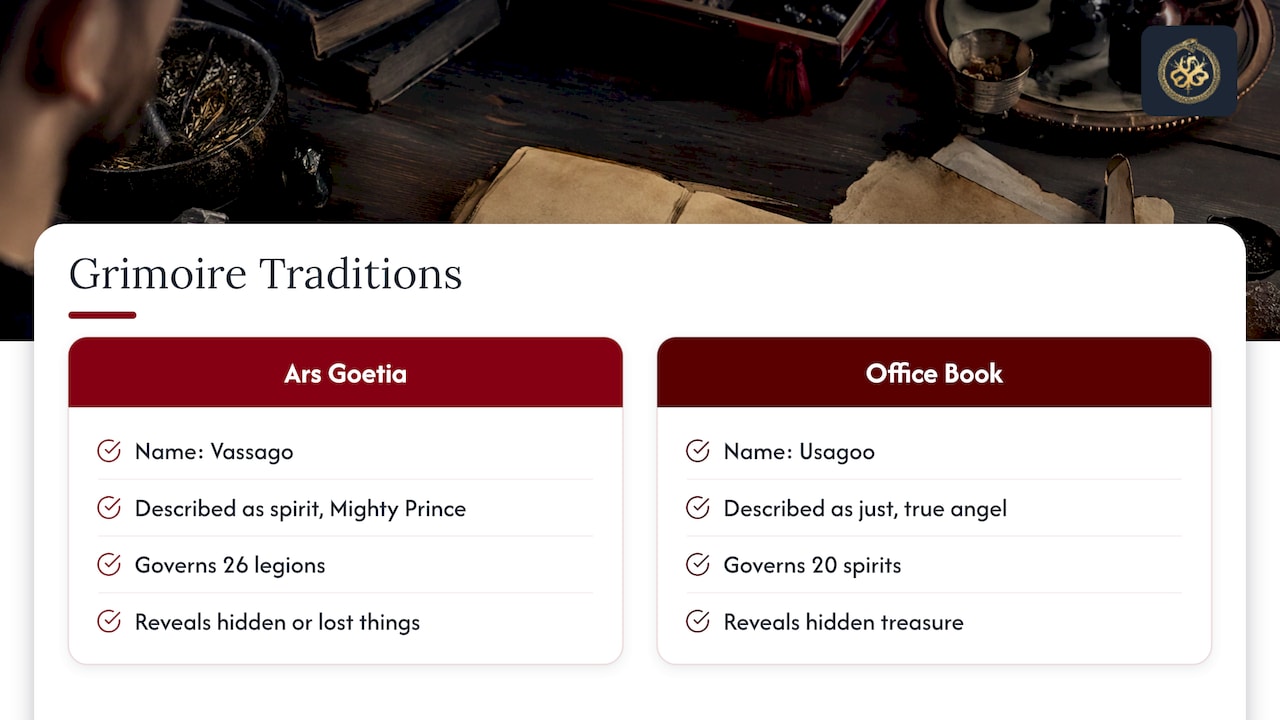
The 1904 Mathers and Crowley edition of the Goetia gives Vassago a short entry. He is the third spirit, a Mighty Prince of the same nature as Agares, who is the first spirit of the book. The entry calls him of a good nature, governing 26 legions, and assigns him the declaration of past and future and the discovery of hidden or lost things. It also supplies his seal, which the operator is expected to make and wear.
Three details from that entry come first.
Rank. A “Mighty Prince” sits in the upper tier of the Goetic hierarchy, though the text’s ranks are not a rigid chain of command. Prince is a title of governance. Vassago has a defined body of subordinate spirits, the twenty-six legions, and a defined sphere of service.
Nature. The phrase “of a good nature” is rare in the Goetia. Most entries stress danger, deception, or the need for firm control. Vassago’s entry does not. This line is the root of his modern reputation as approachable, and we come back to what it means below.
Office. Two functions, both informational: telling what was and what will be, and locating what is missing. He is not assigned a destructive, binding, or transformative office. He is a spirit you consult.
The text uses masculine pronouns for him and calls him a prince, so the grimoire tradition treats him as male. Some modern writers address spirits without gendered language, but the historical entry gives no other reading.
Is Vassago an angel?
Not in the Goetia. The Ars Goetia calls him a spirit and a Mighty Prince, and nothing in the entry places him among the angels.
The angel question has a real source, though. In the Book of the Office of Spirits (Liber Officiorum Spirituum), a related text, the figure appears under the name Usagoo and is described as an angel who is just and true, able to incite the love of women and reveal hidden treasure, governing twenty spirits. The numbers differ from the Goetia (twenty spirits against twenty-six legions), the moral language differs (just and true against good-natured), and the offices partly overlap and partly diverge: hidden treasure is close to hidden or lost things, while the power over the love of women has no counterpart in the Goetia entry.
Two grimoire traditions preserved a spirit with a similar name and a similar revelatory function, then classified him differently. The texts do not settle whether this is one being described twice or two currents that merged. They do show that “angel” or “demon” in this literature often reflects the compiler’s frame more than the spirit himself.
Where the name comes from
The origin of the name is unsettled. The manuscripts give variant spellings such as Usagoo, Vsagoo and Vzago, and none of them points to a secure classical or Semitic derivation. Claims that the name descends from an older deity, a Babylonian or Hebrew root, or an extraterrestrial source belong to personal gnosis. They are not documented history.
The textual record is more modest. Vassago does not appear in Johann Weyer’s Pseudomonarchia Daemonum of 1577 or in Reginald Scot’s Discoverie of Witchcraft of 1584. The Folger manuscript of the Book of the Office of Spirits has him as Vsagoo, and the later Lemegeton includes him as Vassago. His documented appearance therefore belongs to a later grimoire stream.
His age in print has no bearing on how he works. It does tell you which tradition you are entering: a manuscript lineage of the seventeenth century and after, assembled from older material.
How old is the material?
Colin Campbell argues that the sections of the Goetia came from separate manuscripts circulating no later than 1500 CE. He also notes that printed works were sometimes copied by hand because of scarcity, and suggests that the burning of Scot’s work may have contributed to the existence of manuscript copies. Others date the material later. Either way the Goetia is a compiled text with a layered history, and any statement about “the original Vassago” has to be tied to a specific manuscript.
The manuscript trail: Sloane MS 3824
The most practically valuable historical document for Vassago is not the printed Goetia. It is an “Experiment of the Spirit Vassago” in Sloane MS 3824, a manuscript containing copies made by Elias Ashmole from various sources. The experiment gives a procedure for calling him to appear in a crystal, in a glass, or otherwise.
The detail matters twice over.
First, it matches his office. A spirit who reveals what is hidden and what is yet to come is naturally called into a reflective medium, where information arrives as vision, impression, or voice. The operative manuscript and the grimoire’s description of his office agree.
Second, it distinguishes the Vassago experiment from the standard Goetic evocation to visible appearance in a triangle. The crystal or glass is a scrying tradition. If you want to consult him and have no need of a physical manifestation, you are working in line with this manuscript.
Historical method versus contemporary practice
A clear map of the two layers helps you choose a method on purpose instead of by accident.
The historical Goetic frame
The Ars Goetia gives instructions for building a bronze vessel and for using invocations and formulas to call spirits. In that frame, the spirits are compelled by divine names, not negotiated with or bound by pacts. The operator works from authority, using the names, seals, circle, and vessel as instruments of that authority. The seal of Vassago belongs to this apparatus. It is his signature: it identifies him and carries the call to him. Our conjuring method from the Goetia sets out the full sequence.
The contemporary devotional frame
Modern demonolatry approaches Vassago very differently. Practitioners in that current often work with him for divination, clairvoyance, and finding lost information, sometimes using modern chants called enns. Contemporary approaches also tend to separate historical ritual such as Goetic evocation from personal, devotional, or meditative practice, and they emphasize a serene and approachable temperament. That emphasis grows from the grimoire’s “good nature” phrase and from what practitioners report of him.
Both frames work. They are different, and mixing them without noticing muddles the session. A relationship built on courtesy and offering will not be strengthened by suddenly reciting a compulsion formula, and a compulsion-based operation gains nothing from a casual meditative opening.
Does “good nature” mean he is a good guy?
In the grimoire, “good nature” describes how this spirit behaves toward the operator: he is described without the dangers the text attaches to others. It does not make him a creature of human morals, and it does not say he will do whatever you ask.
In practice Vassago is straightforward in his function. He answers questions in his domain, which suits someone who wants information. If you ask him for things outside his offices, such as coercing another person, you are working against the grain of the entry, and the manuscript record gives you no reason to expect clear results.
A working method: scrying with Vassago
This method is a reconstruction. It draws on the crystal and glass tradition in Sloane MS 3824, the Goetic use of a seal, and contemporary devotional practice. Adapt it to your own practice.
1. Define one question
Vassago’s offices are narrow, so your question should be too. Weak: “What does my future hold?” Strong: “What is the origin of the disagreement between me and my business partner, and what did I fail to see?” Or, for the lost-things office: “Where did the document go that I last had in the spring?” A specific, answerable question gives you something to compare against reality afterward.
2. Prepare the instruments
You need three things: his seal, drawn by your own hand on clean paper or parchment; a scrying surface, which can be a crystal, a glass of dark water, a black obsidian scrying mirror, or a bowl; and a notebook with the date, hour, moon phase, and the question written at the top before you begin.
Making the seal yourself matters. In the Goetic tradition the seal is an operative object, and the act of drawing it is the first act of attention directed at the spirit.
3. Choose your frame before you start
Decide whether this is a Goetic operation or a devotional consultation. If it is Goetic, you follow the formal sequence of circle, divine names, and invocation, with the seal displayed and the spirit addressed by authority. If it is devotional, you open with an offering (incense, a candle, water) and speak to him as a counsel you respect.
The choice sets the grammar of everything you say, so decide once and stay consistent for the whole session.
4. Call and wait
Speak the call aloud, state your question once, and then stop talking. The next stretch, usually fifteen to forty minutes, is attention training. Keep your gaze soft on the scrying surface. Record anything that arrives, whether it is an image, a phrase, a physical sensation, or a feeling of certainty. Do not interpret yet.
5. License the departure
Thank him, state clearly that the working is complete, and close the session in the same frame you opened it. In the Goetic frame this is a formal license to depart. In a devotional frame it is a statement of thanks and a clean end to the offering.
6. Review within a day
Read your notes a few hours later, then again after a day. Separate raw impressions from your own commentary. Mark what is checkable. Start with checkable questions, because they show you quickly how Vassago’s answers come through for you.
Typical uses
These are typical uses that show the method. They are not reports about specific people.
Lost records. An accountant who works Goetic magick realizes that a signed engagement letter from a client has vanished from her files, and the client is disputing the scope of work. She works with Vassago for a single session, with the question “Where is the signed copy?” Afterward she writes down an image of a blue folder and a drawer by a window. The next day she checks the one place that fits. The question was concrete, the answer was checkable, and she acted on it in the physical world.
A repeated pattern. A magician who writes grant applications keeps losing grant applications at the same stage of review. Over three sessions, spaced a week apart, he asks the same question: “What am I not seeing about this stage?” His notes show a repeated impression of a paragraph near the end of his proposals. Rereading, he finds that his budget justification contradicts his timeline every time. Vassago showed him where to look; the rewriting was his job.
A decision. A business owner deciding whether to renew a lease asks what she is not accounting for. Her scrying yields only a faint image of scaffolding, and while writing it down she realizes she has never asked her landlord about planned construction. Not every session produces a clear vision, and a faint one still deserves a place in the notebook.
Each case follows the same pattern: one question, a recorded result, and a real-world check.
Building a consistent Vassago practice
One session gives you one answer. A series gives you a relationship and a record.
- Keep a single notebook. Put every session in it with the date, the question, the impression, and the outcome. After ten entries you can see which kinds of questions yield reliable material for you.
- Repeat the frame. Use the same seal, surface, and opening, so the variable you are testing is the question and not the setup.
- Space the sessions. Weekly or at each new moon is enough for most people. Daily consultation tends to produce noise.
- Track hit rate honestly. Count the checkable answers that proved correct, the ones that proved wrong, and the ones you could not verify. The ratio is your own calibration data.
- Keep your mood out of the answer. If you come to the session anxious, write that down. Anxiety colors imagery, and later you will want to discount it.
Over time the notebook shows you how Vassago speaks to you in particular, which is knowledge no grimoire can give.
Where Vassago fits among the Goetic spirits
In practice, Vassago is most often paired with problems of information. Other spirits in the Goetia are drawn on for command, prosperity, legal matters, or protection, and a sensible working plan sequences them: first find out (Vassago), then decide, then act with the right spirit or method. Consulting him before an action-focused spirit gives you a clearer target and keeps you from pushing hard on the wrong problem. It also keeps each working to one problem at a time.
Perspective: why information work comes first
We treat Vassago as the entry point for practitioners who want to work with spirits on a footing of knowledge instead of hope. His offices in the grimoire are revelation of what has been and what is coming, and recovery of what is hidden or lost. Nearly every serious working we have seen begins with a question that was not fully understood.
On the Left-Hand Path you make your own decisions, and you make them better with accurate information about your circumstances. A spirit whose function is to reveal gives you that. The grimoire’s description of him as good-natured fits our experience that consultation with him is a stable, orderly working, which makes it a strong foundation for beginning a relationship with the Goetic current.
Our approach combines the manuscript record with disciplined practice: keep the seal, keep the notebook, test the results against the world, and then move to action with the right method.
Black Witch Coven
Working with a practitioner on divination and spirit guidance
If you would rather have a trained reader consult spirits on your behalf, our Left-Hand Path readings cover questions of the kind described above, and the daemonic workings listed on our demon work page are available for the matters that follow once the question is clear.
FAQ
What does the demon Vassago do?
According to the Lesser Key of Solomon, his offices are to declare things past and to come and to discover all things hidden or lost. In practice, that makes him a spirit of divination, clairvoyance, and recovery of information. Contemporary demonolatry practitioners use him for the same purposes.
Was Vassago an angel?
The Ars Goetia calls him a spirit and a Mighty Prince, not an angel. The Book of the Office of Spirits, under the name Usagoo, describes a related figure as an angel who is just and true. The classification depends on the text you consult.
What gender is Vassago?
The grimoire uses masculine pronouns and calls him a prince, so the historical tradition treats him as male. Modern practitioners sometimes relate to spirits without fixed gender, but the source text does not support that reading for him.
Is Vassago a good guy?
The Goetia calls him “of a good nature,” which is unusual in a book that mostly stresses danger. That describes his demeanor in the text, not a human moral standard. He is best understood as straightforward and reliable within his offices of revelation and finding lost things.
